There is never a chance to write. There is never time to write. Always, life is busy. Always, there is too much to do. And then? Where can one write? When can one write? But the writing calls out to be done. The community need to be expressed. So we wake up early in the morning for the words to come shooting out. We stay up beyond our bedtimes to stay up. Somehow, this writing, it happens.
This is the scenario in which writing takes place for the common man. The man that does not have a massive generational wealth so that he can concentrate on his writing and his ideas. The man that does not have connections that can help him to find work in writing. The man that is not of the right sort in society to write because he comes from the working class, is an ethnic minority and because he is a man.
So when you, the reader, when you read these words, you are reading a rush of thoughts. You are reading writing in which there has been no time. Writing that is beyond time. How does this writing work? How can anything be said at all? The reason is that this man, he types at over ninety words per minute. It is a flood that is unleashed. The reason is that this man, when he sits at the desk, he uses his unconscious to write. He does not plan anything. He does not think over things with his conscious mind. He uses the super genius that is the unconscious to make things work.
Already, you have read something that has taken him four minutes to write. This is the point at which this conversation is right now.
For this writer, his art and his writing is like calligraphy. He has five degrees. He has First Class Honours degrees in English Literature and also in Art History. All this learning, all this erudition and thought, it is being packed into this writing. That is what you are getting when you read all of this.
And now? It is coming up to six minutes of writing. And that is all that this writer has. In six minutes, when he can write, he tries to change the world. He has criticised this oppressive world that only gives him six minutes in which to perform. And that is why this writer writes. To change the world. That is why he will find those six minutes. That is why his writing is beyond time.
Named ‘Beyond Bedlam’, the irony of this exhibition is that the most interesting works from Dadd actually date from the Bedlam period. A period when Dadd really becomes Dadd. Before, he had technical accomplishment and hard work. After, he became an interesting painter and artist. Perhaps this shift and renewal or remaking is reflected in the infamous deed that Dadd did, which was to kill his father during a psychotic outbreak. ‘Dad’ was a word used to refer to the father in Victorian times, so perhaps Dadd killing his father was a killing of himself. A self destruction and self making.
The background to the parricide was that Dadd had been exploring Syria and Egypt, or the Orient and had then become overwhelmed with the sights he had seen. One speculates that he was overcome by the Orient, by difference from the West. Traumatically so. He began to believe that he was the god Osiris, with the over-identification with the East. This trauma of the imagery of the East and of difference would inform his works when he was confined to mental institutions for the rest of his life. So, perhaps one should see Dadd’s works as the traumatic exploration of being different, of being other to the West.
An interesting painting in this regard is ‘Contradiction’, which is about Oberon and Titania fighting over the Indian boy in ‘A Midsummer Night’s Dream’, when the East inspires conflict and overturns the order of nature, as in Shakespeare’s play. The Indian boy seems to be pulling Oberon into nature and its world. Elsewhere, in the Bethlem period and beyond, nature similarly seems to be overtaking the male characters and their portraits too. Portrait of a Young Man, 1853 is enmeshed in nature, as are the figures in Bacchanalian Scene, 1862.
Why does madness make the art of Dadd interesting? Why does difference impose such a trauma on this Western artist? Why are we, the public, in love with the artist’s madness? Is any of us really beyond Bedlam?
A play that was about love and its absurdity. We had the most desirable woman of her time that was absolutely beloved by the public. But the irony? She could not find love in her relationships. Marilyn was presented as the victim of love. She was presented as one that was oppressed by that which masqueraded as love but which was not love. The idea of love that was being used to mask oppressive power.
The question that kept occuring to me throughout the play was why did these super desirable women appear to choose men that would beat them, desert them, never really love them? When there were so many good men about. It is an extraordinary fact that such women will often choose the man that is completely wrong.
Part confessional, part therapy session, and mostly in monologue form interspersed with narrative action, Pixie Lot’s performance as Marilyn was engaging, even mesmerising. The focus was on Marilyn’s relationships with men, mostly her romantic relationships. The idea seemed to be to expose the conspiracy of love. How it favours the men that were in power. How its victims are seduced.
I myself have written about the conspiracy of love. And how it affects Asian men such as myself. In a play like ‘Who Killed Marilyn’, the thought is acceptable. Because of feminism. Is the thought acceptable when it comes from the pen of an Asian man? I would suggest not. Yet we see these conspiracies of love. We feel them and orientate our life around them. As in ‘Who Killed Marilyn?’, it is a power play.
How did Marilyn come across in this play? She is presented as a woman of talent who is not taken seriously by others because of her beauty. She is keenly sensitive to slight, to disrespect. She has horrors of being taken into mental institutions like her mother and her grandmother. She is presented as a voracious reader. As an intellect. And? Also as a writer that keeps a diary with secrets that could shake and take down the world and its system of power. The play is about Marilyn the writer and her power. The divine feminine energy of the writer that writes the truth. And the play is about truth. What is being said, whatever happened, this is a counter narrative that aims to expose power and mechanisms. Not the individualising narrative that lays the blame for the death of the writer and the actress on Marilyn herself, conveniently hushing up the context in which eradication takes place and death is formed.
Film Review by Dr. Suneel Mehmi BA., LLB, LLM, PhD
18.08.2026
Often, I bore my readers by telling them about the origin of my name. My mother named me after Sunil Dutt because he saved the life of the actress that played Mother India, the woman that was playing Sunil’s mother in the film. He protected The Mother. A fire had broken out on set. He was her saviour. She fell in love with Sunil at the hospital while she cared for him with his severe burns. The couple married. Sunil had protected Mother India. And Sunil had married Mother India. His own mother. Here, in Batwara 1947, Sunny Deol was playing the man that protected Mother India. And this time, he was Muslim. What I was seeing on screen was the destiny that my mother had chosen for me. Not least, because Sunil Dutt was Hindu/Sikh and had married a Muslim woman.
The movie has not done good business at the box office. But is this because Sunny Deol, known for his patriotic movies, is playing a Muslim man in a film that criticises the Partition and the separation imposed on us by the Colonisers and the West? The director said that it was difficult to get funding for the movie because of this fact. Without a doubt, there is a strong current of Islamophobia in India at the moment. And this is the reason that films like Batwara 1947 should be made. Because society needs to be changed so that it accords with the Indian ideals of harmony and acceptance. These films are the education that society needs. The message that it needs.
In Indian style, the movie is about syncretism or mixing over discrete boundaries of religion. This is evident in the cast. In the movie, the Hindu mother is played by a Muslim woman. The Sikh and Hindu actors play Muslims. The content of the film is the same. Preity Zinta’s character will cook for The Mother in utensils that have never been used for cooking meat as the mother is a vegetarian by religion for instance. The message is that humanity is greater than religion. Connection is greater than the politics of hate and difference. This was the lesson that my grandfather taught me when I was a child. He would greet each in their own religion’s greeting. Celebrate all religious events despite the fact that he was himself Guru Ravidasia. It is a teaching that is familiar for us from the older generation – a lesson that those who thrive on hate have never learnt, let alone forgotten.
Above everything, the movie is about the religion of the mother. The religion of Durga, the Invincible, The Mother Queen. The one I bowed my head to as a child. It is about the love for Durga. The love for The Mother. The purest relationship and the most natural, as the movie says. The love that comes before organised religion is the love for The Mother. The love that comes before the love of the state – which the movie also criticises – is the love for The Mother. It is the love for The Mother that can achieve harmony and love in this world away from religion and statehood.
The old lessons. The women in the film are the fountains of morality just like in the Indian films of the past. They tell us that one cannot abandon one’s integrity for one’s life. They tell their husbands what to do to uphold right. In feminist thought, the angel conception of womanhood is often criticised. Surely, the Indian says, heroism is known for its morality. The women are being presented as heroines. Why would this be wrong? The hero, Sunny Deol, his fight is what we believe in because it is based on morality. Is this wrong too?
The message of the story is simple. Love triumphs over hate. Hate is peddled by politicians and not the people. Humanity is our greatest strength and virtue. Those who believe in hate are not human. They are not defenders of the faith because all they believe in is themselves and their selfish greed.
The dialogues in the movie were brilliant. It was well written. The music was good too. It was very emotional hearing the hymn of Rama and his mother. The acting in the movie was superb. It combined all of the classic elements of Indian cinema. The second half I found particularly powerful. These were the teachings I had been raised upon as a child. They were the teachings of my grandfather who had married a woman that had had to flee what become known as Pakistan in the Partition. Without making Sunny Deol purely into an action hero and typecasting him – although he still packed a punch in the fight scenes – the film raised him in my estimation as an actor with range and depth. Preity Zinta was also amazing and Karan Deol also surprised me as a talent.
A: Why have you taken this break in writing? Your readers are missing you.
S: I do not owe anyone anything.
A: In some sense, you do. They come to your writing time and time again. They trust you to write something.
S: In any case, what changes with my writing? The world is corrupt when I am writing. It is corrupt when I am not writing. There is no transformation. There is no Revolution.
A: You have lost faith in humanity? You have lost faith in making a difference?
S: If you want to see how much notice people take of you, try pursuing writing, art, poetry and photography for a number of years. And see what it all comes to when you do not come from the dominant culture and you have no connections.
A: I thought you told me that you do not give up.
S: You will merely have to see whether I continue writing or not, won’t you?
A: Do you think that you can give up writing. I would say that is not possible. We all know you. Come, what is happening in your life? You have the most eventful life out of anyone that I know.
S: It is a round of concerts, friendships, romance, reading and rushing. Rushing, rushing, rushing. To fit everything in. To keep everything and everyone going. And then, stepping in where I am needed in this society. Helping old ladies with things in a restaurant. Breaking up fights on the street in the night time. Asking after elderly friends that are sick. Visiting old friends that are not doing so well.
A: You are still waiting for the golden opportunity? You are still waiting to transform this world? Remember what they said in Dhurandhar, ‘The Master of the Field’. To have one’s revenge, one needs energy. Do you have enough? Are you tired and old yet? Have you given up the fight?
S: You ask this of one from whom The Mother expects? You ask this of one that Punjab expects. That India expects. That the People, the Oppressed, that they expect? Do you know why Vishnu came to earth in every age, as in the form of my namesake Krishna? He came to expel sin from the world every time. To soothe the tears of humanity. I have been born for them. That is the destiny that has been picked out for me. You would have me fight against my destiny?
A: What have you done to right the world?
S: Everything. I have taught refugees and migrants English. I have volunteered in after school home work clubs for underprivileged children. I have tackled social isolation through reading as a volunteer. I have written and written and written for charities to spread education. I send money abroad to the poor for education. I give money to the temple so that they can feed everyone and build a community. I give money to charity. I give food to the homeless. I have coached my friends with their ambitions and dreams of advancement, helped them get jobs, supported them. I look after people in public whenever there is any issue, no matter how dangerous it is. I look after my friends and my family, nursing the sick, preparing them for university, teaching them. I have educated myself without mercy to right this world. I write to politicians to right things. Everyone looks to me to be the man and I act like the man. And I do all these things while I have been in a rigorous study for a doctorate or while I work sixty or seventy hour weeks in volunteering and working. No one can say that I do nothing. And the ones that do say I do not do anything? What do they do?
(Photography by Suneel Mehmi. All rights Reserved.)
When listening, it is much more pleasant to have someone that talks with some bounce in their voice, some energy. Fortunately, when Bridgette introduced herself, her voice was abundant in this dynamic quality of bounce. We had both come in together at the very beginning of the exhibition in the morning on the opening and she shot a hello at us all on the front desk as I was filling up on the water on the table in this inclemently hot weather.
(Photography by Suneel Mehmi. All rights Reserved.)
I met her very shortly afterwards at her corner in the exhibition and asked her to give me some direction to her work. There were two rows of exquisite open boxes along the wall which had been chased in gold. The boxes were full of sumptuous designs and objects such as sea shells and butterflies. ‘Gilding,’ she declared, or something of the sort. She was a gilder. She was the first one that I had ever met in my entire life.
‘What attracts you to gold?’ I asked her. She told me that gold was full of light. And that the light would last into the darkness of night. The artworks would glimmer with gold, catching whatever light was left. I did not investigate further and forgot to mention that one of my nicknames at home was actually ‘gold’ as well (‘sona’). For her, it transpired, gold was the day and the sunlight. Gold was the guardian of light.
Gilding, it emerged, was something like a magical alchemy. It involved an array of esoteric qualities like squirrel’s hair for the tip and rabbit skin glue. The whole practice of Bridgette’s degree course seemed to revolve around such rare materials – the Mughal inspired paintings that she had in one corner involved the use of a single hair to get at the details of the miniatures. In this gilder, I was confronting something of the spell caster. And perhaps it was magic to catch the sun in gold and the morning in the night with these works.
(Photography by Suneel Mehmi. All rights Reserved.)
Aside from the Indian miniatures, which included a lovely falcon that had been presented amongst the rich and unique hues of (malachite?), Bridgette’s work was influenced heavily by Japanese gilding and by the Baháʼí Faith, which was evident on a closer examination because the boxes were accompanied by quotations from the religion.
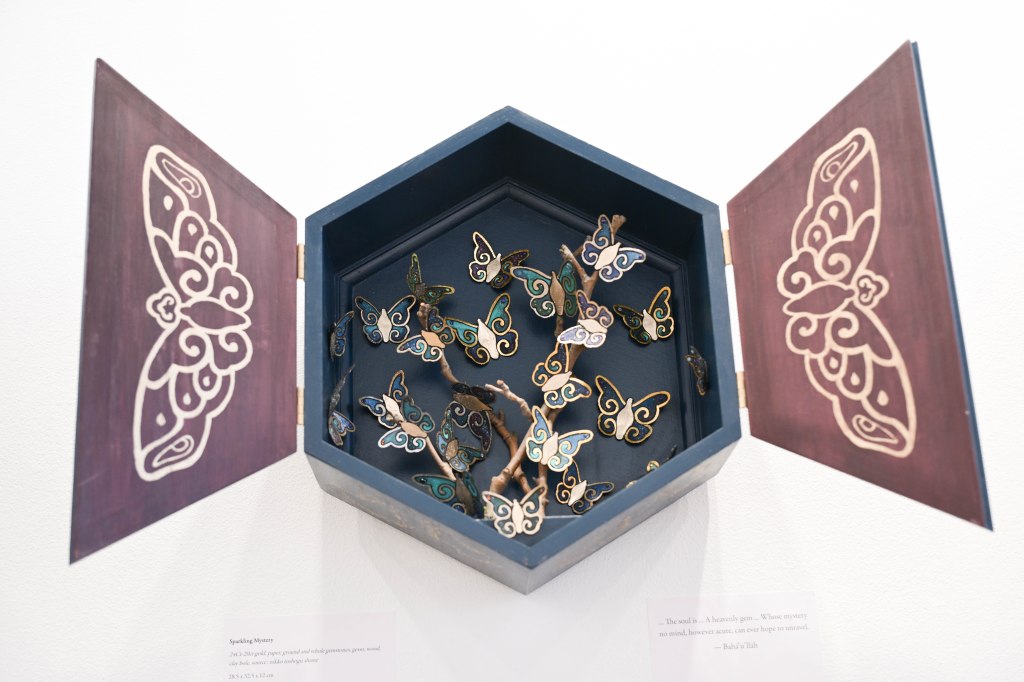
The pieces were composed as boxes. Bridgette told me that this was because there was both an exterior and an interior which could be admired, the hidden and the visible, more to see and explore. And, as I thought, as the boxes could be closed, we had the closed and the open, the entrance into and the shut door of art which was still art itself. Was this an exploration of the visibilities and invisibilities of art? Was it a comment upon the content of art?
One piece particularly aroused my admiration and attention, which was the butterfly box. The butterflies echoed the box because they had two ‘wings’ and shared a mirror symmetry. The butterflies invoked the idea of the soul since the Greek word ‘psyche’ for the soul also meant butterfly. I wondered what Bridgette made of the soul although I did not ask her. Were these souls flying or landing on the branch in these butterflies? The barrenness and bareness of the branch contrasted strongly with the opulence and the elegance of the butterlies, nature versus the man made. The butterflies themselves lacked senses, eyes and antennae. They were abstract and disembodied forms with the blues of heaven and the spiritual set amongst the gold. They were a symbol of metamorphosis and change, perhaps again referencing alchemy from this gilder, the transformation of base metals and nature into gold. Gold as the ultimate apotheosis, the ultimate aim of the alchemist. Gold as telos, as perfection and completion.
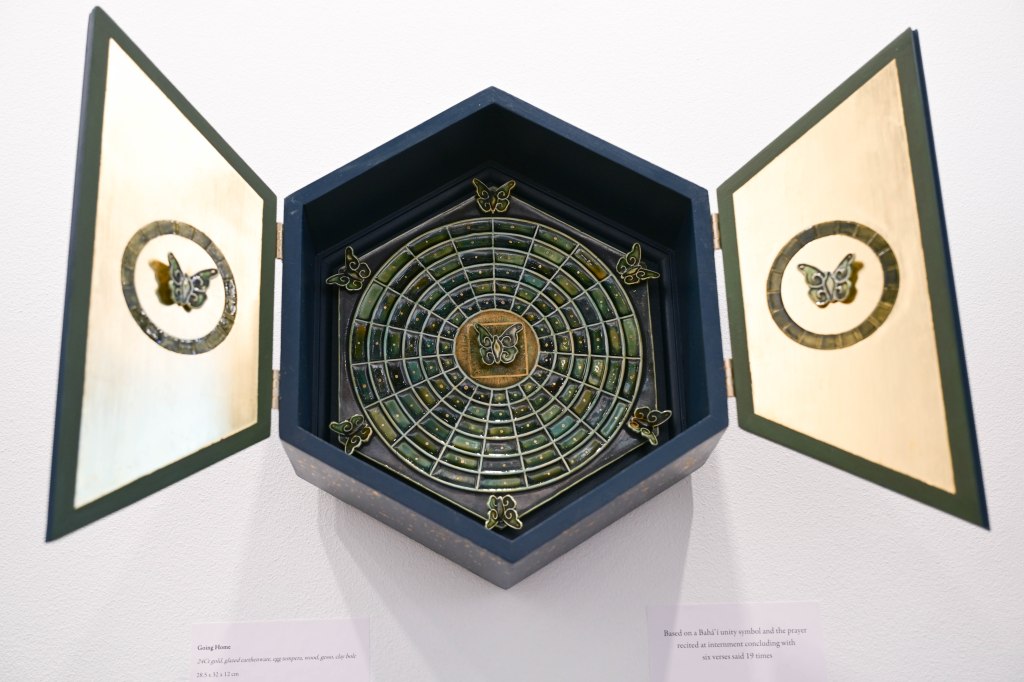
The butterflies re-emerged in ‘Going Home’, which aroused more questions about whether the previous butterflies as souls had been landing or flying, whether they were coming home or flying away from home, whether they were orientated or disorientated. In this, the butterflies seemed to symbolise Bridgette’s own situation. She was an American artist that had been studying in London. Was she going to go back home or was she going to keep on flying through this world here?
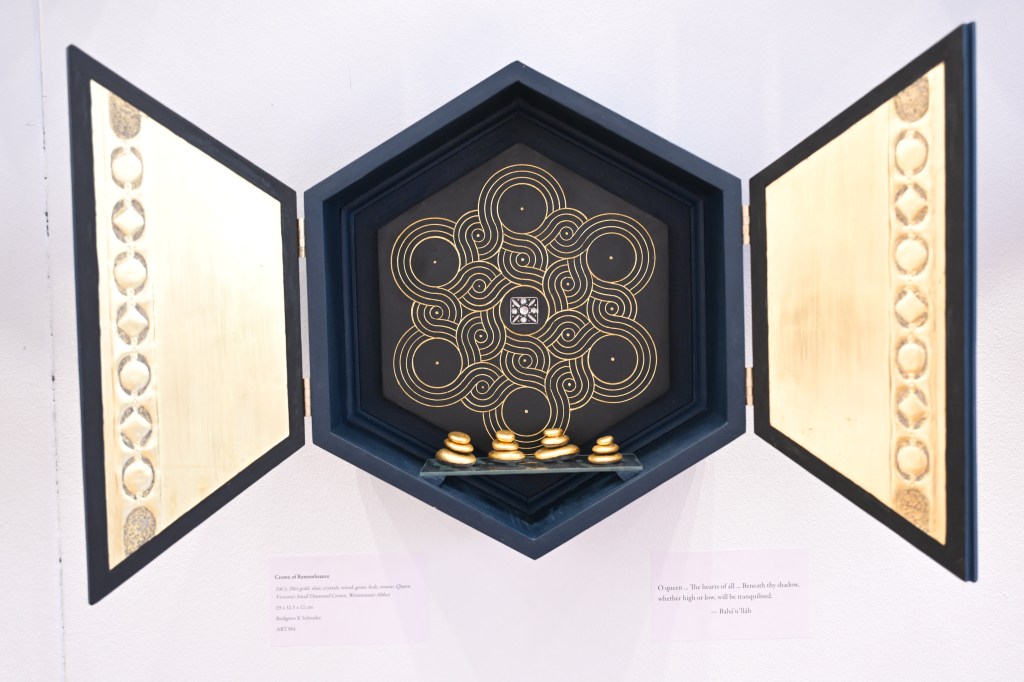
‘Crown of Rememberance’ seems to share the same maze like insinuations in design like ‘Going Home’. If the structure is a maze, it appears that there is no escape. It is a self-contained world, the world of gold and art.
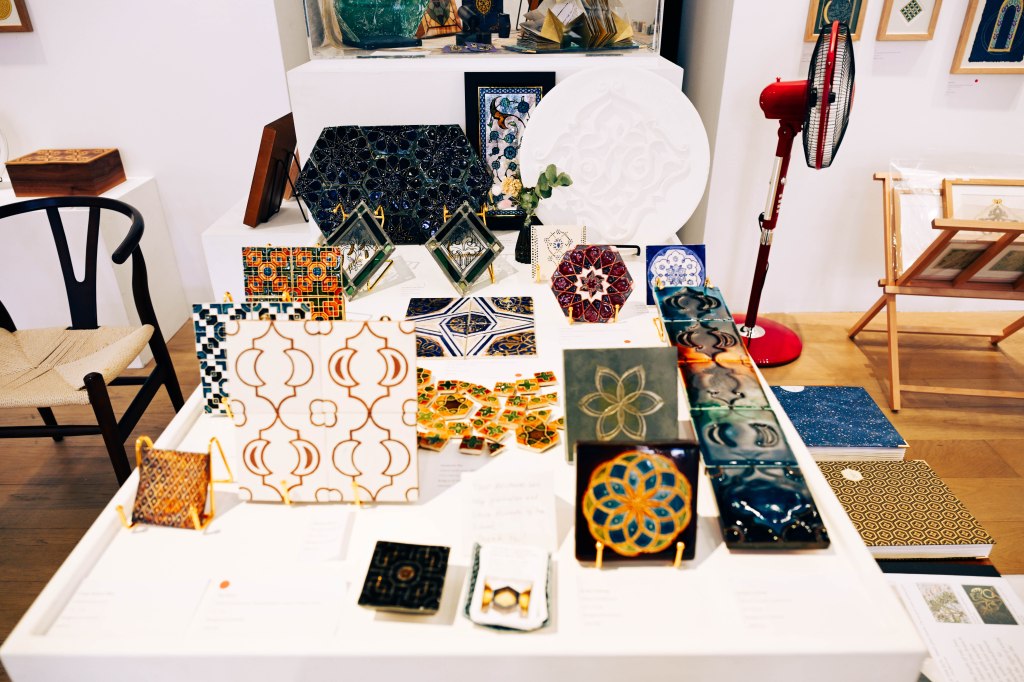
In ceramics, Bridgette dazzled with her colour schemes and her designs. There was many a beautiful piece which I could see in shops such as ‘Liberty’s’ in London.
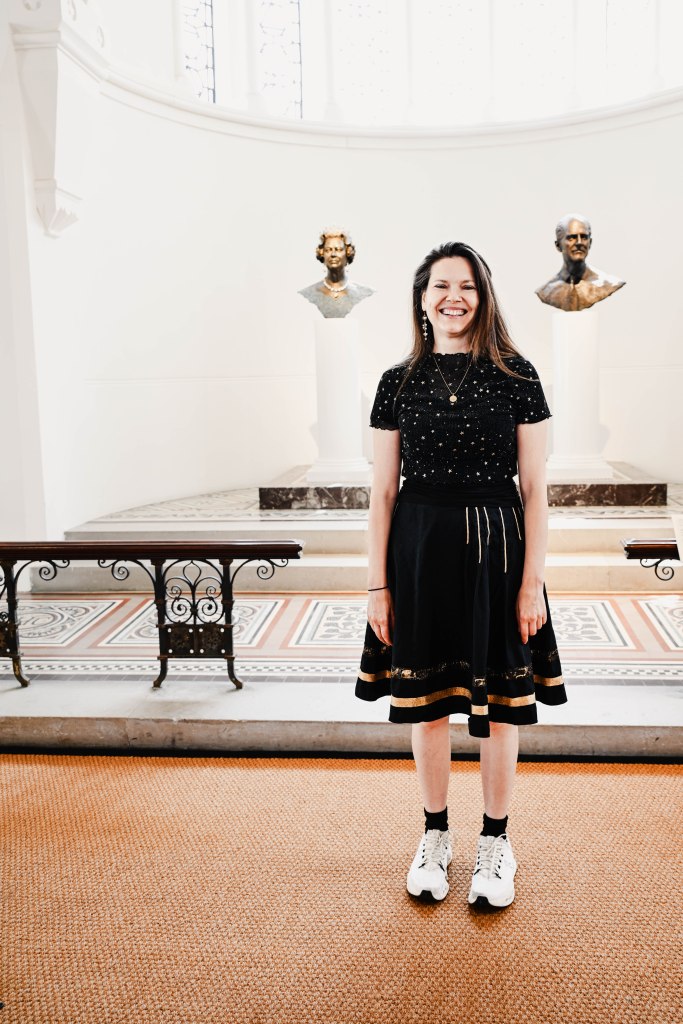
I had another word with Bridgette just before I left. She works extremely hard at her craft and is evidently multi-talented as an artist. She is full of ambition and drive. I was impressed by her and her work and wished that I could do something to open some doors for her. In her outfit full of stars, she was clearly living in the same celestial sphere as the golden butterflies, but also here with us on this grey earth. Such is the reality of the artist that flies in the skies, the reality of the alchemist that deals with the base metals hoping for the magic and the transformation of gold.
S: It was a busy day at work. And then, in the evening, I went to a park, saw a music performance, photographed the artist and finally, met my girlfriend for a date in the park. Followed by a meal of two Whoppers, fries, onion rings, Dr Pepper and a Chocolate milkshake. There was a curious happening on the tube back home.
A: What happened?
S: A young Afro-Caribbean woman suddenly came and sat down next to me between stations. She was putting me between her and a ranting and raving football fan that was off his head down the carriage. He was shouting out football slogans at the top of his head and moving around in a bizarre manner.
A: She chose you as her hero, out of all of the people on the carriage?
S: Yes. Women have always chosen me as the hero. I am named after Sunil Dutt who saved the life of Nargis on the set of Mother India. I come from the Sikh community where it is our duty to protect others. When my grandfather died, the women chosen me as the man that would protect my grandmother in the nights by staying with her in her house, because she could not sleep otherwise. When there is anything that happens out there in this London, they choose me as the hero. It is destiny.
A: Why did she choose you?
S: Because I am evidently the man. I am evidently the hero. It is not a coincidence. It happens again and again. The weak come to the strongest for help. Because only we can deliver it.
A: You are proud to be the hero?
S: I am proud to live the destiny that was chosen for me. I was chosen to be the hero.
A: You looked after her?
S: I spoke to her. I consoled her and reassured her. I asked if she was okay. I took away her fear. It is my duty to protect.
A: What makes you the hero?
S: I have told you. My name. My background. My strength. My manhood.
A: So this is what it means to be a toxic male.
S: However toxic anyone thinks that I am, still they come to me when they need a hero. That is this society.
At about the stroke of midnight, I suddenly had this irresistible urge to write to A. Whatever A. was doing, perhaps sleeping, I always thought A. was free for me. Accessible and open, welcoming even. I wanted to tell A. about my idea of small accomplishments.
In my life, every day, I tried to achieve something. Small things that built up to a general sense of achievement. They did not have to be earth shattering. They were ways of self improvement. Ways of challenging and stretching myself. Ways of stimulation.
So, I wrote to A. I told of my day. It was one of the humble practices of writing. The list. And in order.
Meditation and chi building.
Light weights, stomach crunches and push ups.
Language learning in Spanish, French, German, Hindi, Punjabi, and Urdu through reading short stories, newspapers and novels.
Reading The New Scientist and great stories from British history.
Messaging friends and writing to my pen pal.
Juggling.
Playing at Scrabble, a jigsaw puzzle and a quick crossword.
Researching volunteering places in science for my nephew and sending him over a list so he can choose what he applies to over the summer holidays.
Listening to Hindi film songs on my headphones on my train.
Shopping for lunch and eating while I was exploring the area in London.
Going to various art exhibitions with my girlfriend. I also read poetry today while at the art exhibitions.
Photographing my girlfriend.
Shopping with my girlfriend.
Looking at a cultural destination with my girlfriend.
Editing photographs of my girlfriend with me on my phone.
Eating a dinner of fish and chips with my parents.
Watching ‘The Seven Year Itch’ to watch Marilyn Monroe after going with friends to see her exhibition at the National Portrait Gallery yesterday.
Looking at artwork and photographs on Instagram.
Doing a quick digital art doodle and posting it on Instagram.
S: But it is delicious, no? The ravishment of expression.
A: Whatever do you mean?
S: Why do you think that the artist writes? Why do you think that the writer is an artist?
A: Because they think that language and expression is a way to counter the entropy of the world.
S: It is because it is addictive. It is a dopamine hit. You are letting it all out. Someone, somewhere, they will be reading. You are connecting with society, with another. That is why, for all that I write, the motivation has always been for love. That is why the love letter is the paradigm of my writing and my thought.
A: Love for yourself.
S: For the ideal reader. But you are on to something when you say that it is love for the self as well. Because, after all, I am writing for the community of the Tigers. I am The Tiger. I am expressing us. Us that are not represented. The Oppressed. Those from whom they would snatch the pen, snatch the voice and snatch our lives. I am writing for us. I am us. I am following the philosophy of India.
A: If then, you love to write so much, why are you falling off from this pleasure? From this ravishment of the senses.
S: Life my friend, it is full. So full that it is difficult to write.
A: It takes you no time at all. Get back into the habit of things.
S: These books, these scribblings. Are they life?
A: What is life if it is not the expression of the self?
S: Most of my life, I have sat behind a desk, thinking and writing. And now that I live a little, you would have me imprison myself once again. The unmoving mind.
A: Your mind moves most of all behind the desk. Your mind is like lightning. You begin to write. You look. It has been less than five minutes. And yet, the story has been written. The story of The Tiger and the Tigers.
Again, A. asks me who I am. Are we what we do? This is what I did today. What does it say about me? A. never comments.
Meditation and chi building. To maintain mental clarity, focus and balance.
Reading the newspaper (The BBC website and The Metro). To keep in touch with things. To stay up to date. To connect with the wider world.
Exercise with light weights. Mens sana in corpora sana.
Languages learning in Hindi, Punjabi, Urdu, German, Spanish and French (reading novels, short stories, the news, reading a German grammar book). Because of the challenge, the thrill of learning, connection with my own culture. Connection with the world.
Reading British history. To learn more about this world that I have arrived in. To be erudite and learned.
Reading ‘The Ecology Book’. To face the environmental disaster.
Reading psychology articles. To learn more about the strangers that surround me and the strangeness in myself.
Reading about Christiano Ronaldo on social media. Looking up to a hero that is like myself, the achiever, the goal getter, and understanding the hate sent to him by the jealous.
Phoning my girlfriend. To feel connected to someone, to feel intimate. To show that I care.
Taking my family around London, a museum and the Royal Opera House. Family ties require duty and care.
Playing Scrabble. Keeping the mind nimble.
Doing a crossword. Keeping the memory agile.
Doing anagrams. Keeping creativity and language playing in the mind.
Doing a jigsaw puzzle. Keeping visual processing in check.
Listening to Hindi music on my headphones. Connecting with the culture, enjoyment, language learning.
Writing to my pen pals. Keeping connected. Helping people to stay connected.
Writing some fiction. The drive to write is a compulsion and my biggest ambition.
Quick doodles. To keep the artist’s hand in training.
Looking at photographs and art on social media. To learn and learn and learn again. To be stimulated. To be one with creativity.