While I was born and raised in England, my family in India are poor. So, my whole life, I have been hearing about poverty. I have been hearing about the insecurity and precarity that comes with an unsettled life.
My family in India, they believe that when they get to a developed Western country, their life will be settled. The lives of their children will be settled. This is what my grandfather believed when he came to this country. That’s the future that he imagined for his children and his grandchildren.
But my life has never been settled. I have had to struggle. Just like they dream of a settled life, so I have had to dream of a settled life.
The difference between the ones from India and the ones from here is that they have arranged marriages and they have their own unified community. So they fit in and they get hitched. They’re willing to work in whatever job they find because it is better than being unemployed in India or working for peanuts.
Here, if you are Indian and choose not to get an arranged marriage, try meeting someone. Try starting a family. Try getting the jobs that you are qualified for doing and would excel in. It all hitches on someone giving you a chance or an opportunity. When they cannot. Because of the racism in this country.
So, just like the origin of my poor family in India in the caste of the Dalits and Untouchables has clouded their whole life and made it a struggle, making their lives unsettled, so has my ethnic origin as an Indian person.
But still, I have refused to give up my Indian culture. I have refused to accept the conformity in this country or pander to the unjust expectations that we must all follow convention. Is it worth it? It has come at a great personal cost. The greatest personal cost. Yet if it was easy and convenient to be authentic and true to oneself, then the world would not be what it is.
The virtue of an unsettled life is that this is a life that I have created for myself despite everyone else. Despite the insane pressure from the Indian and the British community, I have forged my own way through life. I have done what I thought is right. I have made my own choices. I have thought out life in my own way.
The reward is isolation, uncertainty, the lack of a resolution or a happy ending. No love. The achievement? Dignity and self respect. We come from the honour culture. It is the greatest prize.
Without a doubt, my favourite Hindi film actor is Sunny Deol. One of his most famous roles is playing a lawyer in Damini (The Lightning). Here, again, Sunny reprises the role of a lawyer. However, this time, in a reversal of the movie plot in Damini, he is on the side of the rich rather than on the side of the poor. It is a reversal of roles.
Why? Just like Damini explored how corrupt the rich are and how they monopolise the legal system against poor women, so Ikka explores this topic. However, what Ikka suggests, is that the law cannot reject the rich and neither can we reject the rich.
Arjun, Sunny’s character in the movie, cannot reject the rich man, the defendant. He has to fight for him in the court to save his daughter’s life who would otherwise die of cancer. The murder victim in the movie, the poor woman (not so poor however this time), also cannot refuse the rich man’s advances. The rich man kills her as a result with his wealth, forcing an expensive car’s key into her throat. The law cannot reject the rich man by treating him as a criminal in the film.
The rich man is protected by his wealth. He can put any kind of duress on anyone because of his wealth. Not only his wealth but his very being and identity as a rich man – the duress he places on Arjun is because he has a bone marrow compatible with that of Arjun’s daughter. He has biological wealth deriving from his stature as The Father – he is the biological father of Arjun’s daughter.
In the movie, Arjun as a father has to bow down to The Father, the patriarchal ideal. In one scene, he makes his ‘son’ Abimanyu (Abimanyu is Arjun’s son in the Mahabharata) testify for the rich man, showing the corruption of the patriarchal relationship and its foundation in lies and misdirection.
There is only one person that can reject the rich man in the movie: The Mother. She is the only one powerful enough to do so. Because The Mother is not the law. She is the dharma. Arjun’s wife, once the former girlfriend of the rich man defendant, she rejects him. She slaps his face. She married Arjun instead of the rich man and rejected him entirely. Again, the victim’s mother, she rejects the rich man. She can only see the rich man as a villain. And then the female lawyer that is fighting against the rich man is also a mother. And she is the one that eventually sends him to jail in the ending of the movie.
The fact is that the rich man dishonours The Mother. He is The Mother’s enemy. At one point, fighting for the rich man, Arjun is forced to dishonour The Mother in court. He hates himself for it. The film is about the honour of The Mother against the dishonourable rich man and his degradation and devaluation of women’s power (this is how the crowd protest against the rich man with their banners, invoking the idea of ‘nari shakti’, women’s empowerment).
Just like Damini, the film is about the power of the rich man pitted against the power of The Mother, of divine female energy. But all this revolves around the idea of rejection. How is it possible to reject the rich man when he has all the financial power? When he has all the resources that sustain life? The answer? You have to go along with the rich man, according to his intentions. You have to accrue resources, wealth and life from him. You have to follow his anti-Mother and misogynist oppressions. And then, when he believes that he is untouchable and invincible, then you have to defeat him with the truth, by fighting for the innocent. It is the story of how to become free. You can only become free from slavery by becoming strong, by having resources. You cannot do it out of nothing. And this is where the film is different from Damini. Because in Damini, the lawyer has to fight with nothing. In this film, the full corruption of the rich man’s law is exposed. The law is financed and serves the corrupt rich man and therefore it is absolutely corrupt itself. To gain justice is to defy the law and the legal structure entirely. Justice relies on rebellion, not adherence to the law.
S: Justice is not won by adherence to law, but through rebellion.
A: What makes you so sure?
S: Look at how Parliament was established in this country. Through Simon de Montfort.
A: He has the same initials as you.
S: The spirit of the Revolutionary lives throughout the ages. We are irresistible and unstoppable. One dies. Another will be born.
A: This pride that you have in rebellion. What sort of pride is it?
S: This pride is based on the belief that the law is unjust. That I am above the law. I am better than the law. That rebellion is better than the law. That Revolution is better than the law. That is what this pride is. It is the pride of Punjab. It is the pride of The Tiger, of the Community of Tigers. It is the pride of the Indian, who has won freedom and independence from the unjust. It is the pride above all of the village, where we are not ruled by oppression and law. Where we govern ourselves. Where we are represented. Where we are the kings and the queens.
A: You would not follow the law?
S: You would follow the rich man’s law? You would follow the racist’s law? You would follow what another has thought, when you know that you are a genius? I decide my own fate. That is what rebellion is in this world. To follow one’s own choice and one’s own path. To decide, to be the judge and the master.
A: This is how ego talks.
S: I am ego. I am god, which is the ego of all. I am The Mother. I am her voice, her son and her lover. I am her. I do not need anyone to tell me what to do. Because the best placed, the best suited, the best, that is me. No other.
S: I am named after the god of love, Krishna. Suneel means the colour of his skin, very blue.
A: You always say this.
S: Have you ever wondered who the god of love is with?
A: Radha. What about her?
S: She is the wife of someone else. Yet her true love is Krishna.
A: Who is she then?
S: She is worshipped as the goddess of love.
A: Krishna’s lover is the Indian Aphrodite?
S: To be with Aphrodite is a curse. But to be with Radha is paradise. She is confidence, devotion, beauty.
A: How can she be devotion if she is with another that is not Krishna?
S: The love with Krishna is a heavenly love. The love with the other is the earthly love. What is more exalted? Heaven or earth? The ideal or practicality?
A: You are fated to be with the goddess of love? These are names. They are not identities.
S: I am the god of love. I bring love into this world of hate. I bring the philosophy of India into the world that is six thousand years old, the philosophy of love that this wicked world could not extinguish. It is my fate to be with the goddess of love.
A: You tell me you are a warrior. How then can you be the god of love?
S: My war is love. Love is my war. The warrior is the lover. Krishna himself was a warrior. He preaches the warrior duty in the Bhagavada-Gita. He is the philosopher of the warrior. The culture that I come from is the warrior culture.
A: And Radha?
S: She is too a warrior. She is the other form of the Mother Goddess, the Warrior Queen. The stories that make us what they are, they are entirely consistent. There is no confusion.
A: It is very fine to call yourself the god of love when you are bagging yourself the goddess of love.
S: Isn’t it? Krishna enchants the world. Radha enchants Krishna.
S: Krishna and Rama are two incarnations of Vishnu. Both warriors. But they are complete opposites.
A: In what way?
S: Rama rescued his wife from a man that tried to abduct her. Krishna consorted with the wife of another, Radha. He took someone’s wife away from them. Not just one woman, but all of them, all of the wives, the Gopis. Rama followed the law of matrimony. Krishna is above the law.
A: Anything else?
S: Rama, when he was exiled to the forest, accepted that another rule in his place. He let the usurper rule the throne when he was the firstborn son and the throne was his inheritance. Krishna, when he was dispossessed of his throne, he killed the usurper and reclaimed his throne. Rama accepts dispossession and unjust usurpation. Krishna fights against it.
A: I know you will say there is more.
S: Krishna has a good stepmother. Rama has an evil stepmother.
A: Always the mother with you.
S: Krishna was raised in a humble background then became a royal. Vice versa for Rama. And then, Krishna is known as the thief of butter because he stole butter. And Rama? He does not steal. Krishna is his own law. Rama follows the law of the other. Even at the end of the story, Rama sacrifices his wife in the name of the law of matrimony, because the people cannot accept that she is pure because she had been abducted by another man.
A: I think I know where this is all leading.
S: I am named after Krishna.
A: Whether it is Krishna or Rama, they are the hero.
S: Rama is the hero of the conservative. Krishna is the hero of the revolutionary.
A: It is a name. I have told you before. It is not an identity.
S: And yet, you can model yourself on that identity. The anarchism of Krishna. And the liberation of Narsimha, the man-tiger, the other incarnation of Vishnu. After all, one of my names is Tiger.
A: This obsession with names and identities, it is old fashioned.
S: I am six thousand years old. And yet, I am fresh. Because I am not just the past and the present. I am also the future. I believe. So does India.
This piece was submitted for a journalism internship as a writing test. The author, Dr. Suneel Mehmi, is proud to come from the Dalit Community and to be an Untouchable.
06.09.2025
India, which has a caste system and caste discrimination against Dalits (the lowest castes) also has the largest population of 287 million illiterate adults in the world. That is 37% of the global total [1]. If illiteracy can be considered an indicator of exclusion from education, then Dalits must be considered as victims of this educational poverty and deprivation, since 62% of Dalits are illiterate indicating they have likely not completed primary school [2]. Informal data indicates that more than nearly 60% of children who drop out of school are Dalit children [3].
Caste discrimination aligns with gender discrimination to fuel illiteracy, evident in the fact that the literacy rate of female Dalits in Bihar was 38.5% in 2011 [4]. To put that into perspective and stark contrast, the literacy rate in the United Kingdom is considered to be 99% for both men and women [5].
Despite the fact that education is the best way to eradicate poverty and build a better future, this education is still systematically denied to Dalit children in India [6].
While the caste system has been abolished in the law, there is ongoing discrimination and prejudice against Dalits throughout India including in the field of education. Dalit students face unique challlenges in becoming students. The family is so poor and unemployment rates are so high that even in today’s world, Dalit children are sold into bonded labour so that they cannot study, just so that the family can eat [7]. Many Dalit children are studying while they are malnourished.
In schools, Dalit children are often bullied and discriminated against. In Bihar State in India for instance, while there is a legal obligation to include children from all castes, still schools are either abandoned or barely functioning. If Dalit children attend the schools, they are treated with cruelty or neglected. Practices of discrimination include being forced to sit at the back of the class and prevented from touching or interacting with classmates from other castes [8]. Far from being able to join in school activities, stories of verbal and physical abuse against Dalit students from both teachers and classmates are rife [9].
The dropout rate for girls is exceptionally high. Children already vulnerable due to caste prejudice are placed in even greater danger, and there is the perpetuation of a cycle of poverty which has remained unchallenged for generations [10].
Education is key to increasing the prosperity, security and happiness of any country. If there is systematic and institutionalised exclusion of the Dalit community in India from learning, then the country cannot advance as a whole. To counter poverty, we must first counter the educational poverty and deprivation for Dalits.
When I did my PhD and then got my doctorate published as a monograph, I showed that, just after the invention of photography, Victorian authors associated photography with women and a challenge to the patriarchy and its law. Because of this, throughout the novels of Thomas Hardy, Charles Dickens, Henry James and Wilkie Collins, photography was belittled and there was an attempt to exorcise it from the text. They associated photography with a woman’s supposedly superficial and legally ignorant gaze in The Moonstone (alongside the Indian gaze of the Idolater). The reason was because photography was used to photograph the body and women were seen as bodies rather than minds. Therefore, the denigration of photography was the denigration of the body in Judaeo Christian culture and the repressed times of the Victorians. The most obvious equation of photography with women and their bodies is in She, where Ayesha, the epitome of feminine beauty and physical attractiveness is able to make telepathic mental photographs of the male heroes through her surveillance in her feminine empire and as an expression of her womanly power.
It was the feminine body of photography that was thought of as such a challenge to the male body of the law in these novels that I studied. A usurper to the throne. The medium of revolution.
Almost two hundred years after that equation of the photographic with women, I walked into a feminist protest through the means of photography at the South London Gallery. It was an exhibition space where women were fighting against injustice, state regimes and the law, like the laws controlling abortion. These women were trying to extend the meaning of protest photography. It was a fight of the truth of women against the ideology of the patriarchal state.
The exhibition label calls this ‘the fourth wave’ of feminist protest which is about the empowerment of women, uses internet tools and includes factors such as intersectionality, where there are overlapping oppressions such as misogyny, race and class (Wikipedia). The exhibition is organised in four different sections:
– Body as Battleground
– Institutional Failure
– Revising Histories
– Feminist Futures
Here, in this review, I am going to consider the photography that I had a particular interest in.
Sofia Karim, Ihtijaj (Resistance) (Delhi, 2019)
This photograph is part of a series against anti-Muslim citizenship laws in India which have gone against the ideals of cosmopolitanism and acceptance that Indian descent people like me have grown up on. The title of the series is Turbine Bagh, which is a woman’s resistance movement intended to go against the oppressive laws. The image is printed on a samosa packet made out of newspaper – Sofia was served a samosa packet with court hearings on it once. The image is something that is being fed to the recipient of the law, of news. It is food, nourishment. For the women’s resistance movement.
What strikes me in this black and white photograph is the relationship between the active body of the woman holding her hand above her head to make a gesture and the seemingly passive bodies of the other seated women around her. This is what is apparent at first sight: the movement towards resistance, the action. The active woman’s mouth is forming words. She is communicating, acting. She is energy in the face of passivity. And you look closely to the woman in the right that creates a relationship to this action – her hands are clasped in seeming prayer. The resistance is the prayer of the people, of women. The active woman is the heroine that they are praying for to overturn the injustice of the modern day state. And then, the passivity of the other seated women becomes something else. It is the gesture of waiting. Patient waiting. For the revolution. For the fire that burns and sears the world.
The humble samosa packet which contains the greatness of the revolution.
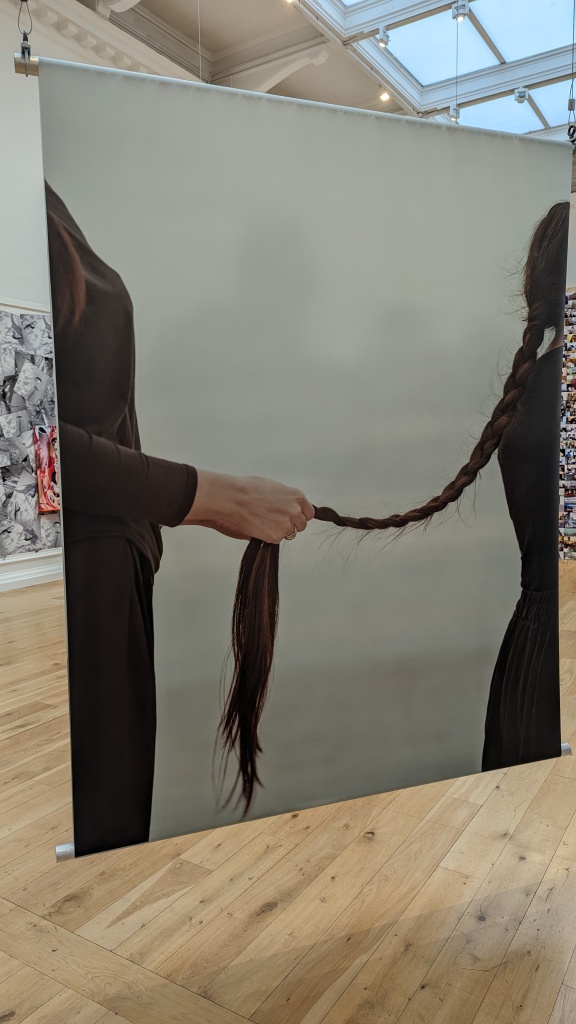
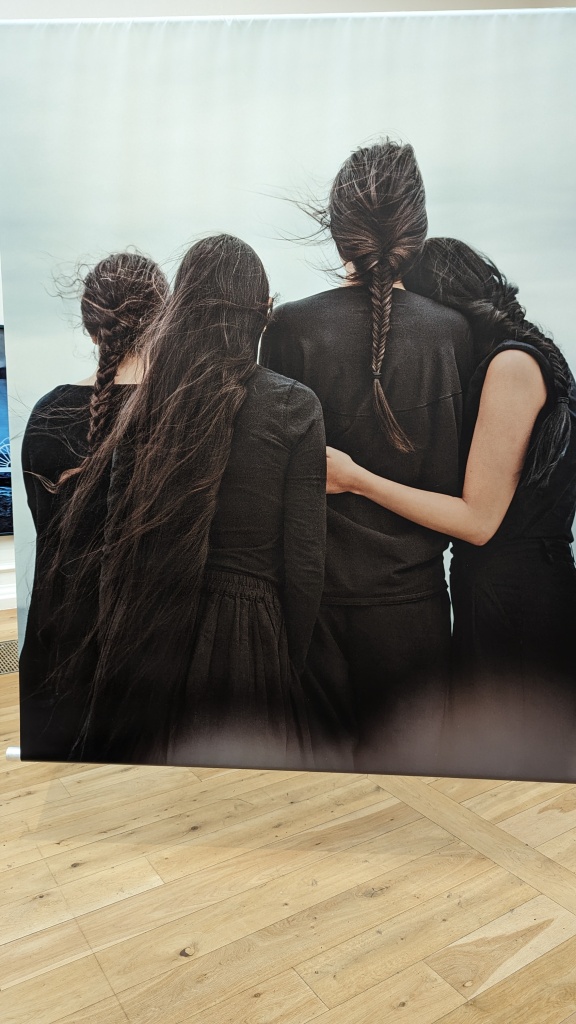
Hoda Afshar, In Turn (2023)
Tehran’s ‘morality police’ killed twenty-two year old Mahsa Amini for not wearing the hijab under government standards. These photographs are one with the protest against that legally sanctioned murder of a woman’s freedom and choice over her body.
The photographs are staged images that utilise the imagery of the doves, birds that are released at the funerals of those that have lost their lives in the protest. The birds stand for martyrdom and peace.
The women in the photographs are largely anonymous because anonymity protects the protesters on social media. These protest photographs show women plaiting each other’s hair and discarding their veils. The hair is plaited as respect is given to women freedom fighters fighting in Kurdistan against the Islamic state. They plait their hair before battle.
These monumental photographs are impressive and powerful. They give a body to the protesters and, with it, humanity. A community is formed around hair and the freedom to show it. The large format itself is a celebration of women and female bodily display, the ‘exposure’ that photography gives. Because, despite the fact that most of the models are anonymous, in the final images as we walk through the space, as you journey through the images and the story they are telling, you see the full frontal body of the woman with doves and her face is completely visible. And on the reverse, you can see the profile of a woman that braids the hair.
The plaited black hair of warfare and the white doves of peace tell a story. To have peace, you have to have the war first. Peace is the aim that can only be achieved through fighting for the rights to have choice and freedom. In the final photograph, a pair of hands braids the hair Another pair of hands superimposed on the back of the woman whose hair is being plaited holds the dove of peace and martyrdom. A reminder that freedom costs something. The fight.
These photographs are an inspiring celebration of heroism.
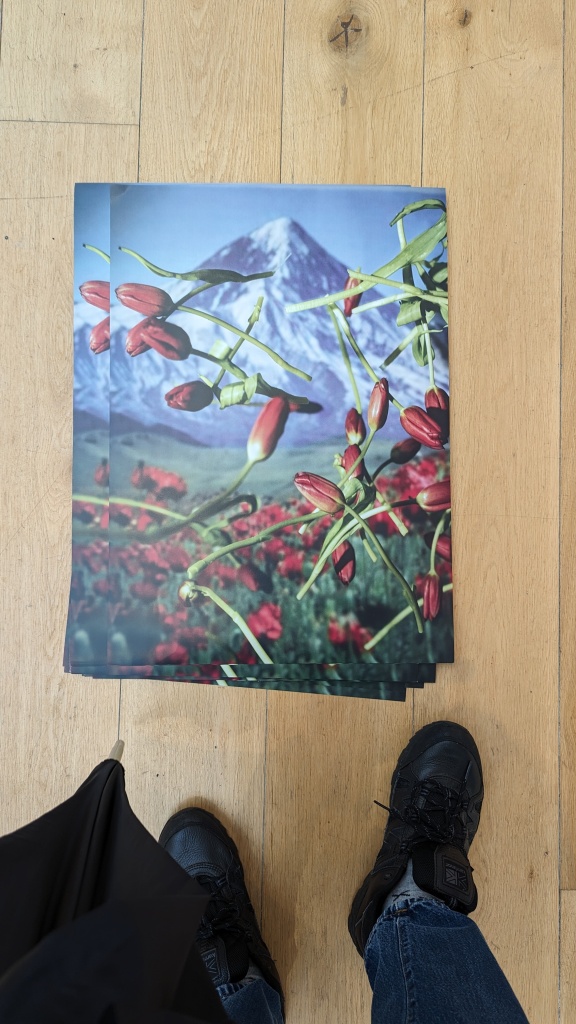
Sheida Soleimani, ‘Tulip Poster’ from the Series To Oblivion (2016)
This poster is a tribute to the Iranian women unjustly imprisoned and killed by the state. The tulips reference an Iranian revolutionary song that sees the flower as revolutionary hope – because although it is fragile, it is resilient and it regrows every spring. The numbers on the back of the poster show current published data of those arrested and killed by the Iranian state.
The redness of the flowers. Blood. Against the mountain in the background. With their stalks, the tulips are the ladders up to the peak. They are the scaffolding that can even go above the peak. To ascend the ladders, you have to have the revolutionary hope. Which no sword can cut down. Which no gun can diminish. The tulips are the beauty of hope. The beauty of the revolution. They transcend death with their growth. They have the beauty of growth, nature, resilience. To ascend the ladder of hope is the ascent into heaven. In the religious context of the photographer’s background, this is the image of faith in the revolution and eternal justice. Like Antigone, the photographer promotes the eternal laws of justice rather than the man-made laws of the earth.
Wendy Red Star, Amni (Echo) (2021)
This is a tribute to the matrilineal clan membership of the Appsalooke Nation which was erased by colonialism and its patriarchal laws. The artwork gives power back to the women in her family (the photographer who is Wendy Red Star, her daughter and her great-great-grandmother). And the power back to the names of the women of the Nation.
This was one of the most moving of the artworks in the exhibition for me. They called them Indians when they are Native Americans. They took their land and tried to destroy their culture and their people. They are us. We also have clan membership through our mother – Mother India is our mother and the religion of my mother is the Mother Goddess. It is this which the patriarchal, colonising state wishes to destroy and, with it, difference.
The names of power call out in the background, behind the photographic sculptures. And the photographs themselves build power. Out of the small photograph at the base, a greater entity is formed through the use of overlapping photographs. If you look carefully, you see that the aura is extended into the names of power behind, with the use of negative white space.
One of the ideas around photography when it first came into widespread use was that it could take away the soul of the sitter. Here, that idea is reversed through resistance against the patriarchy.
Because the photograph of the great-great-grandmother is there and the different generations, the photograph scultptures build up the matrilineal history which the law and the colonising state wanted to end. In the face of erasure, we have the form that has come back to us, become literalised in word and image. The phoenix has emerged from the flame.
…
The exhibition included many other pieces worth a careful examination and study. My overall impression of this exhibition is that I learnt a lot from it and I was inspired by it. We, our community, we also fight the wars against the patriarchal state and its patriarchal laws. For our way of life. For our culture. The patriarchal law wishes to kill what we are. We, the ethnic minorities, even if we are the men, we are also the women.
And the photographs showed the resistance can take many different forms. There are many dances to learn. Many songs to sing.
Time and time again, the photographs exposed what the patriarchal law of the state is. And why it has to be fought against. Not just in ‘other countries’. In Western type countries like Australia and Poland.
Sometimes, I was disappointed. One video installation said to become a ‘peaceful warrior’ and not ‘an angry warrior’. I don’t believe we should spit out our anger. But the philosophy of India is that everyone has their own path. Who are we to judge? As long as the warrior remains the warrior. That is the point.
The union of women with photography suggested calamity to the male Victorian authors that I studied. It suggested the revolution. The exhibit of feminist protest photography is the natural outcome of the resistance. As a form of truth which exposures the corrupt heart of power, photography has few rivals. These images demand more attention and more thought. Within them, they contain the resistance to the state structure and the patriarchal law. And, within them, they contain the conception of justice that the patriarchal law does not have, with its false claims to universality, timelessness and ‘truth’. By making photography concrete, by giving it the female body, these photographers have fought against the male body of the law with its male subject. They have created women’s – and photography’s – jurisprudence in the present moment.
In the end, the warrior loves the warrior. The exhibition is warrior culture.
Buddha’s Parents. Or Bringing Children into a World of Suffering
22.05.2023
The other day, I was telling someone my jaded views of dating and relationships. The guy told me that I was really negative (all I was doing was telling the truth). The topic changed slightly. I said that, for me, one of the main motivations for being in a relationship was having children. The guy stared out into the distance with a frown on his face, asking me, in a tone of wrenching gravity, ‘how can you bring children into this suffering world?’ To my lukewarm negativity, he had suddenly brought a fire of absolute negativity as a response.
I won’t share what I said at the time. However, I did think about this generalised, modern (and to my mind, completely perverse) response to the idea of giving more children to humanity as its future. The story that came to mind was the origin of the Buddha. I hope you are familiar with it, but I will go over its general perimeters again.
Like the guy I was talking to, Buddha’s parents couldn’t stand the thought of bringing a child into this world of suffering. They basically imprisoned Gautama the Buddha – a prince – in the walls of a palace. Here, he could see, hear nor taste any suffering. There were not the old. There were not the sick. There were not the hungry. The Buddha lived in a bliss of non-awareness and ignorance as to the human condition.
As you may know, one day, the Buddha saw an old, sick, emaciated beggar somehow. The walls of ignorance were suddenly torn down. He had encountered all the suffering in the world. Despite the best efforts of his parents, the Buddha had now become chained to suffering, to being.
What I want to point out is this. Buddha’s parents wanted to protect the child from any form of suffering. But this is the human condition. They were really imprisoning the Buddha in a golden cage, separating him from the great mass of humanity. They were making him ignorant, inconsiderate, without compassion, without the means to end suffering for others. They were making him spoilt and careless. Like the rich and powerful, who live a life that is mostly without suffering (let us remember that his father was a king).
So, I have no qualms about bringing a child into this world of suffering. I come from a people that have suffered for thousands of years. But it is our duty, the aim of our life, the source of our greatest happiness to have children to bring into this world of suffering. We do not want to control their existence and keep them cooped up in any kind of golden cage to make them spoilt, isolated and separated from true existence. These are ideas that are foreign to us. We know that the chain of suffering binds us, that the chain of humanity and the human condition binds us to this existence. Yes, I have suffered. But the only things I would change are the mistakes of ignorance that I made when I was younger and more foolish than now, if that is possible. The mistakes that have hurt others. Suffering has taught me. And this is the flower of suffering which Friedrich Nietzsche wrote about. For the Buddha only became the Buddha, the Enlightened One, because he suffered. If we pluck at all the thorns, we cannot truly taste the perfume of the rose or truly see its bloom. Without the possibility of danger and mortality, there is no flower that we can set in our hearts. There is no enlightenment and there is nothing. We will bring children into the world to suffer, because we are the children of suffering.
Often, we retreat from the very great but empty noise that the Oscars make. However, on this occasion I decided to watch one of the films that was up for the nominations, ‘Writing with Fire’. Famously, if one is from an Indian ethnic background, the documentary is the first Academy Awards nomination which has been directed by an Indian director (Rintu Thomas and Sushmit Ghosh). It is also one of the only films, Indian or otherwise, which has ‘untouchable’ women as heroines. Luckily for me, the film is on BBC IPlayer and is available to stream online as part of their ‘Storyville’ series.
‘Writing with Fire’ is about the perils and adventures of three lower caste (‘Dalit’ which translates as ‘oppressed’) women journalists, Meera, Suneeta and Shyamkali. They work for the only entirely woman run newspaper in India, Khabar Lahariya or ‘Waves of News’. In the opening credits, the film makers write that when these Dalit women set up a newspaper in 2002, they ‘started a revolution’. The film follows the newspaper story from 2016 when the publication went digital. The attempt is to show a sea-change. Meera says, “In our region, a journalist meant you are an upper-caste man. A Dalit woman journalist was unthinkable. Over the last 14 years we’ve changed this perception.” Meera asks us to consider what it would be like if Dalit women had power and what they would do with it.
What follows in the film is a traditional and thoroughly conventional hero narrative which has been built up over thousands of years. The difference is that the hero is not a hero, but a heroine, and from the lower castes. What is the traditional hero narrative? The hero comes from humble origins, like the Greek demigods raised secretly by peasants as children. However, such humble origins disguise the greatness, nobility and royalty of the hero, which are revealed later. The hero faces adversity and mortal danger, as in a glorious battle. It is stated in the credits that India is one of the most precarious places in the world to be a journalist, with many murdered. The film shows the response to one murder of a female journalist by the workers of Khabar Lahariya. The hateful trolling of the women journalists is illustrated as well as their vulnerability to the Indian mafia. The hero is threatened by a return to quotidian life, like Hercules compelled to clean the stables. Thus, the women’s husbands attempt to stop them writing for the newspaper to work in the home instead as housewives. Finally, the hero must triumph. Khabar Lahariya is presented as an out and out success, measured by the amount of YouTube views it attracts, which number in the tens of millions.
This hero narrative unfolds amidst a glorification and justification of journalism, the pursuit that the women have dedicated their lives to. Towards the end of the documentary, Meera recites that the journalists are fighting to transform society. That they are holding the powerful to account. That they have made their journalism the voice of democracy. That they didn’t let the fourth pillar fall. And that they continue to hold a mirror to society. Thus, the film seems to be about everything that lip service holds dear: truth, balance, democracy.
Not only this, but the journalists are presented as law-givers. The screen first jumps into motion with Meera asking a woman in person about being raped multiple times in her home by four men. The opening credits mention how many Dalit women are subjected to violence across India and the film shows how Meera and others are trying to challenge the justice system which doesn’t respond to these atrocities. The unnamed rape victim says that the police refuse to lodge her complaint and intimidate her when she attempts to do so. The woman is going to newspaper because they are the only ones that listen to her story. As the husband of the victim says, “We don’t trust anyone else. Khabar Lahariya is our last hope”. Meera confronts the police about the multiple rapes and she proclaims that she is “fighting for justice in a democracy”.
My impression of the film as a whole was that it was a story told well. Certainly, Dalit women deserve to be seen as heroes too. The focus on the stories of the three women journalists gave that personal touch which made the abstract ideals the film supports into something concrete and something that the viewer could really relate to. The cinematography by Sushmit Ghosh and Karan Thapliyal was very beautiful. However, I am more pessimistic about the role of journalism in society. The documentary aims to present the journalist as objective, neutral, impartial, a server of truth, justice and democracy. These are claims that are a stretch of the imagination much too far for me. Again, I am troubled by why the Western media has nominated the film for an Academy Award. Khabar Lahariya is the voice of the poor, oppressed women in India. Naturally, they are pessimistic about power and the government in India. That is, they criticise the society they find themselves in because they hope to transform it and make a better position for themselves. This is fine. This is acceptable. Indeed, I support these women in their mission. However, what is unacceptable, is that the Western media and its public discourse always criticise India when they know nothing about it, in a supreme act of Orientalism and racism. The Academy seems to have selected a film which presents India as a colossal sewer because this is what they think about the country. This is not fine. This is what is unacceptable. And in this, they are trying to use that objectivity associated with journalism to try and present their racist notion of a whole country as the unqualified truth. Final verdict? A good, revolutionary film spoiled by an Oscar nomination and Western practices of racism.
Is it wrong to desire revenge? Some people suggest that it is. My own research into the Victorian period has shown that not only is the desire for revenge seen as irrational, being emotional, and unreasonable, but that it is also feminised. The desire for revenge is a transgressive desire which attacks the very foundations of Western rationality, the rationality and reasonableness of (white, middle-class) men. Perhaps the most famous example of this feminisation is Miss Haversham in Great Expectations which I read as a schoolboy, but it is also in other famous novels like Vanity Fair, where Miss Sharp favours revenge too.
It is with some surprise that I noted that revenge was also feminised in my favourite Hindi film, starring my favourite actor, Sunny Deol. The name of the film is Ghayal, which means, literally, “wounded”, although I believe the correct translation into English should be “The Wounded”, which would make a significant difference to the overall meaning of the film. Ghayal is not just a film, it is an entire philosophy, some of which I will try to make clear in this little piece. I return to the film when I begin to forget who I am and where I come from. The film is a revenge story. The villain kills the hero’s brother. He is framed for the murder and then an accusation that he killed his brother because he was having an affair with his sister-in-law leads her to suicide. The hero triumphs and has his revenge outside of the law. The film is divided into a number of sections, but the obvious structuring is to contrast everything that follows with a first happy period.
Female revenge is present even in the first happy period, which is full of comedy. One day, the heroine of the film travels to see the boxer hero at his training camp. Because he is scared that he might get sent home, he says to her that he doesn’t know her and tells her to go away. The hero is the only person in the world that the heroine loves and who loves her back. She has no family as her mother and father are dead. When the hero tells her to go away and pretends that he doesn’t recognise her, he is refuting his love for her and treating her as a non-person with no identity. He is excluding her and returning hate and apathy for her love. He hurts her badly, he wounds her absolute trust in him and herself, in other and self.
The heroine does go away. But then, the hero has to apologise. He finds her in a restaurant and tries to speak the words of love to her. But now, the heroine’s mind is concentrated on revenge. She tries to provoke the other customers in the restaurant by turning all of the hero’s words against him to insult them, saying that he has called people bald or fat, etc. She wants the hero to be beaten by the mob, she opportunistically manipulates them to give the hurt and the satisfaction that she will feel. The customers are equated with India – this is an explicit comparison that is made. But Mahabharat (Great India, or ancient India) is also invoked when the hero actually touches the heroine.
As soon as the woman is touched, she opportunistically uses the status of victim to further manipulate the mob. She pretends that she is a damsel in distress, she mimics completely passivity and helplessness. She calls out that the hero, who she pretends is a stranger, mirroring his refutation of her identity, has touched her and rhetorically questions the crowd: Is there no man among you (to protect me, to have the courage to protect me, to protect not only me but all women, the women that are your sisters and mothers)? Here is when the Mahabharat comes to the rescue in the form of Bhima. Bhima is perhaps most famous in the epic saga because of his relationship to women, law and revenge. Draupadi, the wife of five men, was dishonoured by Dushasana who vowed to keep her hair unkempt and unmanaged until they were washed with the blood of her oppressor. Bhima was one of her husbands and he vows not only to bring his wife the blood, but also to drink it. Their vows and laws are based on their revenge. The beginning of legality is based on revenge, the revenge of a woman.
The heroine only forgives the hero when he falls from an elephant in trying to win her over. It is only when the hero is hurt that the heroine is able to forgive him. He has now shared her hurt. He has felt what it has been like to have been in pain. He has hurt himself for her. This is love.
The main revenge story is also marked by its relationship to the law and feminisation. First of all, the hero is clearly “the wounded”. I was discussing wounds and their relationship to femininity with one of my supervisors – someone had questioned my tying together of the wound with femininity in a poem by Robert Browning at a postgraduate reading session – and she told me that the wound has indeed been historically been associated with women, which a number of commentators have noted. He has been hurt badly. The hurt is that his loved ones have been taken from him. But the hurt is not just the loss of his brother, who is murdered, but also his sister-in-law who is like his mother that commits suicide. She is murdered just as much as his brother because she is dishonoured and shamed by what the world has been led to believe about her and her brother-in-law. However, the main hurt has been from the law. The law rejects the hero’ hunt for his missing brother and then he is subjected to brutal torture when he is framed for his brother’s murder. It is in the courtroom that the accusation of the incestuous relationship with his sister-in-law is made that leads to her suicide and extinction, her non-identity. The entire legal system fails him. What he should have been able to trust does not help him, it takes away his love, what he loved most. It takes away that which gives him his identity – his family, the brother and sister-in-law that are like his father and his mother.
Thus, the hero’s quest for revenge is a quest for revenge against the law. It is explicitly stated that his campaign of revenge is a campaign against the law since it is a direct challenge to law and the rule of the law. Of course, this law is only there to protect the villain, the rich man who plays Western music on his piano. Yet every time the hero pulls the gun against the villain, he is impotent. The crisis of impotence reaches its head towards the end of the film. Yet, in the most beautiful scene of the film, when the hero’s campaign of revenge is about to fail and he is pounded by a group of policemen and the law which forms a tight circle around him, the heroine sees him as the victim. She remembers what it is like to be the victim. She knows its reality. She knows what it is to be the wounded. And it is woman and the wounded that help the wounded. They see the place of woman in the wounded. She gives him the loaded gun and he is no longer impotent. He shoots and he does not miss. He hands himself over to the police with a smile on his face and a child that he rescued from the villain, the child that was separated from his mother by the villain and snatched from her, separated from the one he loves the most, applauds. The crowd of the people applaud too. The hero walks beside the heroine who gave him back his potency, both towards the law.
On ethics and law. There is a structuring of five. Draupadi had five husbands. There are five in the family: the hero, his brother, his sister-in-law, the heroine and the evil uncle who is a lawyer, the one that makes the suggestion of the incestuous affair. The brother, before he dies, says that five fingers of the hand are not all the same. The hero has four associates in his desire for revenge (five in total), each of which fall, leaving only him. This is because in revenge, the only one concerned and interested and self-serving can carry out their revenge for themselves. The hero kills the evil uncle, the lawyer: the identity of lawyer, liar, must be eliminated. Law itself is a prostitute: it is said to sleep on the bed of those such as the villain, the rich man. It is not the sacred prostitute, it is the one that only serves the rich. Law is there to be hated. It destroys love and unity. It is the insertion of law and the lawyer into the family which leads to the dishonour of woman and her extinction. It is law that stops a woman becoming a woman and which threatens her integrity and existence.
There is a lot to learn from “The Wounded”. Hurt is only appeased by hurt. Because when the oppressor is hurt, it is then and only then that they learn what it means to be hurt. It is only then that they learn the disintegration of self and integrity. It is only then that they learn what it is to be a victim, to be woman. And all of the negative stereotypes associated with an angry and revengeful women are the very things that we need to be: touchy, sensitive. When we want to hurt the law, we have to attack the places that hurt most. We must take everything from the law and give nothing. We must be merciless and relentless. For it is only the execution of revenge that teaches empathy. It is there to eliminate the ego. The oppressor must be humiliated in a contest, in a duel. In the film, the hero kills the villain, but the real defeat of the villain is in knowing that the law which protected his vicious self cannot save him because he has hurt others. Either no-one must be hurt or all must hurt. This is the lesson of empathy. Hurt only desires further hurt. Hurt can only be satisfied by further hurt, by being placed in the exact same place and position that you place another through hurt. Revenge is the teaching of empathy and the production of emphatic persons, learning empathy with woman. This is what is law.