25.07.2026
(Photography by Suneel Mehmi. All rights Reserved.)
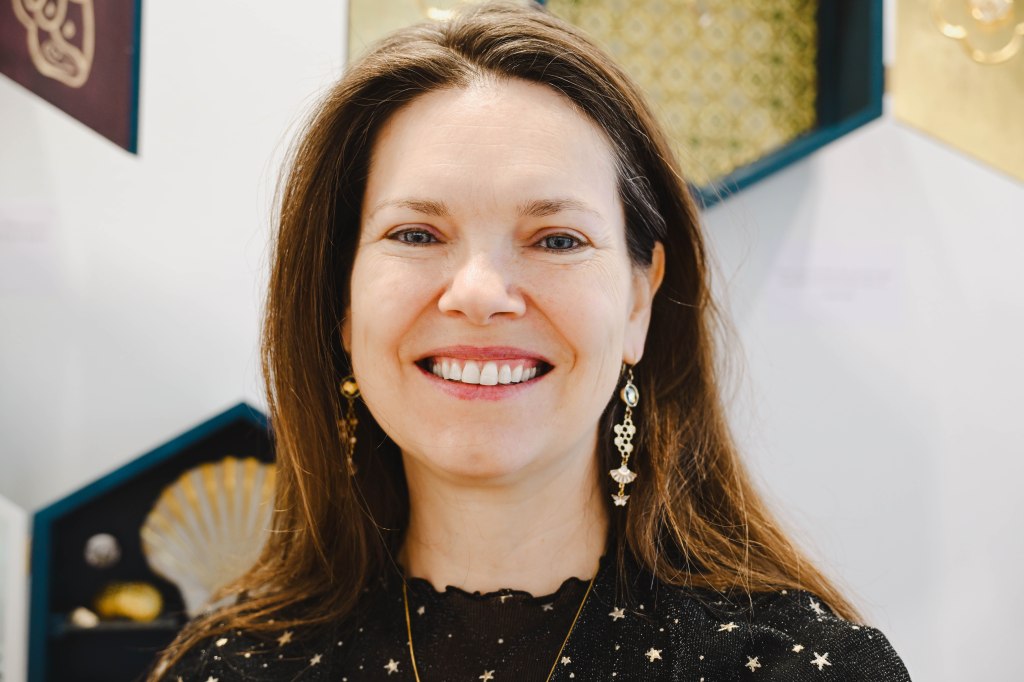
When listening, it is much more pleasant to have someone that talks with some bounce in their voice, some energy. Fortunately, when Bridgette introduced herself, her voice was abundant in this dynamic quality of bounce. We had both come in together at the very beginning of the exhibition in the morning on the opening and she shot a hello at us all on the front desk as I was filling up on the water on the table in this inclemently hot weather.
(Photography by Suneel Mehmi. All rights Reserved.)
I met her very shortly afterwards at her corner in the exhibition and asked her to give me some direction to her work. There were two rows of exquisite open boxes along the wall which had been chased in gold. The boxes were full of sumptuous designs and objects such as sea shells and butterflies. ‘Gilding,’ she declared, or something of the sort. She was a gilder. She was the first one that I had ever met in my entire life.
‘What attracts you to gold?’ I asked her. She told me that gold was full of light. And that the light would last into the darkness of night. The artworks would glimmer with gold, catching whatever light was left. I did not investigate further and forgot to mention that one of my nicknames at home was actually ‘gold’ as well (‘sona’). For her, it transpired, gold was the day and the sunlight. Gold was the guardian of light.
Gilding, it emerged, was something like a magical alchemy. It involved an array of esoteric qualities like squirrel’s hair for the tip and rabbit skin glue. The whole practice of Bridgette’s degree course seemed to revolve around such rare materials – the Mughal inspired paintings that she had in one corner involved the use of a single hair to get at the details of the miniatures. In this gilder, I was confronting something of the spell caster. And perhaps it was magic to catch the sun in gold and the morning in the night with these works.

(Photography by Suneel Mehmi. All rights Reserved.)
Aside from the Indian miniatures, which included a lovely falcon that had been presented amongst the rich and unique hues of (malachite?), Bridgette’s work was influenced heavily by Japanese gilding and by the Baháʼí Faith, which was evident on a closer examination because the boxes were accompanied by quotations from the religion.
The pieces were composed as boxes. Bridgette told me that this was because there was both an exterior and an interior which could be admired, the hidden and the visible, more to see and explore. And, as I thought, as the boxes could be closed, we had the closed and the open, the entrance into and the shut door of art which was still art itself. Was this an exploration of the visibilities and invisibilities of art? Was it a comment upon the content of art?
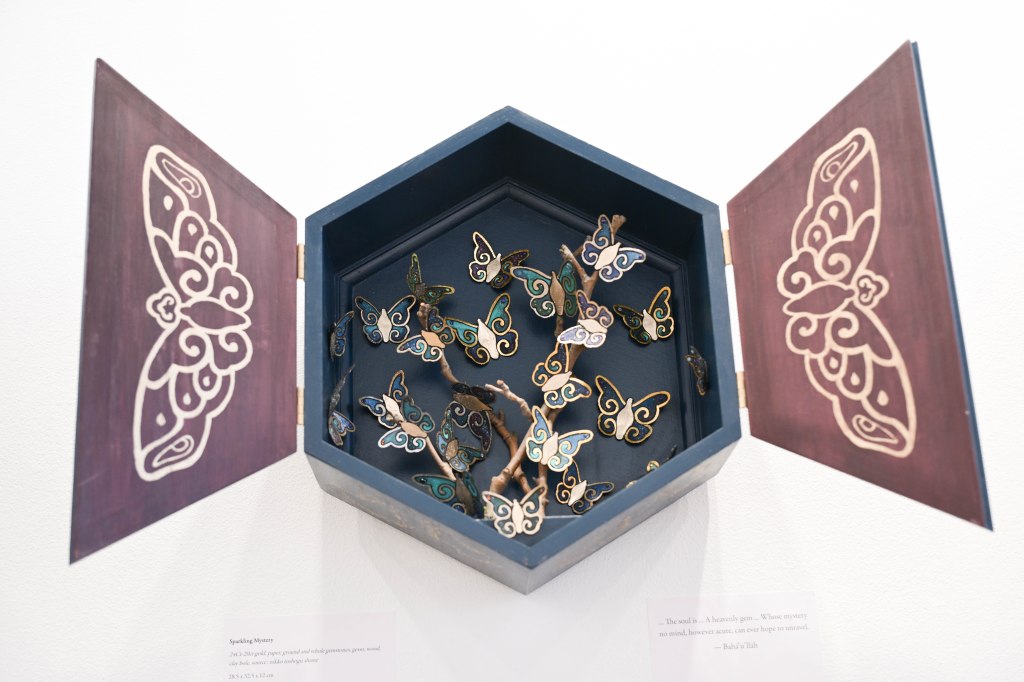
One piece particularly aroused my admiration and attention, which was the butterfly box. The butterflies echoed the box because they had two ‘wings’ and shared a mirror symmetry. The butterflies invoked the idea of the soul since the Greek word ‘psyche’ for the soul also meant butterfly. I wondered what Bridgette made of the soul although I did not ask her. Were these souls flying or landing on the branch in these butterflies? The barrenness and bareness of the branch contrasted strongly with the opulence and the elegance of the butterlies, nature versus the man made. The butterflies themselves lacked senses, eyes and antennae. They were abstract and disembodied forms with the blues of heaven and the spiritual set amongst the gold. They were a symbol of metamorphosis and change, perhaps again referencing alchemy from this gilder, the transformation of base metals and nature into gold. Gold as the ultimate apotheosis, the ultimate aim of the alchemist. Gold as telos, as perfection and completion.
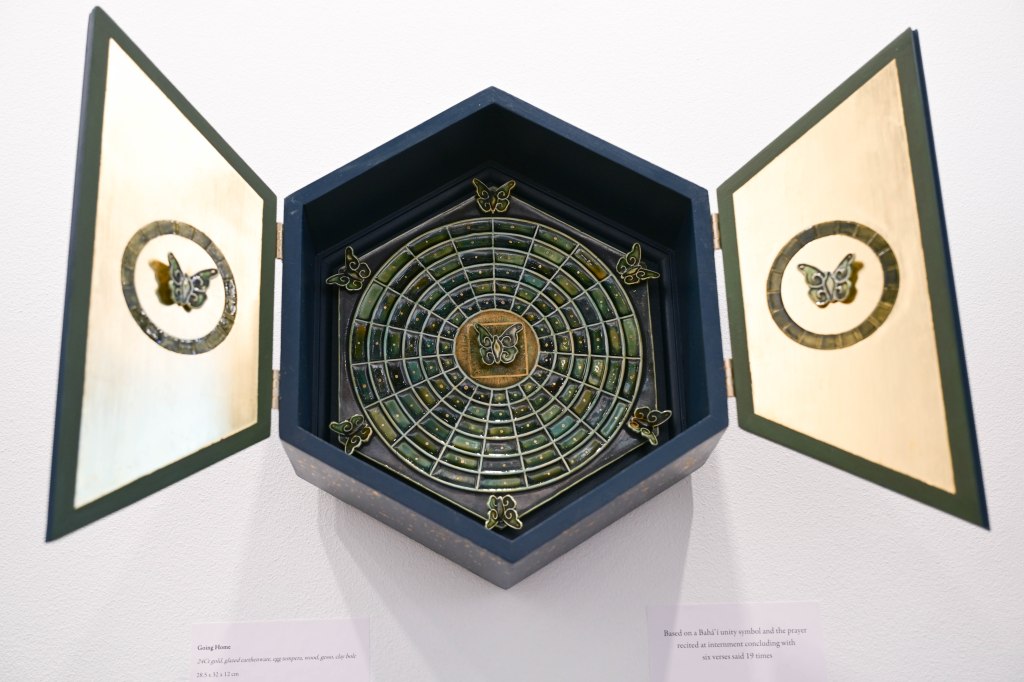
The butterflies re-emerged in ‘Going Home’, which aroused more questions about whether the previous butterflies as souls had been landing or flying, whether they were coming home or flying away from home, whether they were orientated or disorientated. In this, the butterflies seemed to symbolise Bridgette’s own situation. She was an American artist that had been studying in London. Was she going to go back home or was she going to keep on flying through this world here?
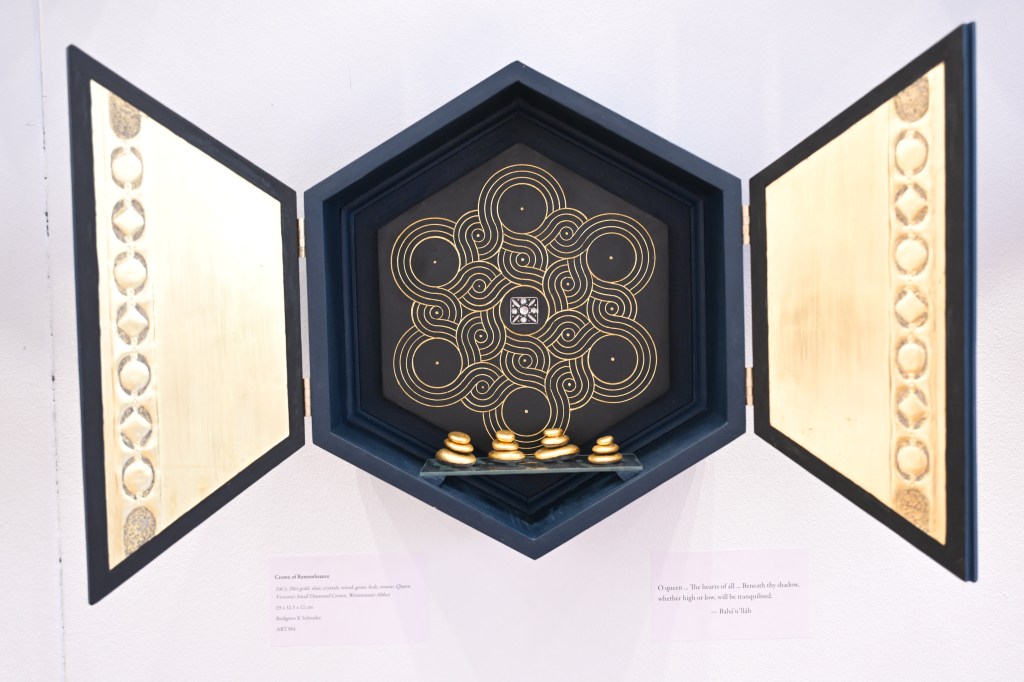
‘Crown of Rememberance’ seems to share the same maze like insinuations in design like ‘Going Home’. If the structure is a maze, it appears that there is no escape. It is a self-contained world, the world of gold and art.
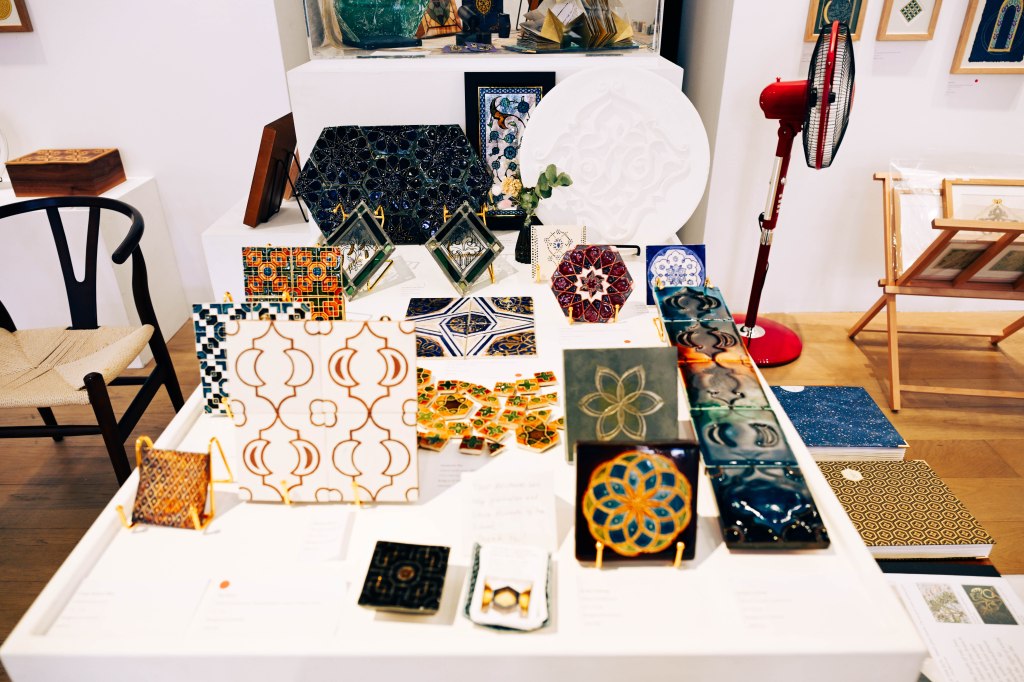
In ceramics, Bridgette dazzled with her colour schemes and her designs. There was many a beautiful piece which I could see in shops such as ‘Liberty’s’ in London.
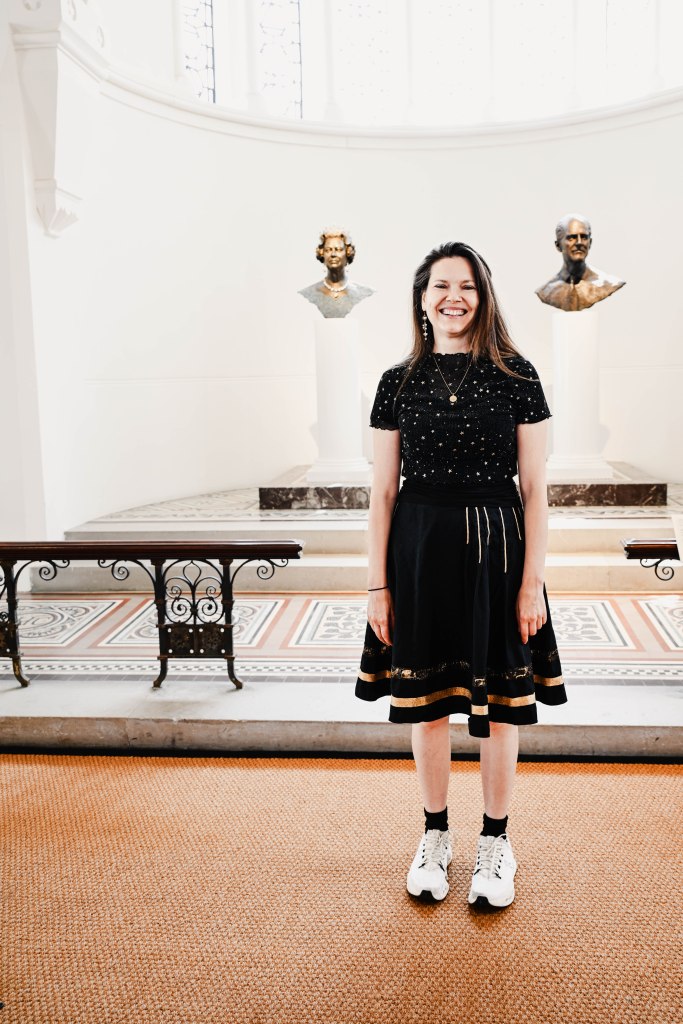
I had another word with Bridgette just before I left. She works extremely hard at her craft and is evidently multi-talented as an artist. She is full of ambition and drive. I was impressed by her and her work and wished that I could do something to open some doors for her. In her outfit full of stars, she was clearly living in the same celestial sphere as the golden butterflies, but also here with us on this grey earth. Such is the reality of the artist that flies in the skies, the reality of the alchemist that deals with the base metals hoping for the magic and the transformation of gold.
Bridgette’s Contacts:
Instagram: colorandgold
Website: colorandgold.com

