The Infinite Colourful Light of the Moving Kaleidoscope – The Spaces In-Between, Tottenham Court Road

The Infinite Colourful Light of the Moving Kaleidoscope – The Spaces In-Between, Tottenham Court Road

08.04.23

FREE ENTRY

Art by Rupert Newman (light artist) and PixelArtworks

It happened unexpectedly. A fine example of serendipity, the right place at the right moment. I had just spent a few hours browsing in Foyle’s and a small independent second-hand bookshop and was just making myself towards Tottenham Court Road. I was musing over the books I had seen and I was thinking to myself that I certainly wasn’t rich enough to have all the books that I wanted to read and to have to keep in my own personal library and to share with my kids. That privilege was reserved for the billionaire or the British Museum.

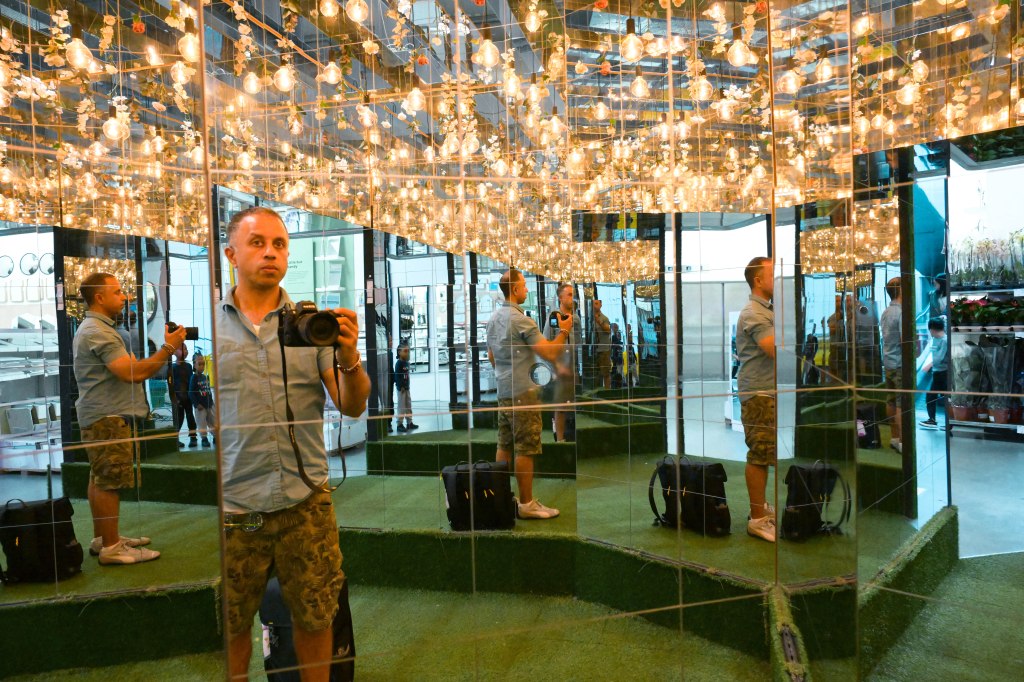
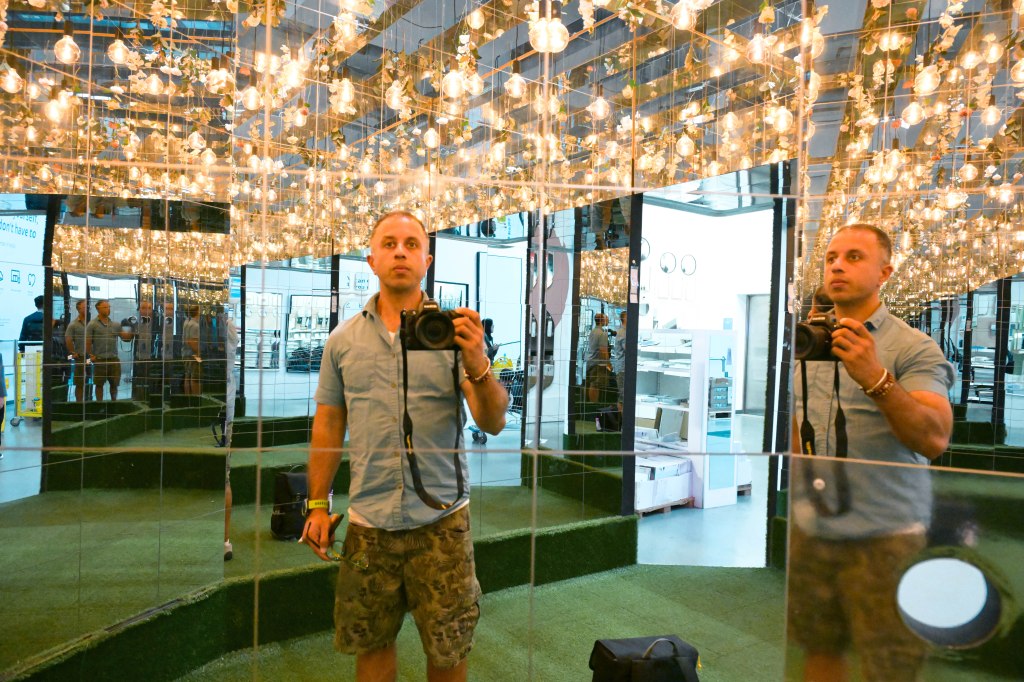
And there it was. The Infinite Colourful Light of the Moving Kaleidoscope… An awe-struck mass of bodies within a space carved out by futuristic light, right next to the station.

The space is described as a ‘digital portal’ and we are meant to ‘discover a prismatic new experience’. The location of the site is important because it is ‘In-Between’ spaces. One of the installations (or ‘spaces’) reacts to your body as you stand before it. The display is in front of you, above, around four walls. It is a type of immersive, interactive art (four dimensional, they sometimes call it). The experience is touted as semi-religious and the installation is described on a panel as a crystalline cathedral of light’.

So this is why I call it ‘The Infinite Colourful Light of the Moving Kaleidoscope ‘. Light, of course, is associated with Christianity, with enlightenment, progress and truth, things that capitalists like to give lip service to when they put us out of work because of computers and technology (it is always right to rail against the so-called technological progress of the capitalists, since this is the weapon of their hubris). I was in a Chapel service recently and they called the Christian God’s kingdom a place of ‘infinite light’. Art is akin to the Christian religion in our age, perhaps its best substitute.  When you go to an art gallery, there is a hush like there is in the chapel. There is a reverent lowering of the eyes before the icons of the age, just as they gaze up at the icons in a religious setting. All the visual display is impregnated with a colossal and sublime meaning, with divine beauty that is not of this earth… For art is considered to be of the spirit for some (not for me, it is still earthly and profane).

As I moved within this computer generated, geometric space, encased in the ingenuity of man and machine, within light, art, animation, music, the energy of the crowd, I was certainly impressed. It was a novel experience. It was a beautiful experience. Yes, it was even a beautiful experience.

Yet where was the meaning behind it all? I read the panels for each of the three different spaces. There were the described themes. Firstly, ‘A Step Beyond’, the immersion in another digital world. Yet how different was it from the contemporary enveloping of the subject in the age of the computer?  Was the artwork just priming us as digital subjects, a repetition of what was happening in our technologically mediated reality? Secondly, ‘Transcendence’. Yes, the art is beautiful. The beautiful forms of nature are rejuvenated in an encounter with geometry. The translation of the subtle mathematics of the world into the mathematical language of geometry. But what does the viewer get from this? A strict regularisation and stylisation of the beauty of what is for what can be imagined is the staple of most art, which is abstract at heart (even within supposed realism). But what is the status of this new abstraction for us now and why are we being placed within it in this space? Is awe for nature to be replaced for the awe of what man and machine in unity can now do, what imagination and computer code can achieve? ‘Tessellations’ was more of the same thing: animated geometric patterns filled with light. A world of code that surrounds us, like the Matrix, changing, transforming, not sending out any obvious message, not allowing any thought but awe…

Perhaps the difficulty is not the lack of the message but the lack of the training we have to try and understand abstract art and the elusiveness of meaning in abstract, geometric art itself. Perhaps I do not understand the proposed religiosity behind the installation. Certainly, geometric art figures in Islam in Mosque designs and calligraphy as an expression of faith. Perhaps there is a feeling of endless harmony and connection with things that the piece is supposed to evoke. I did not get this feeling. I got the beauty. I did not get the sense of the digital sublime which all the spaces were meant to evoke. I did not feel engulfed, threatened (perhaps the wonders of the technology are supposed to threaten to usurp man). I lack fear – Punjabi men are afraid of nothing and no-one. Especially not code or geometry filled with light. For me, the exhibit was a good waste of time just before I got onto the Tube, but not an inspirational experience or one which provoked much thought, except for the vague idea that I could get together a venue for something like it and make a bit of money off it… To be really honest, it was like being in a screensaver.

Dora Batty Poster Parade – London Transport Museum

Dora Batty Poster Parade – London Transport Museum

07.04.2023

You can see all of the posters in the Poster Parade here:

https://www.ltmuseum.co.uk/collections/the-collection

1st Floor, London Transport Museum

Adult ticket: 24 pounds, Concessions including students: 23 pounds (ANNUAL PASS)

REVIEW

While I have many interests in life, there is one game that has always captivated my attention. My friends, it is THE Game. The game of interpretation: finding meaning, making connections, excavating the context, trying to understand what others are trying to express underneath a rigmarole of deceptive diversions. I have played this game quite seriously, having studied for an English Literature degree and then having pursued doctoral studies in the subject (then publishing books and articles). The game is all-consuming and unending. I lie in bed at nights replaying conversations, working over sentences for half an hour at a time if they are important enough to warrant it in the conversations I have during the day. To play the game, I have studied all these subjects at university level: legal studies, English literature, history, psychoanalysis, philosophy, anthropology, criminology, sociology, psychology, the history of photography, feminism, Marxism, deconstruction, Postcolonialism – and now – art history. Besides forays in my spare time into mythology, archaeology, cryptography and the decoding of languages, language learning, politics, animal intelligence, evolutionary psychology, biology, and the physical sciences which reveal how humankind attempts to fathom the cosmos.

Why do I mention The Game? I survey the posters in the London Transport Museum Poster Parade because I love to play it. And above all, the most enticing thing is a mystery, a puzzle, a seeming dead-end, what first comes as a blank wall. As I have admitted so much, it will now do to admit more. It was a genuinely exciting moment to encounter an unknown female artist who has not received much critical attention and about whom I could make a big contribution towards understanding. The subject was the enigmatic Dora Batty…

Little is known about Dora’s life. She is known only for her professional roles and her output. Like other women artists, she has been neglected, never achieved the fame of her male compatriots… As a result, one cannot bring biography to a study of her artwork. Neither can one be misled by what others have written, which seems to be a particularly abhorrent current practice of the scholar, the interpretor and the guide. One imagines a woman that never made much of an impression. One cannot even visualise her appearance because a photograph has not even been recovered. For a moment, I had a fantasy of tracing her family genealogy so that I could try and contact any living descendants that might have a diary, a photograph, written records or objects of some description so that I could have something else than the art. In the game, it is permitted to cheat… What a delicious daydream: an expedition, an adventure, new people to meet, new avenues to pursue, a quest of interpretation…

But I am left to just looking at the work and thinking. Justice demands a scrutiny of the woman artist’s works, a redressing of her dismissal by (White) Man. Let us begin.

The first exhibit that meets us in the Poster Parade is ‘The Underground brings all things nearer’. We are in the conventional grounds of Greek Myth. As it clearly states, the poster celebrates ‘The Return of Persephone’. She is being rescued from the underground by Hermes. Dora loves to tease. The obvious play is upon the concept of the ‘underground’. While it signifies Hades and hell, it is also obviously referencing the Tube. For a poster commissioned by London Transport, this is clearly a subtle bite at the hand that feeds her, the delicious tease of a mocking and ego-defeating woman. From the Underground, hell and the tube, Persephone is emerging. The concept of the poster is that from the Underground, which we imagine as the realm of the dead, life and fertility is emerging in the form of Persephone. But there is a moment of feminism in that period of emerging women’s rights and the Suffragette movement – Persephone (woman oppressed, captured, imprisoned) is rescued from her controlling husband (the LAW, Death, Sovereignty, POWER…) Now, there is the question. What is the biographical aspect, what is the women’s movement? The Suffragettes were around at this time and they were fighting against the patriarchal laws of marriage, with its enclosure of the woman in the domestic realm. But is there something else in Dora’s life? Bearing the hallmarks of its time, Persephone is rescued by Hermes, a man… There isn’t total emancipation of the woman. Is there a new man in Dora’s life at this time, an extra-marital affair…? However, one also remembers that Hermes is the protector of travellers, the god of roads… He is dressed as a traveller, of course, with winged sandals. There are subtle resonances for the highly educated and the classicists in this poster about travel. Dora is clearly classically educated… The game, my friends. One has to learn the mythology of the world to play it…

The tragedy with the poster is that Persephone still had to spend months of the year in the Underworld – there is no ultimate freedom from MAN AS KING AND DEATH… Ambiguity and despair is always there in the background. Is this a realistic assessment of women’s politics at the time (and still now?) Or is it the acceptance that Dora cannot release herself from her marriage (was she married, or is the poster simply about a fantasy of emancipation)?

Now, let us talk about the flowers. Flowers flood the posters. Persephone is also holding a flower. Is the flower sex (the flower is a sexual organ which is ‘penetrated’)? Are we witnessing sexual liberation in Dora’s psyche? The implicit love triangle in the first poster – Hermes, Persephone, Hades. Travel itself as sex (a holiday romance, perhaps?). The fantasy of sex rather than its achievement from a repressed woman? Dear Dora, why do you not write what is the case? If the hypothesis that the flowers are sex is right, can it be confirmed by some of the other posters? [It is worthwhile to mention here that there are other suggestions. Not only have female artists painted flowers throughout art history, as a ‘woman’s genre’, but also that women themselves have been described as flowers throughout history and particularly guilty were the Victorians and those around at the start of the twentieth century – flower as woman herself in this art, or rather her sexual body and her body as a body of desire…)

In ‘Bluebells are out’, an anonymous female caresses the flowers lovingly. Her lips are upon them, her hand clenches them. Her senses are engaged. She smells them. So we have touch, the sexuality of a kiss, intoxication with the scent. Full sensory engagement. She also looks directly into the flowers. Is this look at the flower and sex what the viewer is expected to understand and echo? Woman playing with her own sex and sexuality? Is this the revealing mirror of subjectivity at the heart of the image? Let us be Freudian and make an insinuation about how the hand is holding the phallic bunch of stalks of flowers at the bottom of the image…

In ‘Crocuses are out’, woman swoons over the flowers which she caresses again with her hands. With her eyes shut in ecstasy and Lacanian jouissance… The flower she smells is pinkish red – the colour of sex…

So, perhaps we have an exhibition of a woman artist that is pursuing liberation, including sexual liberation. Perhaps we are seeing a woman fighting against the Law and the figure of the King for a new tomorrow and for ownership over her own body and desires… Perhaps we see Dora the fighter. But a jaded fighter. After all, what is the fight of the artist? It is true that many of the Suffragettes were artists, a disproportionate amount. Was the main fight in the visual arts and against the visual culture of the Law and the King, Oppressor Man?

Let us leave identity politics for a moment. Let us talk about Dora as she is in my favourite works of hers. I will write first about the interesting pattern in ‘Whitsuntide by Underground’. The artist has woven together many moments of leisure into almost a textile pattern (she worked in textiles). The composition is crowded and flooded with energy. People are joined in small communities by their pursuits, families, friends, athletes. They are also integrated in nature and the countryside through trees, fields and water, animals. There is a harmony of leisure and nature, life and the world, an inter-connected and unbreakable pattern. And let us not forget the female body’s interaction with the flowers in the early posters – nature is a body that unites with woman’s body. Woman is nature, humankind is nature – the celebration of the animal self that we have come from that lived in trees…

Similarly, ‘There is still the country’ shows the woman’s body wedded to the (phallic, it must be said) tree. The whole scene is blown about from a strong wind and enriched with the sun which seems to emanate from the woman’s head, her creative force and mind. There is pure energy, enlightenment (emancipation)… The leaves fall from the trees – there is transformation, the relentless but cyclical turning of the time as in Hindu thought… What is dead and dying is to be shed to make space for what is living….

So is this Dora? Or is this merely Suneel’s Dora? One makes an argument. One seeks to persuade. But more than that, one seeks to know. In the absence of clues, one looks to a Suffragette context. In the absence of a photograph, one tries to plumb a mind. The Dora exhibit is interesting and important because it brings these thoughts to mind. It asks why a woman of such talent has no place in thought. It seeks to rectify this wrong. Dora’s art is stylistically very Art Deco. I do not know if she followed the movement, or how much she contributed. I do not know how important she is in the history of Women’s Rights for making art that explores women’s issues and attempts to rescue them from the ills of sexual repression (if sex is the theme that I have not invented for our Dora). And finally, one makes an admission. The interest, the thread that I have followed is that Dora is Modern Woman. Someone that I do not understand – if anyone does. To understand the mind of this challenging and reticent creature, one often has to gaze at the expressions that she leaves about her in the world. And to form an opinion, one has to dare a conjecture, even as a man – which might wholly be wrong and is entirely contestable, of course…

You can see all of the posters in the Poster Parade here:

https://www.ltmuseum.co.uk/collections/the-collection

List of Posters:

  1. Dora Batty, 1923 – The Underground brings all things nearer
  2. Dora Batty, 1925 – From country to the heart of town
  3. Dora Batty, 1924 – Foxgloves, Kew Gardens
  4. Dora Batty, 1925 – From town to open country
  5. Dora Batty, 1921 – Travel with the children
  6. Dora Batty, 1930 – Season ticket, travel cheaply, save money
  7. Dora Batty, 1927 – Bluebells are out
  8. Dora Batty, 1927 – Blackberry time
  9. Dora Batty, 1935 – Special shows of tulips
  10. Dora Batty, 1927 – Crocuses are out
  11. Dora Batty, 1927 – Daffodils are blooming
  12. Dora Batty, 1932 – Regents Park to see the rose garden
  13. Dora Batty, 1928 – Buy a season ticket
  14. Dora Batty, 1924 – Survivals of the past, Painted Hall
  15. Dora Batty, 1932 – RAF display, Colindale station
  16. Dora Batty, 1936 – Trooping the colour
  17. Dora Batty, 1924 – Survivals of the past, Yeoman Warders
  18. Dora Batty, 1934 – Easter
  19. Dora Batty, 1938 – Out and about by London Transport
  20. Dora Batty, 1926 – Make yours a General holiday
  21. Dora Batty, 1931 – Whitsuntide by Underground
  22. Dora Batty, 1926 – Hampton Court by tram
  23. Dora Batty, 1926 – There is still the country

Hallyu the Korean Wave Review – Victoria & Albert Museum Exhibition

Hallyu the Korean Wave Review – Victoria & Albert Museum Exhibition

01.04.2023

https://www.vam.ac.uk/exhibitions/hallyu-the-korean-wave

At home, they sit in a neglected and increasingly dusty pile – with my other language learning books picked up mainly from charity shops – or the internet when the owners lost their interest in learning them (14 languages in total and building). Untouched, they are marked out for future study when my life is not just about work and academia, carefully compiled: a set of Korean language books. I picked them up in a free hotel book sharing point in a country where they have many Korean workers (it is not Korea, my friends).

Although I never got onto the Korea loving bandwagon with ‘Gangham Style’ or ‘Squid Games’, and I didn’t watch the film that won the Oscars (‘Parasite’), I have taught several Korean people when I used to volunteer to teach English to refugees and migrants over five years. I watch some K-Pop, although it is just one band called (G)-IDLE as I like watching the young women dance and perform and I enjoy the cinematography of the music videos. So it was with this light acquaintance in need of improvement and because I wanted to see the Friday Late at the V & A that I meandered my way at the end of the night into the ‘Hallyu the Korean Wave’ exhibit.

The exhibit is exciting, eclectic and vibrant and speaks to the young. Inundated with interest, the walls showcase Korean film, music, beauty and fashion. All of the senses are awakened and rejuvenated by an immersion into a colourful Korean cultural life.

When you go in, you are confronted with several screens showing ‘Gangham Style’ and its parodies. Of course, this song is synonymous with K-Pop and is probably one of the only contemporary songs that everyone in cities around the world probably knows. We get to see the audacious pink suit that Psy wore for the music video. But the surprising thing to learn is that the song and the suit mock South Korea’s ‘hyper-consumerism and material pursuit’, using the district of Gangham as an example. The suit is a sneer at what the elites wear in that area and the iconic dance moves are snipes at posers and wannabes that emulate that kind of lifestyle.

If Korean culture is currently chic, then the next section of the exhibit makes us reflect on the historical miracle of how a colonised, war-torn country which was ravaged by the Cold War and also ‘one of the most violent conflicts in modern history’ in the Korean War of 1950 has followed a ‘remarkable trajectory’ to become a ‘leading cultural powerhouse by the early 2000s’. The formula seems to be ‘governmental control, daring strategies and IT innovation’, alongside quick hands and quick minds.

I will write about the parts that excited me the most in what followed on the journey through the massive space that the exhibition enfolded. A long term fan of athletics and gymnastics, I was entranced by the Volunteer guide uniform for the 1988 Seoul Olympic Games. The clothing draws inspiration from the national costume which is called hanbok. The outfit is beautiful, graceful, an accomplishment of functional style inter-weaved with the Olympic spirit and colours. It is the perfect metaphor of endurance, of a people that have kept their traditions while becoming truly international, even though enmity and colonisation attempted to destroy their way of life. Here, as elsewhere in the exhibition, I was reminded of the affinities of Korea’s history with India’s. In fact, there was even a Hindi film poster which showed a pirated (‘adapted’) Korean film, which influenced my finding of affinities with my motherland even more.

It was also a surreal experience to see the wig worn by Choi Min-sik in ‘Oldboy’. This is probably the most memorable Korean film I have watched. When I was immersed in this filmic universe, I just assumed that the wig was the actor’s real hair. In the exhibit, removed from the face, the wig was patently, even insolently artificial. Yet it still teemed with an energy, almost like that of life. The make up and hair director of the film, Song Jong-hee intended to infuse the wig with wildness to convey the ‘feral emotions’ and the effect of the years of incarceration on the protagonist of the film. To me, raised in Hinduism and Sikhism, where hair is sacred and the god Shiva is known for the strength of his hair, the hairstyle raised the resonance of India, religion, power, feelings hard to express or even describe.

A particularly interesting section of the exhibition was the exploration of beauty standards in Korean culture, since the nation is a ‘global trendsetter’ in this area. The historical background until the 1910s (perhaps longer?) is seven hundred years of maintaining beauty as a ‘moral obligation’ as attractiveness symbolises not only social status, but also virtue.

Where did I spend the most time in the exhibition? I sat before a big screen watching a compilation of snippets from K-Pop videos, admiring the crystal sharpness of today’s video cameras, the lightning flashes of Korean dance moves and the stunning physical beauty of the people. It was intoxicating. Yet, as I watched, the critical part of my mind kept on turning over the question of whether what I was watching was something authentic and organic, something different, or just indoctrination and influence from the Western world, a parroting of the Western music video. I am still not sure.

Surely, ‘Hallyu the Korean Wave’ is one of the most memorable exhibitions that I have been to. I was also pleased to see that the exhibition seems to have been put together from Korean descent people, which seems to give it the authenticity that is lacking from Orientalising Western depictions of Asian people such as Indians. I learned a general history of modern Korea, was amused, inspired to learn more, ever more determined to one day make a serious foray into the language. I felt the unity of Asian culture as a man of Indian descent, almost a sense of belonging. Out of the three exhibitions I went to in the V & A that day, the exhibition was my personal favourite. I never felt even  a moment of boredom in it and my attention was focused entirely on the exhibits.

https://www.vam.ac.uk/exhibitions/hallyu-the-korean-wave

The Refugee Boat – Some Thoughts on an Alternative History of Transport

The Refugee Boat – Some Thoughts on an Alternative History of Transport

10.03.2022

If you go to a transport museum, the likelihood is that you will see ultra-expensive vehicles which were at the cutting edge of technology. These cars, buses, trains and trams would have had all the modern conveniences and would have been fairly safe, even if safety standards in the past were laxer. In terms of production, an entire army of workers would have been involved in the construction, probably an ‘international’ team (by which I mean white Europeans).

The history you would find in such museums would be progressive, a story of increasing rationality, efficiency, cost-effectiveness, capitalism, big business. A story the rich tell themselves to celebrate the world that they have created: the globalised, interlinked world of transport convenience. Where, theoretically, there are no physical barriers to community, commuting, connection.

Standing out in stark contrast to this ‘Whig’ version of history is the humble refugee boat.

The refugee boat is fairly inexpensive. It is the mode of transport of the poor, the desperately oppressed seeking a better life in the only way that they can given their losses in the lottery of life and birth. The refugee boat, while not the worst piece of technology ever invented, is still pretty primitive. The standard image is the unpretentious dinghy, clearly unfit for the purpose of a long journey by the sea in dangerous waters. Travel by sea is itself one of the longest, most inconvenient, inefficient and deadly forms of travel, where you are seemingly at the utmost mercy of nature. There are no modern conveniences. Hardly any water to drink, hardly any room for food. No toilet. There is no safety. There is probably more than a 50:50 chance of death. What about the production? The workers that made these products were probably exploited in sweatshops in economically less dominant countries around the globe.

The history of the refugee boat is the unadulterated, unpolished history of transport in our times. History is not always written by the victors. It is also written by the losers. The refugee boat is the testament to the fact that our modes of travel are not objectively the best. They are merely fit for the types of people and the societies that use them. The transport history in museums is the product of capitalism and the reign of the rich. The transport history of the undocumented migrants is the product of those that power has missed out, those that capitalism has downtrodden.

The unvarnished history of the refugee boat – which the media presents as a horrible throwback to primitive times, a history which is now culminating in government interception of such travellers and their lives being thrown away like trash somewhere else, as someone else’s problem – is the real history of travel beyond propaganda, advertisement, embellishment, cultural narcissism. This is the real story of the world that the ultra-rich have created: a world where you can’t even travel from one country to another to try and better your life. A world in which you are tied to the place you were born and the lack of opportunities there. Why can’t anyone tell this history?

‘Green Travel’, London Transport Museum: Poster Parade Review

‘Green Travel’, London Transport Museum: Poster Parade Review

(Poster Parade lasts for approx. 3 months before it is changed)

1st Floor, London Transport Museum, Covent Garden

Entry to the London Transport Museum: £21 for an annual pass (£20 students and concessions)

08.02.2023

All the posters listed at the bottom in the Poster Parade can be searched for and viewed here:

https://www.ltmuseum.co.uk/collections

I don’t think it is any exaggeration to say that the most important and constant preoccupation of our times is the environment and how we can save the world from the damage that we have done to it. Following the recent, successful, ‘Green Journeys’ exhibition in the Transportorium of the London Transport Museum (LTM), the site is now hosting a ‘Green Travel’ Poster Parade on the first floor. The Museum’s consistent championing of the environmentalist cause has genuinely inspired many youngsters and I remember a visitor telling me how much her daughter missed the ‘Green Journeys’ exhibition when it was gone. She said it had been her daughter’s favourite space in the whole museum because of its educative power.

            Public transport has been hailed as one of the solutions that can help to minimise environmental damage to the planet through the economical use of energy and resources. As the title and introduction of the exhibition suggests, there has been much investment in the tube to ‘make London cleaner and greener’. As Londoners know, there has been a historical practice of encouraging commuters to use their cars less, the advertisement of journeys to clean, green spaces of countryside outside of London, as well as a promotion of walking and cycling so as to ease congestion and keep the air breathable. While many of the strategies have borne fruit, such as in the reduction of coal burning and industrial pollution, the public transport infrastructure still has problems to face in reducing pollution and creating a zone with clean air. The saving of the world is still very much a work in process.

            The historical range of the images in the Poster Parade is from the early twentieth century in the 1910s to the twenty-first century and the 2010s. The styles and subject matter range from realistic landscapes, to illustrations of space and the planets, edited photographs, games of text and image, visual animalistic metaphors of transport as taxis are literalised as snails, and the conversion of the London landscape into bicycle parts. Quirkiness, comedy, creativity – even horror as the effects of smoke pollution are made evident in the imagined future of a child’s photographed face – all these collide together in the exhibition, whose one sure strength is variety.

            The quirkiest image is probably the one of the taxis as snails by Nick Hardcastle, ‘Or take the Tube’. The black cabs of London are famous throughout the world, as is ‘the Knowledge’ that their cab drivers boast after years of learning, but these instantly recognisable facts are given a surprising visual metamorphosis. The familiar is manufactured into the unfamiliar, even the Freudian uncanny. The snail shells add to this impression as Freud called the uncanny the ‘unhomely’ and the shells are their homes. Faintly sickening, the snail taxis glisten with a disgusting mucus which symbolises the dirtiness left by the motor car as its imprint on the world and its journey. The clustered ranks of molluscs, an identical parade, suggest a dreary and unthinking conformism.

            I have two favourite images. The first is ‘Good for you green for London’ (2010) by Rachel Lillie. This is the winning illustration in ‘The best of contemporary illustrators’. The illustration depicts London’s journeys through the experience of the cyclists and the message is the promotion of ‘the benefits of cycling for our health and the environment’. The display notice adds that ‘TFL cycling initiatives such as free and tailored cycle skills sessions are teaching safer ways of navigating the city’. The space is imagined as a leaf unfurling through time, with its veins as pathways to famous London landmarks. I liked the image for two reasons. First of all, this seems to be the only illustration by a woman in the collection, if one assumes that the other illustrations and posters are all by men (they may not be, many of them were presented with ‘Artist Unknown’, which was a slightly frustrating experience). Diversity is still a real challenge in illustration, as I know from my own experience as a digital artist, and it is good to support those of us who are examples of diversity and have got a little recognition. Secondly, like the artist, as she says on her website, I am also interested in the depiction and conceptualisation of space, especially London. An interesting connection is drawn in the illustration between the red bus and the cyclists who are shaped in a blood red. The cyclist moves in the same ethical space as the public transport vehicle, as a being that creates a cleaner and greener city. The famous London landmarks are shrouded in the night as black outlines while the cyclists are illuminated by a light that blesses the good. Perhaps the suggestion is that the conventional vision of the city has to change and the things that were once considered important have to yield to the renewed experience of stewardship we face in the age of environmental calamity.

            My second favourite poster is ‘Carfree Carefree’ by Abram Games (1967) which is given a renewed life in this contemporary exhibition in this contemporary world. The poster and the title are the same, white letters shaped like a bus against a background of purple, red and orange tiles. Typography is one of my own preoccupations as a digital artist and letters shaped like images act upon my senses with an unrivalled seductive power. The letter bus in the poster hurtles past a small car in the background. The demonstration is of the strength of the bus in relation to the individualised, little car: public transport versus the individual, social and public civic responsibility in the age of environmentalism versus the selfish fixation with the material possession of the car and its solitary amusements. As with the other posters, the interest is in how a public transport corporation converts its competition with private forms of transport into an ethical mission to save the entire planet and the people and life within it. Financial competition does not always have to be selfish after all, it can be of the people and for the people, against the luxury and convenience of the individuals that won’t participate in the group.

            The two messages that hit hardest were ‘One full bus equals forty empty cars’ and ‘Each year we cover nearly 1 billion miles in the car on journeys of less than a mile’ (1998). It is always facts that can hit hardest. These facts also contextualise the aim of London transport to get people fitter and get out there walking and cycling. Of course, some have mobility issues, but for the majority of people, it is laziness and the convenience and instant gratification culture that is choking the planet.

            My overall impression of the Poster Parade is that it is successful artistically and in terms of its content and importance. And in terms of inspiration for change. The historical sweep is illuminating because it reminds us that people in London have always cared about its clean air and to eliminate the pernicious effects of pollution. Yes, we are facing an environmental disaster. But the good have always fought against this with technology and with the right morals. There is hope and no need for despair. They, the good, will always fight for a better world. Yet, there is no ‘triumphialism’. The Poster Parade acknowledges that there is still much to do and much to fight for. That elusive dream of ‘Green Travel’ is still a work for the making, even though it is the most alluring and important dream of our times.

List of Posters in the Exhibition (all searchable at: https://www.ltmuseum.co.uk/collections)

  1. Anonymous, ‘Golder’s Green’ (1911)
  2. Maxwell Ashby Armfield, ‘By Underground to fresh air’ (1915)
  3. Gwynedd M Hudson, ‘Spring Beckons You’ (1929)
  4. Alfred Leete, ‘Nightwatchmen’ (1928)
  5. Anonymous, ‘Clear the Air’ (1938)
  6. Charles Sharland, ‘Light, Power and Speed’ (1910)
  7. Anonymous, ‘London’s Tramways’ (1929)
  8. F Gregory Brown, ‘By Trolleybus to Kingston’ (1933)
  9. Abram Games, ‘Carfree Carefree’ (1967)
  10. Nick Hardcastle, ‘Or take the Tube’ (1987)
  11. Austin Cooper, ‘Bicyclism – the art of wheeling’ (1928)
  12. Transport for London, ‘London – made for cycling’ (2007)
  13. Anonymous, ‘Get ready for Prudential Ride London’ (2015)
  14. Rachel Lillie, ‘Good for you green for London’ (2010)
  15. Easy Tiger Creative, ‘Cycling for Pleasure’ (2016)
  16. Anonymous, ‘Don’t Choke London’ (2001)
  17. Anonymous, ‘London Car Free Day’ (2002)
  18. London Transport, ‘One full bus equals forty empty cars’ (1998)
  19. London Transport, ‘1 billion miles in the car’ (1998)
  20. Anonymous, ‘Cleaner Air for Greater London’ (2007)
  21. Anonymous, ‘Hydrogen powers rockets’ (2014)

Winter Wonderland Poster Parade. London Transport Museum.

Winter Wonderland Poster Parade.

London Transport Museum, 1st floor.

Entry: 21 pounds for an adult yearly entry. 20 pound student yearly entry.

05.12.2022

You can see all the posters here via a search of terms for your own virtual exhibition (Full Searchable Exhibition Catalogue given at the end of this short outline of my impressions as a viewer):

https://www.ltmuseum.co.uk/collections/the-collection?f%5B0%5D=collection_type%3APosters

If I cast about in my mind for my most immediately accessible winter memories, there are images of Christmas and snowballs (with flashes of pain in some cases), hot chocolate in an ice skating park, women in smart, expensive coats on the London streets, lavish adverts on television, frenzied shopping during New Year’s sales, and an annoying range of mediocre songs that are played, unaccountably, every single year.

Many, if not all, of these topics are to be found in the Winter Wonderland Poster Parade on the first floor of the London Transport Museum. Certainly, shopping plays a major role in the collection, including a depiction of the Winter sales. For both critics of capitalism and its supporters, there is something for everyone – anonymous subjects wandering around in a state of anomie in between the stores, a cornucopia of street signs arranged artistically to show a virtual map of the sales in London, depictions of women consumers done in a futuristic style (make of that what you will).

The introduction to the poster parade proclaims that there is a focus on ice skating, country walks, shopping and the exploration of historic landmarks during the winter months. The parade emphasises the practical purpose of the posters which encouraged passengers to take off-peak journeys or appealed to our comfort-loving nature by persuading us that it was warmer to travel by public transport in London.

I have fond memories of ice skating, including watching my female companion surreptitiously distancing herself from me and laughing maniacally as I desperately clutched and groped at an innocent female bystander so I didn’t fall down on my first try. So I particularly enjoyed looking at the portrayals of ice skating. The poster that stood out most to me was ‘Ice Skating’ by Charles Pears, printed in 1928. It shows a beautiful woman engaged in a graceful movement across the ice, her face obscured in shadow, her scarf elegantly billowing against the pure snow behind her. She is entranced in the flow of the figure, lost in her skill to the world and its impurities… Such is the beauty of this season and of ice skating itself, one of the most beautiful of pastimes.

The other poster that I quite liked was ‘Winter’s Discontent Made Glorious’.  Against an ominous, sublime, inhumane cloudscape, we see a train in which the windows are filled with scenes from dining, shopping and the theatre, spaces crowded with fashionable people. On one level, the poster reminds us that some of our liveliest and happiest scenes have been in winter. On the other hand, the fact that the train and its illuminated scenes are to plunge into the dark abyss of a tunnel which would extinguish all light seems to refer to the depression that can come upon us in sun-starved winter. It is a conceptually balanced design.

My overall impression of the poster parade is that it contains striking works of art and a good range of different artistic styles. I was interested in how optimistic the collection is about winter. We all know that winter can bring on sadness, and the posters all try to counter this impulse with a positive, upbeat message of hope and happiness. The posters have also inspired me to take a few winter walks, when traditionally, I have avoided long walks out in the cold in the countryside. The posters are intriguing as they show us the emotional appeal of Christmas and winter shopping in the recent past, how they act as a psychological booster during what can be very trying months and also because of the beauty and complexity of the designs and messages that they convey. As such, the poster parade really is what it says it is: a winter wonderland to which all of our senses and feelings are invited.

Exhibition Catalogue

  1. Winter’s Discontent Made Glorious – Anonymous, 1909
  2. Brightest London is Best Reached by Underground – Horace Taylor, 1924
  3. Winter Cavalcade – Margaret Barnard, 1938
  4. Empress Hall – Earls Court – Walter Goetz, 1937
  5. Winter in the Country – Harry Stevens, 1965
  6. Winter Sales – Quickly Reached – Compton Bennett, 1926
  7. Winter Fun – Skating – Anna Hymas, 2016
  8. Winter Sales – Edward McKnight Kauffer, 1924
  9. It is Warmer Below – Frederick Charles Herrick, 1927
  10. Winter Country Walks – Hans Unger, 1958
  11. Hampton Court – Hanna Well, 1963
  12. Ice Skating – Charles Pears, 1928
  13. Winter Walks – Laura Knight, 1957
  14. Keep Warm – travel Underground – Kathleen Stenning, 1925
  15. Out and about in Winter – Molly Moss, 1950
  16. Shop in Town – Leith, 1928
  17. Winter Sales – Artist Unknown, 1920
  18. Winter in London – John Burningham, 1965
  19. Winter – Paul Catherall, 2006
  20. Winter Visitors – Clifford Ellis and Rosemary Ellis, 1937
  21. Brighter London for Winter Sales – Harold Sandys Williamson, 1924

Tom Eckersley Poster Parade

Tom Eckersley Poster Parade

09.11.2022

London Transport Museum, Covent Garden

Price – 21 pounds annual pass regular ticket for the museum (20 for students)

REPRODUCTIONS AVAILABLE AT THE MUSEUM’S ONLINE SHOP.

ALL ECKERSLEY WORKS ACCESSIBLE ONLINE AT:

https://www.ltmuseum.co.uk/collections/the-collection?f%5B0%5D=collection_type%3APosters

Although many Londoners don’t realise it, Transport for London has one of the biggest collections of specially commissioned artworks in the entire world. At the London Transport Museum, the thousands of posters in the archive are narrowed down to a select few for the Poster Parade which can be found on the first floor of the museum, behind some of the historic vehicles. It is one of my post Art History Open University degree ambitions to write a monograph on the collection of posters which bear illustrations and advertisements concerned with the world wars, destinations inside and outside of London, architecture and seasonal greetings which nestle amongst safety warnings and ticketing offers.

Most alluringly, the current exhibition boasts the work of Tom Eckersley, a twentieth century poster designer. The introduction to the exhibition summarises his signature style: “bold, bright colours and flat graphic shapes”. Personally, I think Eckersely owes much to Matisse the master, including the use of cut out colours in collages, the simplification and stylisation of figures and the obsession with the brightest hues.

Eckersely worked through the 1930s to the 1990s and managed to design over eighty posters for London Transport. At first, he worked in collaboration with the artist Eric Lombers. The exhibition describes him as ‘transforming commercial art’.

When Eckerseley was working in the 1930s, ‘posters were a hugely effective form of publicity’ the exhibition relates, although the challenge was to compress information so that it could incite further curiosity and relay compressed information in milliseconds: ‘a strong message with a simple design’. To quote the exhibition again, to achieve these ends, Eckerseley employed ‘minimal text’, conveyed messages ‘through pared-down graphic elements and bold blocks of colour’. My personal view, however, is that the posters play quite complicated visual games. I don’t see them as a visual reduction of information. They take quite a bit of decoding to understand the message shown and to understand the flight of imagination that Eckersely took to create the design.

Overall impressions of the Poster Parade? The artworks are visually stunning, richly coloured and immensely memorable. Eckersely really is a master of the poster genre. It is a delight to see the things. However, the short exhibition suffers from repetition, where nearly identical posters are displayed, and there is a certain fragmentariness where a fish poster is shown with the other half (another poster) missing. Having said that, the final word must be that the posters are beautiful, historically significant and therefore interesting because they deal with issues raised by the World War and show how heritage in London has been promoted before.

Finally, from my perspective as a digital artist that often uses flat, bold colours in my compositions, the exhibition is successful in that it shows how beautiful art can be when it uses simple geometic elements to build up its own language and communicate with the viewer. Although Eckersley uses a much more polished style than my own spontaneous ‘calligraphy-art’, the affinities are astounding, as you can see from a poster I designed recently below, and which I will finish this short summary of my impressions with:

A Phoenix Tells the Tale of Her Rebirth: A Patient’s Notes by Madeleine Channer

“A Patient’s Notes” is the soaring voice of the phoenix as it returns from fire and death to regain its former life, power and glory. Like the phoenix, its author burned in cancer and essentially died to give birth to this short, former nurse’s autobiography. The moments that flashed before the nearly departed’s life are here arranged and presented to form a story of healing, hope and enduring legacy. As the title suggests, the book is concerned with illness and its effects on life and its meanings, for all of us who are patients of this suffering world.

Continuing the theme of healing, the sales of this book written in the genre of the Christian medical memoir provide funds to the Diospi Suyana Hospital in Peru. The name of the hospital means to “Trust in God” in the Quechua language. It is because of this noble mission that I have decided to write this book review, rather than the fact that Madeleine Channer is perhaps one of my best and most intimate friends.

Madeleine has dedicated the book to her beloved father, Lesley Francis Cole, who did not manage to escape the tearing talons of cancer that she managed to evade. In terms of structure, the narrative is initiated by the primary scene of the original patient, the father with terminal cancer and his demise. From this tragic, traumatising moment, Madeline then shows how she builds a life dedicated to healing sickness. Finally, triumphantly, Madeleine’s own struggle with cancer is overcome with the help of those around her and the modern advances in medicine. A cruel contrast therefore motivates the work: the luckily present are compared to those unfortunates of history that did not live in the healing world of today. Those unfortunates who had to say goodbye to us for want of the proper care and knowledge. However, the contrast is also an inspiration: the war that Madeline has fought throughout her entire life against disease and cancer on behalf of patients like her father has resulted in victory.

What makes the book relevant to the historical moment and cultural trends is that Madeline had her recovery in lockdown, just as the world recovered from Covid and its effects. We share the relief and sense of wholeness from the broken years of the pandemic, the exulting sense of survival against the odds. Again, the celebration of the healing profession that the book espouses is a sentiment that has overwhelmed the world and England in particular, with its National Health Service. What adds something extra to this concoction is that the author is one of the upstanding citizens from the old generation, someone who has seen and lived through it all. So we hear things through the voice of those that have built the society and the community of care around us.

The constant theme of the book is adversity and its overcoming. Madeleine writes that hers was a precarious childhood where she was subject to emotional destabilisation and a corresponding lack of self esteem. The solution that the young Madeleine found to this state was the power of prayer, with its promise of change and renewal. She saw Christ as a model to aspire to, particularly as Christ the healer and the master of living. Several other heroes who were Christian saviours of the sick are also mentioned as inspirations: Florence Nightingale, Father Damien, Dr. Albert Schweitzer. The book is therefore a good example of what it means to have an enduring role model and how this can change the course of one’s life, as one tries to live up to the demands of becoming the figure that we idolise. The role model provides organisation and structure for living amidst the chaos of being and ultimately leads Madeleine to become a Christian saviour of those suffering in her own right, one of our most valuable members of society. Christ (and her father’s terminal illness) leads Madeleine to nurse Quechua Indian patients above 10,000 feet in the Andes.

Madeleine writes:

“How do we want to be remembered? What do we leave behind us? The kindness and diligent care provided by those involved in the great work of healing will echo for good, beyond time and into eternity”.

It is because Madeleine was one who nursed the sick and poor the we respect and love her all the more, and she will always be in our thoughts and memories. She has caught that good echo of healing with this well written, engaging and stimulating book, which moreover, brings in donations for the sick and poor of this world through its sales. Even if one is not in the faith community, the book is interesting in itself as it sheds light on the trials of one that sought to do good in the world despite all the set backs that life can throw at us. I was very happy to read and review o the book, and not just because Madeleine is my very good, very supportive, very perfect friend. Rather, it is because the book is the voice of the phoenix that has been brought back to her full beauty, after joining in that restless, oceanic sleep which haunts our being and time.

Writing with Fire Review

12.03.2022

Often, we retreat from the very great but empty noise that the Oscars make. However, on this occasion I decided to watch one of the films that was up for the nominations, ‘Writing with Fire’. Famously, if one is from an Indian ethnic background, the documentary is the first Academy Awards nomination which has been directed by an Indian director (Rintu Thomas and Sushmit Ghosh). It is also one of the only films, Indian or otherwise, which has ‘untouchable’ women as heroines. Luckily for me, the film is on BBC IPlayer and is available to stream online as part of their ‘Storyville’ series.

‘Writing with Fire’ is about the perils and adventures of three lower caste (‘Dalit’ which translates as ‘oppressed’) women journalists, Meera, Suneeta and Shyamkali. They work for the only entirely woman run newspaper in India,  Khabar Lahariya or ‘Waves of News’. In the opening credits, the film makers write that when these Dalit women set up a newspaper in 2002, they ‘started a revolution’. The film follows the newspaper story from 2016 when the publication went digital. The attempt is to show a sea-change. Meera says, “In our region, a journalist meant you are an upper-caste man. A Dalit woman journalist was unthinkable. Over the last 14 years we’ve changed this perception.” Meera asks us to consider what it would be like if Dalit women had power and what they would do with it.

What follows in the film is a traditional and thoroughly conventional hero narrative which has been built up over thousands of years. The difference is that the hero is not a hero, but a heroine, and from the lower castes. What is the traditional hero narrative? The hero comes from humble origins, like the Greek demigods raised secretly by peasants as children. However, such humble origins disguise the greatness, nobility and royalty of the hero, which are revealed later. The hero faces adversity and mortal danger, as in a glorious battle. It is stated in the credits that India is one of the most precarious places in the world to be a journalist, with many murdered. The film shows the response to one murder of a female journalist by the workers of Khabar Lahariya. The hateful trolling of the women journalists is illustrated as well as their vulnerability to the Indian mafia. The hero is threatened by a return to quotidian  life, like Hercules compelled to clean the stables. Thus, the women’s husbands attempt to stop them writing for the newspaper to work in the home instead as housewives. Finally, the hero must triumph. Khabar Lahariya is presented as an out and out success, measured by the amount of YouTube views it attracts, which number in the tens of millions.

This hero narrative unfolds amidst a glorification and justification of journalism, the pursuit that the women have dedicated their lives to. Towards the end of the documentary, Meera recites that the journalists are fighting to transform society. That they are holding the powerful to account. That they have made their journalism the voice of democracy. That they didn’t let the fourth pillar fall. And that they continue to hold a mirror to society. Thus, the film seems to be about everything that lip service holds dear: truth, balance, democracy.

Not only this, but the journalists are presented as law-givers. The screen first jumps into motion with Meera asking a woman in person about being raped multiple times in her home by four men. The opening credits mention how many Dalit women are subjected to violence across India and the film shows how Meera and others are trying to challenge the justice system which doesn’t respond to these atrocities. The unnamed rape victim says that the police refuse to lodge her complaint and intimidate her when she attempts to do so. The woman is going to newspaper because they are the only ones that listen to her story. As the husband of the victim says, “We don’t trust anyone else. Khabar Lahariya is our last hope”. Meera confronts the police about the multiple rapes and she proclaims that she is “fighting for justice in a democracy”.

My impression of the film as a whole was that it was a story told well. Certainly, Dalit women deserve to be seen as heroes too. The focus on the stories of the three women journalists gave that personal touch which made the abstract ideals the film supports into something concrete and something that the viewer could really relate to. The cinematography by Sushmit Ghosh and Karan Thapliyal was very beautiful. However, I am more pessimistic about the role of journalism in society. The documentary aims to present the journalist as objective, neutral, impartial, a server of truth, justice and democracy. These are claims that are a stretch of the imagination much too far for me. Again, I am troubled by why the Western media has nominated the film for an Academy Award. Khabar Lahariya is the voice of the poor, oppressed women in India. Naturally, they are pessimistic about power and the government in India. That is, they criticise the society they find themselves in because they hope to transform it and make a better position for themselves. This is fine. This is acceptable. Indeed, I support these women in their mission. However, what is unacceptable, is that the Western media and its public discourse always criticise India when they know nothing about it, in a supreme act of Orientalism and racism. The Academy seems to have selected a film which presents India as a colossal sewer because this is what they think about the country. This is not fine. This is what is unacceptable. And in this, they are trying to use that objectivity associated with journalism to try and present their racist notion of a whole country as the unqualified truth. Final verdict? A good, revolutionary film spoiled by an Oscar nomination and Western practices of racism.

Becoming a Woman: Revenge, Ethics, Law and The Wounded in a Hindi Film

13.10.16

Is it wrong to desire revenge? Some people suggest that it is. My own research into the Victorian period has shown that not only is the desire for revenge seen as irrational, being emotional, and unreasonable, but that it is also feminised. The desire for revenge is a transgressive desire which attacks the very foundations of Western rationality, the rationality and reasonableness of (white, middle-class) men. Perhaps the most famous example of this feminisation is Miss Haversham in Great Expectations which I read as a schoolboy, but it is also in other famous novels like Vanity Fair, where Miss Sharp favours revenge too.

It is with some surprise that I noted that revenge was also feminised in my favourite Hindi film, starring my favourite actor, Sunny Deol. The name of the film is Ghayal, which means, literally, “wounded”, although I believe the correct translation into English should be “The Wounded”, which would make a significant difference to the overall meaning of the film. Ghayal is not just a film, it is an entire philosophy, some of which I will try to make clear in this little piece. I return to the film when I begin to forget who I am and where I come from. The film is a revenge story. The villain kills the hero’s brother. He is framed for the murder and then an accusation that he killed his brother because he was having an affair with his sister-in-law leads her to suicide. The hero triumphs and has his revenge outside of the law. The film is divided into a number of sections, but the obvious structuring is to contrast everything that follows with a first happy period.

Female revenge is present even in the first happy period, which is full of comedy. One day, the heroine of the film travels to see the boxer hero at his training camp. Because he is scared that he might get sent home, he says to her that he doesn’t know her and tells her to go away. The hero is the only person in the world that the heroine loves and who loves her back. She has no family as her mother and father are dead. When the hero tells her to go away and pretends that he doesn’t recognise her, he is refuting his love for her and treating her as a non-person with no identity. He is excluding her and returning hate and apathy for her love. He hurts her badly, he wounds her absolute trust in him and herself, in other and self.

The heroine does go away. But then, the hero has to apologise. He finds her in a restaurant and tries to speak the words of love to her. But now, the heroine’s mind is concentrated on revenge. She tries to provoke the other customers in the restaurant by turning all of the hero’s words against him to insult them, saying that he has called people bald or fat, etc. She wants the hero to be beaten by the mob, she opportunistically manipulates them to give the hurt and the satisfaction that she will feel. The customers are equated with India – this is an explicit comparison that is made. But Mahabharat (Great India, or ancient India) is also invoked when the hero actually touches the heroine.

As soon as the woman is touched, she opportunistically uses the status of victim to further manipulate the mob. She pretends that she is a damsel in distress, she mimics completely passivity and helplessness. She calls out that the hero, who she pretends is a stranger, mirroring his refutation of her identity, has touched her and rhetorically questions the crowd: Is there no man among you (to protect me, to have the courage to protect me, to protect not only me but all women, the women that are your sisters and mothers)? Here is when the Mahabharat comes to the rescue in the form of Bhima. Bhima is perhaps most famous in the epic saga because of his relationship to women, law and revenge. Draupadi, the wife of five men, was dishonoured by Dushasana who vowed to keep her hair unkempt and unmanaged until they were washed with the blood of her oppressor. Bhima was one of her husbands and he vows not only to bring his wife the blood, but also to drink it. Their vows and laws are based on their revenge. The beginning of legality is based on revenge, the revenge of a woman.

The heroine only forgives the hero when he falls from an elephant in trying to win her over. It is only when the hero is hurt that the heroine is able to forgive him. He has now shared her hurt. He has felt what it has been like to have been in pain. He has hurt himself for her. This is love.

The main revenge story is also marked by its relationship to the law and feminisation. First of all, the hero is clearly “the wounded”. I was discussing wounds and their relationship to femininity with one of my supervisors – someone had questioned my tying together of the wound with femininity in a poem by Robert Browning at a postgraduate reading session – and she told me that the wound has indeed been historically been associated with women, which a number of commentators have noted. He has been hurt badly. The hurt is that his loved ones have been taken from him. But the hurt is not just the loss of his brother, who is murdered, but also his sister-in-law who is like his mother that commits suicide. She is murdered just as much as his brother because she is dishonoured and shamed by what the world has been led to believe about her and her brother-in-law. However, the main hurt has been from the law. The law rejects the hero’ hunt for his missing brother and then he is subjected to brutal torture when he is framed for his brother’s murder. It is in the courtroom that the accusation of the incestuous relationship with his sister-in-law is made that leads to her suicide and extinction, her non-identity. The entire legal system fails him. What he should have been able to trust does not help him, it takes away his love, what he loved most. It takes away that which gives him his identity – his family, the brother and sister-in-law that are like his father and his mother.

Thus, the hero’s quest for revenge is a quest for revenge against the law. It is explicitly stated that his campaign of revenge is a campaign against the law since it is a direct challenge to law and the rule of the law. Of course, this law is only there to protect the villain, the rich man who plays Western music on his piano. Yet every time the hero pulls the gun against the villain, he is impotent. The crisis of impotence reaches its head towards the end of the film. Yet, in the most beautiful scene of the film, when the hero’s campaign of revenge is about to fail and he is pounded by a group of policemen and the law which forms a tight circle around him, the heroine sees him as the victim. She remembers what it is like to be the victim. She knows its reality. She knows what it is to be the wounded. And it is woman and the wounded that help the wounded. They see the place of woman in the wounded. She gives him the loaded gun and he is no longer impotent. He shoots and he does not miss. He hands himself over to the police with a smile on his face and a child that he rescued from the villain, the child that was separated from his mother by the villain and snatched from her, separated from the one he loves the most, applauds. The crowd of the people applaud too. The hero walks beside the heroine who gave him back his potency, both towards the law.

On ethics and law. There is a structuring of five. Draupadi had five husbands. There are five in the family: the hero, his brother, his sister-in-law, the heroine and the evil uncle who is a lawyer, the one that makes the suggestion of the incestuous affair. The brother, before he dies, says that five fingers of the hand are not all the same. The hero has four associates in his desire for revenge (five in total), each of which fall, leaving only him. This is because in revenge, the only one concerned and interested and self-serving can carry out their revenge for themselves. The hero kills the evil uncle, the lawyer: the identity of lawyer, liar, must be eliminated. Law itself is a prostitute: it is said to sleep on the bed of those such as the villain, the rich man. It is not the sacred prostitute, it is the one that only serves the rich. Law is there to be hated. It destroys love and unity. It is the insertion of law and the lawyer into the family which leads to the dishonour of woman and her extinction. It is law that stops a woman becoming a woman and which threatens her integrity and existence.

There is a lot to learn from “The Wounded”. Hurt is only appeased by hurt. Because when the oppressor is hurt, it is then and only then that they learn what it means to be hurt. It is only then that they learn the disintegration of self and integrity. It is only then that they learn what it is to be a victim, to be woman. And all of the negative stereotypes associated with an angry and revengeful women are the very things that we need to be: touchy, sensitive. When we want to hurt the law, we have to attack the places that hurt most. We must take everything from the law and give nothing. We must be merciless and relentless. For it is only the execution of revenge that teaches empathy. It is there to eliminate the ego. The oppressor must be humiliated in a contest, in a duel. In the film, the hero kills the villain, but the real defeat of the villain is in knowing that the law which protected his vicious self cannot save him because he has hurt others. Either no-one must be hurt or all must hurt. This is the lesson of empathy. Hurt only desires further hurt. Hurt can only be satisfied by further hurt, by being placed in the exact same place and position that you place another through hurt. Revenge is the teaching of empathy and the production of emphatic persons, learning empathy with woman. This is what is law.