Acts of Resistance: Photography, Feminisms and the Art of Protest

ACTS OF RESISTANCE: PHOTOGRAPHY, FEMINISMS AND THE ART OF PROTEST

8 MAR – 9 JUN 2024

FREE EXHIBITION, The South London Gallery

https://www.southlondongallery.org/exhibitions/acts-of-resistance/

When I did my PhD and then got my doctorate published as a monograph, I showed that, just after the invention of photography, Victorian authors associated photography with women and a challenge to the patriarchy and its law. Because of this, throughout the novels of Thomas Hardy, Charles Dickens, Henry James and Wilkie Collins, photography was belittled and there was an attempt to exorcise it from the text. They associated photography with a woman’s supposedly superficial and legally ignorant gaze in The Moonstone (alongside the Indian gaze of the Idolater). The reason was because photography was used to photograph the body and women were seen as bodies rather than minds. Therefore, the denigration of photography was the denigration of the body in Judaeo Christian culture and the repressed times of the Victorians. The most obvious equation of photography with women and their bodies is in She, where Ayesha, the epitome of feminine beauty and physical attractiveness is able to make telepathic mental photographs of the male heroes through her surveillance in her feminine empire and as an expression of her womanly power.

It was the feminine body of photography that was thought of as such a challenge to the male body of the law in these novels that I studied. A usurper to the throne. The medium of revolution.

Almost two hundred years after that equation of the photographic with women, I walked into a feminist protest through the means of photography at the South London Gallery. It was an exhibition space where women were fighting against injustice, state regimes and the law, like the laws controlling abortion. These women were trying to extend the meaning of protest photography. It was a fight of the truth of women against the ideology of the patriarchal state.

The exhibition label calls this ‘the fourth wave’ of feminist protest which is about the empowerment of women, uses internet tools and includes factors such as intersectionality, where there are overlapping oppressions such as misogyny, race and class (Wikipedia). The exhibition is organised in four different sections:

– Body as Battleground

– Institutional Failure

– Revising Histories

– Feminist Futures

Here, in this review, I am going to consider the photography that I had a particular interest in.

Sofia Karim, Ihtijaj (Resistance) (Delhi, 2019)

This photograph is part of a series against anti-Muslim citizenship laws in India which have gone against the ideals of cosmopolitanism and acceptance that Indian descent people like me have grown up on. The title of the series is Turbine Bagh, which is a woman’s resistance movement intended to go against the oppressive laws. The image is printed on a samosa packet made out of newspaper – Sofia was served a samosa packet with court hearings on it once. The image is something that is being fed to the recipient of the law, of news. It is food, nourishment. For the women’s resistance movement.

What strikes me in this black and white photograph is the relationship between the active body of the woman holding her hand above her head to make a gesture and the seemingly passive bodies of the other seated women around her. This is what is apparent at first sight: the movement towards resistance, the action. The active woman’s mouth is forming words. She is communicating, acting. She is energy in the face of passivity. And you look closely to the woman in the right that creates a relationship to this action – her hands are clasped in seeming prayer. The resistance is the prayer of the people, of women. The active woman is the heroine that they are praying for to overturn the injustice of the modern day state. And then, the passivity of the other seated women becomes something else. It is the gesture of waiting. Patient waiting. For the revolution. For the fire that burns and sears the world.

The humble samosa packet which contains the greatness of the revolution.

Hoda Afshar, In Turn (2023)

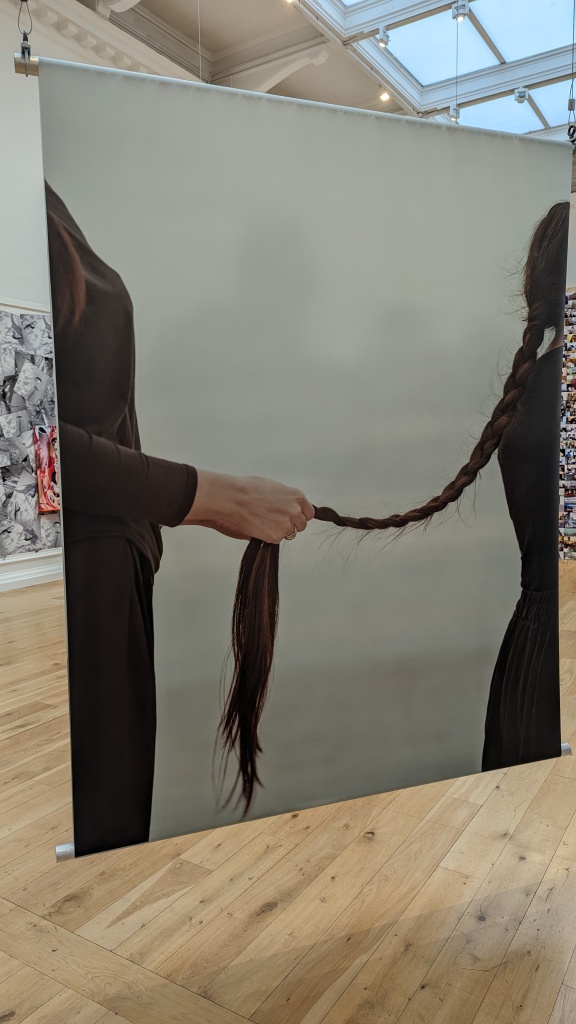
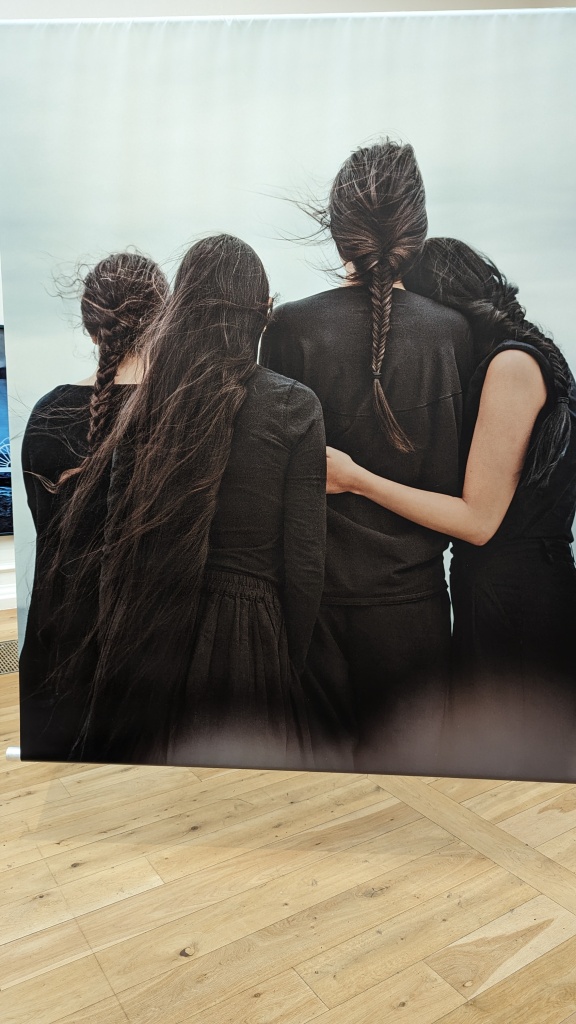
Tehran’s ‘morality police’ killed twenty-two year old Mahsa Amini for not wearing the hijab under government standards. These photographs are one with the protest against that legally sanctioned murder of a woman’s freedom and choice over her body.

The photographs are staged images that utilise the imagery of the doves, birds that are released at the funerals of those that have lost their lives in the protest. The birds stand for martyrdom and peace.

The women in the photographs are largely anonymous because anonymity protects the protesters on social media. These protest photographs show women plaiting each other’s hair and discarding their veils. The hair is plaited as respect is given to women freedom fighters fighting in Kurdistan against the Islamic state. They plait their hair before battle.

These monumental photographs are impressive and powerful. They give a body to the protesters and, with it, humanity. A community is formed around hair and the freedom to show it. The large format itself is a celebration of women and female bodily display, the ‘exposure’ that photography gives. Because, despite the fact that most of the models are anonymous, in the final images as we walk through the space, as you journey through the images and the story they are telling, you see the full frontal body of the woman with doves and her face is completely visible. And on the reverse, you can see the profile of a woman that braids the hair.

The plaited black hair of warfare and the white doves of peace tell a story. To have peace, you have to have the war first. Peace is the aim that can only be achieved through fighting for the rights to have choice and freedom. In the final photograph, a pair of hands braids the hair Another pair of hands superimposed on the back of the woman whose hair is being plaited holds the dove of peace and martyrdom. A reminder that freedom costs something. The fight.

These photographs are an inspiring celebration of heroism.

Sheida Soleimani, ‘Tulip Poster’ from the Series To Oblivion (2016)
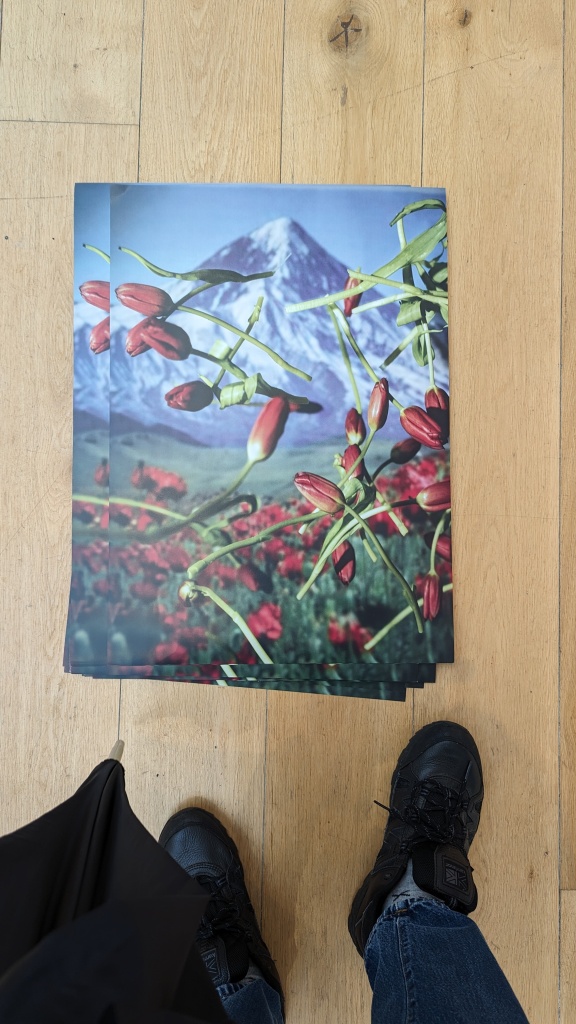
This poster is a tribute to the Iranian women unjustly imprisoned and killed by the state. The tulips reference an Iranian revolutionary song that sees the flower as revolutionary hope – because although it is fragile, it is resilient and it regrows every spring. The numbers on the back of the poster show current published data of those arrested and killed by the Iranian state.

The redness of the flowers. Blood. Against the mountain in the background. With their stalks, the tulips are the ladders up to the peak. They are the scaffolding that can even go above the peak. To ascend the ladders, you have to have the revolutionary hope. Which no sword can cut down. Which no gun can diminish. The tulips are the beauty of hope. The beauty of the revolution. They transcend death with their growth. They have the beauty of growth, nature, resilience. To ascend the ladder of hope is the ascent into heaven. In the religious context of the photographer’s background, this is the image of faith in the revolution and eternal justice. Like Antigone, the photographer promotes the eternal laws of justice rather than the man-made laws of the earth.

Wendy Red Star, Amni (Echo) (2021)

This is a tribute to the matrilineal clan membership of the Appsalooke Nation which was erased by colonialism and its patriarchal laws. The artwork gives power back to the women in her family (the photographer who is Wendy Red Star, her daughter and her great-great-grandmother). And the power back to the names of the women of the Nation.

This was one of the most moving of the artworks in the exhibition for me. They called them Indians when they are Native Americans. They took their land and tried to destroy their culture and their people. They are us. We also have clan membership through our mother – Mother India is our mother and the religion of my mother is the Mother Goddess. It is this which the patriarchal, colonising state wishes to destroy and, with it, difference.

The names of power call out in the background, behind the photographic sculptures. And the photographs themselves build power. Out of the small photograph at the base, a greater entity is formed through the use of overlapping photographs. If you look carefully, you see that the aura is extended into the names of power behind, with the use of negative white space.

One of the ideas around photography when it first came into widespread use was that it could take away the soul of the sitter. Here, that idea is reversed through resistance against the patriarchy.

Because the photograph of the great-great-grandmother is there and the different generations, the photograph scultptures build up the matrilineal history which the law and the colonising state wanted to end. In the face of erasure, we have the form that has come back to us, become literalised in word and image. The phoenix has emerged from the flame.

The exhibition included many other pieces worth a careful examination and study. My overall impression of this exhibition is that I learnt a lot from it and I was inspired by it. We, our community, we also fight the wars against the patriarchal state and its patriarchal laws. For our way of life. For our culture. The patriarchal law wishes to kill what we are. We, the ethnic minorities, even if we are the men, we are also the women.

And the photographs showed the resistance can take many different forms. There are many dances to learn. Many songs to sing.

Time and time again, the photographs exposed what the patriarchal law of the state is. And why it has to be fought against. Not just in ‘other countries’. In Western type countries like Australia and Poland.

Sometimes, I was disappointed. One video installation said to become a ‘peaceful warrior’ and not ‘an angry warrior’. I don’t believe we should spit out our anger. But the philosophy of India is that everyone has their own path. Who are we to judge? As long as the warrior remains the warrior. That is the point.

The union of women with photography suggested calamity to the male Victorian authors that I studied. It suggested the revolution. The exhibit of feminist protest photography is the natural outcome of the resistance. As a form of truth which exposures the corrupt heart of power, photography has few rivals. These images demand more attention and more thought. Within them, they contain the resistance to the state structure and the patriarchal law. And, within them, they contain the conception of justice that the patriarchal law does not have, with its false claims to universality, timelessness and ‘truth’. By making photography concrete, by giving it the female body, these photographers have fought against the male body of the law with its male subject. They have created women’s – and photography’s – jurisprudence in the present moment.

In the end, the warrior loves the warrior. The exhibition is warrior culture.

Review of Tsunagu/Connect: Uncovering the Lives of Japanese Women in the UK. (Barbican Centre)

18.02.2024

My mother is a migrant from India. Many of my relatives and friends are migrant women. I volunteered for years teaching migrant and refugee women English. Although I have heard my mother talk about why she came to the UK, I haven’t heard in much detail about what these women think of their arrival here, their journey in becoming British – even when I have asked them about it. You get snips and pieces: women that feel the hostility of this environment and the judgement of the people here over them. You get a sense of the insecurity and loneliness, the lack of belonging, when you watch them orchestrate their lives around phone calls and video calls back home, when you see that their closest friends are other migrant women from their home country. You sense their confusion about life here in London and the people here from the comments that they make. Tsunagu/Connect was a chance to hear what they wanted to be heard said about all of these topics.

Addressing the neglect of the topic, this exhibition is about the personal experiences and memories of migrant Japanese women that have come to the UK since the end of the Second World War. Over 30 Japanese women were interviewed to provide the oral histories for the exhibition on a one to one basis.

One of the stated aims of the exhibition is to overturn the ‘myths about Japanese women as passive and obedient housewives and provide an insight into the complexity, diversity, and agency of Japanese women in the UK’.

I picked out a few of the exhibits that caught my interest. I didn’t have time to listen to the audio descriptions. Masayo Aizawa chose to talk about her father through a strange object which she remembered him through, a calculator. She spoke about his harshness and the fact that he was traditional, that she could never express her gratitude to her father and that she only understood him late in life. This exhibit was interesting to me because it is often arbitrary objects that we associate with people. Because this was an example of a migrant woman reflecting on the people that she left behind, that she couldn’t get to know as well as she wanted to, that she had to separate herself from. And at the end of the exhibit, she says that she is like her father – it is just the illusion of separation. Perhaps this is what these migrant women feel – that their connection with the people around them in their countries of birth is unbreakable, one of the greatest influences on their lives. Perhaps this is what gives them stability and belonging, their identities.

Elizabeth Fusae Thurley spoke about what has been the astounding fact that I have witnessed throughout my life – that someone can come into a new country without knowing anything about it and at the greatest risk of precarity. Sometimes, they don’t even know the language. Elizabeth had come with a man with no job, no house and whose parents were against the marriage. She astonished herself with her bravery. You have to have courage to leave everything behind for a hope. She reminded me of my grandfather who came to this country from India and left everything behind him for the hope – the future for the children. Elizabeth came here in the hope of love: she got it.

Atsuko kamura spoke about how strange the people seemed here when she came: ‘The people sitting on the tube looked like as soon as they got off the train they would go and kill themselves’. That quote conveys the radical sense of defamiliarisation that these women experienced when they came to this country. But it carries a sadder tone for me – she came here for her happiness. But what she found when she first came here was sadness. What you think will make you happy in life often makes you sad. It is the way of the world.

This is conveyed most vividly in the story of Haruka Kuroda: ‘soon after I arrived in the UK, I was extremely homesick. I didn’t speak a word of English and for about 3 months, I called home every day using collect calls – remember those?! – costing my parents over £1000 on the phone bill each month!’

The dual kinship of the women here to their home countries and to the UK was apparent in the desire of Miyuki Tanaka to have her ashes floating in the air around Japan and the UK. After all, when they are here, the UK becomes their home. But it doesn’t always supersede their original home for all these women. Home is home is home. You can have more than one home – and what could be better than to have many places to call a home?

I reflected on the exhibition for a good while. Was it a success? Was it a failure? Some of the stories were about the bravery of these women, their pioneering entry into art school. Some of them were about their bravery in love, like I have mentioned above. Some of them were about the sadness, the struggle. The narrative of the exhibition is to present these women as heroes in the traditional mould – someone brave that faces adversity, that overcomes, that achieves, that finds a place in the world. The exhibition wants us to think of these women as strong. As strength. But I have a question. When the whole world is dominated by the West, when this country has a superiority complex, when the whole world is being Westernised, when people in this country think that every other country is misogynistic and a restriction on women’s freedom, how innocent is this narrative? Isn’t it just part of the problem? Is the only way a woman can be seen as a hero is to embrace the West? The Indian watches. The Indian judges. The Indian finds the exhibition wanting. What strikes the Indian is the sadness of coming to this land. To endure here. The disappointment. The defeat of the dream. That is what I found in this exhibition.

Some Thoughts on Medusa in the Painted Hall Ceiling at the Old Royal Naval College in Greenwich

Some Thoughts on Medusa in the Painted Hall Ceiling at the Old Royal Naval College in Greenwich

17.03.2023 (amended 07.05.2023)

There is an obvious theme of mirroring in the Painted Ceiling, which you can see in the mirroring of the arches or balustrades and in the mirroring of defeated sea vessels. THE MIRROR OF PRUDENCE – important for royal authority to control the mirror and mirror images. I am looking at this around the figure of Medusa.

The Facts are that the severed head of Medusa is depicted on Athena’s shield as in ancient Greek myth. Perseus the hero slew Medusa while looking at her reflection in his own shield so that he could avoid being turned to stone through her gaze.

– Wikipedia: “Medusa was beheaded by the Greek hero Perseus, who then used her head, which retained its ability to turn onlookers to stone, as a weapon until he gave it to the goddess Athena to place on her shield. In classical antiquity, the image of the head of Medusa appeared in the evil-averting device known as the Gorgoneion”.

Medusa means ‘guardian’ or ‘protectress’ in Ancient Greek (Wikipedia). Possibly why she is on the shield. Athena is wisdom/protectress of the city of Athens. So, there is a  doubling between Athena and Medusa in the role of protectress. Because Perseus looked in the mirror to slay Medusa, there is a role for doubling in the original myth – I will argue that Medusa is associated with doubling that gets out of control later (as she is associated with the Hydra, which also doubles). (DEFINITION – Doubling means produces copies, reflections, doppelgangers, etc.)

– The most obvious Double: There is another Gorgon depicted right of the shield and to the right of Hercules who is clubbing away at the Vices with Athena. While it may be that this Gorgon is a sister of Athena (and it has been suggested that the gorgon is ‘Envy’ amongst the vices stamped out by William and Mary), there is an uncanny, visual doubling between the gorgon and Medusa at least. The uninitiated would not know that it is not another Medusa. The Vices also included the snake-like many headed Hydra – Hydra is a water monster (like Medusa – see below about her links to water). I AM ARGUING THAT THE WATER LINK IS CONNECTED TO THE THEME OF DOUBLING – WATER HAS A REFLECTION WHICH DOUBLES THE INDIVIDUAL LOOKING INTO IT.

DOUBLING AROUND THE ROYAL CREST:  Queen Mary as Athena at least

– MEDUSA’S LINKS TO THE SEA/NAVAL PENSIONERS – ILLEGITIMATE RELATIONSHIPS TO THE GOD OF THE SEA AND NAVAL POWER:

  • The three Gorgon sisters—Medusa, Stheno, and Euryale—were all children of the ancient marine deities Phorcys (or “Phorkys”) and his sister Ceto (or “Keto”), chthonic monsters from an archaic world (Wikipedia). 
  • In a late version of the Medusa myth, by the Roman poet Ovid (Metamorphoses 4.794–803), Medusa was originally a beautiful maiden, but when Neptune/Poseidon (THE GOD OF THE SEA) had sex with her in Minerva/Athena‘s temple,[7] Minerva punished Medusa by transforming her beautiful hair into horrible snakes.
  • When Perseus slayed Medusa, she was pregnant by Poseidon. SHE WAS ABOUT to Reproduce/Double as the bad mother, dark mother (Jung), produce an alternative sea god, naval power, etc.

Subjective Facts

–  We note that the Gorgon next to Hercules (THE ONE THAT DOUBLES AS MEDUSA VISUALLY IF NOT LITERALLY) has escaped the goddess and demi-god casting the Vices out of the kingdom. Instead of being under their feet and being trampled on, she is actually equal with them, as though she is divine herself (doubling the divinity of the gods).

– THE ROYAL CREST – Look at the gilding on the royal crest and compare it with the shield of Athena and Medusa’s head on it. The gold of Medusa’s head mirrors the royal crest of Queen Mary. However, the inclusion of Queen Mary as Athena on the right of the crest (doubling) creates a good double as opposed to a bad double (like Medusa). Let us remember the doubling of the idea of ‘protrectress’ (‘Medusa’ in Ancient Greek). Queen Mary was the ‘protectress’ of the Naval Pensioners…

– (The gorgon that visually doubles as Medusa is possibly Envy.) However, if it turns out the Gorgon that visually doubles as Medusa is Euryale, one of Medusa’s two sisters, this might mean ‘the wide sea’ (as a daughter of the sea gods) (Greek and Roman Mythology, A to Z, Kathleen N. DalyMarian Rengel, 2009, 54). AS I HAVE SAID BEFORE, THE SEA REFLECTS – IT IS A MIRROR… Her mouth is open on the painted ceiling: she was known for an agonised, piercing shriek after Medusa was killed, which was turned into a lamenting song and music for humans (ibid.)

– Athena actually directs the shield with Medusa’s head on it at Hercules, not at the Vices – against men (Medusa is associated with feminism in modern scholarship – is this a coincidence?)

– Hydra kept on spouting two heads when one was cut off (doubling), similarly the Gorgons are repeating in the painting, or doubling. Doubling between Athena and Medusa as protectress. Deduction – there is a theme of doubling going on.

– Apollo killed the Python (snake/chaos) – snakes at bottom to illustrate their lowliness, killer of snakes at top as God of reason, light (enlightenment) etc. Is Apollo being badly doubled by Louis IV ‘the Sun King’ that is being trampled by King William? (depends on if this is Louis IV or not). Certainly, Truth is holding is a miniature sun in her hand – the doubling of Apollo with light (truth).

– Medusa was killed through doubling – in the mirror, when she was to give birth to the god of the sea’s son. Wikipedia: “In most versions of the story, she was beheaded by the hero Perseus, who was sent to fetch her head by King Polydectes of Seriphus because Polydectes wanted to marry Perseus’s mother. The gods were well aware of this, and Perseus received help. He received a mirrored shield from Athena, sandals with gold wings from Hermes, a sword from Hephaestus and Hades‘s helm of invisibility. Since Medusa was the only one of the three Gorgons who was mortal, Perseus was able to slay her while looking at the reflection from the mirrored shield he received from Athena. During that time, Medusa was pregnant by Poseidon”. 

– Woman as animal nature – is this is link to the sea and the power of nature in the water? That woman/nature can’t be controlled, but controls (as in Queen Mary controlling the kingdom of men?) Is this why the Gorgon escapes the casting out of the vices in the kingdom and mimics the power of the gods?

INTERPRETATION (Psychoanalysis, mirroring)

– Does Medusa and the other Gorgon represent a male artist’s misogynistic response to Queen Mary’s rule (as ‘Queen of the Sea) [part of the general expectation that only men rule and women’s rule leads to monstrosity and chaos – chaos as the snake which Apollo defeated]? This is a CONTROL OF DOUBLING – IF ONE WOMAN’S RULE IS ACCEPTED, OTHER WOMEN WILL RULE AS HER ‘DOUBLES’. Is this an example of the attitude to the daughter that usurped her father’s throne? We know that Athena is also doubling as Queen Mary from the arch. The whole game is about doubling: the ‘good’ double and the ‘bad’ double. On the one hand, Mary can double as the goddess, the good double. On the other hand, is she doubling as Medusa the monster, with illegitimate power, producing Hydra like monsters in the kingdom as the Vices? Is she the reverse of Apollo the Sun King?

– Between Hercules and the Gorgon, there is a V sign (largely empty, representing lack, something to be filled in as per misogynistic constructions) – if we look in terms of psychoanalysis, does this represent the vagina (and therefore female power?) Snake as phallic symbol – women seizing phallic power illegitimately in the form of Athena with the shield and with forming Hydra type monsters (i.e. more women that rule – Mary led to Queen Anne and no male heirs)?

Music and Patriarchy: The Gendered Opposition of Bodily Performance and Bodily Abstraction

11.05.2018 –

Abstract: Women are seen as bodies, not minds. As such, they are seen as suitable for bodily performance in a patriarchal society rather than for composing music which is perceived as a non-bodily and abstract form of representation. This division between body and mind underpins the division between the private and the public sphere.
Keywords: Music, Feminism, Patriarchy, Body, Mind, Secret Superstar, Public, Private

Knowledge of the history of women’s musical practices is aided by a concept which I call ‘musical patriarchy’. The division of musical work into a largely male public sphere and a largely female private sphere is a trait of Western music history and also of many musical cultures from all around the world.
Lucy Green, Music, Gender, Education (Cambridge: Cambridge University Press, 1997), 15.

I was listening to some songs by Vidya Vox, the famous YouTuber recently. I had downloaded them for free off of her website. Vidya sings in a combination of Hindi and English, as well as other languages. She does cover versions of songs and mash-ups. I grew curious about the singer and her music, so I put her name into a search engine. It turned out that the music behind Vidya’s songs comes from her white husband. Here was yet another female singer that didn’t produce her own music and that traded on her Indian ethnicity and sex to entice audiences while relying on a masculine, Western sound and mind.

Racial dimensions aside for the time being, the question was, why were there so few famous female music producers both in India and the West? Personal experience, as usual, prompted the question. One of my amateur pursuits is singing and song-writing. I also compose the music for my songs and make the music myself. Although my musical education in England was peculiarly lamentable, I went ahead and learned how to do everything myself. Is my music perfect? Of course not. It doesn’t have a professional sound and even my singing is just recorded on the computer using the free and in-built software. However, the point is, that I can sit down and compose my own music and, if I had enough free time and money, I could produce my own tracks to a good standard. I could even lay down tracks for the melodies and sounds that I can invent in my head but am currently unable to represent in concrete musical form due to my lack of ability and skill in playing music. Why can’t more women do the same thing successfully?

One could gather various ideas to answer the question. I have put the quote at the top of this piece to show one possible interpretation. The argument is that women’s music is regarded as private, rather than public. It is men’s music that is regarded as public. However, what I want to argue in this short piece is that women are not admitted to the masculine sphere of music because it is a form of representation that is regarded as abstract, invisible and bodiless, qualities associated with men and not women. It is my contention that in a patriarchal society, women are regarded as incapable of mastering the abstract discipline of music and of transcending their bodily form to enter into the realms of thought and meaning. This is why there are so few famous female musical composers and why the ones that do exist are not rewarded and recognized for their efforts. https://www.billboard.com/…/female-music-producers-industry…

I want to start, as I often do, with a Hindi film which I watched. I am talking about the huge international success which was recently released, Secret Superstar (2017). I will not go into the story too much, nor criticise the type of feminism which was portrayed in the film. Instead, I will concentrate on the relationship between femininity, the body and music in the film. There is a young girl in the film that becomes famous on YouTube for singing in burqa which covers her whole body, including her face. The burqa makes her “bodiless” and as invisible as it is possible to be without advanced technology. At this stage of her career, the girl is capable of composing her own music and songs. She doesn’t need any man to guide her voice. She is both singer and songwriter, player and composer. However, the girl doesn’t want to be bodiless and invisible, because that would mean that she remains anonymous. She wants to be known. This desire to be recognised as a person, as a singer, to enter the public stage and leave behind the private sphere of the domestic, leads the girl to a famous male composer. It also leads her to abandon the role of music composer, a being that is invisible and bodiless because he, and it is usually a he, usually stays behind the scenes. She then becomes the voice for the male music composer’s music and finds success. The girl is therefore led into the patriarchal music establishment and away from composing her own music because of her desire to become a body with a recognisable face, to be seen as a woman with a woman’s body. She leaves the realm of abstraction, invisibility and thought to become a performing body, the face of music rather than its “soul”. Such is the brand of “feminism” in Secret Superstar: a female’s desire can only be to perform as a body, to become a voice. She cannot become one with abstract thought, invisibility and the abstract and non-bodily representation of music.

In fact, if you watch Secret Superstar closely enough, you will find that the girl rebels against all forms of abstract thought. Her rebellion is chiefly conducted against her father, who is an engineer and relies on the abstract disciplines of maths. She also rebels against her education in maths and science. The young girl supports her uneducated mother over her educated father and leaves education to do so, running away from school secretly. She even effects a separation between her uneducated mother and her educated father (in the film’s defence, he is depicted as an abusive father and husband). Clearly, the girl does not wish to remain within the realm of thought. She wants blissful ignorance and to be seen as nothing more than a body, to be accepted in the realm of the body.

My speculation is that Secret Superstar reflects the existing reality of music in a patriarchal society; that there is a gendered play between the bodily performance of voice and the abstract and non-bodily performance of music. To enter onto the public stage in musical performance, the rules dictate that women have to be seen as bodies, not as minds. It is men that are celebrated as being of the mind and having rational “souls”. It is men that can give birth to music, which is, of course, related to maths (look up Pythagoras and his ideas about maths and music if you don’t believe me). Thus we have an explanation of why there are so few successful music composers in both India and the West. I have argued at length about the relationship between the body and non-bodily abstraction and their relationship to the private and public spheres throughout my writing and I believe it informs most aspects of the society that we live in. The body is therefore supremely important as a site from which to make the resistance against the forms that constrain us and the female body is, I think, the supreme form which can fight against the forces of concealment, invisibility, pretended abstraction and universality. There is a further speculation: that the music that we all listen to and enjoy is founded in a masculine mind set and worldview. The very nature of our listening and auditory enjoyment is founded in patriarchy and its conditions. Films like Secret Superstar can reveal exactly what the nature of that patriarchal sound is and how it operates, if only we watch carefully and learn. One thing is clear: such a sound hates synaesthesia since it separates listening and sight, music and the body.