survival (microfiction)

25.10.2025

Yesterday, he had been in a car accident.

An unaccountable crash had deafened everyone on the bus. A moment of shock and surprise. Its origin unclear, a bastard noise.

The explosion had come when he had been getting off at his stop. He had been gloating to himself about how quick his journey from work had been. He had cleared it all in about thirty five minutes. The train had come exactly on time. And then the bus had come exactly on time. It had even stopped raining.

In the first few moments, while the public were immobile and dazed, the duty of a hero called. He was a man of action and a man of quick thoughts. He was the only real man on that bus. Investigation to see if there was anyone that needed help. Instinctively, he had jumped out of the bus and gone round to the back. Without knowing what had happened. It could have been a terrorist with a gun. In the eventuality, it was an expensive white car which had collided with the back of the bus. They were fine. Stupid and incompetent. But fine.

As he had walked home, he had reflected to himself that it is never the ones that are tired of life that die. The ones that are tired of life, they are preserved. Priam in the Trojan war longed for death and it would not come. He had to watch all the ones that he loved die all around him. It could have been so easy, so peaceful. A loud noise and then sleep…

Even the stupidity and ignorance of these people around him, their sheer incompetence, these things could not kill him.

It was just a fact that the hand of the Mother Goddess was upon his head. Nothing could touch him. So many incidents in his life. So many encounters. The blood clot. Assaults. Being mugged. The bombing of London. The sickness. She had given him the strength and endurance to last in this cold and hard world of enemies and suffering. He would always live to fight another day. Whether he wanted to or not.

Chigwell to Harold’s Wood – London Loop (Travel Diary)

05.10.2025

Absolutely superb. That’s what the weather was like for the long walk. I met up with my friend at Newbury station and we bundled ourselves onto the Tube at nine o’clock for an early start on the day.

In the morning, it took about the same time to get into Chigwell as it would take me to get into Central London for work due to a change at Hainault and a long wait for the next service. On arriving at Chigwell, I was struck by the beauty of the place and the grandeur of the big houses out there. Really a dream destination to live in. Chigwell is called Chigwell because the name derives from an Anglo-Saxon personal name, ‘Cicca,’ and the word ‘well,’ meaning “Cicca’s well”. 

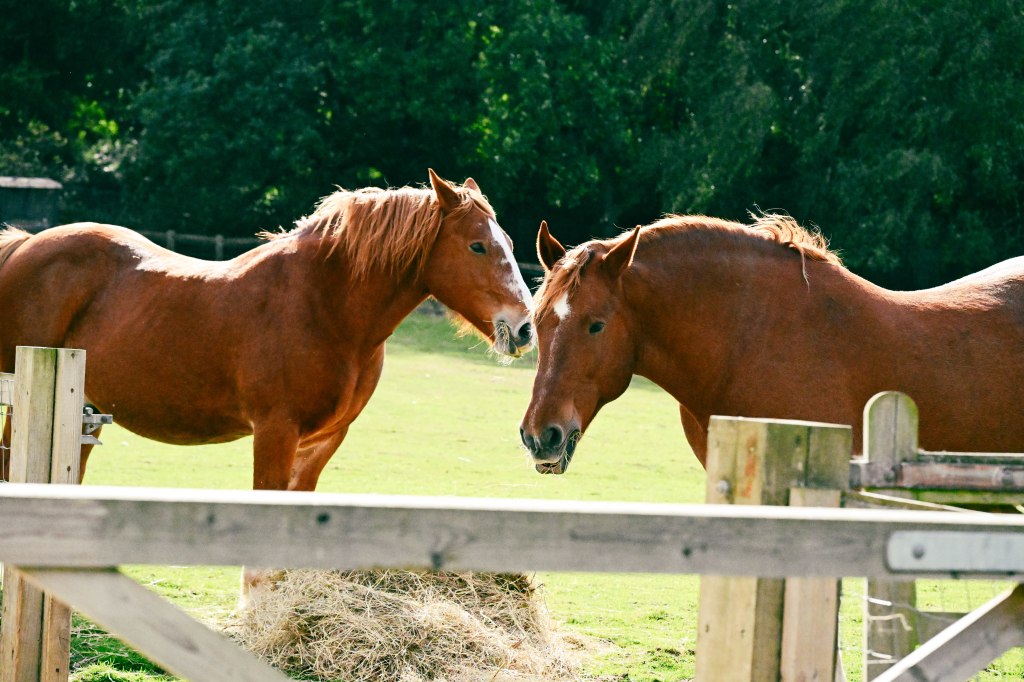
We came across some beautiful horses but I couldn’t get a good shot or composition. I have a personal ambition to ride a horse but haven’t got round to it yet. It is a very modest and achievable ambition but I am always too busy for it.

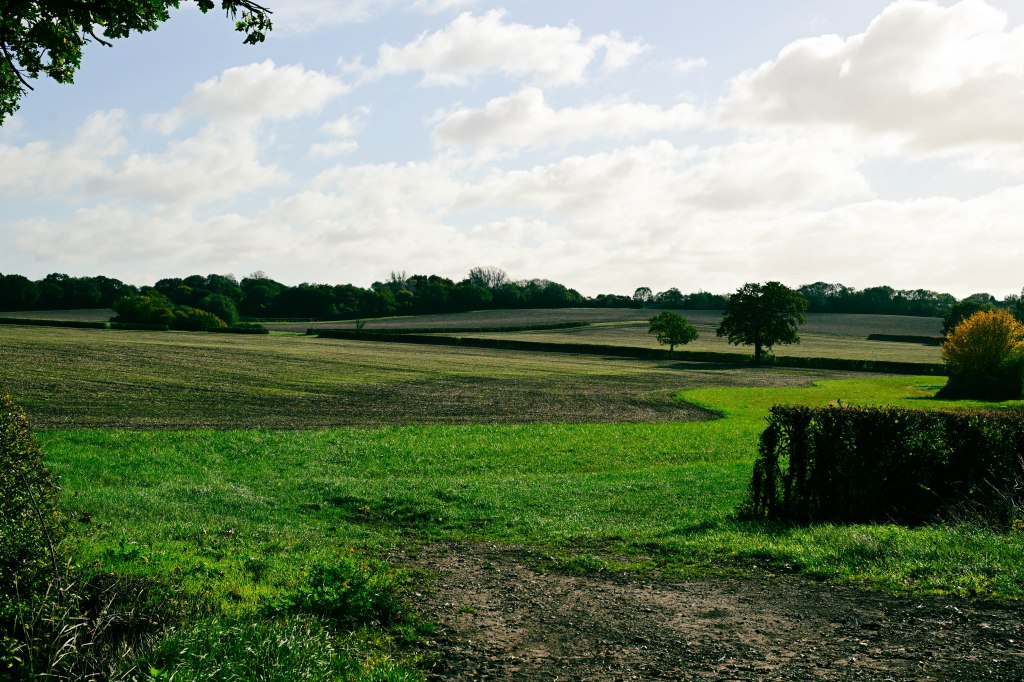
Almost at once, we came to a beautiful view and the farmlands. I had already got out my camera and was trying a few shots. As I did so, we came across some fellow walkers and they told me and my friend that they had been doing the walks on the London Loop for about two years. They were finally going to finish off the walk today. It was an old father with two young blonde daughters, one of them wearing a red jacket and looking somewhat like Red Riding Hood.

As we trailed after them when we were ready and they were already in the far distance, we worked out the percentage of weekends they had committed to their mission as we were arguing about how committed they were as walkers. If they had taken two years for about twelve walks on the London Loop, that would work out as them having invested 6% of their weekends on the trips over two years. I maintained that that was quite committed but my contrary friend disagreed with me.

My friend is a birdwatcher and I was trying to one up him by spotting more birds than him. I got a robin that he hadn’t noticed and felt quite chuffed but then he showed his experience and expertise in this subject. He spotted a woodpecker, a brilliantly yellow coloured creature that I had never seen before. It was winging its way through the air. He also spotted some buzzards and regaled me about the story of the corpse of one he had encountered recently as roadkill. On the trip, we saw about nine different species of bird, so it wasn’t a bad day: peacocks, hens, Egyptian geese, robins, a white egret, the woodpecker, crows, some little ones I forget the names of and seagulls and magpies. So for birds, it was certainly a great day.

It was a delight to stop for elevenses at precisely eleven on a little bench in the woods as I had a Dairy Milk with me. I shared the chocolate with my friend. I was watching the birds fly into the trees. A Dairy Milk always reminds me of the war. Probably it is because Roald Dahl, my favourite author as a boy, mentions being a taster for Cadbury’s chocolates in his biography and he fought in the war.

Around Chigwell and its forest, we came across an Islamic chapel with Christian gravestones in the garden which was quite an example of religious amalgamation. We didn’t go inside but looked at it with intrigue from the outside wondering what it was.

The next phase of our walk was Hainault Forest Country Park which is not too far from our local area. Hainault Forest was an old royal hunting forest. I had gone there many a time with the family. We saw the two daughters with their father there and I shouted out to them that ‘it wasn’t a contest, but…’ and they all laughed which was pleasing. They were sitting on a bench looking out at the lake. We kept on walking and didn’t see them again and probably won’t in this lifetime.

Hainault gets its name because its original Old English name, recorded as “Henehout” in 1221, meant “wood belonging to a monastic community”. The Abbey of Barking owned Hainault Forest. The name’s spelling later changed because it was incorrectly associated with Philippa of Hainault, the queen of Edward III. 

We stopped for a hot drink in the cafe and it was absolutely chock-a-block with young families. So we sat outside. Lazily, I watched two brightly coloured aeroplanes flying about in the sky and the families with their dogs all making their usual Sunday walk around the park. I was telling my friend that I should buy a dog so that I could also talk to the dog people.

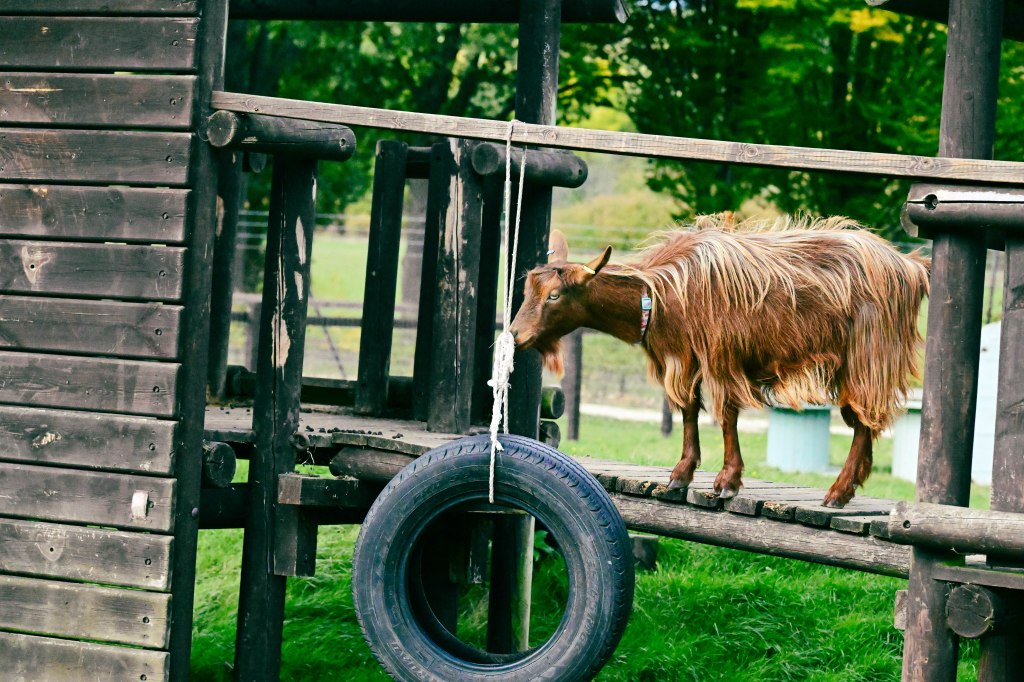
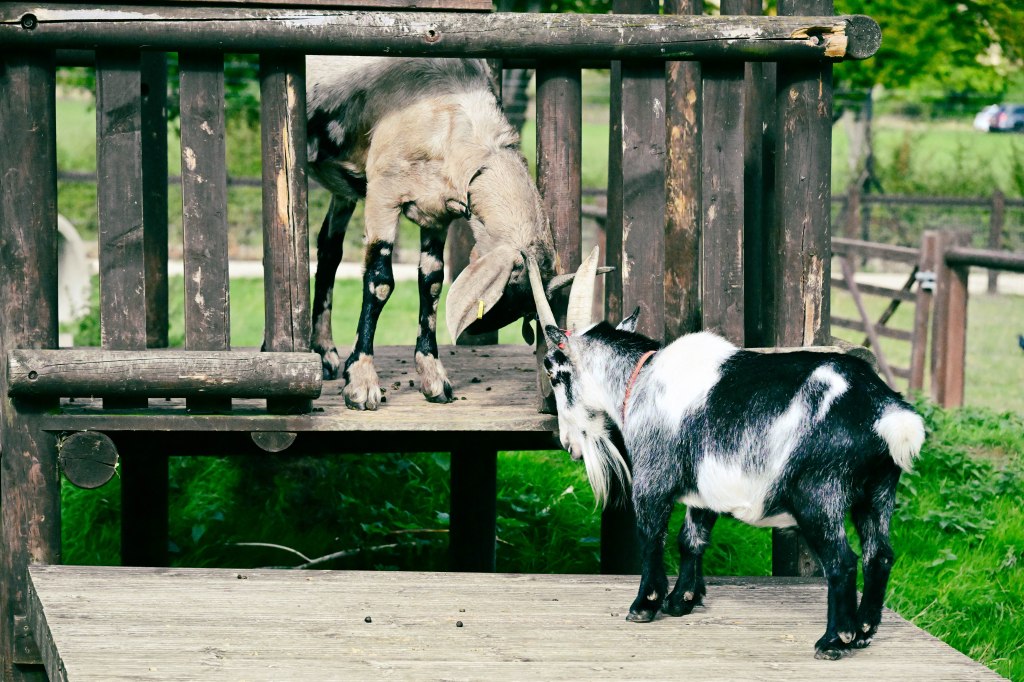
After that I persuaded my friend to go to the farm and look at the animals. The goats were all butting heads with each other and the peacocks were sunning themselves. I got a few okayish shots on my camera as the light was quite good but missed a dramatic fight that the goats with brown hides were having as people had stopped to watch them and I didn’t want any people in the shot.

We walked through the golf course next and then we were back in the forest and in the farmland and then the forest again. There was a rough swing rope that someone had put up in the trees. The only way to get to it was up some precariously placed logs, so it was a challenge of balance. I climbed up it childishly and recklessly. It was only a few feet off the ground but felt like I was walking in the atmosphere and slipping about. I managed to get to the swing rope with my hands but then there was no way to get any momentum to swing about! I had almost fallen off once, but only once. And I hadn’t. So man nature was appeased. My friend shot a video of me doing it.

When we had walked through an enchanted pine soaked place with a delicious scent, I decided that we should stop for lunch. I had brought chicken satays from the reduced aisle with me and the scent was too much. Because we were accosted by two dogs that wanted to partake of the feast. The first one was a giant and was very forward and slightly menacing. Two young boys had to run up and grab him by the leash to get him away. The other dog was a black miniature hound and his owner, an elderly lady, said that he was ‘incorrigible’ as she rushed off with him.

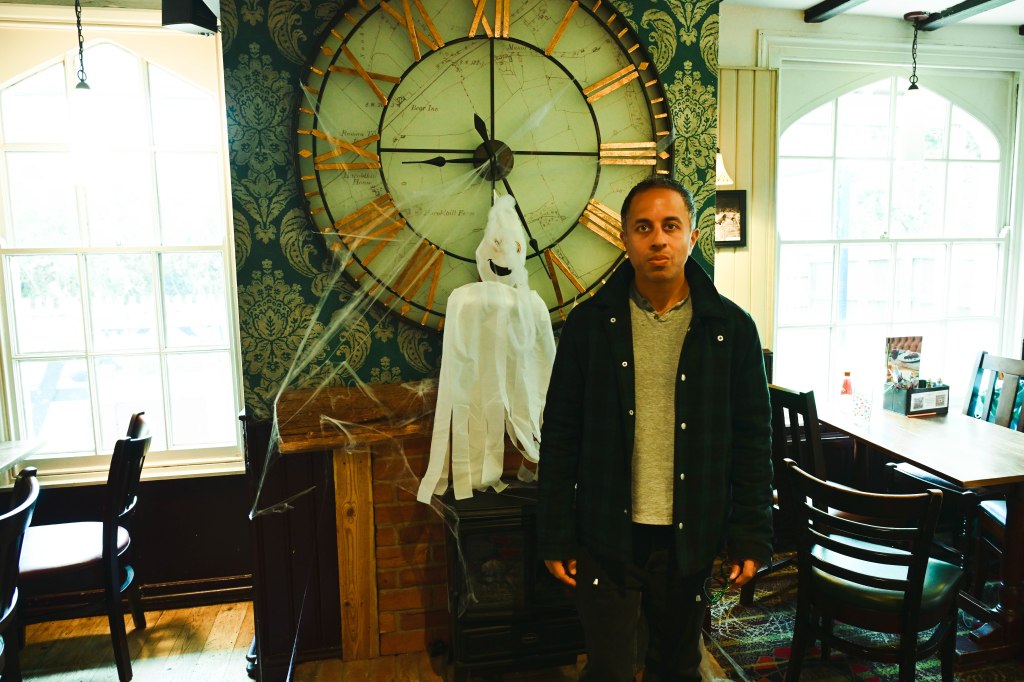
After the forest, with its beautiful light and soothing smells and ambience, and after watching the little trickle that was the river Rom, the next thing, we were sitting in a pub called The Deer’s Rest which was in Romford itself. The whole pub was tricked out in Halloween decor. I got us some drinks and downed an ice cold Pepsi. It was absolutely delicious in a way that Cola is not always. My friend told me that I had worked enough so my body was rewarding me for the work with that delicious sensation. He said that he was having it with his drink as well. The pub had this wallpaper of framed butterfly specimens and it was something that I quite wanted for myself as I thought it looked very sophisticated and cool. And much nicer than real specimens of butterflies which I have always found slightly creepy. Because they are dead beauty.

We walked on through the beauties of nature talking about life, the universe and everything. At some point, we found ourselves in a park. I was keen to watch the young people at the skate park but it was disappointing. They were not doing any tricks! The kids were quite young, but then that Olympics gold medallist had been about thirteen. As we progressed through the park, we came across a father at the top of the slope throwing around a brightly yellow coloured glider aeroplane towards his son. The son was babbling away at us as I remarked that the dad had made a good throw. It was a really touching scene of family and its happiness, the joy of children.

The last stretch of the walk took us to Harold Wood. The name Harold Wood refers to an area of land associated with King Harold Godwinson, the last Anglo-Saxon king of England. It was about four o’clock. We had initially decided to do a bit more but decided to pack it up before the light started going and we’d done about thirty thousand steps. It was about eleven miles well spent.

the world of the unbalanced elephants – ten minutes of story (microfiction)

17.08.2025

Alfonso had given me just ten minutes to write a story. He had odd whims. And he knew that I had a busy schedule, so he did not make inordinate demands.

So what could I write?

I thought about an elephant that was climbing a wire over a city. The elephant was making its way across the wire sedately and elegantly. It was definitely possible. However, then a child let off a balloon from the crowd, a red balloon that veered into the elephant’s delicate trunk. Instability had been introduced, and missteps. The elephant desperately tried to regain balance. Everyone thought that the elephant was done for. Then, either from a stroke of luck or from a generous and hopeful intention, a crow landed on the uneven side of the balance. The elephant was saved. However, the unscrupulous bookies and organisers of the event decided that this was cheating on the part of the elephant, notwithstanding the fact that the bird had actually saved the poor creature’s life. They disqualified the elephant straight away. Yet the elephant was a beast of dignity. The elephant finished the walk across the wire. The silly child who had let off the balloon kicked up a fuss for more ice cream and treats from its entitled parents and the world went back to doing what it was doing: destroying, killing and hating. It is the world of the ignorant, not the world of a balanced elephant. And for that reason, because of the mindless mob, it is the world of the unbalanced elephants.

Alfonso did not deign to comment on the story. He asked me why all the characters in it were genderless, nonetheless. I asked him what difference he thought it would make. He was silent and suggested that we both go out for a chocolate sundae.

life as a bus (microfiction)

14.08.2025

‘You don’t have a reason to complain. You have a good life.’

Alfonso wasn’t wrong. I did have a good life. A disposable income. Savings. Food and shelter. Nice things. An interesting job. Interesting friends. The best education that money could buy. My health was pretty good and I had high energy levels. But was I happy? There was something very important that was missing from my life. Not something but someone.

The loss of one person. When there are several billion people in the world. It was a marginal loss. I was stupid to feel it. I should be like them. Forget everyone. Have no one as special. Forget about caring about someone. They did it and they were happy doing it. Why couldn’t I be like them? Nobody really cared about losing me from their lives. I sincerely doubted whether I could get more than ten people to come to my funeral if something happened to me.

‘When you search for a metaphor for life,’ I told Alfonso, ‘you would think of a maze or a dark forest. That is the stereotype. However, something happened today which I think is the perfect metaphor for life.’

‘And?’ Alfonso sniffed peculiarly. His guard was up and he eyed me warily. He knew that I was going to say something cynical and suspicious.

‘As I was crossing the road, a bus came that would make my walk back home redundant and conserve my energy after I had been on my newly healed leg all day. I sprinted to catch it. I got there at the door. The bus driver was letting some passengers off. I waited patiently at that bus door for it to open. The bus driver didn’t even give me a look while I was standing at the bus door. He drove off. That situation explains my life. Not a portion of my life. But my whole life.’

‘How so?’ Alfonso looked scrupulously at his fingernails. It was good of him to always ask for elaboration, when no one else ever did and I often wondered if they ever listened to anything that I said.

‘I beat that driver who had an unfair advantage to me in a race and then he still would not pay up. He would not give my reward. I was faster than him, more courageous than him, more talented than him. Yet he had something and he would never give it to me. He did not care about fairness. He did not care if he upset me. He would not do the right thing.’

‘That is your life?’

‘Yes.’

‘You have a chip on your shoulder.’

‘You would have too if you were a genius and had to live with these people.’

Alfonso harumped. He knew that I was right. This was how they treated me. This was the treatment of our people. We were a threat to them so they tried to keep us down.

‘You have done well if that’s how you think you have been treated.’

‘I don’t think. I know.’

‘Life as a bus,’ continued Alfonso, pretending that he had not heard me, ‘is not very appealing. But it is moving.’ He smiled at me naughtily. I did love Alfonso. I smiled back at him. You do not have to agree on everything, not at all. It was about friendship. You could always listen even if you did not agree. It was sad that people had not learnt that lesson yet.

where can i go? (microfiction)

07.08.2025

Finally, after several years of not taking a holiday abroad, he had decided to go to foreign shores. However, nothing in life is easy, least of all a journey of ease. He did not know where to go.

His parents had not taken him on holidays abroad when he was a child. He had never booked a holiday abroad by himself or had the decision about where to go.

He lacked any kind of experience and he was stumped.

The first choice had been Japan. Beautiful Japan, the land of inspiration. But what was it that he was actually going to do there? He had a vague impression of nature and local traditions. But how was he going to organise everything?

The second idea was to take a coach trip around Europe and to cram in as much as possible. But then, how much did Europe interest him? Surely it would be pretty much the same as England?

The third idea was Athens. He had always wanted to go there. But then there was that association…

Athens could be had for about seven hundred pounds. A nice hotel with a swimming pool and breakfast. Plenty of archaeological curiosities out there.

Choices. The whole world to be had. And yet, every time he had tried to go abroad, all the plans had come crashing down around him.

There was nowhere to go. There was no place for him.

And at the same time, he could not rest where he was.

In the universe, we are a space. Our body is a space. A tiny little space in what is almost an infinity of space. And that space of the body relates to the spaces of the bodies around it. His space, his body, it had no relationship to the bodies around it. So it did not matter what country he went to or what he did, he would never have a human space around him. So why try? Why imagine being in a different human space? It was all very well saying that no man is an island. But an island he was. He would be an island in Japan, Europe, Athens or Africa. It was not what he wanted, but what he was.

This holiday was already stressing him out.

FLOWERS – FLORA IN CONTEMPORARY ART & CULTURE

12 February – 5 May 2025, the Saatchi Gallery

Review by Dr. Suneel Mehmi. Images courtesy of the Saatchi Gallery with permission granted to reuse. This is an unpublished first draft for the Plant Curator website – https://plantcurator.com/

https://www.saatchigallery.com/exhibition/flowers-flora-in-contemporary-art-amp-culture

An inspiration for the ages and a fount of creativity, flowers have been the originating force, subject and detail of the masterpieces of all cultures. A colossus of endeavour and love, the flower exhibition at the Saatchi Gallery celebrates the contribution – and the omnipresence – of these unparalleled objects of beauty up to and including the present moment. The achievement? To have made a discriminating incision into the ubiquity of the flower in art so that the satisfactory slice can be served up – and digested.

Ranging across two floors which house large-scale installations, technically innovative videography, paintings, graphic design, textiles and photography, over 500 unique artworks and objects form the display. Organisation across this wealth of material is found in nine sections which deal with topics such as fashion, books and film, and representations of the flowers in the work of emerging contemporary artists.

In one room, we find the bespoke installation piece by Rebecca Louise Law, made up of over 100,000 dried flowers that have been salvaged from the wasteful society. A creation of sublimity from rejection which can be viewed from the floor or from above in the balcony. Another space has been transformed into an innovative and interactive digital projection by French artist Miguel Chevalier where we move the flowers and, in turn, they move us. A virtual garden of the imagination.

There is a mixture of justifiably perennial sources of delight such as Boticelli’s Primavera and the designs of William Morris alongside the unknown and uncontemplated work of others around the globe. Highlights include the 3D bronze sculpture of Van Gogh’s ‘Sunflowers’ by Rob and Nick Carter, where the viewing experience of the artwork is renewed (and given another dimension, if the pun is forgiven), Anna Von Freyburg’s gloriously coloured textile interpretation of a Dutch still life painting, Vivienne Westwood’s sensational floral costumes and Ann Carrington’s collection of finds in silver and cutlery for her shining and awe inpiring sculptures of remodification and metamorphosis.

What the exhibition succeeds in doing well is to sting the monkey of the mind so that she flickers across the branches of the canopy, forever at all moments looking for new paths of exploration and into new thoughts. There is so much beauty, so much food for thought.

What struck me in particular was the constant oscillation and the influence of the flower on the female body and the female body on the flowers. And how this dynamic has been woven into art and culture. Women have been understood as flowers, however we may interpret that equation. The exhibition suggests that works such as Mucha’s ‘La Rose’ give the woman flower the aura of power, the transcendence of a domestic role. In Gary Hume’s ‘Two Blooms, Grey Fields’, we are advised to see human faces in the flowers, a coupling of minds.

Another theme that emerged was the relationship between violence and the flowers. Sometimes, ‘flower power’ was an antidote to the oppressive state and the military as we see in photographs, such as Bernie Boston’s image of George Harris sticking carnations into gun barrels during the demonstrations against the Vietnamese war in 1967. In Wole Lagunju’s reinterpretation of the violence of ‘Judith with the Head of Holofernes’, we see flowers from the cultural iconography of the Yoruba which invigorates a postcolonial approach to real history.

As with all subjects of art, it was interesting to see the pull between the abstract representations of flowers, such as Damien Hirst’s ‘Valium’ and the figurative brilliances of art such as Janet Pulcho’s ‘The Dream of Love’ which was painted last year.

To end the exhibition on emerging voices was infinitely pleasing. A demonstration that the fascination with the flower and its beauty drives contemporary art and will be the future for art for time to come.

Immensely enjoyable and productive for a creative mind, ‘Flowers’ at the Saatchi Gallery is a big and delicious fish to have caught and to feast upon. I spent three hours in each of the spaces hoovering everything up. Beautiful variety, stylish presentation of the pieces, the experience was like an entry in the kaleidoscope of the senses. I learnt much, I contemplated much, I hungered much for the beauty of some of the pieces. My overall impression was of a shining, irresistibly coloured flower which emerges from the dark to cast its wonder upon a world of hearts.

Print to Pattern: Unveiling the Kimono Through Japanese Prints

Ezen Foundation, Angel

Review by Dr. Suneel Mehmi on 19.05.2024. (Suneel’s original artwork from 2016).

This is my personal view of the exhibition and does not reflect the view or any consensus at any of the places I work at or volunteer.

For a very long time, Ezen Foundation featured a breath-taking wedding kimono decorated with cranes in its exhibition space. I was absolutely entranced by this wonderful construction of textile and art. I would take a careful look at the kimono every time I went to the gallery. For me, the kimono stood for everything that was beautiful about not just Japanese, but Asian culture. For the kimono was red, like the wedding dress of an Indian woman. The textiles were magical, shiny, seductive, splendid. They spelt out love.

My family comes from those involved in the clothing trade in India and in Britain. My mother’s side are leather merchants. My grandfather’s side were shoe makers. My grandmother worked in textiles when she was invited into this country. My mother made her own Punjabi suits when I was growing up on the sewing machine at home from the sumptuous fabrics she bought from the Indian shops. It has always been interesting to me to look at clothes and, when my grandmother passed away, I am reminded of her through the beautiful clothes that I see around me. She made me shirts and jumpers when I was a child and even when I was an adult. So when I look at these kimonos, I think of my grandmother and my mother, even if they have been made by men. That is the memory

Familiar to even the farthest flung nooks and crannies of the globe, the kimono is synonymous with Japanese culture and style. This exhibition at Ezen Foundation aims to showcase the clothing’s remarkable evolution in the latter half of the nineteenth century alongside the country’s ‘cultural and artistic transformation’.

Print to Pattern displays over 20 antique woodblock prints from kimono pattern books primarily dating from the late 19th century, also known as the Meiji era. The pattern books are fashion catalogues which were used in a multitude of ways by a diverse range of audiences and which feature designs for kimonos, patterns and motifs. The exhibition comes in the form of pictures, curator labels and then QR codes which give us more information about the exhibits.

The exhibition begins by featuring kimono designs of trees and their blossoms as auspicious motifs. A tree loving country is how we know Japan. From the bonsai tree collector Mr Miyagi in The Karate Kid to the equation of everything Japanese with the cherry blossoms, that is how we have imagined and known Japan in the West. We are told how the trees form symbols and meanings, how humans are relating to the natural world by representing it in a system of human meaning. We form the idea of the Japanese as those that communicate through nature, that style themselves through nature. That see human qualities in the plants as well as abstract qualities like transience in the cherry blossoms or adversity in white irises.

There is a sensation of magic in the air because the trees are regarded as auspicious symbols in these designs. We are seeing the aspiration of magic in the flesh, the starvation for sorcery. Magic infiltrates the picture plane, the desire for success to be accomplished, the desire for love. It is a touching human moment.

The exhibition then moves to animals that figure on kimono design such as bats and cranes. As with the natural environment in the form of trees, we find out the meanings of these auspicious creatures and how they have figured in the Japanese imagination. The case of the bats is indicative of the historical contextualisation at work in the exhibition. We learn how the bats went from representations of prosperity to representations of modernity and aspirations for economic growth and social advancement.

Objects as motifs in kimonos now make their way into the gaze. There are bobbins, threads and needles as well as sake cups.  Then, there is a print showing the iconic Mount Fuji which has remained ‘a prominent theme in kimono designs’. We learn that the motif has traditionally adorned the kimonos of young boys and has stood for resilience and strength.

We then stand before a wall decorated with floral patterns. Each element repeated into an overall scheme in a sparing, minimalistic aesthetic, with the use of negative space and flat colours to highlight the Japanese emphasis on the idea that what is not there structures the space just as much as what is there.

Other exhibits include wonderfully coloured and striking, intricately designed obi belts and prints which feature women in beautiful kimonos.

Then, finally, we see how the kimono looked on the body and in the social contexts that the women carried themselves in. We are reminded that the kimono was for presenting the body, for presenting subjectivity. There has been a move from the realm of abstract design towards how these designs signified the female form, the concrete lived experience of the Japanese in time.

In my view, Print to Pattern is a good, short introduction to the Japanese aesthetic and kimono design in the Meiji period. I remember that gallery space through the inclusion of that wonderful red wedding kimono dancing with cranes and beauty. And the exhibits of kimono design are beautiful too. Textile design is itself a neglected field in Western art history and the gallery space, so I feel that the exhibit does something to remedy this injustice. With fabrics and clothing, we see how the body relates most intimately to art and the movement of the exhibition has expressed this very well, from abstract design to, concretely, women wearing the kimono designs. There is much food for thought with the arrangement and the research into the symbolism of the things we are seeing. And the exhibition stimulates our curiosity to learn more and to see more kimonos, the crystallisation of skills in cloth-making, dying, design and fashion.

Print to Pattern is organised and curated by Olivia Mieke Maria-Paulina Martha, Wojtek Doria Dernalowicz, and Kalliopi Hadjipateras.

‘Chocolate House Greenwich – Society, Intellect and Chocolate in 1700s Greenwich’

Old Royal Naval College

22.04.2024

This opinion reflects my personal views in my capacity as a private individual and does not reflect any consensus or anyone else at any of the organisations I work at or volunteer for.

Ascending up the stairs to the exhibition space on the mezzanine, you see a window through which you glimpse another world, another milieu, the past. It is a rare interior scene of a coffee house, one of the new forums for public debate that shaped the modern world. The customers are reading the newspapers that created the imagined community and fostered and nurtured the Western nation-state. Thus begins the historical journey into the Chocolate House in Greenwich. We are guided through a sort of window onto the past.

Behind another window, we then see the esteemed lady that ran the Chocolate House on Blackheath as one of the many women in history that have provided the world with its unique and wanted things. It is Grace Tosier ‘at the height of her powers’. Her eyes stare at us in the portrait through time. We are sharing her vision. She is the character that is leading us through things, the guide, the model: a strong, independent woman in a capitalistic culture. The heroine for this time and this society.

We learn that the Chocolate house served royalty. It then ‘became the Georgian equivalent of a celebrity hotspot’. So now we experience the glamour of the place.

The exhibition now shifts its focus. The story changes. We start learning about the origins of chocolate in South America, how it came to Europe, how it involved the morally reprehensible evils of a capitalistic society which evolved from slavery and exploitation. The trajectory of the story has shifted. We have come to a moral reckoning of the realities behind the glamour of the chocolate house. A confrontation with evil.

At this point in the story of the exhibition, like a huge wild monster from the imagination, we see a glorious display of the Cacao Tree rising up on the wall against a black canvas. The plant is covered over in insects. Why this image? The beauties of nature? The absolute origin of chocolate depicted without any varnish, perhaps, warts and all? The idea that the comforting illusions of capitalism, when the veil of ideology has been ripped off, reveal an insect-ridden reality?

The story of the exhibition journeys next into how coffee houses enabled ‘the free discussion of the latest ideas, unrestrained by the protocols of the royal court.’ In the light of what was before, the implications begin to produce a result: the free speech of this country is founded on the fruits of slavery and exploitation. It is an implicit link.

There are quite a few interesting pictures to ponder over at this junction in our journey which reflect the culture of the times, so that the task of time travel is further enabled.

Now, there is the context: Greenwich. So the place is elaborated.

A table draped in a table cloth reveals the production process of chocolate.

We then move onto the last years of the Chocolate House. And we see an image of what the building might have looked like from the outside.

Finally, the piece of the resistance: the final destination of our time travel. In a room, we enter the chocolate house. We are fully immersed now in the space. There is a life size reproduction of Grace Tosier’s image as we descend down the ramp to meet her face to face. A video plays in the space to complete the immersion not only through space in the room, but through vision, sound and characterisation. We have travelled backwards through time into the space of the chocolate house.

What do we make of this exhibition? It covers a lot of ground to make a coherent narrative: this was the chocolate house, with all of its social and political implications at the time, with its basis in capitalism, exploitation, slavery. With its enabling of social mobility at the same time for women like Grace Tosier in this context. All of the pertinent facts are presented. There is balance. And there is a stimulation of the senses with pictures and videos alongside the curator labels. There is the face of Grace Tosier to characterise the whole scene, as well as the images from the country of origin with the people there.

You get a sense of historical immersion in the chocolate house. You get a ticket into time travel into Greenwich in the 1700s – a unique virtual reality experience. An enabling of the imagination. A real journey into another place and time.

My overall sense of the exhibition is that it is interesting, unique, well researched and well thought out. In addition, there were labels for the children which would make them interested in this topic that they love too – chocolate (and the pictures to stimulate their imaginations). This was a conscience driven exposure of the past and its evils, the foundations of the public forums and the discussions that they bred that have lasted into the present, the foundations of the modern day nation state and its present evils in the evils of the past.

I did feel a certain want in the exhibition – I wanted to know more about Grace Tosier, the character that we meet face to face. A curiosity about her. But of course, the reality is that while we have a name and an image, we cannot expect a biography in a historical exhibition like this. Part of the fun is imagining her life, too. Part of the fun is being stimulated to know more – and the chocolate house exhibition certainly does this. So, in summation, a stimulating and unique experience which fosters a self-reflection on the economic and political origins of our public forums and our public discourse, what has made us and this state into what it is today, a real journey. A real experience of learning.

Future You: 21st Century Skills Exhibition

London Transport Museum

19-22 April 2024

These are my own personal views of the exhibition and do not represent any of the views at any of the organisations I am working in.

This exhibition is a triumph of energy and imaginative problem solving from the children, the future. It is a reaffirmation of the fact that the human race has always solved any problems that have come into its path and will do so again. That we do not lack inventiveness and ways of thinking around and through things. Even with problems that we have created for ourselves. It is a reaffirmation of optimism in the world and in the future of our children and the species. This world which we have spoilt can be fixed. That is the message of the exhibition.

Six primary schools were set an imaginative task in collaboration with the London Transport Museum – they had to find solutions for the climate change crisis. Aliens had told them that their planet was no longer liveable and they needed to start over again in an environmentally friendly way. The inspiration for their planet-friendly technology was to come from animals and plants.

As I walked around the masses of reclaimed cardboard boxes and lollipop sticks, the resourcefulness of the children was in abundant evidence. These cast away objects had been magically transformed. They had become something again. They had become the visions of the future. The tinkering of the children, with the artistic designs, showed their enviable creativity and collaboration skills.

Inventions were strewn about everywhere like a mad scientist’s frenzied laboratory:

‘The Helpful Bumblebee cleans the air and rubbish. The Earthly trees stop flooding and pollution as well as cleaning the Earth and so prevents coughing and sneezing. The Legendary Pigeon sucks in pollution through its nose.’ (Exhibition Text).

The models for each of the animal inspired inventions were cute and beautiful in their way – the innocent and sweet and simple beauty of children’s art and the infantile imagination.

The young artists and inventors had become curators too, and told us about the most interesting and important facts about the exhibits in the museum. It was beautiful to see what they had learnt and what had inspired them to share.

A nice touch was to show an old poster that imagined the future in London as a skyline with skyscrapers and flying vehicles. The idea that we have always dreamed of a better future for transport, that we have always had dreams which have changed this world that we live in for the better, that allow us to make a fantasy world that we live in in reality. The strength and far seeing sight of our mind’s eye.

This was a beautiful exhibition –  full of dynamism, an adventure into a mad scientist’s laboratory. An excursion into possibility and the resilience of the children’s mind that can respond to the death of a world to create new life and new beginnings, to build a world entire, the world of the imagination. The desire for a better world from the innocent that have not been corrupted by dismay and stagnation in the selfishness and greed that is around us. But which rejuvenates itself in animal and plant life, in caring and positive change.

Dora Batty Poster Parade – London Transport Museum

Dora Batty Poster Parade – London Transport Museum

07.04.2023

You can see all of the posters in the Poster Parade here:

https://www.ltmuseum.co.uk/collections/the-collection

1st Floor, London Transport Museum

Adult ticket: 24 pounds, Concessions including students: 23 pounds (ANNUAL PASS)

REVIEW

While I have many interests in life, there is one game that has always captivated my attention. My friends, it is THE Game. The game of interpretation: finding meaning, making connections, excavating the context, trying to understand what others are trying to express underneath a rigmarole of deceptive diversions. I have played this game quite seriously, having studied for an English Literature degree and then having pursued doctoral studies in the subject (then publishing books and articles). The game is all-consuming and unending. I lie in bed at nights replaying conversations, working over sentences for half an hour at a time if they are important enough to warrant it in the conversations I have during the day. To play the game, I have studied all these subjects at university level: legal studies, English literature, history, psychoanalysis, philosophy, anthropology, criminology, sociology, psychology, the history of photography, feminism, Marxism, deconstruction, Postcolonialism – and now – art history. Besides forays in my spare time into mythology, archaeology, cryptography and the decoding of languages, language learning, politics, animal intelligence, evolutionary psychology, biology, and the physical sciences which reveal how humankind attempts to fathom the cosmos.

Why do I mention The Game? I survey the posters in the London Transport Museum Poster Parade because I love to play it. And above all, the most enticing thing is a mystery, a puzzle, a seeming dead-end, what first comes as a blank wall. As I have admitted so much, it will now do to admit more. It was a genuinely exciting moment to encounter an unknown female artist who has not received much critical attention and about whom I could make a big contribution towards understanding. The subject was the enigmatic Dora Batty…

Little is known about Dora’s life. She is known only for her professional roles and her output. Like other women artists, she has been neglected, never achieved the fame of her male compatriots… As a result, one cannot bring biography to a study of her artwork. Neither can one be misled by what others have written, which seems to be a particularly abhorrent current practice of the scholar, the interpretor and the guide. One imagines a woman that never made much of an impression. One cannot even visualise her appearance because a photograph has not even been recovered. For a moment, I had a fantasy of tracing her family genealogy so that I could try and contact any living descendants that might have a diary, a photograph, written records or objects of some description so that I could have something else than the art. In the game, it is permitted to cheat… What a delicious daydream: an expedition, an adventure, new people to meet, new avenues to pursue, a quest of interpretation…

But I am left to just looking at the work and thinking. Justice demands a scrutiny of the woman artist’s works, a redressing of her dismissal by (White) Man. Let us begin.

The first exhibit that meets us in the Poster Parade is ‘The Underground brings all things nearer’. We are in the conventional grounds of Greek Myth. As it clearly states, the poster celebrates ‘The Return of Persephone’. She is being rescued from the underground by Hermes. Dora loves to tease. The obvious play is upon the concept of the ‘underground’. While it signifies Hades and hell, it is also obviously referencing the Tube. For a poster commissioned by London Transport, this is clearly a subtle bite at the hand that feeds her, the delicious tease of a mocking and ego-defeating woman. From the Underground, hell and the tube, Persephone is emerging. The concept of the poster is that from the Underground, which we imagine as the realm of the dead, life and fertility is emerging in the form of Persephone. But there is a moment of feminism in that period of emerging women’s rights and the Suffragette movement – Persephone (woman oppressed, captured, imprisoned) is rescued from her controlling husband (the LAW, Death, Sovereignty, POWER…) Now, there is the question. What is the biographical aspect, what is the women’s movement? The Suffragettes were around at this time and they were fighting against the patriarchal laws of marriage, with its enclosure of the woman in the domestic realm. But is there something else in Dora’s life? Bearing the hallmarks of its time, Persephone is rescued by Hermes, a man… There isn’t total emancipation of the woman. Is there a new man in Dora’s life at this time, an extra-marital affair…? However, one also remembers that Hermes is the protector of travellers, the god of roads… He is dressed as a traveller, of course, with winged sandals. There are subtle resonances for the highly educated and the classicists in this poster about travel. Dora is clearly classically educated… The game, my friends. One has to learn the mythology of the world to play it…

The tragedy with the poster is that Persephone still had to spend months of the year in the Underworld – there is no ultimate freedom from MAN AS KING AND DEATH… Ambiguity and despair is always there in the background. Is this a realistic assessment of women’s politics at the time (and still now?) Or is it the acceptance that Dora cannot release herself from her marriage (was she married, or is the poster simply about a fantasy of emancipation)?

Now, let us talk about the flowers. Flowers flood the posters. Persephone is also holding a flower. Is the flower sex (the flower is a sexual organ which is ‘penetrated’)? Are we witnessing sexual liberation in Dora’s psyche? The implicit love triangle in the first poster – Hermes, Persephone, Hades. Travel itself as sex (a holiday romance, perhaps?). The fantasy of sex rather than its achievement from a repressed woman? Dear Dora, why do you not write what is the case? If the hypothesis that the flowers are sex is right, can it be confirmed by some of the other posters? [It is worthwhile to mention here that there are other suggestions. Not only have female artists painted flowers throughout art history, as a ‘woman’s genre’, but also that women themselves have been described as flowers throughout history and particularly guilty were the Victorians and those around at the start of the twentieth century – flower as woman herself in this art, or rather her sexual body and her body as a body of desire…)

In ‘Bluebells are out’, an anonymous female caresses the flowers lovingly. Her lips are upon them, her hand clenches them. Her senses are engaged. She smells them. So we have touch, the sexuality of a kiss, intoxication with the scent. Full sensory engagement. She also looks directly into the flowers. Is this look at the flower and sex what the viewer is expected to understand and echo? Woman playing with her own sex and sexuality? Is this the revealing mirror of subjectivity at the heart of the image? Let us be Freudian and make an insinuation about how the hand is holding the phallic bunch of stalks of flowers at the bottom of the image…

In ‘Crocuses are out’, woman swoons over the flowers which she caresses again with her hands. With her eyes shut in ecstasy and Lacanian jouissance… The flower she smells is pinkish red – the colour of sex…

So, perhaps we have an exhibition of a woman artist that is pursuing liberation, including sexual liberation. Perhaps we are seeing a woman fighting against the Law and the figure of the King for a new tomorrow and for ownership over her own body and desires… Perhaps we see Dora the fighter. But a jaded fighter. After all, what is the fight of the artist? It is true that many of the Suffragettes were artists, a disproportionate amount. Was the main fight in the visual arts and against the visual culture of the Law and the King, Oppressor Man?

Let us leave identity politics for a moment. Let us talk about Dora as she is in my favourite works of hers. I will write first about the interesting pattern in ‘Whitsuntide by Underground’. The artist has woven together many moments of leisure into almost a textile pattern (she worked in textiles). The composition is crowded and flooded with energy. People are joined in small communities by their pursuits, families, friends, athletes. They are also integrated in nature and the countryside through trees, fields and water, animals. There is a harmony of leisure and nature, life and the world, an inter-connected and unbreakable pattern. And let us not forget the female body’s interaction with the flowers in the early posters – nature is a body that unites with woman’s body. Woman is nature, humankind is nature – the celebration of the animal self that we have come from that lived in trees…

Similarly, ‘There is still the country’ shows the woman’s body wedded to the (phallic, it must be said) tree. The whole scene is blown about from a strong wind and enriched with the sun which seems to emanate from the woman’s head, her creative force and mind. There is pure energy, enlightenment (emancipation)… The leaves fall from the trees – there is transformation, the relentless but cyclical turning of the time as in Hindu thought… What is dead and dying is to be shed to make space for what is living….

So is this Dora? Or is this merely Suneel’s Dora? One makes an argument. One seeks to persuade. But more than that, one seeks to know. In the absence of clues, one looks to a Suffragette context. In the absence of a photograph, one tries to plumb a mind. The Dora exhibit is interesting and important because it brings these thoughts to mind. It asks why a woman of such talent has no place in thought. It seeks to rectify this wrong. Dora’s art is stylistically very Art Deco. I do not know if she followed the movement, or how much she contributed. I do not know how important she is in the history of Women’s Rights for making art that explores women’s issues and attempts to rescue them from the ills of sexual repression (if sex is the theme that I have not invented for our Dora). And finally, one makes an admission. The interest, the thread that I have followed is that Dora is Modern Woman. Someone that I do not understand – if anyone does. To understand the mind of this challenging and reticent creature, one often has to gaze at the expressions that she leaves about her in the world. And to form an opinion, one has to dare a conjecture, even as a man – which might wholly be wrong and is entirely contestable, of course…

You can see all of the posters in the Poster Parade here:

https://www.ltmuseum.co.uk/collections/the-collection

List of Posters:

  1. Dora Batty, 1923 – The Underground brings all things nearer
  2. Dora Batty, 1925 – From country to the heart of town
  3. Dora Batty, 1924 – Foxgloves, Kew Gardens
  4. Dora Batty, 1925 – From town to open country
  5. Dora Batty, 1921 – Travel with the children
  6. Dora Batty, 1930 – Season ticket, travel cheaply, save money
  7. Dora Batty, 1927 – Bluebells are out
  8. Dora Batty, 1927 – Blackberry time
  9. Dora Batty, 1935 – Special shows of tulips
  10. Dora Batty, 1927 – Crocuses are out
  11. Dora Batty, 1927 – Daffodils are blooming
  12. Dora Batty, 1932 – Regents Park to see the rose garden
  13. Dora Batty, 1928 – Buy a season ticket
  14. Dora Batty, 1924 – Survivals of the past, Painted Hall
  15. Dora Batty, 1932 – RAF display, Colindale station
  16. Dora Batty, 1936 – Trooping the colour
  17. Dora Batty, 1924 – Survivals of the past, Yeoman Warders
  18. Dora Batty, 1934 – Easter
  19. Dora Batty, 1938 – Out and about by London Transport
  20. Dora Batty, 1926 – Make yours a General holiday
  21. Dora Batty, 1931 – Whitsuntide by Underground
  22. Dora Batty, 1926 – Hampton Court by tram
  23. Dora Batty, 1926 – There is still the country