S: Recently, Imran Khan, a failed actor with no good films of his own and, really, a non-entity in Hindi film who was there because of his famous uncle, criticised Ranveer Singh, the hero of Dhurandhar 2 (‘The Master of the Field’). Khan said that he didn’t want to do any films portraying an angry man and this version of masculinity.
A: Thoughts? Are we preparing for another diatribe?
S: The thought is that we get all these people that are against anger. It is their culture. They want to kill anger. They think they are better than other people because they don’t have anger. They act like anger is a false emotion. In fact, anger is the most real of the emotions.
A: Proof?
S: Look at the Christian idea that you should turn the other cheek. And I remember reading a summary of a book that said the ancient writers all talked about expelling anger from the collective psyche. There is a conspiracy against anger.
A: People do not worship anger like you do.
S: I do worship anger. I worship the Dark Mother, Maa Kaali. Whose bloodlust is uncontrollable.
A: Why?
S: Do you know why The Mother has four arms? Because she is strength personified. Anger gives you energy. In the film that Imran Khan mocked, Ranveer Singh (a fellow Punjabi) says that not everyone can attain revenge. For revenge you have to have courage and energy. That’s what the film says. It is anger that gives you energy.
A: Proof?
S: Look at me. I am motivated by rage. Absolute rage. A rage that is unthinkable in this society. I got up after three or so years of debilitating illness because the Mother Goddess, Maa Kaali came to me. To get my revenge. I do seven paid jobs, more volunteering work on top of that, university study, a girlfriend, family commitments including mentoring and teaching my nephew. It is driven by absolute rage. The energy of anger. The energy of the Revolutionary.
A: You are Dhurandhar? The Master of the Field?
S: If it is not the Punjabi Tiger, who is it then? Certainly not Imran Khan. He can go back to his non-existence as an actor. India has rejected him. Me? They have accepted. I am their hero.
Hunger for the stars. Hunger to be the stars. They shine above. We below, stranded in our narrowness, separated from the skies.
Most lunchtimes at work I go down to the National Maritime to see the stars and the skies in the Astronomy Photographer of the Year Exhibit. I have the name ‘Sun’ in my name. The star conveys my identity. The one of our low castes in the Mahabharata, the hero Karana, he was the son of the Sun god. The sun is me and us. And the sun belongs in the skies.
These photographs are going to be my friends for a year. New friends. The places that I travel to in the imagination. An introduction to my new friends.
Mission Espada is a UNESCO World Heritage Site and this view of the annular solar eclipse was taken there. The photographer was worried that the clouds would cover the shot but they got the shot of the “Ring of Fire” – the bright ring-like appearance of the sun which is not obscured by the moon.
I loved the rolling, spiralling clouds in the sky which framed rather than obscured the shot. Without them, there would not be the drama.
The story of Mission Espada is that it was a site of colonisation: a place where they converted Native Americans to Christianity. Having the building in the shot below the skies perhaps puts colonisation into perspective: there is a larger reality beyond imperialism, between the forcing of others to become white.
And it is here that the white clouds become whiteness itself: something that the sun with his union in the female moon penetrates and overcomes. The Sun with his Other. Union over the strategy of divide and rule, union over white supremacism. The cloud of whiteness and white supremacism is division, obfuscation, coercion, duress, injustice. The Sun with his Moon is Love. They blaze above. They reign through Love.
Nobody knows who has put these sculptures in Namibia. In this place of the mystery of art, the running man sculpture runs into the stars. The desire to run amidst the stars. The ultimate mission of humankind: to populate the stars. To bring life to the universe. The dream. The hope. To be a part of the universe.
The rocks of the ground contrast with the beauty of the lights in the skies. The humble matter that is the rocks and us. Us men of dirt. That aspire to the heavens. Ambition. The intrepid explorer. The desire to become better. What makes us human.
As the photographer contemplates the artwork, as photography contemplates art and her mystery, as the dreamer dreams, the eye of the mind awakens.
“I visited the northern beach of the small island of Medhufaru and couldn’t believe my eyes. The whole beach shone with engaging turquoise light, while the gems of the Southern Cross constellation – such as the Gum Nebula or Carina Nebula – appeared in the sky,” Petr recalls.
Water as the blue electric. Dazzling, mesmerising, scintillating. The energy of the water cascading in the folds of the eyes and the body. The unity of the sky with the water, spaces filled with light.
The photographer calls the water the blue lava. The eruption of the earth in synchronicity with the light of the heavens. The emergence from the deep underneath into vision and beauty. And this blue lava, he swims in it. The dream of the swimmer, to be immersed in this blue lava. The cold blue fire of eruption and light.
4. Cloud Parade
Gällivare, Norrbotten, Sápmi (formerly Lapland), Sweden, 17 December 2023
Polar stratospheric clouds (nacreous clouds). Achingly beautiful, drenched in colours. You look upon the beauty of the natural world and her patterns. Hoping for a beauty like that in your life.
We dream of the days of leisure when we can look up into the clouds and admire their beauty. We dream of the days when we have time for the moments of beauty in this life. We envy those who have the time for this beauty. For the beauty of the clouds. This fleeting beauty that, like love, does not stay anywhere, that never rests. That blows in the wind. And, puff. She is gone. They are gone. All is gone. The cloud disappears like youth, the one who turned away from us. That never even looked back.
A beautiful panorama, a beautiful cinematic scene. Bringing back the memories of walking in the mountains in communion with nature, the mother and the goddess. Bringing to the viewer the closeness to the skies that comes with being in the mountains. The connection with the universe, when you touch the face of the mother.
The warmth of the orange, the invitation. The pleasure. The diagonal across the sky – the sublime power of the universe and of nature. The terrain: the welcome to exploration, to connect with the vastness of being.
6. Heaven is Remote
Deadvlei/Sossusvlei, Namib-Naukluft National Park, Namibia, 22 and 23 March 2023
The arc of the milky way in these magical dead trees. Spectacular, mystical, resonant, spiritual.
Death is meeting light. It is almost a regeneration. The movement from death into another plane of being, as in the mysticism of religion. The portal into another state.
The blueness of the scene like mourning, like depression, like grief.
A capture of death. As death becomes light.
The hope after death. A light filled place.
Which I do not believe in.
7. Aurora Borealis Over Brighton Seafront by Michael Steven Harris
Taken in Brighton, East Sussex, UK, 1 November 2023
An amazing vision resplendent with neon lights. A vision which brings back beauty to the city, the beauty of the skies. The city where we shrink, where no one knows us, where we know no one. Where there are no connections and no light.
The three layers: water at the base, the city in the middle, the sky above. Each filled with beautiful colour and wonder, the wonder that you never really experience in the city when you are no longer young. The city as a dream of promise. The way you saw the city once. Once long ago.
Once, I went to Iceland. I was recovering from a long illness. It is a place of memory. A place of healing. A place of discovery, the rediscovery of the self.
The dragon, she is memory too. The memory of pain.
This photograph is like an artist’s vision. It looks like imaginative truth. But it is not imaginative truth. It is the truth of the lens. The truth of time and space. Perhaps a little processed. But the truth of the skies. An amazing sight, an amazing shot, an amazing conception. Perfect in every way. An example of the realness of photography as art. And the photographer as artist. An artist that paints with the palette of the real.
9. The Palette Of The Himalayas
Shigatse City, Xizang Province, China, 24 January 2023
Where the sun and the altostratus clouds act together to create a huge corona soaring above the roof of the world.
The multicoloured spectrum that is the splendour and power of the sun, the one that I identify with. In the Himalayas, the mountains where the land meets the sky, in Asia where my parents come from.
Light and colour. Colour and light. Floating in magnificence in the blue boat of the sky.
10. Crescent by Jinyuan Chen
Taken in Launceston, Tasmania, Australia, 16 October 2023
The moon is beauty in Indian culture. If a woman is beautiful, we say that she is a fragment of the moon. The moon herself is a beautiful woman.
And here, we have the beauty of the Chinese conception. The moon floating in the mists of the clouds, like a Chinese ink brush painting in greyscale. Poetic, evocative. Resonant with the mystery of the moon and the mystery of nature. The mystery of women, the mystery that men seek to uncover. We spend our lives in the attempt to discover the moon, to discover the woman. Are we ever successful?
11. Anatomy of a Habitable Planet by Sergio Díaz Ruiz
“This seemingly alien world is actually our endangered planet, Earth, as a distant civilization might study it,” explains Sergio.
“This image was created by mixing the 16 bands monitored by the GOES-18 weather satellite to encode landmasses, oceans and atmospheric features as different colours.”
At the end of the exhibition, there is this reminder, this distorted view of the earth, our home, our mother. Our mother is in trouble. She needs our protection. There is no Planet B.
For a moment, we dwell amongst the stars. For the rest of a lifetime, we dwell upon the earth.
There is an Indian song in the Hindi film ‘Flying Jatt’, where the Sikh flies in the skies, like I fly in the skies in the National Maritime Museum. A film about protecting Mother Earth and the environment. The Sikh only bows his head for three places:
Ek maa ke charno mein – One in the feet of his mother
Ek mitti ki shaan mein – One in the splendour of (his) earth
Ek rabb ji di dvaari – One in the court of God.
….
The Museum website where you can see all the images:
No one understands your heart. No one understands your words. No one understands your actions. But people think they understand your photographs.
The day:
Bus into the Flower show: Three women my age from outside London came and sat next to me on the bus and started talking to me and joking around with me. Proving that everyone outside of London is still friendly.
Walking around the place where they were selling all the flowers. An inspiring experience. People kept on complimenting me on my clothes – it was at least twenty people, mostly women. And the women gardeners all approached me and talked to me themselves. Women kept on talking to me all day.
However, I had work to do (and what was I going to do talking to women that live outside of London?). It was a case of mixing pleasure with business. Or, rather, pleasure with pleasure. Because my obsession is writing. I went to all of the art stores because I write for a website about plant art. So I collected lots of contacts and got permission to use their artwork for the site. There is a huge amount of stuff to get through.
I skipped lunch. I thought I could treat myself on my holiday to an expensive lunch. I am not used to luxury when that money could be used for something useful. I stayed hungry the whole day and survived off two chocolate bars and water (two Lindt chocolate bars for £1.80).
Hampton Court Palace Gardens towards the end before one final push to get some good photographs inside again.
I went on the Ferry back to the station to get a boat ride in. There was some miscommunication about a buoy a boat had ran into – a young girl thought it was a boy and not a buoy which everyone found amusing.
I walked into town afterwards to look around and went into a last art gallery with a daughter and father duo of artists. He was a carver, she was a painter. I got permission from her to use her work and to write about it for the website.
I was going to go straight home and eat but I ended up helping a sick person on the tube that was throwing up in the bins. It is my duty to help people – the philosophy of the religion I was raised in. No one else was helping him and he needed help. I ran to get someone even though they took their time to walk to him and get him assistance. I had to stay with him for a while.
Which meant that I ended up eating a take out in London before I went home.
Please note: The views in my personal review do not reflect the views of any organisation in which I work and do not reflect any kind of consensus within any organisation in which I work. This is an independent review for my non-commercial personal blog written in my free time in which I am at liberty to think and say what I want. And nobody is compelled to read what I write – I can only offer an invitation.
In the atmospheric bowels of the King William building, Hugh Fox’s photographs document the interactions of visitors with the space at the Old Royal Naval College, as well as portraits of staff and brief interviews. Visitors are thus able to learn more about what happens behinds the scenes at such a grand historic site, the tales of protection and conservation.
The first photograph is of one of the entrance gates to the attraction, the first glimpse of the beauty inside. Fox has chosen an angle which hides the building behind the trees. So there is a mystery created, a veil between the viewer and the site. There is an idea of an inner, hidden core within the building that is to be investigated. Is this an invitation to penetrate the veil? The allurement of concealment? The lamp in the middle of the archway of the entrance floats over the veil of the trees suggesting the enlightenment of obscurity. Perhaps it is also a reflection on the nature of photography which is writing with light, which promises to go deep within the exhibition.
The fact that there is a tussle between the trees in the archway and the man-made building suggests a fight between humans and nature, culture and authenticity, perhaps even the life of the trees and the stasis of stone. Does nature – and the representation of nature – win? One of the trees appears as though it is bigger than the Baroque dome of the building.
Actually, this entrance (The West Gate) was photographed by the inventor of the photograph in Great Britain, William Henry Fox Talbot in about 1839. So this photograph could possibly be a modern update of that historic photograph – particularly as Hugh Fox also has the name ‘Fox’ in his name.
The theme of enlightenment is continued in the photograph of a mother with a pram who is walking beside her daughter in the shadows. They are walking towards the lamp to the right of the image in one of the colonnades in the site. Because there are two children, perhaps we can assume that they represent the curiosity which the photographer is to kindle in the audience that are following the light of photography and its writing. Illumination is manifest in the image – the three bodies are to move from the sphere of darkness into the light just in front of them. And there is a subtlety too – the mother has one foot behind her in the pool of light. She is leading her daughter into the path of light. She is a being of light herself. The lamp itself is situated over the skyscape of the London Docklands – it represents modernity and the future rather than the Baroque of the Old Royal Naval College.
What is peculiar about the mother is that she wears a yellow coat. This was the coat that the Naval Pensioners wore as punishment in the days of the Royal Hospital for Seamen. This incidental detail may seem to complicate the image in one sense. And then, there is a further complication. Because the staff at the Old Royal Naval College also wear yellow T-shirts. Therefore, the yellow is split between goodness and badness and is ambiguous in its suggestion of the role for the mother.
Particularly interesting to someone with some familiarity of these figures is the portrait of Natalie Conboy, Collections Manager. Obviously the scholarly aspects of her work persona are emphasised and she holds a pencil in her hand. Her personality shines through in her smile: we know that she is a warm person. At the same time, she blazes spectacularly in blue, like a blue fire. Because her hair is blue and she is wearing a blue outfit. In the photograph of the mother leading her daughter into the light, the mother was wearing a blue rucksack. Is this a thematic resonance within the series of photographs here, the breaking down of the barrier between visitor and staff, like this exhibition which presents them both side to side?
But there is also a theme of blackness here. Because the blue has black tiger’s stripes pulsating through it and Natalie also wears black gloves. And there is a mirroring of the black gloves in her necklace that she wears, in which a black hand dangles as a pendant, pointing downwards so that the black hand is gesturing to the black hands below. The photograph is there a symphony of colours and hands. That portray and point to the act of writing, research. And that point to something else: a transformation of the white body into blackness with the black hands of the writer: maybe an allusion to the act of writing where the white body transmutes into the black ink which then relays personality and identity.
But again, there is the pointing towards what is concealed: the concealed hand behind the hand that writes. The hand behind the scenes. We have a meta reference to what is being portrayed in the photograph: the work that is going on behind the vision of the visitor. It is what is concealed that is the object of attraction.
And then, there is an insinuation of precarity here. Because the focus is on writing and the most visible writing in the photograph is the word ‘FRAGILE’ in capital letters on the box above Natalie’s head to the right. The gloves, of course, are to protect the collection, our precious history. They need delicate handling. So Natalie’s role as protectress is emphasised. But at the same time, she is positioned in the shot as fragile herself: she is amongst the shelves which form the background, as one of the objects in the collection…
One photograph of a man looking upwards in front of the West Wall in the Painted Hall and who is directing his smartphone as a camera has a game of arms. The figures behind him are touching his outstretched arms: the nude woman and the King. The relationships between photography, femininity and power are perhaps being explored here as the photographer reflects upon his craft. Photography here appears to be a joining with woman’s body and the photographer gives ‘the elbow’ to male power. It is indicative that all of the staff that he has photographed are women….
The torch and the image of the light makes its way again into the image of one of the friendly Volunteer Tour Guides, Chenda. She is directing the gaze of the visitors upwards with her torch. Once again, the educative mission of the charity and the site is highlighted, its leading of the viewers and the visitors to Enlightenment. It is the gaze upwards towards the heavens…
Does the posture of Chenda imitate the photograph of the mother leading her daughter to the lamp? The mother who was also wearing yellow? Because Chenda is holding her stomach as she points the torch, the place where the babies come from… The action of holding her hand there also obscures her name tag and therefore her identity as she becomes the anonymous purveyor of truth, knowledge, art and culture.
An interesting exhibit with some interesting photographs. A perspective on the site and the people that make it what it is that is well worth exploring. And, furthermore, with the use of framing devices around the site, some of the photographs were quite visually striking.
About the Author
Dr. Suneel Mehmi holds a PhD in the history of photography which was published as a monograph by Routledge – Law, Literature and the Power of Reading: Literalism and Photography in the Nineteenth Century. He is currently in the third year of an Open University Degree in Art History and Visual Culture.
When I did my PhD and then got my doctorate published as a monograph, I showed that, just after the invention of photography, Victorian authors associated photography with women and a challenge to the patriarchy and its law. Because of this, throughout the novels of Thomas Hardy, Charles Dickens, Henry James and Wilkie Collins, photography was belittled and there was an attempt to exorcise it from the text. They associated photography with a woman’s supposedly superficial and legally ignorant gaze in The Moonstone (alongside the Indian gaze of the Idolater). The reason was because photography was used to photograph the body and women were seen as bodies rather than minds. Therefore, the denigration of photography was the denigration of the body in Judaeo Christian culture and the repressed times of the Victorians. The most obvious equation of photography with women and their bodies is in She, where Ayesha, the epitome of feminine beauty and physical attractiveness is able to make telepathic mental photographs of the male heroes through her surveillance in her feminine empire and as an expression of her womanly power.
It was the feminine body of photography that was thought of as such a challenge to the male body of the law in these novels that I studied. A usurper to the throne. The medium of revolution.
Almost two hundred years after that equation of the photographic with women, I walked into a feminist protest through the means of photography at the South London Gallery. It was an exhibition space where women were fighting against injustice, state regimes and the law, like the laws controlling abortion. These women were trying to extend the meaning of protest photography. It was a fight of the truth of women against the ideology of the patriarchal state.
The exhibition label calls this ‘the fourth wave’ of feminist protest which is about the empowerment of women, uses internet tools and includes factors such as intersectionality, where there are overlapping oppressions such as misogyny, race and class (Wikipedia). The exhibition is organised in four different sections:
– Body as Battleground
– Institutional Failure
– Revising Histories
– Feminist Futures
Here, in this review, I am going to consider the photography that I had a particular interest in.
Sofia Karim, Ihtijaj (Resistance) (Delhi, 2019)
This photograph is part of a series against anti-Muslim citizenship laws in India which have gone against the ideals of cosmopolitanism and acceptance that Indian descent people like me have grown up on. The title of the series is Turbine Bagh, which is a woman’s resistance movement intended to go against the oppressive laws. The image is printed on a samosa packet made out of newspaper – Sofia was served a samosa packet with court hearings on it once. The image is something that is being fed to the recipient of the law, of news. It is food, nourishment. For the women’s resistance movement.
What strikes me in this black and white photograph is the relationship between the active body of the woman holding her hand above her head to make a gesture and the seemingly passive bodies of the other seated women around her. This is what is apparent at first sight: the movement towards resistance, the action. The active woman’s mouth is forming words. She is communicating, acting. She is energy in the face of passivity. And you look closely to the woman in the right that creates a relationship to this action – her hands are clasped in seeming prayer. The resistance is the prayer of the people, of women. The active woman is the heroine that they are praying for to overturn the injustice of the modern day state. And then, the passivity of the other seated women becomes something else. It is the gesture of waiting. Patient waiting. For the revolution. For the fire that burns and sears the world.
The humble samosa packet which contains the greatness of the revolution.
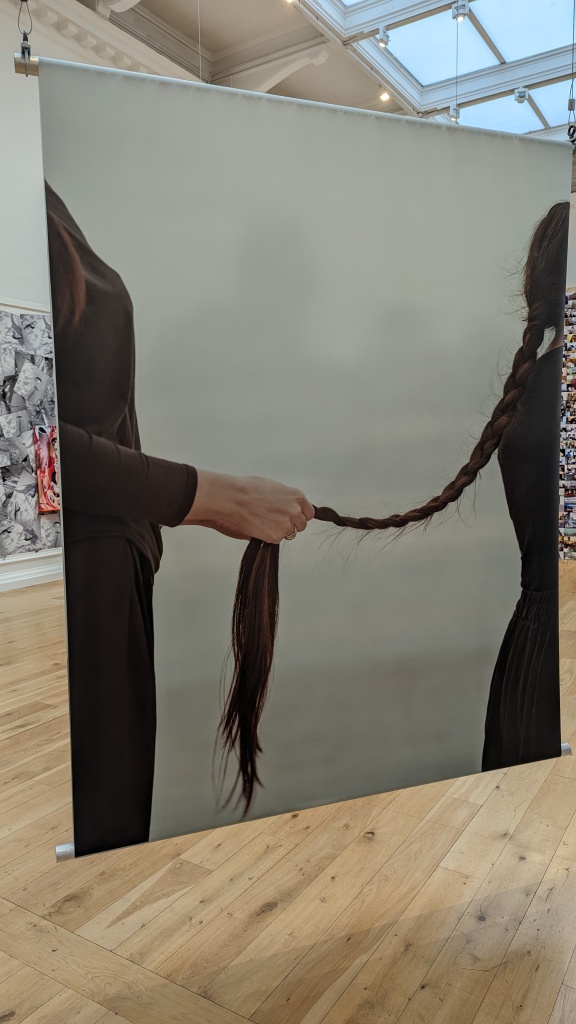
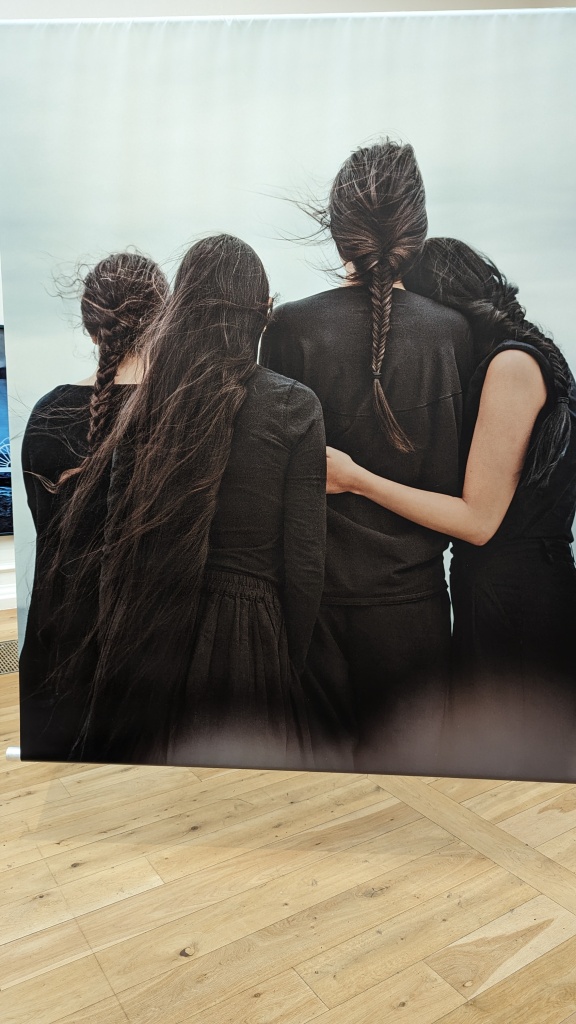
Hoda Afshar, In Turn (2023)
Tehran’s ‘morality police’ killed twenty-two year old Mahsa Amini for not wearing the hijab under government standards. These photographs are one with the protest against that legally sanctioned murder of a woman’s freedom and choice over her body.
The photographs are staged images that utilise the imagery of the doves, birds that are released at the funerals of those that have lost their lives in the protest. The birds stand for martyrdom and peace.
The women in the photographs are largely anonymous because anonymity protects the protesters on social media. These protest photographs show women plaiting each other’s hair and discarding their veils. The hair is plaited as respect is given to women freedom fighters fighting in Kurdistan against the Islamic state. They plait their hair before battle.
These monumental photographs are impressive and powerful. They give a body to the protesters and, with it, humanity. A community is formed around hair and the freedom to show it. The large format itself is a celebration of women and female bodily display, the ‘exposure’ that photography gives. Because, despite the fact that most of the models are anonymous, in the final images as we walk through the space, as you journey through the images and the story they are telling, you see the full frontal body of the woman with doves and her face is completely visible. And on the reverse, you can see the profile of a woman that braids the hair.
The plaited black hair of warfare and the white doves of peace tell a story. To have peace, you have to have the war first. Peace is the aim that can only be achieved through fighting for the rights to have choice and freedom. In the final photograph, a pair of hands braids the hair Another pair of hands superimposed on the back of the woman whose hair is being plaited holds the dove of peace and martyrdom. A reminder that freedom costs something. The fight.
These photographs are an inspiring celebration of heroism.
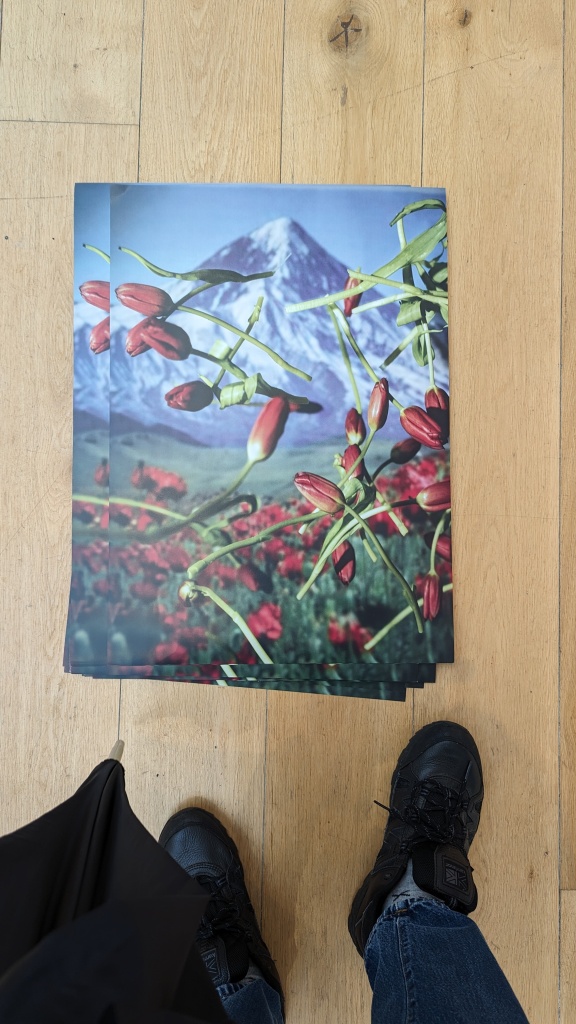
Sheida Soleimani, ‘Tulip Poster’ from the Series To Oblivion (2016)
This poster is a tribute to the Iranian women unjustly imprisoned and killed by the state. The tulips reference an Iranian revolutionary song that sees the flower as revolutionary hope – because although it is fragile, it is resilient and it regrows every spring. The numbers on the back of the poster show current published data of those arrested and killed by the Iranian state.
The redness of the flowers. Blood. Against the mountain in the background. With their stalks, the tulips are the ladders up to the peak. They are the scaffolding that can even go above the peak. To ascend the ladders, you have to have the revolutionary hope. Which no sword can cut down. Which no gun can diminish. The tulips are the beauty of hope. The beauty of the revolution. They transcend death with their growth. They have the beauty of growth, nature, resilience. To ascend the ladder of hope is the ascent into heaven. In the religious context of the photographer’s background, this is the image of faith in the revolution and eternal justice. Like Antigone, the photographer promotes the eternal laws of justice rather than the man-made laws of the earth.
Wendy Red Star, Amni (Echo) (2021)
This is a tribute to the matrilineal clan membership of the Appsalooke Nation which was erased by colonialism and its patriarchal laws. The artwork gives power back to the women in her family (the photographer who is Wendy Red Star, her daughter and her great-great-grandmother). And the power back to the names of the women of the Nation.
This was one of the most moving of the artworks in the exhibition for me. They called them Indians when they are Native Americans. They took their land and tried to destroy their culture and their people. They are us. We also have clan membership through our mother – Mother India is our mother and the religion of my mother is the Mother Goddess. It is this which the patriarchal, colonising state wishes to destroy and, with it, difference.
The names of power call out in the background, behind the photographic sculptures. And the photographs themselves build power. Out of the small photograph at the base, a greater entity is formed through the use of overlapping photographs. If you look carefully, you see that the aura is extended into the names of power behind, with the use of negative white space.
One of the ideas around photography when it first came into widespread use was that it could take away the soul of the sitter. Here, that idea is reversed through resistance against the patriarchy.
Because the photograph of the great-great-grandmother is there and the different generations, the photograph scultptures build up the matrilineal history which the law and the colonising state wanted to end. In the face of erasure, we have the form that has come back to us, become literalised in word and image. The phoenix has emerged from the flame.
…
The exhibition included many other pieces worth a careful examination and study. My overall impression of this exhibition is that I learnt a lot from it and I was inspired by it. We, our community, we also fight the wars against the patriarchal state and its patriarchal laws. For our way of life. For our culture. The patriarchal law wishes to kill what we are. We, the ethnic minorities, even if we are the men, we are also the women.
And the photographs showed the resistance can take many different forms. There are many dances to learn. Many songs to sing.
Time and time again, the photographs exposed what the patriarchal law of the state is. And why it has to be fought against. Not just in ‘other countries’. In Western type countries like Australia and Poland.
Sometimes, I was disappointed. One video installation said to become a ‘peaceful warrior’ and not ‘an angry warrior’. I don’t believe we should spit out our anger. But the philosophy of India is that everyone has their own path. Who are we to judge? As long as the warrior remains the warrior. That is the point.
The union of women with photography suggested calamity to the male Victorian authors that I studied. It suggested the revolution. The exhibit of feminist protest photography is the natural outcome of the resistance. As a form of truth which exposures the corrupt heart of power, photography has few rivals. These images demand more attention and more thought. Within them, they contain the resistance to the state structure and the patriarchal law. And, within them, they contain the conception of justice that the patriarchal law does not have, with its false claims to universality, timelessness and ‘truth’. By making photography concrete, by giving it the female body, these photographers have fought against the male body of the law with its male subject. They have created women’s – and photography’s – jurisprudence in the present moment.
In the end, the warrior loves the warrior. The exhibition is warrior culture.
This opinion reflects my personal views in my capacity as a private individual and does not reflect any consensus or anyone else at any of the organisations I work at or volunteer for.
Ascending up the stairs to the exhibition space on the mezzanine, you see a window through which you glimpse another world, another milieu, the past. It is a rare interior scene of a coffee house, one of the new forums for public debate that shaped the modern world. The customers are reading the newspapers that created the imagined community and fostered and nurtured the Western nation-state. Thus begins the historical journey into the Chocolate House in Greenwich. We are guided through a sort of window onto the past.
Behind another window, we then see the esteemed lady that ran the Chocolate House on Blackheath as one of the many women in history that have provided the world with its unique and wanted things. It is Grace Tosier ‘at the height of her powers’. Her eyes stare at us in the portrait through time. We are sharing her vision. She is the character that is leading us through things, the guide, the model: a strong, independent woman in a capitalistic culture. The heroine for this time and this society.
We learn that the Chocolate house served royalty. It then ‘became the Georgian equivalent of a celebrity hotspot’. So now we experience the glamour of the place.
The exhibition now shifts its focus. The story changes. We start learning about the origins of chocolate in South America, how it came to Europe, how it involved the morally reprehensible evils of a capitalistic society which evolved from slavery and exploitation. The trajectory of the story has shifted. We have come to a moral reckoning of the realities behind the glamour of the chocolate house. A confrontation with evil.
At this point in the story of the exhibition, like a huge wild monster from the imagination, we see a glorious display of the Cacao Tree rising up on the wall against a black canvas. The plant is covered over in insects. Why this image? The beauties of nature? The absolute origin of chocolate depicted without any varnish, perhaps, warts and all? The idea that the comforting illusions of capitalism, when the veil of ideology has been ripped off, reveal an insect-ridden reality?
The story of the exhibition journeys next into how coffee houses enabled ‘the free discussion of the latest ideas, unrestrained by the protocols of the royal court.’ In the light of what was before, the implications begin to produce a result: the free speech of this country is founded on the fruits of slavery and exploitation. It is an implicit link.
There are quite a few interesting pictures to ponder over at this junction in our journey which reflect the culture of the times, so that the task of time travel is further enabled.
Now, there is the context: Greenwich. So the place is elaborated.
A table draped in a table cloth reveals the production process of chocolate.
We then move onto the last years of the Chocolate House. And we see an image of what the building might have looked like from the outside.
Finally, the piece of the resistance: the final destination of our time travel. In a room, we enter the chocolate house. We are fully immersed now in the space. There is a life size reproduction of Grace Tosier’s image as we descend down the ramp to meet her face to face. A video plays in the space to complete the immersion not only through space in the room, but through vision, sound and characterisation. We have travelled backwards through time into the space of the chocolate house.
What do we make of this exhibition? It covers a lot of ground to make a coherent narrative: this was the chocolate house, with all of its social and political implications at the time, with its basis in capitalism, exploitation, slavery. With its enabling of social mobility at the same time for women like Grace Tosier in this context. All of the pertinent facts are presented. There is balance. And there is a stimulation of the senses with pictures and videos alongside the curator labels. There is the face of Grace Tosier to characterise the whole scene, as well as the images from the country of origin with the people there.
You get a sense of historical immersion in the chocolate house. You get a ticket into time travel into Greenwich in the 1700s – a unique virtual reality experience. An enabling of the imagination. A real journey into another place and time.
My overall sense of the exhibition is that it is interesting, unique, well researched and well thought out. In addition, there were labels for the children which would make them interested in this topic that they love too – chocolate (and the pictures to stimulate their imaginations). This was a conscience driven exposure of the past and its evils, the foundations of the public forums and the discussions that they bred that have lasted into the present, the foundations of the modern day nation state and its present evils in the evils of the past.
I did feel a certain want in the exhibition – I wanted to know more about Grace Tosier, the character that we meet face to face. A curiosity about her. But of course, the reality is that while we have a name and an image, we cannot expect a biography in a historical exhibition like this. Part of the fun is imagining her life, too. Part of the fun is being stimulated to know more – and the chocolate house exhibition certainly does this. So, in summation, a stimulating and unique experience which fosters a self-reflection on the economic and political origins of our public forums and our public discourse, what has made us and this state into what it is today, a real journey. A real experience of learning.
All views in this article represent my personal views as a private and political individual and do not represent the views of any of the organisations I work at. My expertise? My PhD involved the early history and reception of photography in its political and legal contexts.
‘Don’t survive it. Live it.’ These were the words that someone said to me recently. Survival is the most important thing for us as a species. In the field of psychology, they tell us that the human mind is geared towards survival. That’s where we get our intelligence from: evolutionary adaptations for surviving. But with survival, you have to live it too. You have to experience the fight.
The new photographic display ‘Echoes of the Blitz’ shows how we have to live through our survival. The exhibition ‘explores how Underground stations and metro systems provide shelter to citizens during periods of war – now and in the past’ [1]. How, when you are confronted with death and mortality, when you look death in the eyes, you fight for breath, sense and security. How you find shelter in unexpected places in extreme circumstances and still make a life for yourself. How throughout history and its rivers of blood, throughout the modern period and the supposedly ‘civilised’ Western world, people have hidden in fear to preserve their life, children, culture and heritage.
In total, the photography gallery displays:
‘70 striking images, including historical images from the Museum collection alongside 38 contemporary photographs by six renowned, mainly Ukrainian, documentary photographers.’ [2]
Some of the most recognisable images of the war have been of people sheltering in the London Underground shelters and these icons of memory are given an update and a new relevance through a juxtaposition of the scenes in the Underground shelters in Ukraine.
According to the London Transport Museum, what we are seeing is:
recent photography of ordinary Ukrainian citizens in extraordinary circumstances. They are shown sleeping, waiting, cooking, washing clothes, caring for their pets and creating temporary make-shift homes in Metro stations in the Ukrainian capital Kyiv and its second largest city Kharkiv. These scenes are ‘echoed’ in the black and white archive images of Londoners taking refuge in Tube stations during the Second World War. [3]
The aim of the exhibition is to:
present strong parallels of human experience across different locations and conflicts. This exhibition documents the resilience of people in Ukraine and London during times of war and the reality of having to escape from aerial bombardment. [4]
Other comments have been made about the aims of the exhibition. Matt Brosnan, Head Curator, London Transport Museum, said that the photographs ‘show the resilience and tragic reality of war’ [5]. Stefan Günther, Project Manager, Photo, n-ost, said that the exhibition is ‘an opportunity to perceive the current war in Ukraine on a very personal level, away from the wider political and media glare’. [6]
I think that the exhibit makes concrete the idea of Ukrainians rather than Ukraine. All nations are fictions. It is the people there that are real. And in these photographs, we see the people directly and how they are having to live. And it is photography and its truth that allows us to see the reality behind the abstractions of the newspapers. It is photography that allows us to see them face to face and come directly into their lives. As a matter of fact, the frames of the exhibition invite us to do this. The black and white World War photographs have black frames. These photographs are framed and closed off to us – because as we know, the past is a foreign country. However, the photographs of the Ukrainians are not framed. We are in direct contact with them through our eyes and our perspectives. We are immersed into their world. There is no separation from us through the device of the frame. What is happening there is spilling out into our world, including us. Asking us to contemplate, sympathise.
Some historical details taken from the London Transport Museum website allow us to see the facts behind what is being portrayed:
London’s air raid sirens sounded almost every day for eight months from September 1940 to May 1941 and again between June 1944 and March 1945. Sheltering in Tube stations overnight became a routine. There were special admission tickets, bunk beds on the platforms, refreshments and, at some stations, libraries, music and live entertainment.
In Kyiv, sheltering in the Metro peaked at around 40,000 people at the beginning of the Russian invasion in February 2022. Some stayed overnight, others for days or weeks, returning to the surface only for groceries or to wash. Those who lost their homes lived underground for months.
Kharkiv, close to the border with Russia, experiences more frequent shelling. People spent more time in the Metro there, creating comfortable homely spaces with bedding, tents, carpets, decorations and toys. [7]
After you have read the blurb of the exhibition, the first photograph that dominates is ‘Woman in tent at Dorohozhychi station’ by Maxim Dondyuk, 2 March 2022. The woman defensively has her hand held to her shoulder, covering her chest: a striking image of someone in need of protection, someone that has to defend themselves from an unjust attack. She has to comfort herself with that hand on her shoulder. The woman stands out isolated from the crowd behind her that is not visible, vulnerable and isolated, perhaps like the situation of Ukraine itself – a country that has been left to fend for itself by the ‘civilised’ world of modernity which has disappeared when it is needed. She looks directly at the camera: she implores us to look upon her as the fate of her people, the innocent civilians subjected to the imperialism of the modern day state and its brutality, to their unjust greed and their uncontrolled and obscene desire for control, domination, land and resources. She asks us to acknowledge our role, the roles of our countries that have left her in this position. Does she ask us why? Her face is touched with sadness and suffering. She is in – through the connotations of the opening of the tent – in the dark den of despair, half-eaten by the hole, the absence.
In terms of its historical importance, the exhibition features one of the first ever photographs that were taken when the war broke out and the Ukranians sheltered in the underground stations. Viacheslav Ratynkyi, that on the very first day of the Russian invasion on 24 February 2022 he went down into the Metro and brought a camera so that he could document the situation. [8] The people have used the edges of the stairs along the walls as seats to create a clearing in the middle so that others can move up and down. They have been resourceful to give themselves make-shift seats that would be extremely uncomfortable to sit upon for long periods of time. They have had to adapt for survival and protection as a group, a group and species bound together by necessity and the cruel games of the politicians and the modern day states that are supposed to serve and protect them, the states that are supposed to be bound by the laws and justice. In response to the unjust throne of the state and its modern day king, who cannot sit as he should, the people sit heroically and patiently, in solidarity and suffering. They begin the long wait for peace, the desire of every thinking and feeling human being. These people are the human contrast to the inhuman face of power and brutality, the fascism of the modern-day state.
When I say I am Indian and come from India, it is the India of the people, not the India of the politicians or the intolerant and oppressive citizenship that they want to create. The state that they create is not India. What they create is corruption. We, we the people, we are India. And here, in this photography exhibit, we have the Ukrainians and Ukraine. These people are not defined by the war. In this exhibit, we see them doing the things that we all do every day: listening to music, learning, reading, dying their hair. Holding each other for comfort. They are victims of the state and the politicians. But they have organised themselves. They have created a space away from the brutal games of the state and its quest for total domination. Across world history, across the suffering that man has created, we look at the victims of the politicians and how they have tried to carve out another space and another reality beyond what the unimaginative and corrupt state has imagined. People who live through their struggle for survival. With resilience. As I look at these photographs, I know that one day, the modern-day state with its evils will fall. It has to. Because the spirit of the people will one day overcome the absurd egotistical limitations of geographical and racial boundaries. You can see this in the people and the photographs. You can feel the power of pure being. The desire to move out of the control of others. The spirit of resistance. The spirit of overcoming. Because these people are not trying to create a nation state down there in the underground shelters. They are trying to create a human community: a sphere of protection and life. It is a world meant to foster life – the world that we are trying to create by countering domination with the philosophy of live and let live, by countering selfishness with the desire for preservation, by countering the desire for destruction and death with the desire for life and the future.
If you want to see what a real hero looks like, don’t look at the soldier with blood on his hands, the killer for the state. Look at the everyday hero that fights for survival in an oppressive world and the games of control around them by trying to create another reality – the reality of peace and life. Freedom from death, envy, killing, exploitation. Freedom from the state and its obscenity and blood lust. The people that have created history, tradition and culture by surviving – by fighting to survive and live through that survival – and not by dying and killing in war.
Since I work in the area, it is quite convenient for me to see the Astronomy Photographer of the Year exhibition during my lunch breaks. So I often go down to see it. I love looking into the sky of stars and look at the universe which envelops us, the larger world that gives us perspective and power. Because we are all part of something larger. We are the consciousness of the universe, if it has one. We are its only known intelligent life forms. And she is our mother.
This is a universe that has been taken away from us through the narrow mindedness of the world, through light pollution, urbanisation and industrialisation. That view of the skies which was us for thousands of years and millions of years when we were not yet quite human has been taken away from us by Them. This exhibition gives us back our continuous inheritance. That is why it is important to me and why I love it.
Here are some of my favourite images from the exhibit and why:
Filip Hrebenda ‘Green Snakes’
A photograph of green aurorae, the coloured lights in the sky. Amongst reflections of water and and stark black lava-esque mountains and ridges. Green is one of my favourite colours and you can see the hazy greens here melting into the skies. The leading lines of the reflecting water lead the eye towards the peak of the mountain, giving an effect of the sublime – overwhelming power that engulfs us. It is a truly awesome and epic shot which leaves us in awe at the beauty and the mystery of nature.
Peter Hoszang ‘The Green Glow’
The same subject as before – the coloured lights in the sky and the mountains. This one has less of a warm feel because there are more blues. And there is also ice in the waters. It is a different vibe, but with the same sublime feeling, since the lights in the sky dwarf the snow-capped mountains.
Monika Deviat ‘Brushstroke’
The aurora – the coloured lights – again green, look more abstract here because they are only seen against the night sky and the stars. The aurora is divorced from the setting. The artist says it looks like a brush stroke. The image is effective because we concentrate on the lights without any distractions in the background. Simple and focused, isolated. The beauty of light, pure and simple.
Vincent Beudez ‘Butterfly’
Purple, white and green aurora in the shape of a butterfly. Amazingly poetic and beautiful. The word butterfly is associated through tradition with the ancient Greek word ‘psyche’, which means soul. Wouldn’t a soul – if such a thing existed – come in the form of a butterfly of light? Radiant, ravishing, roaring.
Katie McGuinness ‘Close Encounters of the Haslingden Kind’
A stunning view of Haslingden’s Halo – a panopticon sculpture – amidst the night sky. The shining structure pictured against the movements of the night sky through a time lapse capture really caught my imagination with the blue and the white hues. It was a moment where you realise that the future that they imagined, the technological future, has actually become a reality for us now. The technology, the art, the structures that we make, seem like something that has come almost from an alien intelligence that is years ahead of us in thought and technology. But it is us that did it. We are the alien intelligence.
Angel An ‘Grand Cosmic Fireworks’ Dancing, fluorescent lights above the Himalaya mountains (atmospheric luminescence made of plasma and electric discharge). What is there not to like? There is something like seaweed about the lights that are almost immersed in the clear water of the skies. It is a scene which I could never have imagined and this is what gives it its power. Things like this are happening beyond our eyes, our comprehension, our ken. They enlarge us when we see them.
Chunlin Liu ‘Autumn Milky Way Arc and an Orion Bolide’
There is something so exceptionally Chinese about this image of the Milky Way arc, something so emblematic of the art. The horizontality of the image for one thing, the delicacy of the skies that have been rendered, the mountain scene which we associate with Chinese ink brush drawings. Amazingly beautiful, delicate and wonderful. A loving homage to the perspective of a culture which has been fostered carefully through thousands of years of an art tradition.
Vikas Chander ‘The Dancing Trees of Sumba’
These mangrove trees are shaped in such a way that people call them the dancing trees. They look as though they are frozen in a dance posture. Against the beautiful sky reflecting in the water which is like a mirror, they are incredibly elegant, a reminder that nature thrives in the universe, it dances in the dance of creation.
Mehmet Ergun ‘The Great Solar Flare’
I think of myself as the Sun (my name is Sun-eel). This amazingly detailed, textured view of the sun and its awesome power is really an iconic image. So bold. The sun fills the frame, giving that air of dominance as the ruler of our galaxy.
Alex Savenok ‘C/2021 A1 (Leonard) in the Sky of Israel’
Above the Negev desert and its picturesque ridges, we see ‘a celestial visitor in the night sky’. The image looks like the covers of science fiction books. It doesn’t seem real. Yet this is our earth at night time, if only we had the opportunity to see it. A taste of what we have had to miss because of the industrialised world and urban living. A taste of what we have had to lose, that connection with the skies and the reality of this planet, this universe, our mother.
Eduardo Schaberger Poupeau ‘Crescent Moon in a Magical Sunset’
A beautiful crescent moon in an orange, yellow and white sky. A sense of the crescent swirling in the clouds, full of movement and dance.
James Baguley ‘The Dark Wolf – Fenrir’
A homage to Norse mythology – Fenrir the wolf caught in red (a molecular cloud surrounded by red hydrogen gas). A reminder of the phrase that ‘Nature is red in tooth and claw’ – a lesson to be learnt from a perusal of this image. If anyone knows the mythology of Fenrir – I used to read mythology books as a child and was obssessed with the myths – this picture would become pregnant with meaning. With the themes of fatherhood, destruction, trickery, imprisonment, the animality of the human…
Steeve Body ‘The Majestic Tarantula Nebula’ Runwei X and Binyu Wang ‘The Running Chicken Nebula’
Both of these are a ‘cosmic ballet’ in glorious and awe-inspiring colour. Showing that human made abstract art can’t rival the play of forces in the universe to create patterns in the universe on a colossal scale as works of art. Full of fire and life.
* NOTE: My amateur shots above. All images are copyrighted, but please ask if you want permission to share.
In the time when I had leisure at my command, I spent many happy moments in my garden photographing the microbeasts. I would scour the grass and the leaves, upturn the stones, scrutinise the spider’s webs, look in every nook and cranny. And there! I would find it, a beautiful little minibeast. The camera dangling around my neck would be de-lidded, I would focus the shot several times before I got one good image and I would try out several different angles to try and get the best shot. It would take a good while, the camera would shake because I was focusing on something so tiny, the shooting was basically impossible when the critters were moving around, and I had to take a good many steps to the side before I could get the insect out of the shade for a good, lighted image.
I worked with cheap apparatus (not the cheapest, but fairly close to it). My parents had bought me an entry level digital camera that was on sale as a present and I attached magnifying lens filters to the standard lens. This was the cheapest option instead of paying several hundred pounds for a macro lens. Even the activity itself was cheap – aside from a battery charge, it was basically free (an important consideration for why I did it – I was studying my PhD – which included an analysis of fictional representations of photography – at the time). Even the photo editing was done on free software (at first).
It was with some curiosity as to how a professional approached the task that I went down to the ‘Microsculpture’ exhibit at the British Library (one of my favourite places in the whole world, it must be said, as a bibliophile and a researcher). Levon Biss used the focus stacking technique in which you take multiple photographs from different angles and combine them together in an image that gives consistent depth of field over the whole shot. The results are nothing short of miraculous and awe-inspiring. Yet, for me, the amateur, there was always the thought: it was because he had more money, technology and resources than me that he could produce these photographic masterpieces.
The insects are set against a black background. They glisten like petrol, as though they were doused in the stuff. They are incredibly colourful and one wonders at their ‘fearful symmetry’.
The advances in technology have provided the conditions for these striking images. Biss was able to take thousands of photographs to combine together to give the perfect focus over every aspect of the form of the minibeasts. And there was the wonderful microscope that he had been using as well. All the painstaking labour that it would have taken to get each individual shot and then combine everything was all digitised and done relatively speedily. There was also a massive scientific endeavour which allowed Biss to retrieve such beautiful specimens from the insect archive. Although the exhibition bears his name, there are so many people involved in this contemporary process of photography: scientists, archivists, inventors, businessmen… I’m sure I’m not doing much justice to the list.
What were my impressions of the specimens? I am a lover of nature. I am also a lover of design. The specimens were almost presented like samples of design and this is the intent of the exhibition which emphasises them as microsculpture: a focus on the evolutionary adaptations of the bodies of the insects. There was a cross-fertilisation between product photography and nature photography. I liked the results, but I wonder how less scientific people would think of presenting living bodies as pure function. For me, the functional aspects contribute to the beauty seen. But I believe that we are just bodies and nothing more, machines that think based on the arrangement of matter of which we are composed.
The Western mindset is different to my Indian mindset. The West sees things and bodies as discrete objects. Hence, there is the insect against the black background, a solitary individual. I, the Indian, see things in their context. This is why I photographed in the garden, with real backgrounds. The presentation of the discrete, individualised insect is a reflection of a culture that values ‘independence’ (which is impossible, since we live in a network of dependency and relations). The exhibition is asking us to identify with these creatures as isolated and atomised (dead) objects: a reflection on this contemporary world.
My overall impression of the exhibition is the pure love of the crystal sharp, enhanced, blown up image that I was not able to produce. As an amateur that worked for free for my own amusement, I was nowhere near these productions. They are the result of massive investment, many hands, cutting edge technology. They are an inspiration. But in the history of photography, they are the work of a tiny minority. Us amateurs still rule. And, compared with my own humble shots, these highly finished and sharp images lack something in their presentation of a perfect, direct, ‘straight’ shot. They lack the element of chance, imperfection, technological limitation. Those ingredients created shots with more character and more drama, to my mind (I am talking about photographs that are my memories, my babies, my loved ones, over whom I am possessive). If the exhibition is science, if the exhibition is for the animal lover, the direct vision is what is wanted (let us not pretend it is objective and unmediated however. Selection and arrangement and angle all play their part). If the exhibition is seen as a demonstration of skill rather than technical proficiency, I would query whether it was really better than my potterings about in my back garden with basic equipment. But this, of course, is purely subjective: envious, of course. It is a good, pioneering exhibition and I would like to buy the book.






 diary of a lone man