Chigwell to Harold’s Wood – London Loop (Travel Diary)

05.10.2025

Absolutely superb. That’s what the weather was like for the long walk. I met up with my friend at Newbury station and we bundled ourselves onto the Tube at nine o’clock for an early start on the day.

In the morning, it took about the same time to get into Chigwell as it would take me to get into Central London for work due to a change at Hainault and a long wait for the next service. On arriving at Chigwell, I was struck by the beauty of the place and the grandeur of the big houses out there. Really a dream destination to live in. Chigwell is called Chigwell because the name derives from an Anglo-Saxon personal name, ‘Cicca,’ and the word ‘well,’ meaning “Cicca’s well”. 

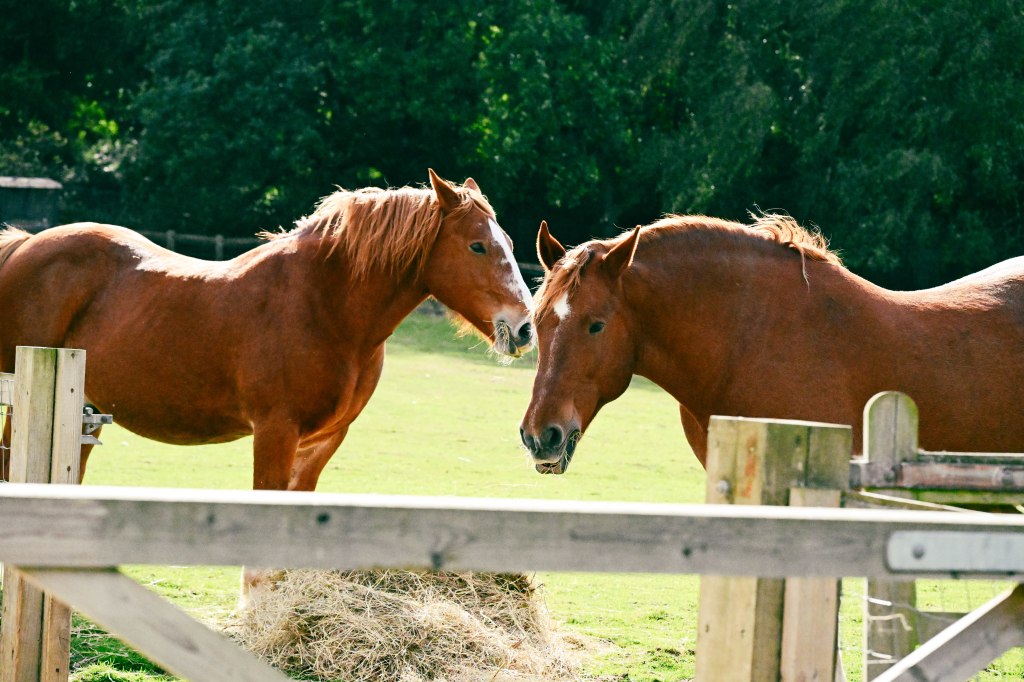
We came across some beautiful horses but I couldn’t get a good shot or composition. I have a personal ambition to ride a horse but haven’t got round to it yet. It is a very modest and achievable ambition but I am always too busy for it.

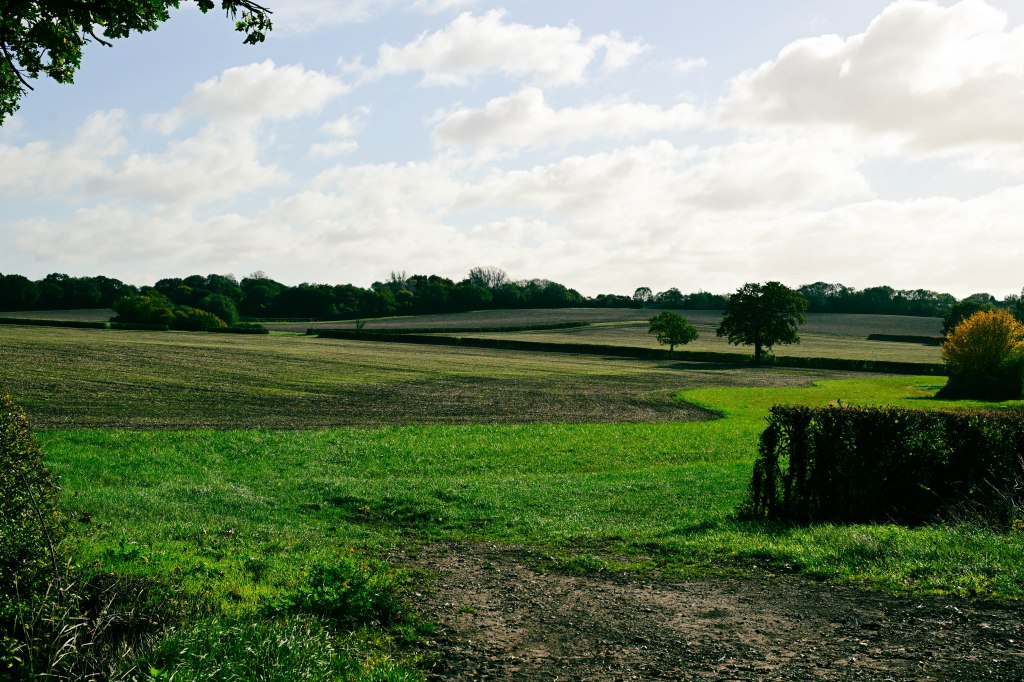
Almost at once, we came to a beautiful view and the farmlands. I had already got out my camera and was trying a few shots. As I did so, we came across some fellow walkers and they told me and my friend that they had been doing the walks on the London Loop for about two years. They were finally going to finish off the walk today. It was an old father with two young blonde daughters, one of them wearing a red jacket and looking somewhat like Red Riding Hood.

As we trailed after them when we were ready and they were already in the far distance, we worked out the percentage of weekends they had committed to their mission as we were arguing about how committed they were as walkers. If they had taken two years for about twelve walks on the London Loop, that would work out as them having invested 6% of their weekends on the trips over two years. I maintained that that was quite committed but my contrary friend disagreed with me.

My friend is a birdwatcher and I was trying to one up him by spotting more birds than him. I got a robin that he hadn’t noticed and felt quite chuffed but then he showed his experience and expertise in this subject. He spotted a woodpecker, a brilliantly yellow coloured creature that I had never seen before. It was winging its way through the air. He also spotted some buzzards and regaled me about the story of the corpse of one he had encountered recently as roadkill. On the trip, we saw about nine different species of bird, so it wasn’t a bad day: peacocks, hens, Egyptian geese, robins, a white egret, the woodpecker, crows, some little ones I forget the names of and seagulls and magpies. So for birds, it was certainly a great day.

It was a delight to stop for elevenses at precisely eleven on a little bench in the woods as I had a Dairy Milk with me. I shared the chocolate with my friend. I was watching the birds fly into the trees. A Dairy Milk always reminds me of the war. Probably it is because Roald Dahl, my favourite author as a boy, mentions being a taster for Cadbury’s chocolates in his biography and he fought in the war.

Around Chigwell and its forest, we came across an Islamic chapel with Christian gravestones in the garden which was quite an example of religious amalgamation. We didn’t go inside but looked at it with intrigue from the outside wondering what it was.

The next phase of our walk was Hainault Forest Country Park which is not too far from our local area. Hainault Forest was an old royal hunting forest. I had gone there many a time with the family. We saw the two daughters with their father there and I shouted out to them that ‘it wasn’t a contest, but…’ and they all laughed which was pleasing. They were sitting on a bench looking out at the lake. We kept on walking and didn’t see them again and probably won’t in this lifetime.

Hainault gets its name because its original Old English name, recorded as “Henehout” in 1221, meant “wood belonging to a monastic community”. The Abbey of Barking owned Hainault Forest. The name’s spelling later changed because it was incorrectly associated with Philippa of Hainault, the queen of Edward III. 

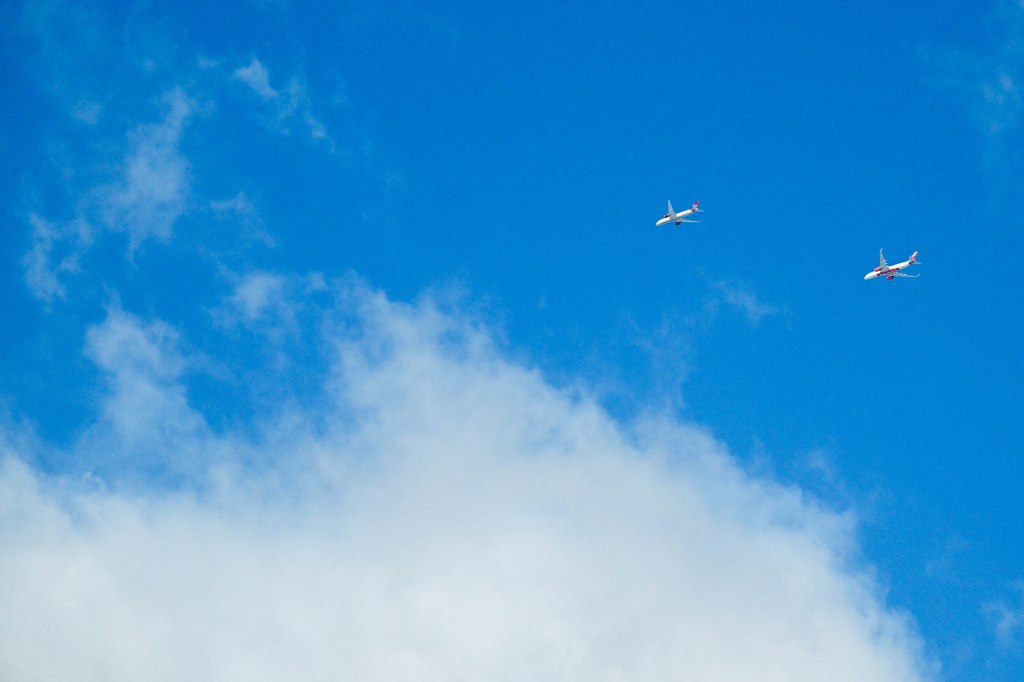
We stopped for a hot drink in the cafe and it was absolutely chock-a-block with young families. So we sat outside. Lazily, I watched two brightly coloured aeroplanes flying about in the sky and the families with their dogs all making their usual Sunday walk around the park. I was telling my friend that I should buy a dog so that I could also talk to the dog people.

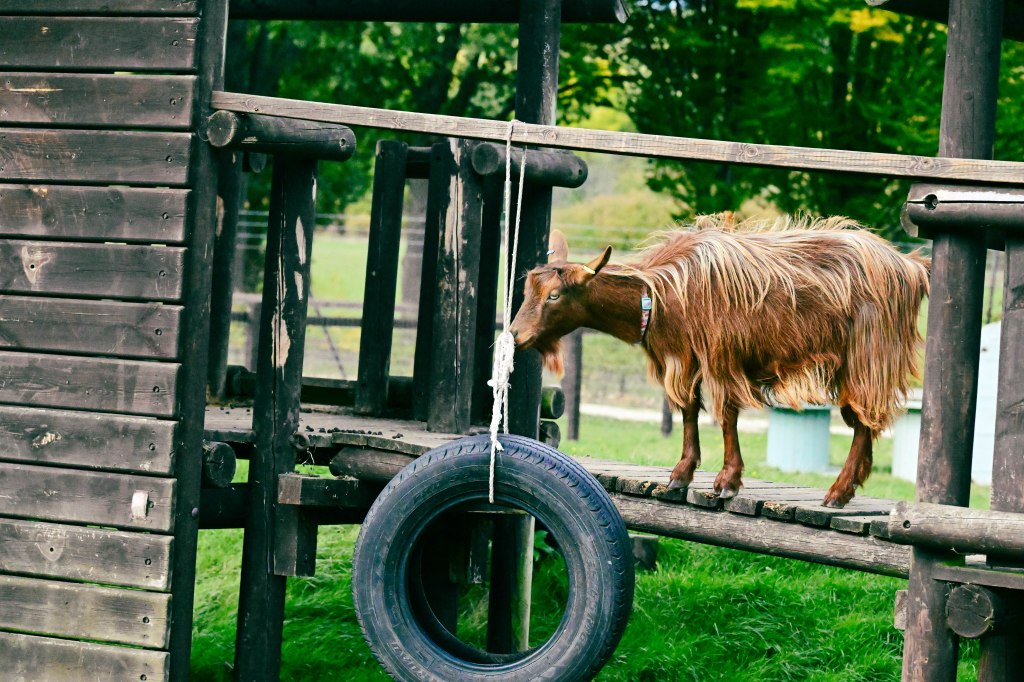
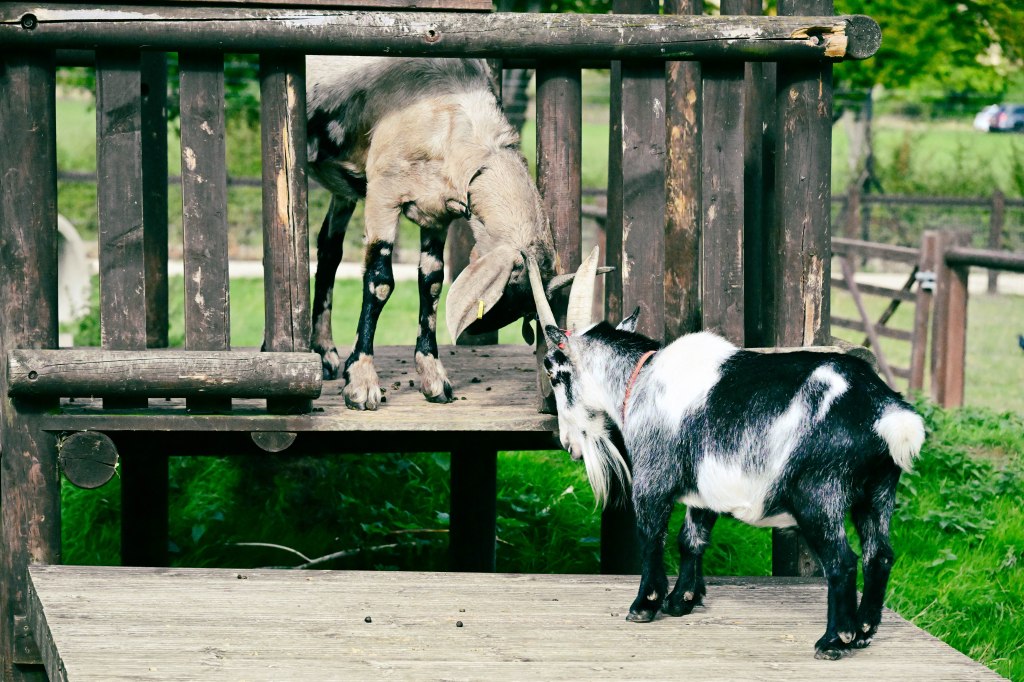
After that I persuaded my friend to go to the farm and look at the animals. The goats were all butting heads with each other and the peacocks were sunning themselves. I got a few okayish shots on my camera as the light was quite good but missed a dramatic fight that the goats with brown hides were having as people had stopped to watch them and I didn’t want any people in the shot.

We walked through the golf course next and then we were back in the forest and in the farmland and then the forest again. There was a rough swing rope that someone had put up in the trees. The only way to get to it was up some precariously placed logs, so it was a challenge of balance. I climbed up it childishly and recklessly. It was only a few feet off the ground but felt like I was walking in the atmosphere and slipping about. I managed to get to the swing rope with my hands but then there was no way to get any momentum to swing about! I had almost fallen off once, but only once. And I hadn’t. So man nature was appeased. My friend shot a video of me doing it.

When we had walked through an enchanted pine soaked place with a delicious scent, I decided that we should stop for lunch. I had brought chicken satays from the reduced aisle with me and the scent was too much. Because we were accosted by two dogs that wanted to partake of the feast. The first one was a giant and was very forward and slightly menacing. Two young boys had to run up and grab him by the leash to get him away. The other dog was a black miniature hound and his owner, an elderly lady, said that he was ‘incorrigible’ as she rushed off with him.

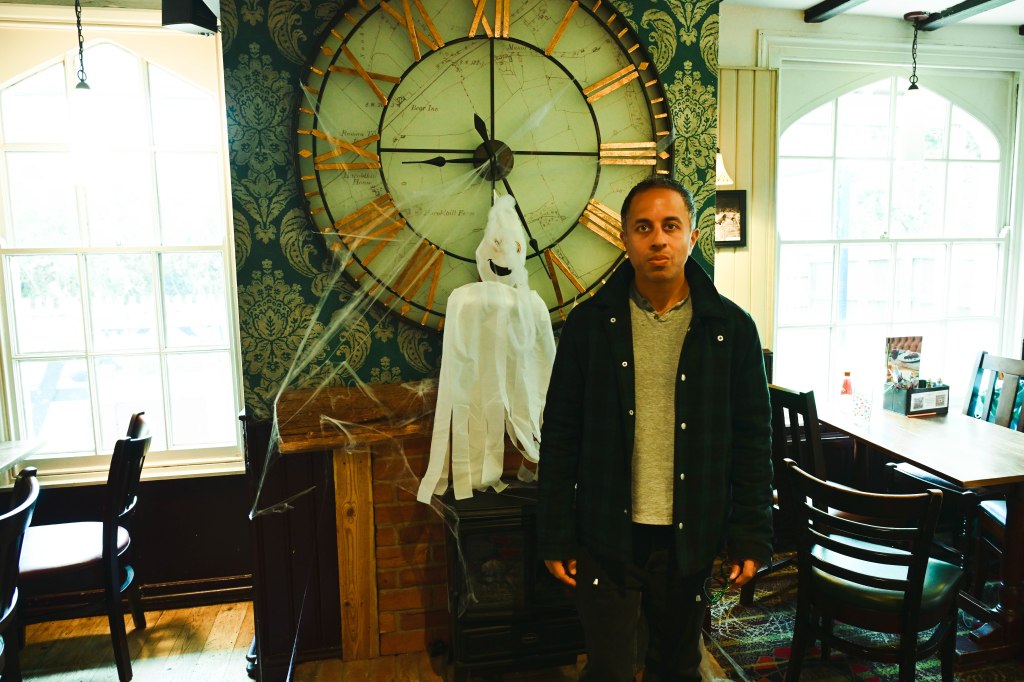
After the forest, with its beautiful light and soothing smells and ambience, and after watching the little trickle that was the river Rom, the next thing, we were sitting in a pub called The Deer’s Rest which was in Romford itself. The whole pub was tricked out in Halloween decor. I got us some drinks and downed an ice cold Pepsi. It was absolutely delicious in a way that Cola is not always. My friend told me that I had worked enough so my body was rewarding me for the work with that delicious sensation. He said that he was having it with his drink as well. The pub had this wallpaper of framed butterfly specimens and it was something that I quite wanted for myself as I thought it looked very sophisticated and cool. And much nicer than real specimens of butterflies which I have always found slightly creepy. Because they are dead beauty.

We walked on through the beauties of nature talking about life, the universe and everything. At some point, we found ourselves in a park. I was keen to watch the young people at the skate park but it was disappointing. They were not doing any tricks! The kids were quite young, but then that Olympics gold medallist had been about thirteen. As we progressed through the park, we came across a father at the top of the slope throwing around a brightly yellow coloured glider aeroplane towards his son. The son was babbling away at us as I remarked that the dad had made a good throw. It was a really touching scene of family and its happiness, the joy of children.

The last stretch of the walk took us to Harold Wood. The name Harold Wood refers to an area of land associated with King Harold Godwinson, the last Anglo-Saxon king of England. It was about four o’clock. We had initially decided to do a bit more but decided to pack it up before the light started going and we’d done about thirty thousand steps. It was about eleven miles well spent.

Eija-Liisa Ahtila, “The Power of Trees”

Exhibition at Kew Gardens Shirley Sherwood Gallery of Botanical Art

Running from April 12 to September 14, 2025

Review by Dr. Suneel Mehmi (first version of an exhibition review for Plantcurator.com)

Images courtesy of Kew Gardens.

What is a portrait of a tree? And what can such a portrait do? What can a tree portrait tell us about ourselves as humans and our systems of representing ourselves and nature? These are some of the questions behind the Finnish visual artist Eija-Liisa Ahtila’s exhibition ‘The Power of Trees’ at the Shirley Sherwood Gallery of Botanical Art at Kew Gardens.

The Power of Trees. Royal Botanic Gardens, Kew. The Power of Trees invites visitors to explore the enduring beauty of trees across art and culture.

A prominent – and spectacular – piece in the exhibition Ahtila’s Horizontal–Vaakasuora offers the living video portrait of a 30-metre-tall spruce in Finland’s boreal forest. The tree is shown as a sublime horizontal, subverting our intuitive perceptions of how to portray a tree and highlighting how the limitations of the film frame can shape understanding since the tree could not be captured as a great vertical but had to be rendered horizontally to capture its majesty.

Alongside the installation are Ahtila’s preparatory works, Anthropomorphic Exercises in Film, which are going to be seen for the first time in the country at Kew. Anthropomorphic Exercises in Film are a series of sketches which cast the trees as human characters in movie scenes. The conception is to foreground and analyse our human ways of seeing through film, one of the forms of representation that dominate our understanding of the world around us.

What I found to be an especially stimulating artwork is Point of View/With a Human. There is a step and in front of it, there are three sections on the tree. The fourth section at the top is a mirror in which we look into. Is this artwork a ladder of the tree into the self? The tree as a spiritual guide for the recognition of the self? Or (even at the same time), a puncturing of human arrogance as you step to look at your face in the top branches of the tree? An insight that our sight and our vision of nature is based on narcissism and ego? That we can we only see ourselves in nature? Nature as ourselves?

Finnish art has traditionally been preoccupied with fragments rather than wholes as we learn from the exhibition curatorial note. What is the artwork saying about human beings as a fragment of nature, as part of nature’s collection of fragments? The fragmented self of human beings in the world of nature?

I found Eija-Liisa Ahtila’s exhibition “The Power of Trees” to be a very well conceptualised thought experiment into how we represent the outside world of nature, but also how we represent the inner world of ourselves through filmic representations. How a portrait and character is built. It is an art of the tree that allows us to know ourselves and the limitations and fabrications of our self-knowledge. The exhibition is playful, earnest, important and stimulating and worth not just one, but repeated visits to tease out its subtlety. After you see it, when you look next at at tree in art, you will definitely look at it differently. And perhaps at yourself too.

Review of Hugh Fox Photography Gallery: A Day in the Life: People and Places of the Old Royal Naval College

11.06.2024

Dr. Suneel Mehmi

Please note: The views in my personal review do not reflect the views of any organisation in which I work and do not reflect any kind of consensus within any organisation in which I work. This is an independent review for my non-commercial personal blog written in my free time in which I am at liberty to think and say what I want. And nobody is compelled to read what I write – I can only offer an invitation.

In the atmospheric bowels of the King William building, Hugh Fox’s photographs document the interactions of visitors with the space at the Old Royal Naval College, as well as portraits of staff and brief interviews. Visitors are thus able to learn more about what happens behinds the scenes at such a grand historic site, the tales of protection and conservation.

The first photograph is of one of the entrance gates to the attraction, the first glimpse of the beauty inside. Fox has chosen an angle which hides the building behind the trees. So there is a mystery created, a veil between the viewer and the site. There is an idea of an inner, hidden core within the building that is to be investigated. Is this an invitation to penetrate the veil? The allurement of concealment? The lamp in the middle of the archway of the entrance floats over the veil of the trees suggesting the enlightenment of obscurity. Perhaps it is also a reflection on the nature of photography which is writing with light, which promises to go deep within the exhibition.

The fact that there is a tussle between the trees in the archway and the man-made building suggests a fight between humans and nature, culture and authenticity, perhaps even the life of the trees and the stasis of stone. Does nature – and the representation of nature – win? One of the trees appears as though it is bigger than the Baroque dome of the building.

Actually, this entrance (The West Gate) was photographed by the inventor of the photograph in Great Britain, William Henry Fox Talbot in about 1839. So this photograph could possibly be a modern update of that historic photograph – particularly as Hugh Fox also has the name ‘Fox’ in his name.

The theme of enlightenment is continued in the photograph of a mother with a pram who is walking beside her daughter in the shadows. They are walking towards the lamp to the right of the image in one of the colonnades in the site. Because there are two children, perhaps we can assume that they represent the curiosity which the photographer is to kindle in the audience that are following the light of photography and its writing. Illumination is manifest in the image – the three bodies are to move from the sphere of darkness into the light just in front of them. And there is a subtlety too – the mother has one foot behind her in the pool of light. She is leading her daughter into the path of light. She is a being of light herself. The lamp itself is situated over the skyscape of the London Docklands – it represents modernity and the future rather than the Baroque of the Old Royal Naval College.

What is peculiar about the mother is that she wears a yellow coat. This was the coat that the Naval Pensioners wore as punishment in the days of the Royal Hospital for Seamen. This incidental detail may seem to complicate the image in one sense. And then, there is a further complication. Because the staff at the Old Royal Naval College also wear yellow T-shirts. Therefore, the yellow is split between goodness and badness and is ambiguous in its suggestion of the role for the mother.

Particularly interesting to someone with some familiarity of these figures is the portrait of Natalie Conboy, Collections Manager. Obviously the scholarly aspects of her work persona are emphasised and she holds a pencil in her hand. Her personality shines through in her smile: we know that she is a warm person. At the same time, she blazes spectacularly in blue, like a blue fire. Because her hair is blue and she is wearing a blue outfit. In the photograph of the mother leading her daughter into the light, the mother was wearing a blue rucksack. Is this a thematic resonance within the series of photographs here, the breaking down of the barrier between visitor and staff, like this exhibition which presents them both side to side?

But there is also a theme of blackness here. Because the blue has black tiger’s stripes pulsating through it and Natalie also wears black gloves. And there is a mirroring of the black gloves in her necklace that she wears, in which a black hand dangles as a pendant, pointing downwards so that the black hand is gesturing to the black hands below. The photograph is there a symphony of colours and hands. That portray and point to the act of writing, research. And that point to something else: a transformation of the white body into blackness with the black hands of the writer: maybe an allusion to the act of writing where the white body transmutes into the black ink which then relays personality and identity.

But again, there is the pointing towards what is concealed: the concealed hand behind the hand that writes. The hand behind the scenes. We have a meta reference to what is being portrayed in the photograph: the work that is going on behind the vision of the visitor. It is what is concealed that is the object of attraction.

And then, there is an insinuation of precarity here. Because the focus is on writing and the most visible writing in the photograph is the word ‘FRAGILE’ in capital letters on the box above Natalie’s head to the right. The gloves, of course, are to protect the collection, our precious history. They need delicate handling. So Natalie’s role as protectress is emphasised. But at the same time, she is positioned in the shot as fragile herself: she is amongst the shelves which form the background, as one of the objects in the collection…

One photograph of a man looking upwards in front of the West Wall in the Painted Hall and who is directing his smartphone as a camera has a game of arms. The figures behind him are touching his outstretched arms: the nude woman and the King. The relationships between photography, femininity and power are perhaps being explored here as the photographer reflects upon his craft. Photography here appears to be a joining with woman’s body and the photographer gives ‘the elbow’ to male power. It is indicative that all of the staff that he has photographed are women….

The torch and the image of the light makes its way again into the image of one of the friendly Volunteer Tour Guides, Chenda. She is directing the gaze of the visitors upwards with her torch. Once again, the educative mission of the charity and the site is highlighted, its leading of the viewers and the visitors to Enlightenment. It is the gaze upwards towards the heavens…

Does the posture of Chenda imitate the photograph of the mother leading her daughter to the lamp? The mother who was also wearing yellow? Because Chenda is holding her stomach as she points the torch, the place where the babies come from… The action of holding her hand there also obscures her name tag and therefore her identity as she becomes the anonymous purveyor of truth, knowledge, art and culture.

An interesting exhibit with some interesting photographs. A perspective on the site and the people that make it what it is that is well worth exploring. And, furthermore, with the use of framing devices around the site, some of the photographs were quite visually striking.

About the Author

Dr. Suneel Mehmi holds a PhD in the history of photography which was published as a monograph by Routledge – Law, Literature and the Power of Reading: Literalism and Photography in the Nineteenth Century. He is currently in the third year of an Open University Degree in Art History and Visual Culture.

Suneel’s Favourites in Astronomy Photographer of the Year – National Maritime Museum

05.01.2024

https://www.rmg.co.uk/whats-on/astronomy-photographer-year/exhibition

Since I work in the area, it is quite convenient for me to see the Astronomy Photographer of the Year exhibition during my lunch breaks. So I often go down to see it. I love looking into the sky of stars and look at the universe which envelops us, the larger world that gives us perspective and power. Because we are all part of something larger. We are the consciousness of the universe, if it has one. We are its only known intelligent life forms. And she is our mother.

This is a universe that has been taken away from us through the narrow mindedness of the world, through light pollution, urbanisation and industrialisation. That view of the skies which was us for thousands of years and millions of years when we were not yet quite human has been taken away from us by Them. This exhibition gives us back our continuous inheritance. That is why it is important to me and why I love it.

Here are some of my favourite images from the exhibit and why:

Filip Hrebenda ‘Green Snakes’

A photograph of green aurorae, the coloured lights in the sky. Amongst reflections of water and and stark black lava-esque mountains and ridges. Green is one of my favourite colours and you can see the hazy greens here melting into the skies. The leading lines of the reflecting water lead the eye towards the peak of the mountain, giving an effect of the sublime – overwhelming power that engulfs us. It is a truly awesome and epic shot which leaves us in awe at the beauty and the mystery of nature.

Peter Hoszang ‘The Green Glow’

The same subject as before – the coloured lights in the sky and the mountains. This one has less of a warm feel because there are more blues. And there is also ice in the waters. It is a different vibe, but with the same sublime feeling, since the lights in the sky dwarf the snow-capped mountains.

Monika Deviat ‘Brushstroke’

The aurora – the coloured lights – again green, look more abstract here because they are only seen against the night sky and the stars. The aurora is divorced from the setting. The artist says it looks like a brush stroke. The image is effective because we concentrate on the lights without any distractions in the background. Simple and focused, isolated. The beauty of light, pure and simple.

Vincent Beudez ‘Butterfly’

Purple, white and green aurora in the shape of a butterfly. Amazingly poetic and beautiful. The word butterfly is associated through tradition with the ancient Greek word ‘psyche’, which means soul. Wouldn’t a soul – if such a thing existed – come in the form of a butterfly of light? Radiant, ravishing, roaring.

Katie McGuinness ‘Close Encounters of the Haslingden Kind’

A stunning view of Haslingden’s Halo – a panopticon sculpture – amidst the night sky. The shining structure pictured against the movements of the night sky through a time lapse capture really caught my imagination with the blue and the white hues. It was a moment where you realise that the future that they imagined, the technological future, has actually become a reality for us now. The technology, the art, the structures that we make, seem like something that has come almost from an alien intelligence that is years ahead of us in thought and technology. But it is us that did it. We are the alien intelligence.

Angel An ‘Grand Cosmic Fireworks’
Dancing, fluorescent lights above the Himalaya mountains (atmospheric luminescence made of plasma and electric discharge). What is there not to like? There is something like seaweed about the lights that are almost immersed in the clear water of the skies. It is a scene which I could never have imagined and this is what gives it its power. Things like this are happening beyond our eyes, our comprehension, our ken. They enlarge us when we see them.

Chunlin Liu ‘Autumn Milky Way Arc and an Orion Bolide’

There is something so exceptionally Chinese about this image of the Milky Way arc, something so emblematic of the art. The horizontality of the image for one thing, the delicacy of the skies that have been rendered, the mountain scene which we associate with Chinese ink brush drawings. Amazingly beautiful, delicate and wonderful. A loving homage to the perspective of a culture which has been fostered carefully through thousands of years of an art tradition.

Vikas Chander ‘The Dancing Trees of Sumba’

These mangrove trees are shaped in such a way that people call them the dancing trees. They look as though they are frozen in a dance posture. Against the beautiful sky reflecting in the water which is like a mirror, they are incredibly elegant, a reminder that nature thrives in the universe, it dances in the dance of creation.

Mehmet Ergun ‘The Great Solar Flare’

I think of myself as the Sun (my name is Sun-eel). This amazingly detailed, textured view of the sun and its awesome power is really an iconic image. So bold. The sun fills the frame, giving that air of dominance as the ruler of our galaxy.

Alex Savenok ‘C/2021 A1 (Leonard) in the Sky of Israel’

Above the Negev desert and its picturesque ridges, we see ‘a celestial visitor in the night sky’. The image looks like the covers of science fiction books. It doesn’t seem real. Yet this is our earth at night time, if only we had the opportunity to see it. A taste of what we have had to miss because of the industrialised world and urban living. A taste of what we have had to lose, that connection with the skies and the reality of this planet, this universe, our mother.

Eduardo Schaberger Poupeau ‘Crescent Moon in a Magical Sunset’

A beautiful crescent moon in an orange, yellow and white sky. A sense of the crescent swirling in the clouds, full of movement and dance.

James Baguley ‘The Dark Wolf – Fenrir’

A homage to Norse mythology – Fenrir the wolf caught in red (a molecular cloud surrounded by red hydrogen gas). A reminder of the phrase that ‘Nature is red in tooth and claw’ – a lesson to be learnt from a perusal of this image. If anyone knows the mythology of Fenrir – I used to read mythology books as a child and was obssessed with the myths – this picture would become pregnant with meaning. With the themes of fatherhood, destruction, trickery, imprisonment, the animality of the human…

Steeve Body ‘The Majestic Tarantula Nebula’
Runwei X and Binyu Wang ‘The Running Chicken Nebula’

Both of these are a ‘cosmic ballet’ in glorious and awe-inspiring colour. Showing that human made abstract art can’t rival the play of forces in the universe to create patterns in the universe on a colossal scale as works of art. Full of fire and life.