Review of Hugh Fox Photography Gallery: A Day in the Life: People and Places of the Old Royal Naval College

11.06.2024

Dr. Suneel Mehmi

Please note: The views in my personal review do not reflect the views of any organisation in which I work and do not reflect any kind of consensus within any organisation in which I work. This is an independent review for my non-commercial personal blog written in my free time in which I am at liberty to think and say what I want. And nobody is compelled to read what I write – I can only offer an invitation.

In the atmospheric bowels of the King William building, Hugh Fox’s photographs document the interactions of visitors with the space at the Old Royal Naval College, as well as portraits of staff and brief interviews. Visitors are thus able to learn more about what happens behinds the scenes at such a grand historic site, the tales of protection and conservation.

The first photograph is of one of the entrance gates to the attraction, the first glimpse of the beauty inside. Fox has chosen an angle which hides the building behind the trees. So there is a mystery created, a veil between the viewer and the site. There is an idea of an inner, hidden core within the building that is to be investigated. Is this an invitation to penetrate the veil? The allurement of concealment? The lamp in the middle of the archway of the entrance floats over the veil of the trees suggesting the enlightenment of obscurity. Perhaps it is also a reflection on the nature of photography which is writing with light, which promises to go deep within the exhibition.

The fact that there is a tussle between the trees in the archway and the man-made building suggests a fight between humans and nature, culture and authenticity, perhaps even the life of the trees and the stasis of stone. Does nature – and the representation of nature – win? One of the trees appears as though it is bigger than the Baroque dome of the building.

Actually, this entrance (The West Gate) was photographed by the inventor of the photograph in Great Britain, William Henry Fox Talbot in about 1839. So this photograph could possibly be a modern update of that historic photograph – particularly as Hugh Fox also has the name ‘Fox’ in his name.

The theme of enlightenment is continued in the photograph of a mother with a pram who is walking beside her daughter in the shadows. They are walking towards the lamp to the right of the image in one of the colonnades in the site. Because there are two children, perhaps we can assume that they represent the curiosity which the photographer is to kindle in the audience that are following the light of photography and its writing. Illumination is manifest in the image – the three bodies are to move from the sphere of darkness into the light just in front of them. And there is a subtlety too – the mother has one foot behind her in the pool of light. She is leading her daughter into the path of light. She is a being of light herself. The lamp itself is situated over the skyscape of the London Docklands – it represents modernity and the future rather than the Baroque of the Old Royal Naval College.

What is peculiar about the mother is that she wears a yellow coat. This was the coat that the Naval Pensioners wore as punishment in the days of the Royal Hospital for Seamen. This incidental detail may seem to complicate the image in one sense. And then, there is a further complication. Because the staff at the Old Royal Naval College also wear yellow T-shirts. Therefore, the yellow is split between goodness and badness and is ambiguous in its suggestion of the role for the mother.

Particularly interesting to someone with some familiarity of these figures is the portrait of Natalie Conboy, Collections Manager. Obviously the scholarly aspects of her work persona are emphasised and she holds a pencil in her hand. Her personality shines through in her smile: we know that she is a warm person. At the same time, she blazes spectacularly in blue, like a blue fire. Because her hair is blue and she is wearing a blue outfit. In the photograph of the mother leading her daughter into the light, the mother was wearing a blue rucksack. Is this a thematic resonance within the series of photographs here, the breaking down of the barrier between visitor and staff, like this exhibition which presents them both side to side?

But there is also a theme of blackness here. Because the blue has black tiger’s stripes pulsating through it and Natalie also wears black gloves. And there is a mirroring of the black gloves in her necklace that she wears, in which a black hand dangles as a pendant, pointing downwards so that the black hand is gesturing to the black hands below. The photograph is there a symphony of colours and hands. That portray and point to the act of writing, research. And that point to something else: a transformation of the white body into blackness with the black hands of the writer: maybe an allusion to the act of writing where the white body transmutes into the black ink which then relays personality and identity.

But again, there is the pointing towards what is concealed: the concealed hand behind the hand that writes. The hand behind the scenes. We have a meta reference to what is being portrayed in the photograph: the work that is going on behind the vision of the visitor. It is what is concealed that is the object of attraction.

And then, there is an insinuation of precarity here. Because the focus is on writing and the most visible writing in the photograph is the word ‘FRAGILE’ in capital letters on the box above Natalie’s head to the right. The gloves, of course, are to protect the collection, our precious history. They need delicate handling. So Natalie’s role as protectress is emphasised. But at the same time, she is positioned in the shot as fragile herself: she is amongst the shelves which form the background, as one of the objects in the collection…

One photograph of a man looking upwards in front of the West Wall in the Painted Hall and who is directing his smartphone as a camera has a game of arms. The figures behind him are touching his outstretched arms: the nude woman and the King. The relationships between photography, femininity and power are perhaps being explored here as the photographer reflects upon his craft. Photography here appears to be a joining with woman’s body and the photographer gives ‘the elbow’ to male power. It is indicative that all of the staff that he has photographed are women….

The torch and the image of the light makes its way again into the image of one of the friendly Volunteer Tour Guides, Chenda. She is directing the gaze of the visitors upwards with her torch. Once again, the educative mission of the charity and the site is highlighted, its leading of the viewers and the visitors to Enlightenment. It is the gaze upwards towards the heavens…

Does the posture of Chenda imitate the photograph of the mother leading her daughter to the lamp? The mother who was also wearing yellow? Because Chenda is holding her stomach as she points the torch, the place where the babies come from… The action of holding her hand there also obscures her name tag and therefore her identity as she becomes the anonymous purveyor of truth, knowledge, art and culture.

An interesting exhibit with some interesting photographs. A perspective on the site and the people that make it what it is that is well worth exploring. And, furthermore, with the use of framing devices around the site, some of the photographs were quite visually striking.

About the Author

Dr. Suneel Mehmi holds a PhD in the history of photography which was published as a monograph by Routledge – Law, Literature and the Power of Reading: Literalism and Photography in the Nineteenth Century. He is currently in the third year of an Open University Degree in Art History and Visual Culture.

Acts of Resistance: Photography, Feminisms and the Art of Protest

ACTS OF RESISTANCE: PHOTOGRAPHY, FEMINISMS AND THE ART OF PROTEST

8 MAR – 9 JUN 2024

FREE EXHIBITION, The South London Gallery

https://www.southlondongallery.org/exhibitions/acts-of-resistance/

When I did my PhD and then got my doctorate published as a monograph, I showed that, just after the invention of photography, Victorian authors associated photography with women and a challenge to the patriarchy and its law. Because of this, throughout the novels of Thomas Hardy, Charles Dickens, Henry James and Wilkie Collins, photography was belittled and there was an attempt to exorcise it from the text. They associated photography with a woman’s supposedly superficial and legally ignorant gaze in The Moonstone (alongside the Indian gaze of the Idolater). The reason was because photography was used to photograph the body and women were seen as bodies rather than minds. Therefore, the denigration of photography was the denigration of the body in Judaeo Christian culture and the repressed times of the Victorians. The most obvious equation of photography with women and their bodies is in She, where Ayesha, the epitome of feminine beauty and physical attractiveness is able to make telepathic mental photographs of the male heroes through her surveillance in her feminine empire and as an expression of her womanly power.

It was the feminine body of photography that was thought of as such a challenge to the male body of the law in these novels that I studied. A usurper to the throne. The medium of revolution.

Almost two hundred years after that equation of the photographic with women, I walked into a feminist protest through the means of photography at the South London Gallery. It was an exhibition space where women were fighting against injustice, state regimes and the law, like the laws controlling abortion. These women were trying to extend the meaning of protest photography. It was a fight of the truth of women against the ideology of the patriarchal state.

The exhibition label calls this ‘the fourth wave’ of feminist protest which is about the empowerment of women, uses internet tools and includes factors such as intersectionality, where there are overlapping oppressions such as misogyny, race and class (Wikipedia). The exhibition is organised in four different sections:

– Body as Battleground

– Institutional Failure

– Revising Histories

– Feminist Futures

Here, in this review, I am going to consider the photography that I had a particular interest in.

Sofia Karim, Ihtijaj (Resistance) (Delhi, 2019)

This photograph is part of a series against anti-Muslim citizenship laws in India which have gone against the ideals of cosmopolitanism and acceptance that Indian descent people like me have grown up on. The title of the series is Turbine Bagh, which is a woman’s resistance movement intended to go against the oppressive laws. The image is printed on a samosa packet made out of newspaper – Sofia was served a samosa packet with court hearings on it once. The image is something that is being fed to the recipient of the law, of news. It is food, nourishment. For the women’s resistance movement.

What strikes me in this black and white photograph is the relationship between the active body of the woman holding her hand above her head to make a gesture and the seemingly passive bodies of the other seated women around her. This is what is apparent at first sight: the movement towards resistance, the action. The active woman’s mouth is forming words. She is communicating, acting. She is energy in the face of passivity. And you look closely to the woman in the right that creates a relationship to this action – her hands are clasped in seeming prayer. The resistance is the prayer of the people, of women. The active woman is the heroine that they are praying for to overturn the injustice of the modern day state. And then, the passivity of the other seated women becomes something else. It is the gesture of waiting. Patient waiting. For the revolution. For the fire that burns and sears the world.

The humble samosa packet which contains the greatness of the revolution.

Hoda Afshar, In Turn (2023)

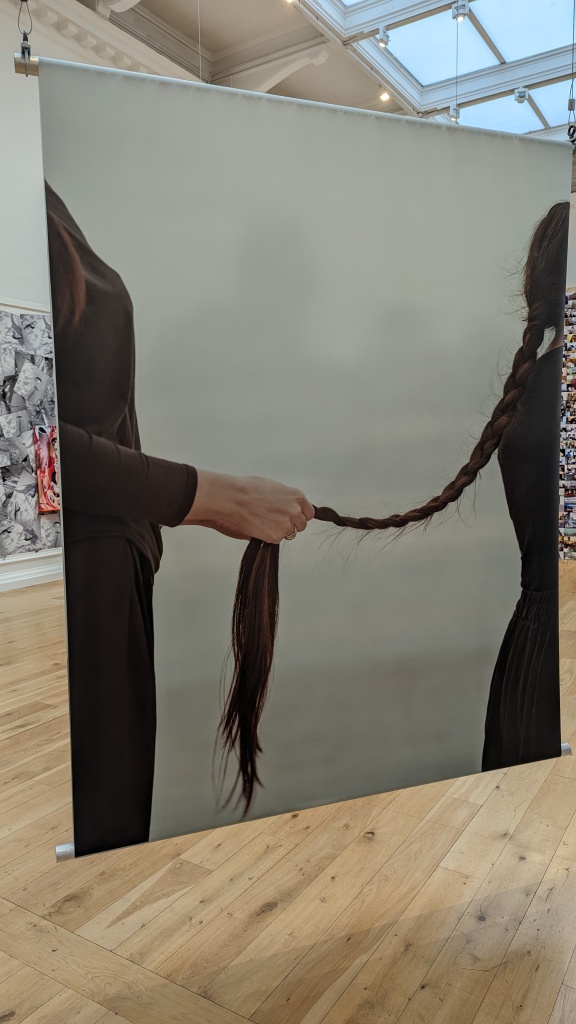
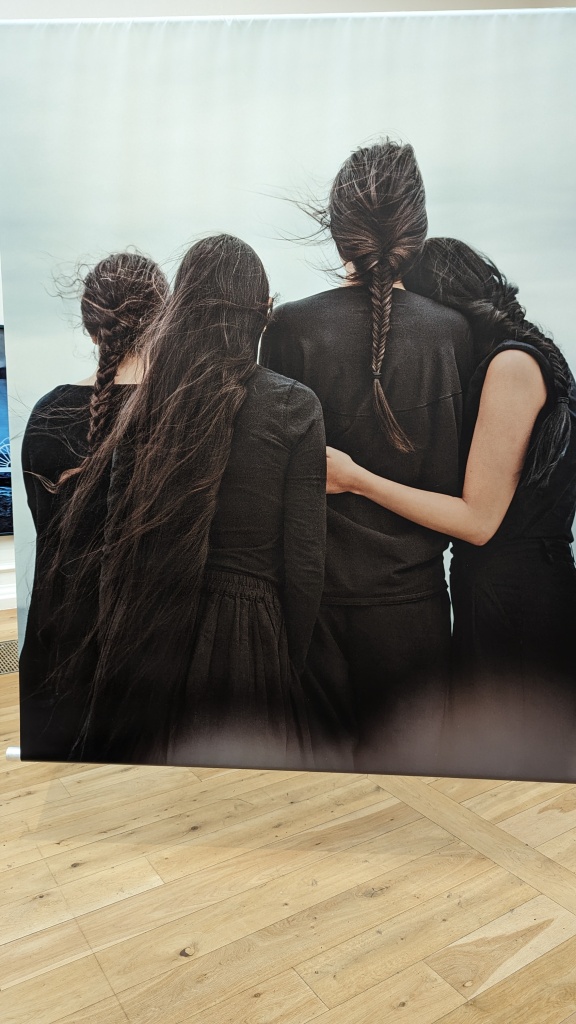
Tehran’s ‘morality police’ killed twenty-two year old Mahsa Amini for not wearing the hijab under government standards. These photographs are one with the protest against that legally sanctioned murder of a woman’s freedom and choice over her body.

The photographs are staged images that utilise the imagery of the doves, birds that are released at the funerals of those that have lost their lives in the protest. The birds stand for martyrdom and peace.

The women in the photographs are largely anonymous because anonymity protects the protesters on social media. These protest photographs show women plaiting each other’s hair and discarding their veils. The hair is plaited as respect is given to women freedom fighters fighting in Kurdistan against the Islamic state. They plait their hair before battle.

These monumental photographs are impressive and powerful. They give a body to the protesters and, with it, humanity. A community is formed around hair and the freedom to show it. The large format itself is a celebration of women and female bodily display, the ‘exposure’ that photography gives. Because, despite the fact that most of the models are anonymous, in the final images as we walk through the space, as you journey through the images and the story they are telling, you see the full frontal body of the woman with doves and her face is completely visible. And on the reverse, you can see the profile of a woman that braids the hair.

The plaited black hair of warfare and the white doves of peace tell a story. To have peace, you have to have the war first. Peace is the aim that can only be achieved through fighting for the rights to have choice and freedom. In the final photograph, a pair of hands braids the hair Another pair of hands superimposed on the back of the woman whose hair is being plaited holds the dove of peace and martyrdom. A reminder that freedom costs something. The fight.

These photographs are an inspiring celebration of heroism.

Sheida Soleimani, ‘Tulip Poster’ from the Series To Oblivion (2016)

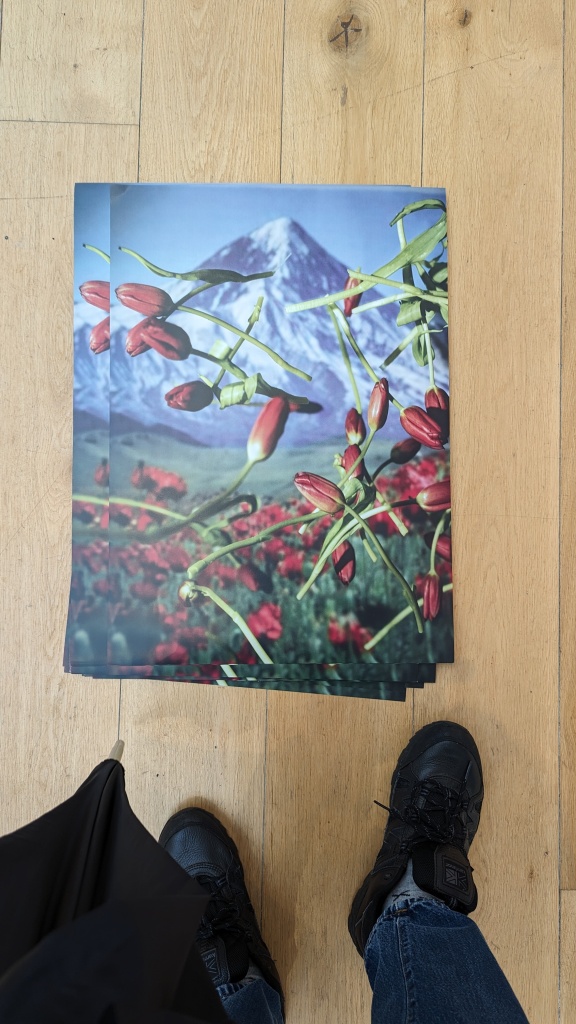
This poster is a tribute to the Iranian women unjustly imprisoned and killed by the state. The tulips reference an Iranian revolutionary song that sees the flower as revolutionary hope – because although it is fragile, it is resilient and it regrows every spring. The numbers on the back of the poster show current published data of those arrested and killed by the Iranian state.

The redness of the flowers. Blood. Against the mountain in the background. With their stalks, the tulips are the ladders up to the peak. They are the scaffolding that can even go above the peak. To ascend the ladders, you have to have the revolutionary hope. Which no sword can cut down. Which no gun can diminish. The tulips are the beauty of hope. The beauty of the revolution. They transcend death with their growth. They have the beauty of growth, nature, resilience. To ascend the ladder of hope is the ascent into heaven. In the religious context of the photographer’s background, this is the image of faith in the revolution and eternal justice. Like Antigone, the photographer promotes the eternal laws of justice rather than the man-made laws of the earth.

Wendy Red Star, Amni (Echo) (2021)

This is a tribute to the matrilineal clan membership of the Appsalooke Nation which was erased by colonialism and its patriarchal laws. The artwork gives power back to the women in her family (the photographer who is Wendy Red Star, her daughter and her great-great-grandmother). And the power back to the names of the women of the Nation.

This was one of the most moving of the artworks in the exhibition for me. They called them Indians when they are Native Americans. They took their land and tried to destroy their culture and their people. They are us. We also have clan membership through our mother – Mother India is our mother and the religion of my mother is the Mother Goddess. It is this which the patriarchal, colonising state wishes to destroy and, with it, difference.

The names of power call out in the background, behind the photographic sculptures. And the photographs themselves build power. Out of the small photograph at the base, a greater entity is formed through the use of overlapping photographs. If you look carefully, you see that the aura is extended into the names of power behind, with the use of negative white space.

One of the ideas around photography when it first came into widespread use was that it could take away the soul of the sitter. Here, that idea is reversed through resistance against the patriarchy.

Because the photograph of the great-great-grandmother is there and the different generations, the photograph scultptures build up the matrilineal history which the law and the colonising state wanted to end. In the face of erasure, we have the form that has come back to us, become literalised in word and image. The phoenix has emerged from the flame.

The exhibition included many other pieces worth a careful examination and study. My overall impression of this exhibition is that I learnt a lot from it and I was inspired by it. We, our community, we also fight the wars against the patriarchal state and its patriarchal laws. For our way of life. For our culture. The patriarchal law wishes to kill what we are. We, the ethnic minorities, even if we are the men, we are also the women.

And the photographs showed the resistance can take many different forms. There are many dances to learn. Many songs to sing.

Time and time again, the photographs exposed what the patriarchal law of the state is. And why it has to be fought against. Not just in ‘other countries’. In Western type countries like Australia and Poland.

Sometimes, I was disappointed. One video installation said to become a ‘peaceful warrior’ and not ‘an angry warrior’. I don’t believe we should spit out our anger. But the philosophy of India is that everyone has their own path. Who are we to judge? As long as the warrior remains the warrior. That is the point.

The union of women with photography suggested calamity to the male Victorian authors that I studied. It suggested the revolution. The exhibit of feminist protest photography is the natural outcome of the resistance. As a form of truth which exposures the corrupt heart of power, photography has few rivals. These images demand more attention and more thought. Within them, they contain the resistance to the state structure and the patriarchal law. And, within them, they contain the conception of justice that the patriarchal law does not have, with its false claims to universality, timelessness and ‘truth’. By making photography concrete, by giving it the female body, these photographers have fought against the male body of the law with its male subject. They have created women’s – and photography’s – jurisprudence in the present moment.

In the end, the warrior loves the warrior. The exhibition is warrior culture.

Print to Pattern: Unveiling the Kimono Through Japanese Prints

Ezen Foundation, Angel

Review by Dr. Suneel Mehmi on 19.05.2024. (Suneel’s original artwork from 2016).

This is my personal view of the exhibition and does not reflect the view or any consensus at any of the places I work at or volunteer.

For a very long time, Ezen Foundation featured a breath-taking wedding kimono decorated with cranes in its exhibition space. I was absolutely entranced by this wonderful construction of textile and art. I would take a careful look at the kimono every time I went to the gallery. For me, the kimono stood for everything that was beautiful about not just Japanese, but Asian culture. For the kimono was red, like the wedding dress of an Indian woman. The textiles were magical, shiny, seductive, splendid. They spelt out love.

My family comes from those involved in the clothing trade in India and in Britain. My mother’s side are leather merchants. My grandfather’s side were shoe makers. My grandmother worked in textiles when she was invited into this country. My mother made her own Punjabi suits when I was growing up on the sewing machine at home from the sumptuous fabrics she bought from the Indian shops. It has always been interesting to me to look at clothes and, when my grandmother passed away, I am reminded of her through the beautiful clothes that I see around me. She made me shirts and jumpers when I was a child and even when I was an adult. So when I look at these kimonos, I think of my grandmother and my mother, even if they have been made by men. That is the memory

Familiar to even the farthest flung nooks and crannies of the globe, the kimono is synonymous with Japanese culture and style. This exhibition at Ezen Foundation aims to showcase the clothing’s remarkable evolution in the latter half of the nineteenth century alongside the country’s ‘cultural and artistic transformation’.

Print to Pattern displays over 20 antique woodblock prints from kimono pattern books primarily dating from the late 19th century, also known as the Meiji era. The pattern books are fashion catalogues which were used in a multitude of ways by a diverse range of audiences and which feature designs for kimonos, patterns and motifs. The exhibition comes in the form of pictures, curator labels and then QR codes which give us more information about the exhibits.

The exhibition begins by featuring kimono designs of trees and their blossoms as auspicious motifs. A tree loving country is how we know Japan. From the bonsai tree collector Mr Miyagi in The Karate Kid to the equation of everything Japanese with the cherry blossoms, that is how we have imagined and known Japan in the West. We are told how the trees form symbols and meanings, how humans are relating to the natural world by representing it in a system of human meaning. We form the idea of the Japanese as those that communicate through nature, that style themselves through nature. That see human qualities in the plants as well as abstract qualities like transience in the cherry blossoms or adversity in white irises.

There is a sensation of magic in the air because the trees are regarded as auspicious symbols in these designs. We are seeing the aspiration of magic in the flesh, the starvation for sorcery. Magic infiltrates the picture plane, the desire for success to be accomplished, the desire for love. It is a touching human moment.

The exhibition then moves to animals that figure on kimono design such as bats and cranes. As with the natural environment in the form of trees, we find out the meanings of these auspicious creatures and how they have figured in the Japanese imagination. The case of the bats is indicative of the historical contextualisation at work in the exhibition. We learn how the bats went from representations of prosperity to representations of modernity and aspirations for economic growth and social advancement.

Objects as motifs in kimonos now make their way into the gaze. There are bobbins, threads and needles as well as sake cups.  Then, there is a print showing the iconic Mount Fuji which has remained ‘a prominent theme in kimono designs’. We learn that the motif has traditionally adorned the kimonos of young boys and has stood for resilience and strength.

We then stand before a wall decorated with floral patterns. Each element repeated into an overall scheme in a sparing, minimalistic aesthetic, with the use of negative space and flat colours to highlight the Japanese emphasis on the idea that what is not there structures the space just as much as what is there.

Other exhibits include wonderfully coloured and striking, intricately designed obi belts and prints which feature women in beautiful kimonos.

Then, finally, we see how the kimono looked on the body and in the social contexts that the women carried themselves in. We are reminded that the kimono was for presenting the body, for presenting subjectivity. There has been a move from the realm of abstract design towards how these designs signified the female form, the concrete lived experience of the Japanese in time.

In my view, Print to Pattern is a good, short introduction to the Japanese aesthetic and kimono design in the Meiji period. I remember that gallery space through the inclusion of that wonderful red wedding kimono dancing with cranes and beauty. And the exhibits of kimono design are beautiful too. Textile design is itself a neglected field in Western art history and the gallery space, so I feel that the exhibit does something to remedy this injustice. With fabrics and clothing, we see how the body relates most intimately to art and the movement of the exhibition has expressed this very well, from abstract design to, concretely, women wearing the kimono designs. There is much food for thought with the arrangement and the research into the symbolism of the things we are seeing. And the exhibition stimulates our curiosity to learn more and to see more kimonos, the crystallisation of skills in cloth-making, dying, design and fashion.

Print to Pattern is organised and curated by Olivia Mieke Maria-Paulina Martha, Wojtek Doria Dernalowicz, and Kalliopi Hadjipateras.

‘Chocolate House Greenwich – Society, Intellect and Chocolate in 1700s Greenwich’

Old Royal Naval College

22.04.2024

This opinion reflects my personal views in my capacity as a private individual and does not reflect any consensus or anyone else at any of the organisations I work at or volunteer for.

Ascending up the stairs to the exhibition space on the mezzanine, you see a window through which you glimpse another world, another milieu, the past. It is a rare interior scene of a coffee house, one of the new forums for public debate that shaped the modern world. The customers are reading the newspapers that created the imagined community and fostered and nurtured the Western nation-state. Thus begins the historical journey into the Chocolate House in Greenwich. We are guided through a sort of window onto the past.

Behind another window, we then see the esteemed lady that ran the Chocolate House on Blackheath as one of the many women in history that have provided the world with its unique and wanted things. It is Grace Tosier ‘at the height of her powers’. Her eyes stare at us in the portrait through time. We are sharing her vision. She is the character that is leading us through things, the guide, the model: a strong, independent woman in a capitalistic culture. The heroine for this time and this society.

We learn that the Chocolate house served royalty. It then ‘became the Georgian equivalent of a celebrity hotspot’. So now we experience the glamour of the place.

The exhibition now shifts its focus. The story changes. We start learning about the origins of chocolate in South America, how it came to Europe, how it involved the morally reprehensible evils of a capitalistic society which evolved from slavery and exploitation. The trajectory of the story has shifted. We have come to a moral reckoning of the realities behind the glamour of the chocolate house. A confrontation with evil.

At this point in the story of the exhibition, like a huge wild monster from the imagination, we see a glorious display of the Cacao Tree rising up on the wall against a black canvas. The plant is covered over in insects. Why this image? The beauties of nature? The absolute origin of chocolate depicted without any varnish, perhaps, warts and all? The idea that the comforting illusions of capitalism, when the veil of ideology has been ripped off, reveal an insect-ridden reality?

The story of the exhibition journeys next into how coffee houses enabled ‘the free discussion of the latest ideas, unrestrained by the protocols of the royal court.’ In the light of what was before, the implications begin to produce a result: the free speech of this country is founded on the fruits of slavery and exploitation. It is an implicit link.

There are quite a few interesting pictures to ponder over at this junction in our journey which reflect the culture of the times, so that the task of time travel is further enabled.

Now, there is the context: Greenwich. So the place is elaborated.

A table draped in a table cloth reveals the production process of chocolate.

We then move onto the last years of the Chocolate House. And we see an image of what the building might have looked like from the outside.

Finally, the piece of the resistance: the final destination of our time travel. In a room, we enter the chocolate house. We are fully immersed now in the space. There is a life size reproduction of Grace Tosier’s image as we descend down the ramp to meet her face to face. A video plays in the space to complete the immersion not only through space in the room, but through vision, sound and characterisation. We have travelled backwards through time into the space of the chocolate house.

What do we make of this exhibition? It covers a lot of ground to make a coherent narrative: this was the chocolate house, with all of its social and political implications at the time, with its basis in capitalism, exploitation, slavery. With its enabling of social mobility at the same time for women like Grace Tosier in this context. All of the pertinent facts are presented. There is balance. And there is a stimulation of the senses with pictures and videos alongside the curator labels. There is the face of Grace Tosier to characterise the whole scene, as well as the images from the country of origin with the people there.

You get a sense of historical immersion in the chocolate house. You get a ticket into time travel into Greenwich in the 1700s – a unique virtual reality experience. An enabling of the imagination. A real journey into another place and time.

My overall sense of the exhibition is that it is interesting, unique, well researched and well thought out. In addition, there were labels for the children which would make them interested in this topic that they love too – chocolate (and the pictures to stimulate their imaginations). This was a conscience driven exposure of the past and its evils, the foundations of the public forums and the discussions that they bred that have lasted into the present, the foundations of the modern day nation state and its present evils in the evils of the past.

I did feel a certain want in the exhibition – I wanted to know more about Grace Tosier, the character that we meet face to face. A curiosity about her. But of course, the reality is that while we have a name and an image, we cannot expect a biography in a historical exhibition like this. Part of the fun is imagining her life, too. Part of the fun is being stimulated to know more – and the chocolate house exhibition certainly does this. So, in summation, a stimulating and unique experience which fosters a self-reflection on the economic and political origins of our public forums and our public discourse, what has made us and this state into what it is today, a real journey. A real experience of learning.

Future You: 21st Century Skills Exhibition

London Transport Museum

19-22 April 2024

These are my own personal views of the exhibition and do not represent any of the views at any of the organisations I am working in.

This exhibition is a triumph of energy and imaginative problem solving from the children, the future. It is a reaffirmation of the fact that the human race has always solved any problems that have come into its path and will do so again. That we do not lack inventiveness and ways of thinking around and through things. Even with problems that we have created for ourselves. It is a reaffirmation of optimism in the world and in the future of our children and the species. This world which we have spoilt can be fixed. That is the message of the exhibition.

Six primary schools were set an imaginative task in collaboration with the London Transport Museum – they had to find solutions for the climate change crisis. Aliens had told them that their planet was no longer liveable and they needed to start over again in an environmentally friendly way. The inspiration for their planet-friendly technology was to come from animals and plants.

As I walked around the masses of reclaimed cardboard boxes and lollipop sticks, the resourcefulness of the children was in abundant evidence. These cast away objects had been magically transformed. They had become something again. They had become the visions of the future. The tinkering of the children, with the artistic designs, showed their enviable creativity and collaboration skills.

Inventions were strewn about everywhere like a mad scientist’s frenzied laboratory:

‘The Helpful Bumblebee cleans the air and rubbish. The Earthly trees stop flooding and pollution as well as cleaning the Earth and so prevents coughing and sneezing. The Legendary Pigeon sucks in pollution through its nose.’ (Exhibition Text).

The models for each of the animal inspired inventions were cute and beautiful in their way – the innocent and sweet and simple beauty of children’s art and the infantile imagination.

The young artists and inventors had become curators too, and told us about the most interesting and important facts about the exhibits in the museum. It was beautiful to see what they had learnt and what had inspired them to share.

A nice touch was to show an old poster that imagined the future in London as a skyline with skyscrapers and flying vehicles. The idea that we have always dreamed of a better future for transport, that we have always had dreams which have changed this world that we live in for the better, that allow us to make a fantasy world that we live in in reality. The strength and far seeing sight of our mind’s eye.

This was a beautiful exhibition –  full of dynamism, an adventure into a mad scientist’s laboratory. An excursion into possibility and the resilience of the children’s mind that can respond to the death of a world to create new life and new beginnings, to build a world entire, the world of the imagination. The desire for a better world from the innocent that have not been corrupted by dismay and stagnation in the selfishness and greed that is around us. But which rejuvenates itself in animal and plant life, in caring and positive change.

Echoes of the Blitz: Underground shelters in Ukraine and London

London Transport Museum in Covent Garden

Dr. Suneel Mehmi

01.04.2024

All views in this article represent my personal views as a private and political individual and do not represent the views of any of the organisations I work at. My expertise? My PhD involved the early history and reception of photography in its political and legal contexts.

‘Don’t survive it. Live it.’ These were the words that someone said to me recently. Survival is the most important thing for us as a species. In the field of psychology, they tell us that the human mind is geared towards survival. That’s where we get our intelligence from: evolutionary adaptations for surviving. But with survival, you have to live it too. You have to experience the fight.

The new photographic display ‘Echoes of the Blitz’ shows how we have to live through our survival. The exhibition ‘explores how Underground stations and metro systems provide shelter to citizens during periods of war – now and in the past’ [1]. How, when you are confronted with death and mortality, when you look death in the eyes, you fight for breath, sense and security. How you find shelter in unexpected places in extreme circumstances and still make a life for yourself. How throughout history and its rivers of blood, throughout the modern period and the supposedly ‘civilised’ Western world, people have hidden in fear to preserve their life, children, culture and heritage.

In total, the photography gallery displays:

‘70 striking images, including historical images from the Museum collection alongside 38 contemporary photographs by six renowned, mainly Ukrainian, documentary photographers.’ [2]

Some of the most recognisable images of the war have been of people sheltering in the London Underground shelters and these icons of memory are given an update and a new relevance through a juxtaposition of the scenes in the Underground shelters in Ukraine.

According to the London Transport Museum, what we are seeing is:

recent photography of ordinary Ukrainian citizens in extraordinary circumstances. They are shown sleeping, waiting, cooking, washing clothes, caring for their pets and creating temporary make-shift homes in Metro stations in the Ukrainian capital Kyiv and its second largest city Kharkiv. These scenes are ‘echoed’ in the black and white archive images of Londoners taking refuge in Tube stations during the Second World War. [3]

The aim of the exhibition is to:

present strong parallels of human experience across different locations and conflicts. This exhibition documents the resilience of people in Ukraine and London during times of war and the reality of having to escape from aerial bombardment. [4]

Other comments have been made about the aims of the exhibition. Matt Brosnan, Head Curator, London Transport Museum, said that the photographs ‘show the resilience and tragic reality of war’ [5].  Stefan Günther, Project Manager, Photo, n-ost, said that the exhibition is ‘an opportunity to perceive the current war in Ukraine on a very personal level, away from the wider political and media glare’. [6] 

I think that the exhibit makes concrete the idea of Ukrainians rather than Ukraine. All nations are fictions. It is the people there that are real. And in these photographs, we see the people directly and how they are having to live. And it is photography and its truth that allows us to see the reality behind the abstractions of the newspapers. It is photography that allows us to see them face to face and come directly into their lives. As a matter of fact, the frames of the exhibition invite us to do this. The black and white World War photographs have black frames. These photographs are framed and closed off to us – because as we know, the past is a foreign country. However, the photographs of the Ukrainians are not framed. We are in direct contact with them through our eyes and our perspectives. We are immersed into their world. There is no separation from us through the device of the frame. What is happening there is spilling out into our world, including us. Asking us to contemplate, sympathise.

Some historical details taken from the London Transport Museum website allow us to see the facts behind what is being portrayed:

London’s air raid sirens sounded almost every day for eight months from September 1940 to May 1941 and again between June 1944 and March 1945. Sheltering in Tube stations overnight became a routine. There were special admission tickets, bunk beds on the platforms, refreshments and, at some stations, libraries, music and live entertainment.

In Kyiv, sheltering in the Metro peaked at around 40,000 people at the beginning of the Russian invasion in February 2022. Some stayed overnight, others for days or weeks, returning to the surface only for groceries or to wash. Those who lost their homes lived underground for months. 

Kharkiv, close to the border with Russia, experiences more frequent shelling. People spent more time in the Metro there, creating comfortable homely spaces with bedding, tents, carpets, decorations and toys. [7]  

After you have read the blurb of the exhibition, the first photograph that dominates is ‘Woman in tent at Dorohozhychi station’ by Maxim Dondyuk, 2 March 2022. The woman defensively has her hand held to her shoulder, covering her chest: a striking image of someone in need of protection, someone that has to defend themselves from an unjust attack. She has to comfort herself with that hand on her shoulder. The woman stands out isolated from the crowd behind her that is not visible, vulnerable and isolated, perhaps like the situation of Ukraine itself – a country that has been left to fend for itself by the ‘civilised’ world of modernity which has disappeared when it is needed. She looks directly at the camera: she implores us to look upon her as the fate of her people, the innocent civilians subjected to the imperialism of the modern day state and its brutality, to their unjust greed and their uncontrolled and obscene desire for control, domination, land and resources. She asks us to acknowledge our role, the roles of our countries that have left her in this position. Does she ask us why? Her face is touched with sadness and suffering. She is in – through the connotations of the opening of the tent – in the dark den of despair, half-eaten by the hole, the absence.

In terms of its historical importance, the exhibition features one of the first ever photographs that were taken when the war broke out and the Ukranians sheltered in the underground stations. Viacheslav Ratynkyi, that on the very first day of the Russian invasion on 24 February 2022 he went down into the Metro and brought a camera so that he could document the situation. [8] The people have used the edges of the stairs along the walls as seats to create a clearing in the middle so that others can move up and down. They have been resourceful to give themselves make-shift seats that would be extremely uncomfortable to sit upon for long periods of time. They have had to adapt for survival and protection as a group, a group and species bound together by necessity and the cruel games of the politicians and the modern day states that are supposed to serve and protect them, the states that are supposed to be bound by the laws and justice. In response to the unjust throne of the state and its modern day king, who cannot sit as he should, the people sit heroically and patiently, in solidarity and suffering. They begin the long wait for peace, the desire of every thinking and feeling human being. These people are the human contrast to the inhuman face of power and brutality, the fascism of the modern-day state.

When I say I am Indian and come from India, it is the India of the people, not the India of the politicians or the intolerant and oppressive citizenship that they want to create. The state that they create is not India. What they create is corruption. We, we the people, we are India. And here, in this photography exhibit, we have the Ukrainians and Ukraine. These people are not defined by the war. In this exhibit, we see them doing the things that we all do every day: listening to music, learning, reading, dying their hair. Holding each other for comfort. They are victims of the state and the politicians. But they have organised themselves. They have created a space away from the brutal games of the state and its quest for total domination. Across world history, across the suffering that man has created, we look at the victims of the politicians and how they have tried to carve out another space and another reality beyond what the unimaginative and corrupt state has imagined. People who live through their struggle for survival. With resilience. As I look at these photographs, I know that one day, the modern-day state with its evils will fall. It has to. Because the spirit of the people will one day overcome the absurd egotistical limitations of geographical and racial boundaries. You can see this in the people and the photographs. You can feel the power of pure being. The desire to move out of the control of others. The spirit of resistance. The spirit of overcoming. Because these people are not trying to create a nation state down there in the underground shelters. They are trying to create a human community: a sphere of protection and life. It is a world meant to foster life – the world that we are trying to create by countering domination with the philosophy of live and let live, by countering selfishness with the desire for preservation, by countering the desire for destruction and death with the desire for life and the future.

If you want to see what a real hero looks like, don’t look at the soldier with blood on his hands, the killer for the state. Look at the everyday hero that fights for survival in an oppressive world and the games of control around them by trying to create another reality – the reality of peace and life. Freedom from death, envy, killing, exploitation. Freedom from the state and its obscenity and blood lust. The people that have created history, tradition and culture by surviving – by fighting to survive and live through that survival – and not by dying and killing in war.

[1] https://www.ltmuseum.co.uk/news/new-echoes-blitz-underground-shelters-ukraine-and-london-photography-exhibition-now-open#:~:text=A%20new%20photography%20exhibition%3A%20Echoes,now%20and%20in%20the%20past. 

[2] Ibid.

[3] Ibid.

[4] Ibid.

[5] Ibid.

[6] Ibid.

[7] Ibid.

[8] Ibid.

Review of Tsunagu/Connect: Uncovering the Lives of Japanese Women in the UK. (Barbican Centre)

18.02.2024

My mother is a migrant from India. Many of my relatives and friends are migrant women. I volunteered for years teaching migrant and refugee women English. Although I have heard my mother talk about why she came to the UK, I haven’t heard in much detail about what these women think of their arrival here, their journey in becoming British – even when I have asked them about it. You get snips and pieces: women that feel the hostility of this environment and the judgement of the people here over them. You get a sense of the insecurity and loneliness, the lack of belonging, when you watch them orchestrate their lives around phone calls and video calls back home, when you see that their closest friends are other migrant women from their home country. You sense their confusion about life here in London and the people here from the comments that they make. Tsunagu/Connect was a chance to hear what they wanted to be heard said about all of these topics.

Addressing the neglect of the topic, this exhibition is about the personal experiences and memories of migrant Japanese women that have come to the UK since the end of the Second World War. Over 30 Japanese women were interviewed to provide the oral histories for the exhibition on a one to one basis.

One of the stated aims of the exhibition is to overturn the ‘myths about Japanese women as passive and obedient housewives and provide an insight into the complexity, diversity, and agency of Japanese women in the UK’.

I picked out a few of the exhibits that caught my interest. I didn’t have time to listen to the audio descriptions. Masayo Aizawa chose to talk about her father through a strange object which she remembered him through, a calculator. She spoke about his harshness and the fact that he was traditional, that she could never express her gratitude to her father and that she only understood him late in life. This exhibit was interesting to me because it is often arbitrary objects that we associate with people. Because this was an example of a migrant woman reflecting on the people that she left behind, that she couldn’t get to know as well as she wanted to, that she had to separate herself from. And at the end of the exhibit, she says that she is like her father – it is just the illusion of separation. Perhaps this is what these migrant women feel – that their connection with the people around them in their countries of birth is unbreakable, one of the greatest influences on their lives. Perhaps this is what gives them stability and belonging, their identities.

Elizabeth Fusae Thurley spoke about what has been the astounding fact that I have witnessed throughout my life – that someone can come into a new country without knowing anything about it and at the greatest risk of precarity. Sometimes, they don’t even know the language. Elizabeth had come with a man with no job, no house and whose parents were against the marriage. She astonished herself with her bravery. You have to have courage to leave everything behind for a hope. She reminded me of my grandfather who came to this country from India and left everything behind him for the hope – the future for the children. Elizabeth came here in the hope of love: she got it.

Atsuko kamura spoke about how strange the people seemed here when she came: ‘The people sitting on the tube looked like as soon as they got off the train they would go and kill themselves’. That quote conveys the radical sense of defamiliarisation that these women experienced when they came to this country. But it carries a sadder tone for me – she came here for her happiness. But what she found when she first came here was sadness. What you think will make you happy in life often makes you sad. It is the way of the world.

This is conveyed most vividly in the story of Haruka Kuroda: ‘soon after I arrived in the UK, I was extremely homesick. I didn’t speak a word of English and for about 3 months, I called home every day using collect calls – remember those?! – costing my parents over £1000 on the phone bill each month!’

The dual kinship of the women here to their home countries and to the UK was apparent in the desire of Miyuki Tanaka to have her ashes floating in the air around Japan and the UK. After all, when they are here, the UK becomes their home. But it doesn’t always supersede their original home for all these women. Home is home is home. You can have more than one home – and what could be better than to have many places to call a home?

I reflected on the exhibition for a good while. Was it a success? Was it a failure? Some of the stories were about the bravery of these women, their pioneering entry into art school. Some of them were about their bravery in love, like I have mentioned above. Some of them were about the sadness, the struggle. The narrative of the exhibition is to present these women as heroes in the traditional mould – someone brave that faces adversity, that overcomes, that achieves, that finds a place in the world. The exhibition wants us to think of these women as strong. As strength. But I have a question. When the whole world is dominated by the West, when this country has a superiority complex, when the whole world is being Westernised, when people in this country think that every other country is misogynistic and a restriction on women’s freedom, how innocent is this narrative? Isn’t it just part of the problem? Is the only way a woman can be seen as a hero is to embrace the West? The Indian watches. The Indian judges. The Indian finds the exhibition wanting. What strikes the Indian is the sadness of coming to this land. To endure here. The disappointment. The defeat of the dream. That is what I found in this exhibition.

Suneel’s Favourites in Astronomy Photographer of the Year – National Maritime Museum

05.01.2024

https://www.rmg.co.uk/whats-on/astronomy-photographer-year/exhibition

Since I work in the area, it is quite convenient for me to see the Astronomy Photographer of the Year exhibition during my lunch breaks. So I often go down to see it. I love looking into the sky of stars and look at the universe which envelops us, the larger world that gives us perspective and power. Because we are all part of something larger. We are the consciousness of the universe, if it has one. We are its only known intelligent life forms. And she is our mother.

This is a universe that has been taken away from us through the narrow mindedness of the world, through light pollution, urbanisation and industrialisation. That view of the skies which was us for thousands of years and millions of years when we were not yet quite human has been taken away from us by Them. This exhibition gives us back our continuous inheritance. That is why it is important to me and why I love it.

Here are some of my favourite images from the exhibit and why:

Filip Hrebenda ‘Green Snakes’

A photograph of green aurorae, the coloured lights in the sky. Amongst reflections of water and and stark black lava-esque mountains and ridges. Green is one of my favourite colours and you can see the hazy greens here melting into the skies. The leading lines of the reflecting water lead the eye towards the peak of the mountain, giving an effect of the sublime – overwhelming power that engulfs us. It is a truly awesome and epic shot which leaves us in awe at the beauty and the mystery of nature.

Peter Hoszang ‘The Green Glow’

The same subject as before – the coloured lights in the sky and the mountains. This one has less of a warm feel because there are more blues. And there is also ice in the waters. It is a different vibe, but with the same sublime feeling, since the lights in the sky dwarf the snow-capped mountains.

Monika Deviat ‘Brushstroke’

The aurora – the coloured lights – again green, look more abstract here because they are only seen against the night sky and the stars. The aurora is divorced from the setting. The artist says it looks like a brush stroke. The image is effective because we concentrate on the lights without any distractions in the background. Simple and focused, isolated. The beauty of light, pure and simple.

Vincent Beudez ‘Butterfly’

Purple, white and green aurora in the shape of a butterfly. Amazingly poetic and beautiful. The word butterfly is associated through tradition with the ancient Greek word ‘psyche’, which means soul. Wouldn’t a soul – if such a thing existed – come in the form of a butterfly of light? Radiant, ravishing, roaring.

Katie McGuinness ‘Close Encounters of the Haslingden Kind’

A stunning view of Haslingden’s Halo – a panopticon sculpture – amidst the night sky. The shining structure pictured against the movements of the night sky through a time lapse capture really caught my imagination with the blue and the white hues. It was a moment where you realise that the future that they imagined, the technological future, has actually become a reality for us now. The technology, the art, the structures that we make, seem like something that has come almost from an alien intelligence that is years ahead of us in thought and technology. But it is us that did it. We are the alien intelligence.

Angel An ‘Grand Cosmic Fireworks’
Dancing, fluorescent lights above the Himalaya mountains (atmospheric luminescence made of plasma and electric discharge). What is there not to like? There is something like seaweed about the lights that are almost immersed in the clear water of the skies. It is a scene which I could never have imagined and this is what gives it its power. Things like this are happening beyond our eyes, our comprehension, our ken. They enlarge us when we see them.

Chunlin Liu ‘Autumn Milky Way Arc and an Orion Bolide’

There is something so exceptionally Chinese about this image of the Milky Way arc, something so emblematic of the art. The horizontality of the image for one thing, the delicacy of the skies that have been rendered, the mountain scene which we associate with Chinese ink brush drawings. Amazingly beautiful, delicate and wonderful. A loving homage to the perspective of a culture which has been fostered carefully through thousands of years of an art tradition.

Vikas Chander ‘The Dancing Trees of Sumba’

These mangrove trees are shaped in such a way that people call them the dancing trees. They look as though they are frozen in a dance posture. Against the beautiful sky reflecting in the water which is like a mirror, they are incredibly elegant, a reminder that nature thrives in the universe, it dances in the dance of creation.

Mehmet Ergun ‘The Great Solar Flare’

I think of myself as the Sun (my name is Sun-eel). This amazingly detailed, textured view of the sun and its awesome power is really an iconic image. So bold. The sun fills the frame, giving that air of dominance as the ruler of our galaxy.

Alex Savenok ‘C/2021 A1 (Leonard) in the Sky of Israel’

Above the Negev desert and its picturesque ridges, we see ‘a celestial visitor in the night sky’. The image looks like the covers of science fiction books. It doesn’t seem real. Yet this is our earth at night time, if only we had the opportunity to see it. A taste of what we have had to miss because of the industrialised world and urban living. A taste of what we have had to lose, that connection with the skies and the reality of this planet, this universe, our mother.

Eduardo Schaberger Poupeau ‘Crescent Moon in a Magical Sunset’

A beautiful crescent moon in an orange, yellow and white sky. A sense of the crescent swirling in the clouds, full of movement and dance.

James Baguley ‘The Dark Wolf – Fenrir’

A homage to Norse mythology – Fenrir the wolf caught in red (a molecular cloud surrounded by red hydrogen gas). A reminder of the phrase that ‘Nature is red in tooth and claw’ – a lesson to be learnt from a perusal of this image. If anyone knows the mythology of Fenrir – I used to read mythology books as a child and was obssessed with the myths – this picture would become pregnant with meaning. With the themes of fatherhood, destruction, trickery, imprisonment, the animality of the human…

Steeve Body ‘The Majestic Tarantula Nebula’
Runwei X and Binyu Wang ‘The Running Chicken Nebula’

Both of these are a ‘cosmic ballet’ in glorious and awe-inspiring colour. Showing that human made abstract art can’t rival the play of forces in the universe to create patterns in the universe on a colossal scale as works of art. Full of fire and life.

Kumihimo – Japanese Silk Braiding by Domyo Exhibition

Kumihimo – Japanese Silk Braiding by Domyo Exhibition

Japan House (Free, book in advance)

Only until 11 June 2023

07.06.23

Silk is splendour. Silk is shine. Silk is skill. This wonderful material comes from the East and is one of its most remarkable achievements, the mode in which it has produced masterpiece after masterpiece, all of them wearable. The world of fashion is surely indebted beyond measure to the smooth, radiant designs that have been produced in the medium. For me, the beauty of the East is conveyed in the four letters of the name ‘silk’.

It was then with some big expectations today – as a lover of silk (and art, craft, fashion, Asia and the Japanese, as well as the art gallery and the art museum) – that I made my way down to Japan house for the very first time to view the Japanese Silk Braiding (Kumihimo) exhibition. As I came in, I received smile after smile and received a friendly, first class reception from the staff that were on. I was also handed a pile of goodies to take – a beautiful bookmark featuring the coloured silk braids in a rainbow of hues, a wonderfully designed and informative guide, and also a strikingly designed poster (or flyer) for the next exhibition that is coming up (WAVE – Currents in Japanese Graphic Arts, 6 July to 22 October 2023).

Japan house gleams with a minimalist white interior design. It reminded me somewhat of an oyster shell which contains the precious pearl. I was in a hurry after work so I could not take in everything but I got the general impression of painstaking cleanliness and the inspired arrangement of things and interiors that is the hallmark of the modern Japanese aesthetic.

The exhibition ‘explores the history, techniques and potential of kumihimo silk braiding’, with some focus on the craftspeople of the Domyo workshop which has been in business since 1652 CE and is in its tenth generation of artists (guide).

What is a great source of pride to Asian people (Indian) like me is the fact that our civilisation has been around in continuous form for several thousand years, unlike other ‘great’ civilisations that have fallen. So, I was glad that it was a similar story here with the Kumihimo. The silk braids have endured in some form in Japan since the time of the Jōmon people and early pre-history (if not in silk). We are seeing old knowledge extending into the present and into the future with technological advances in this exhibition, as new worlds of geometry and mathematical genius are being created with continuous forms throughout the greater part of post-ancient human history.

However, the Japan exhibition is not parochial. There is a global dimension to the braids because they have been shared across cultures across the world, which the curator was careful to show. There are examples from Tibet and Peru, for instance.

I was mesmerised by the videos showing the making of the silk braids. The one where the cords were dyed purple and washed in a vessel of water was a piece of art in itself, a metaphor for the act of creation out of the waters that have given humankind birth and belonging on this planet.

It was fascinating to see the use of the silk braids on armour as well as in religious sutras or scrolls and for such uses as the ‘internal organs placed inside a sculpture’. The designs were wonderful, a real virtuoso exhibition of the combination of skill, maths and technology to create beauty. My absolute favourites were, firstly, the ornamental braid from the Buddhist temple Hōryū-ji. It is a majestic piece in red and gold, with diagonals like the third eye of the Hindu god Shiva (to me). There are golden beads interlaced in the design which remind me of the organic shape of seeds. Secondly, I loved the other ‘multiple diamond’ designs done in brown and creme, achingly wonderful. Again, I particularly enjoyed the deconstruction of historical costumes such as a Victorian dolman which the workshop has used to recreate these splendours of the Japanese people.

Of great interest to me (science is another one of my hobbies) was the use of Kumihimo to create new mathematical structures and experimentations in concrete geometry. The model that had been created was an amazing piece of design innovation and a contribution to our shared knowledge as a species. Such is the influence and intellectual power of the Japanese people, all based on traditional knowledge and its reworking into modern day life – an example and a contrast for the countries in Asia that have been colonised and want to forgot their customs and local knowledges in favour of economic servitude to their erstwhile colonisers and their knowledges (or rather, complex of power/knowledge).

This silk braid exhibition is an experience that I will never forget. It had everything: a beautiful setting, beautiful people, beautiful things, a beautiful philosophy, a beautiful lesson. I have always admired the creativity, discipline and historical stewardship of the Japanese people and they never disappoint me with their arts and crafts. Japan house is a testament to the radiance of the people of the rising sun, and so is this exhibition. And to Japan’s generosity to the world. For as I made my way out of the exhibition, the smiling lady on the counter offered me a crane made out of origami which I had admired. It is just another of the gifts that the Japanese have given me in this life, this glorious culture that adopted our Indian religion of Buddhism and became our brothers and sisters.

Terence Conran’s Memories of Dora Batty – Dora Batty as a Person

Terence Conran’s Memories of Dora Batty – Dora Batty as a Person

23.05.2023

MY PREVIOUS REVIEW OF THE DORA BATTY POSTER PARADE AT THE LONDON TRANSPORT MUSEUM:

https://diaryofaloneman.home.blog/2023/04/07/dora-batty-poster-parade-london-transport-museum/ 

(note: This analysis has been done for non-profit purposes of education, and makes ‘fair use’ of the publication cited for purposes of analysis and comment in the public domain).

1946 – Sir Terence Conran was a student of Dora Batty’s at the Central School of Arts and Crafts in London in textile design (he wanted to be a textile designer at first). He mentions her in his autobiography. this is an attempted analysis of the writing – a psychological study of Dora Batty (as artist) through Conran’s recollections.

CONRAN TURNED UP FOR HIS INTERVIEW WITH DORA BATTY WITH ‘repeat-pattern drawings, a book of pressed flowers (Suneel’s note – maybe this is why she liked him so much and gave him a chance – she loved drawing flowers), paintings, a few fuzzy photographs, ceramics, and bits and bobs of metalwork and woodwork.’ (26)

Source: Sir Terence Conran, Terence Conran: My Life in Design (Conran Octopus, 2016) – ALL REFERENCES IN BRACKETS REFER TO THIS SOURCE.

(NOTE) GOOGLE BOOKS: (Sir Terence Conran) founded the Habitat chain of stores in England. Starting in 1977, his U.S.-based Conran’s stores helped launch the home furnishings retail boom. He is the author of thirteen books and was knighted in 1983 for his service to British industry and design. He lives in London, England.

  1. DORA AS ‘WONDERFUL’ AND WARM-HEARTED

Conran describes Dora as ‘wonderful’ (26). She stands out as a unique (and warm-hearted) person in contrast to ‘a bunch of stern middle-aged ladies’. Dora gives Conran a chance and lets him pass the interview even though he didn’t have much knowledge of textiles (26). This reveals various aspects of Dora’s personality:

  • Conran remembers Dora fondly. He has no reason to lie about what she was like. This indicates that she had a welcoming and friendly, nurturing aura as a teacher
  • She was good at recognising talent in someone like Conran who would become a famous designer
  • She would nurture promise if given a chance – even in an unconventional way – Conran says he was actually surprised to have passed the interview (26). The lack of conventionality and following strict rules of ‘objective’ assessment shows that Dora had good intuition, flexibility and discretion and judgement (reminder – look at how influential Conran is)
  • Not everyone gives people a chance in life – Dora was a good, generous person
  • Dora was compassionate to the young and inexperienced – and patient enough to teach such students even if they didn’t know that much
  • Conran says he was shy (26) – Dora looked beyond social conventionalities and was impartial enough to give Conran a chance on his art, rather than judging him as a person
  • GENDER: After he passed the interview, Conran was the only boy in a class of 33 women. Just like the London Underground gave Dora a chance as a woman in a male-dominated industry, she gave Conran a chance as a man in a female dominated industry. She was fair and inclusive and challenged the social norms in favour of meritocracy and giving someone a chance (to change the status quo).
  • STRICT AND CAPABLE
  • ‘Dora Batty was very strict but she ran the course superbly. She saw that her students really had something to do at every moment they were there…’ (26).
  • Why was she strict? Maybe because she cared about art and design so much. But this also indicates a controlling side to Dora. If you look at her art, it is all very controlled and restrained and ordered.
  • Dora as overachiever student? She piled on work on the students – maybe this is because she worked very hard herself (ceramics, textiles, posters, etc. – it takes a lot of work, effort and learning to master all these different disciplines).
  • MULTICULTURAL, RESOURCEFUL AND HISTORICAL – THE MUSEUM-GOER

‘One of the most fascinating things she arranged was a twice-a-week, behind-the-scenes visit to the historic textiles collection at the Victoria and Albert Museum in South Kensington, where there are vast halls with hundreds of thousands of prints and textiles from all over the world…’ (26)

  • Dora was an avid museum-goer – it’s fitting that she is in a museum through her art
  • Conran was there at the school in 1946 – Dora had negotiated the teaching at the V & A in the immediate post-war period when there were limited opportunities – she was incredibly resourceful
  • The first poster with Persephone and Hermes reveals her interest in historical costume and textiles, as well as her multiculturalism (ancient Greece)
  • Dora had good connections – she was a people person. Imagine how hard it would be to arrange a behind-the-scenes at a museum today, especially such a prestigious one – people wanted to help Dora. Remember, she was a woman in a man’s world, too… Even more of an achievement
  • The initiative of Dora: this is quite a creative solution to education – to share world-class resources that most people don’t have access to for her students and to give them a multicultural and global education
  • THE INSPIRER/THE MUSE/THE GOOD TEACHER

‘Dora brought in a whole raft of young designers and artists to broaden our horizons and inspire us.’ (26)

  • Dora is interested in contemporary art – see her Art Deco influences in posters such as the RAF poster. She kept up with everything that was happening (to improve the craft – conscientiousness, awareness).
  • Dora likes the energy of the young and encourages them. Not only did she teach youngsters, give inexperienced youngsters like Conran a chance, but also, she promoted the work of young designers and artists. Compare this to the current climate: she used her power for good and for a meritocracy. She challenged the status quo in favour of the new and change (all the while also giving her students a historical, world culture with the V & A). She is generous, embracing, inclusive, creates a stimulating intellectual environment of like minded souls.
  • Remember, she is choosing these new artists and designers because they could inspire – great artistic discretion and knowledge of people.