S: I’ve lost the will to do. I have disbelief in the London encounter.
A: In what way?
S: Before, I used to sing, act, speak to all these different people in London. I used to know hundreds of people. For about three and a half years, I spent my time trying to meet people in London. It went nowhere.
A: And now?
S: I don’t do any of that stuff.
A: Why?
S: First and foremost, I have someone now that I spend a lot of time with.
A: You don’t need anyone else?
S: No.
A: And the other reasons?
S: It is like what I said. I have disbelief in the London encounter. These people are not friendly. You cannot count them as your close friends. You cannot rely on them. They are cold people.
A: You have never liked Londoners.
S: Who would? All they have is a friendship of convenience. They are fair weather friends. I am lucky that I am not from London. I am lucky that I am not like them.
A: But surely you enjoy acting, singing and talking?
S: Not with fake people. Not with people without a heart.
A: What about your real friends? You have lots of real friends. You told me that when you wanted a party, about twelve of your friends rocked up.
S: We all live on the outskirts of London. They are all open and generous, accepting people. They actually have hearts. Even the one I am with, they live outside of London. The irony is that all these people live in London. You think you will meet someone there. But they are not real people. The city is full of fakes. The reality of this world is that it is hostile. You don’t have real intimacy with most of the people that you meet. You really are surrounded by strangers. They call themselves human when they have no humanity. They make every excuse. I am busy. I am tired. It is too far. But in reality, they cannot accept that you are different from them. But that they exclude on the basis of difference is a good thing. Because no one would ever want to be like them.
A: You have gone from being open to becoming completely closed.
S: I will only try to be friends up to a point. When I see that there is nothing being returned, then it is all over. Then, there is nothing.
Absolutely superb. That’s what the weather was like for the long walk. I met up with my friend at Newbury station and we bundled ourselves onto the Tube at nine o’clock for an early start on the day.
In the morning, it took about the same time to get into Chigwell as it would take me to get into Central London for work due to a change at Hainault and a long wait for the next service. On arriving at Chigwell, I was struck by the beauty of the place and the grandeur of the big houses out there. Really a dream destination to live in. Chigwell is called Chigwell because the name derives from an Anglo-Saxon personal name, ‘Cicca,’ and the word ‘well,’ meaning “Cicca’s well”.
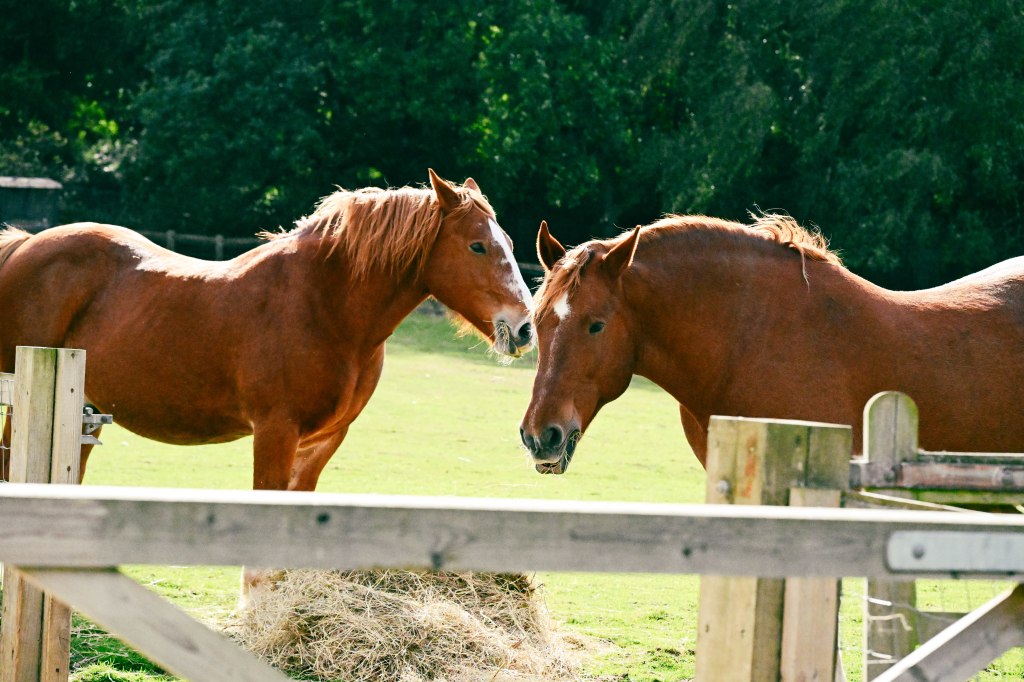
We came across some beautiful horses but I couldn’t get a good shot or composition. I have a personal ambition to ride a horse but haven’t got round to it yet. It is a very modest and achievable ambition but I am always too busy for it.
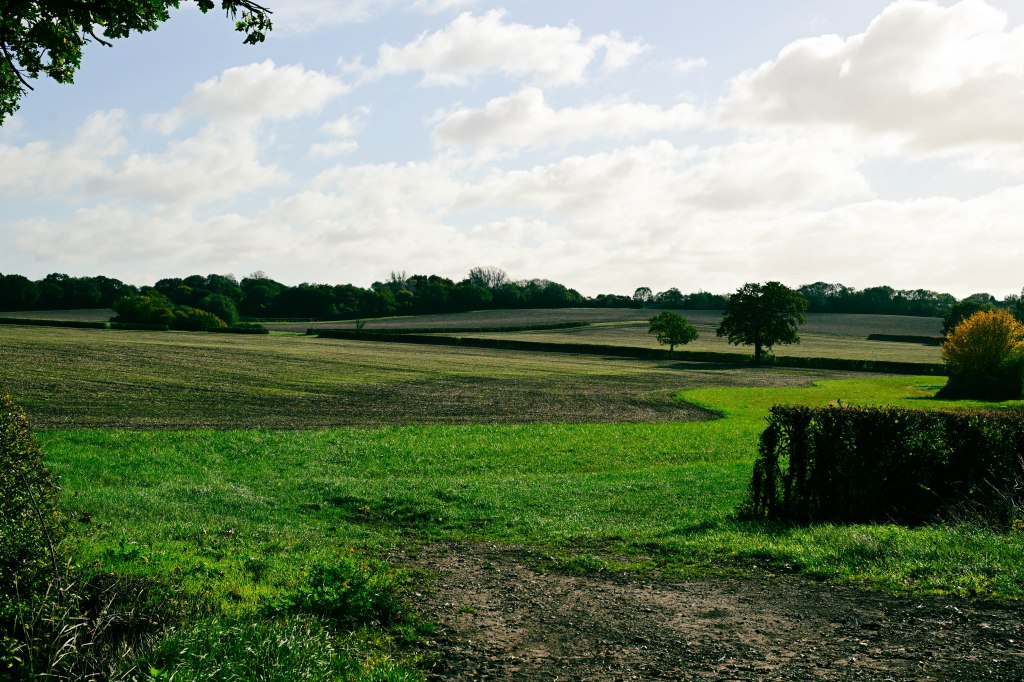
Almost at once, we came to a beautiful view and the farmlands. I had already got out my camera and was trying a few shots. As I did so, we came across some fellow walkers and they told me and my friend that they had been doing the walks on the London Loop for about two years. They were finally going to finish off the walk today. It was an old father with two young blonde daughters, one of them wearing a red jacket and looking somewhat like Red Riding Hood.
As we trailed after them when we were ready and they were already in the far distance, we worked out the percentage of weekends they had committed to their mission as we were arguing about how committed they were as walkers. If they had taken two years for about twelve walks on the London Loop, that would work out as them having invested 6% of their weekends on the trips over two years. I maintained that that was quite committed but my contrary friend disagreed with me.
My friend is a birdwatcher and I was trying to one up him by spotting more birds than him. I got a robin that he hadn’t noticed and felt quite chuffed but then he showed his experience and expertise in this subject. He spotted a woodpecker, a brilliantly yellow coloured creature that I had never seen before. It was winging its way through the air. He also spotted some buzzards and regaled me about the story of the corpse of one he had encountered recently as roadkill. On the trip, we saw about nine different species of bird, so it wasn’t a bad day: peacocks, hens, Egyptian geese, robins, a white egret, the woodpecker, crows, some little ones I forget the names of and seagulls and magpies. So for birds, it was certainly a great day.
It was a delight to stop for elevenses at precisely eleven on a little bench in the woods as I had a Dairy Milk with me. I shared the chocolate with my friend. I was watching the birds fly into the trees. A Dairy Milk always reminds me of the war. Probably it is because Roald Dahl, my favourite author as a boy, mentions being a taster for Cadbury’s chocolates in his biography and he fought in the war.
Around Chigwell and its forest, we came across an Islamic chapel with Christian gravestones in the garden which was quite an example of religious amalgamation. We didn’t go inside but looked at it with intrigue from the outside wondering what it was.
The next phase of our walk was Hainault Forest Country Park which is not too far from our local area. Hainault Forest was an old royal hunting forest. I had gone there many a time with the family. We saw the two daughters with their father there and I shouted out to them that ‘it wasn’t a contest, but…’ and they all laughed which was pleasing. They were sitting on a bench looking out at the lake. We kept on walking and didn’t see them again and probably won’t in this lifetime.
Hainault gets its name because its original Old English name, recorded as “Henehout” in 1221, meant “wood belonging to a monastic community”. The Abbey of Barking owned Hainault Forest. The name’s spelling later changed because it was incorrectly associated with Philippa of Hainault, the queen of Edward III.
We stopped for a hot drink in the cafe and it was absolutely chock-a-block with young families. So we sat outside. Lazily, I watched two brightly coloured aeroplanes flying about in the sky and the families with their dogs all making their usual Sunday walk around the park. I was telling my friend that I should buy a dog so that I could also talk to the dog people.
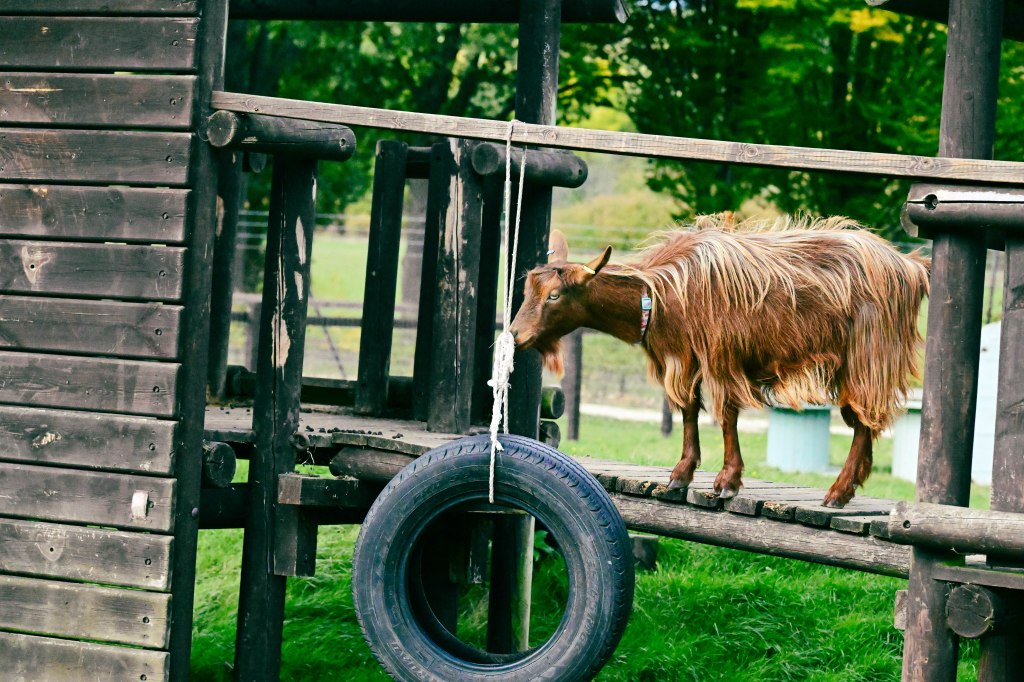
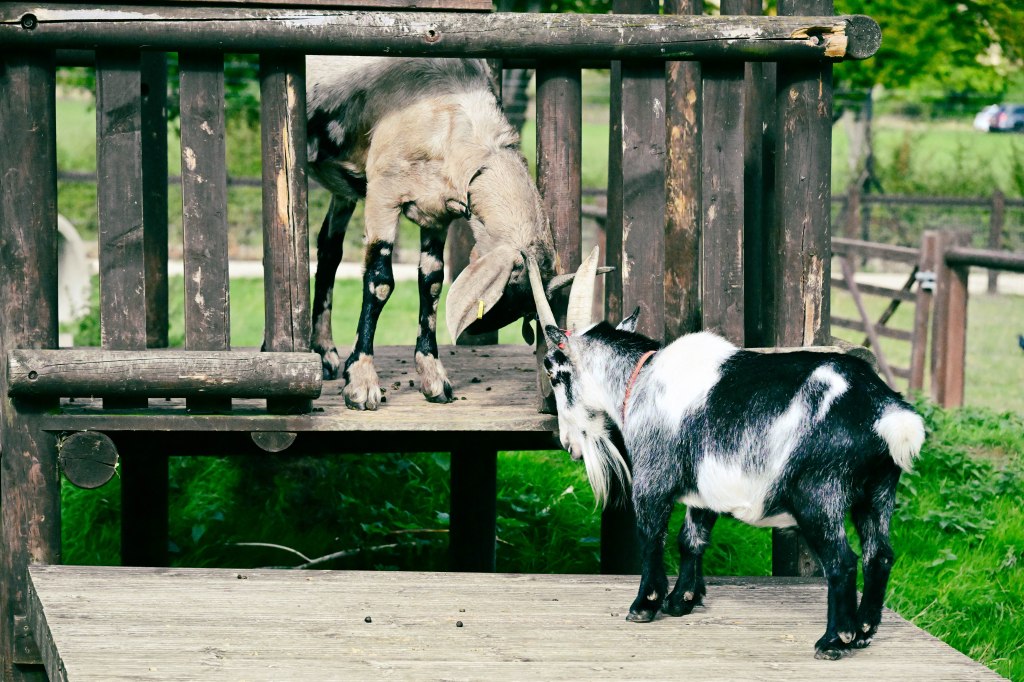
After that I persuaded my friend to go to the farm and look at the animals. The goats were all butting heads with each other and the peacocks were sunning themselves. I got a few okayish shots on my camera as the light was quite good but missed a dramatic fight that the goats with brown hides were having as people had stopped to watch them and I didn’t want any people in the shot.
We walked through the golf course next and then we were back in the forest and in the farmland and then the forest again. There was a rough swing rope that someone had put up in the trees. The only way to get to it was up some precariously placed logs, so it was a challenge of balance. I climbed up it childishly and recklessly. It was only a few feet off the ground but felt like I was walking in the atmosphere and slipping about. I managed to get to the swing rope with my hands but then there was no way to get any momentum to swing about! I had almost fallen off once, but only once. And I hadn’t. So man nature was appeased. My friend shot a video of me doing it.
When we had walked through an enchanted pine soaked place with a delicious scent, I decided that we should stop for lunch. I had brought chicken satays from the reduced aisle with me and the scent was too much. Because we were accosted by two dogs that wanted to partake of the feast. The first one was a giant and was very forward and slightly menacing. Two young boys had to run up and grab him by the leash to get him away. The other dog was a black miniature hound and his owner, an elderly lady, said that he was ‘incorrigible’ as she rushed off with him.
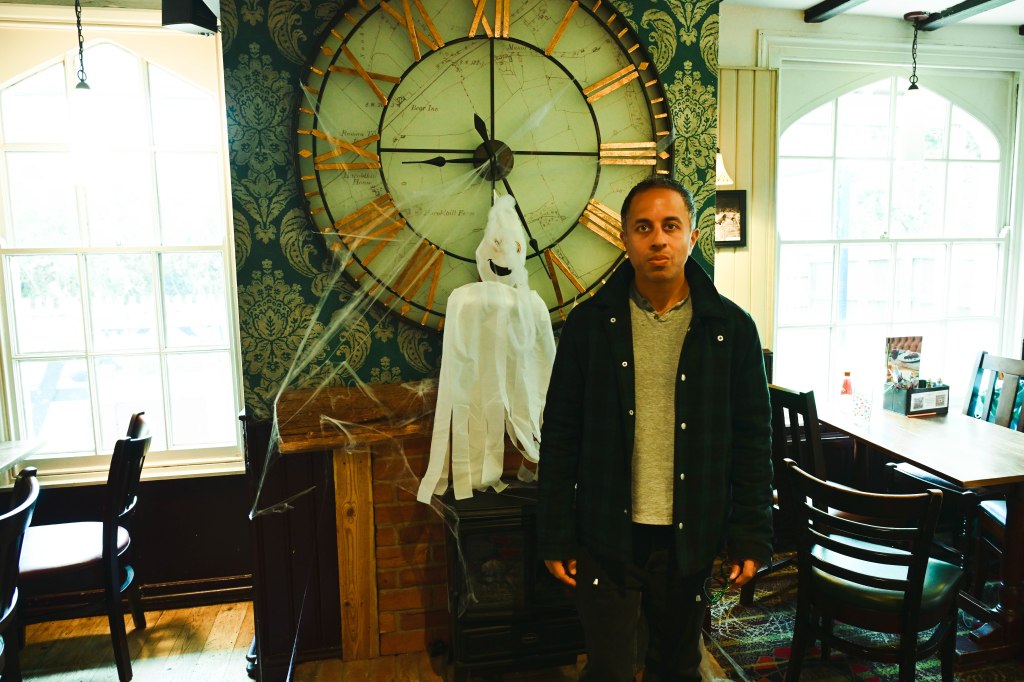
After the forest, with its beautiful light and soothing smells and ambience, and after watching the little trickle that was the river Rom, the next thing, we were sitting in a pub called The Deer’s Rest which was in Romford itself. The whole pub was tricked out in Halloween decor. I got us some drinks and downed an ice cold Pepsi. It was absolutely delicious in a way that Cola is not always. My friend told me that I had worked enough so my body was rewarding me for the work with that delicious sensation. He said that he was having it with his drink as well. The pub had this wallpaper of framed butterfly specimens and it was something that I quite wanted for myself as I thought it looked very sophisticated and cool. And much nicer than real specimens of butterflies which I have always found slightly creepy. Because they are dead beauty.
We walked on through the beauties of nature talking about life, the universe and everything. At some point, we found ourselves in a park. I was keen to watch the young people at the skate park but it was disappointing. They were not doing any tricks! The kids were quite young, but then that Olympics gold medallist had been about thirteen. As we progressed through the park, we came across a father at the top of the slope throwing around a brightly yellow coloured glider aeroplane towards his son. The son was babbling away at us as I remarked that the dad had made a good throw. It was a really touching scene of family and its happiness, the joy of children.
The last stretch of the walk took us to Harold Wood. The name Harold Wood refers to an area of land associated with King Harold Godwinson, the last Anglo-Saxon king of England. It was about four o’clock. We had initially decided to do a bit more but decided to pack it up before the light started going and we’d done about thirty thousand steps. It was about eleven miles well spent.
Last night, my friend invited me to come down to the Dickens House as it was free entry. I had been before a few times a few years ago when I used to volunteer at the Foundling Hospital Museum down the road. Charles Dickens is one of my favourite authors as I admire his maximalist style, his sentimentality and also the fact that he came from an impoverished background and was a champion of the oppressed (except for the colonised and the Indians). As I am a published expert on Charles Dickens (‘The Preservation of the Power Name ‘Boz’ and the Foundling’ in The Dickens Quarterly), I decided to go down and give him a tour around the place. It was almost like being invited into the author’s home by the author himself. A visit to the ghost.
On arrival, I was given solicitous care by the staff because they saw I was carrying a walking stick. And almost at once, I met a volunteer I work with because I am also in the museums industry. As ever, he showcased his great customer service skills.
We started off in the kitchen downstairs and I was very pleased to see how inviting and friendly the volunteers were. We spoke to two of them, one an intern who was a student in Museum studies. The volunteer in the kitchen was very knowledgeable and we talked about Dickens’s love of food and wine which stemmed from his starvation as a child. We speculated on whether he would have spent any time in the kitchen. There was a likelihood as he was quite fastidious in matters as a whole and food was one of his especial subjects. In the corner of the room there was an interesting curator label – after Dickens, one of the residents in the house had been a sufragette who had slashed the Velazquez Venus in the National Gallery.
In the laundry room, I commented to another visitor, a blonde American lady, that this was the height of sophistication and luxury in that period. They even boiled the Christmas pudding there once a year!
On the ground floor, in the dining room, we admired the Moses Pickwick clock that had been gifted to Charles Dickens. I had written about Charles Dickens’s assumption of the name Moses in my article, so I knew quite a lot about this gentleman who had been a foundling. We speculated on who had carved the letters C.D. onto one of the utensils in the room.
The second room on the ground floor was the morning room. We spent quite a while gazing at the portrait of Catherine, Dickens’s wife. This captivating piece was painted by Daniel Maclise. The setting is the morning room itself. In response to what one of the visitors said, and sadly to disillusion her, I mentioned that Dickens eventually separated from her and even tried to get her admitted to a lunatic asylum. There was the President of one of the Dickens Committee there and I told her about my article about Dickens.
Upstairs, there was Dickens’s study and the drawing room. I was excited to see the desk where all the magic happened. It was always the highlight of my trip there in the past. A volunteer called Michael answered my friend’s questions and told us about the lighting at the time for writing. Then he answered my questions about who owned the house at the moment and showed me to the drawing room because I said to him that I had heard that the descendant of Dickens was there too.
The drawing room was magnificent. It must have been such a wonderful experience to meet the author there. The descendant was a handsome, brown-haired, articulate and charismatic young gentleman called Ollie. I watched an eager crowd filming him as they asked him questions. I waited until they had gone and asked him if he wrote himself. Not so much he said, although he was an actor. I said that then he was following in Dickens’s footsteps and we talked about the author’s dramatic experiences.
In the exhibitions space, we admired the only surviving costume that we knew Dickens had worn and talked about his heroism when there was a train wreck. It was also a great highlight to see the Gold beater’s arm (‘the Golden Arm’) of a Tale of Two Cities. While for Dickens, it stood for the brutality of the Revolution, for me the anarchist, it stood as a symbol of hope for the transformation of the present and the future.
On the second floor, it was interesting to learn that Dickens had surrounded himself with mirrors so that he could practice his acting. I imagined him there, gesticulating in front of his mirrors, refining the expressions on his face, communicating something to his imaginary audience.
In the dressing room, we looked out of the window that Dickens might have looked out of. An emotional moment was in Mary Hogarth’s bedroom. I imagined her dying in Dickens’s arms and I said to my friend that I found the sentimentality in the work of Dickens very affecting. I had found the death of Little Nell (modelled on Mary Hogarth, his young sister-in-law) to be quite affecting. It is the emotion that Dickens arouses that is the draw to his work in a modern Western literature of restraint, of stunted emotion and stunted prose.
The whole room was dedicated to death and the vacuum it brings with it. The death of Mary Hogarth and Little Nell was likened to the death of Dickens himself in an exhibit, ’The Empty Chair’, Gad’s Hill–Ninth of June 1870, a print of an engraving by Samuel Luke Fildes. Apparently, this haunting image of the author’s absence influenced Van Gogh who also famously painted an empty chair too, to play with the idea of absence and presence. I am an admirer of both Dickens and Gogh, so this creative correspondence was highly engaging.
After I had looked at the empty chair, I myself fell into the empty chair in the room. I have had that leg operation and I needed a rest for the niggling pain in my shin but I was very pleased that it wasn’t that bad over the past few days and I am improving on the strength in the leg. The volunteer very kindly cleared it and gave it to me. An elderly lady passing by me looked at me conspiratorially and fanned herself, evidently in the throes of a hot flush.
My friend and I read a children’s book together in the book corner to do with a Jewish woman called Eliza who had written to complain to Dickens about his representation of the Jewish Fagin. The children’s book was intended to show it as an example of social transformation and atonement for wrong to a people. I did wonder to myself what Dickens would have made of me writing to him as an Indian to address the wrongs that he had done to our people in his writing (“The Perils of Certain English Prisoners” for instance showed his lack of sympathy for the Indian Mutiny). What was interesting about the book is that we think these kind of debates about identity are a mark of ‘woke culture’, when we have been having these debates for centuries. And still racism persists. Because people will not wake up from oppression, prejudice and injustice.
In the upper floor, we talked about the influence of the raven in Barnaby Rudge upon Edgar Allen Poe. And whether ravens could actually talk!
On the way out, Ollie and the other staff gave us a warm farewell. It was a nice ending to a beautiful visit. I remarked to my friend that I was inspired again to read the novels of this master. Looking around at the lived reality and material objects and scenes that had given form to the works had really enriched my understanding of the memories of reading and being in the mind of Dickens. The experience was invigorating, incredible, intimate.
Exhibition at Kew Gardens Shirley Sherwood Gallery of Botanical Art
Running from April 12 to September 14, 2025
Review by Dr. Suneel Mehmi (first version of an exhibition review for Plantcurator.com)
Images courtesy of Kew Gardens.
What is a portrait of a tree? And what can such a portrait do? What can a tree portrait tell us about ourselves as humans and our systems of representing ourselves and nature? These are some of the questions behind the Finnish visual artist Eija-Liisa Ahtila’s exhibition ‘The Power of Trees’ at the Shirley Sherwood Gallery of Botanical Art at Kew Gardens.
The Power of Trees. Royal Botanic Gardens, Kew. The Power of Trees invites visitors to explore the enduring beauty of trees across art and culture.
A prominent – and spectacular – piece in the exhibition Ahtila’s Horizontal–Vaakasuora offers the living video portrait of a 30-metre-tall spruce in Finland’s boreal forest. The tree is shown as a sublime horizontal, subverting our intuitive perceptions of how to portray a tree and highlighting how the limitations of the film frame can shape understanding since the tree could not be captured as a great vertical but had to be rendered horizontally to capture its majesty.
Alongside the installation are Ahtila’s preparatory works, Anthropomorphic Exercises in Film, which are going to be seen for the first time in the country at Kew. Anthropomorphic Exercises in Film are a series of sketches which cast the trees as human characters in movie scenes. The conception is to foreground and analyse our human ways of seeing through film, one of the forms of representation that dominate our understanding of the world around us.
What I found to be an especially stimulating artwork is Point of View/With a Human. There is a step and in front of it, there are three sections on the tree. The fourth section at the top is a mirror in which we look into. Is this artwork a ladder of the tree into the self? The tree as a spiritual guide for the recognition of the self? Or (even at the same time), a puncturing of human arrogance as you step to look at your face in the top branches of the tree? An insight that our sight and our vision of nature is based on narcissism and ego? That we can we only see ourselves in nature? Nature as ourselves?
Finnish art has traditionally been preoccupied with fragments rather than wholes as we learn from the exhibition curatorial note. What is the artwork saying about human beings as a fragment of nature, as part of nature’s collection of fragments? The fragmented self of human beings in the world of nature?
I found Eija-Liisa Ahtila’s exhibition “The Power of Trees” to be a very well conceptualised thought experiment into how we represent the outside world of nature, but also how we represent the inner world of ourselves through filmic representations. How a portrait and character is built. It is an art of the tree that allows us to know ourselves and the limitations and fabrications of our self-knowledge. The exhibition is playful, earnest, important and stimulating and worth not just one, but repeated visits to tease out its subtlety. After you see it, when you look next at at tree in art, you will definitely look at it differently. And perhaps at yourself too.
Review by Dr. Suneel Mehmi. Images courtesy of the Saatchi Gallery with permission granted to reuse. This is an unpublished first draft for the Plant Curator website – https://plantcurator.com/
An inspiration for the ages and a fount of creativity, flowers have been the originating force, subject and detail of the masterpieces of all cultures. A colossus of endeavour and love, the flower exhibition at the Saatchi Gallery celebrates the contribution – and the omnipresence – of these unparalleled objects of beauty up to and including the present moment. The achievement? To have made a discriminating incision into the ubiquity of the flower in art so that the satisfactory slice can be served up – and digested.
Ranging across two floors which house large-scale installations, technically innovative videography, paintings, graphic design, textiles and photography, over 500 unique artworks and objects form the display. Organisation across this wealth of material is found in nine sections which deal with topics such as fashion, books and film, and representations of the flowers in the work of emerging contemporary artists.
In one room, we find the bespoke installation piece by Rebecca Louise Law, made up of over 100,000 dried flowers that have been salvaged from the wasteful society. A creation of sublimity from rejection which can be viewed from the floor or from above in the balcony. Another space has been transformed into an innovative and interactive digital projection by French artist Miguel Chevalier where we move the flowers and, in turn, they move us. A virtual garden of the imagination.
There is a mixture of justifiably perennial sources of delight such as Boticelli’s Primavera and the designs of William Morris alongside the unknown and uncontemplated work of others around the globe. Highlights include the 3D bronze sculpture of Van Gogh’s ‘Sunflowers’ by Rob and Nick Carter, where the viewing experience of the artwork is renewed (and given another dimension, if the pun is forgiven), Anna Von Freyburg’s gloriously coloured textile interpretation of a Dutch still life painting, Vivienne Westwood’s sensational floral costumes and Ann Carrington’s collection of finds in silver and cutlery for her shining and awe inpiring sculptures of remodification and metamorphosis.
What the exhibition succeeds in doing well is to sting the monkey of the mind so that she flickers across the branches of the canopy, forever at all moments looking for new paths of exploration and into new thoughts. There is so much beauty, so much food for thought.
What struck me in particular was the constant oscillation and the influence of the flower on the female body and the female body on the flowers. And how this dynamic has been woven into art and culture. Women have been understood as flowers, however we may interpret that equation. The exhibition suggests that works such as Mucha’s ‘La Rose’ give the woman flower the aura of power, the transcendence of a domestic role. In Gary Hume’s ‘Two Blooms, Grey Fields’, we are advised to see human faces in the flowers, a coupling of minds.
Another theme that emerged was the relationship between violence and the flowers. Sometimes, ‘flower power’ was an antidote to the oppressive state and the military as we see in photographs, such as Bernie Boston’s image of George Harris sticking carnations into gun barrels during the demonstrations against the Vietnamese war in 1967. In Wole Lagunju’s reinterpretation of the violence of ‘Judith with the Head of Holofernes’, we see flowers from the cultural iconography of the Yoruba which invigorates a postcolonial approach to real history.
As with all subjects of art, it was interesting to see the pull between the abstract representations of flowers, such as Damien Hirst’s ‘Valium’ and the figurative brilliances of art such as Janet Pulcho’s ‘The Dream of Love’ which was painted last year.
To end the exhibition on emerging voices was infinitely pleasing. A demonstration that the fascination with the flower and its beauty drives contemporary art and will be the future for art for time to come.
Immensely enjoyable and productive for a creative mind, ‘Flowers’ at the Saatchi Gallery is a big and delicious fish to have caught and to feast upon. I spent three hours in each of the spaces hoovering everything up. Beautiful variety, stylish presentation of the pieces, the experience was like an entry in the kaleidoscope of the senses. I learnt much, I contemplated much, I hungered much for the beauty of some of the pieces. My overall impression was of a shining, irresistibly coloured flower which emerges from the dark to cast its wonder upon a world of hearts.
Photographs reproduced by permission from the exhibition curator for my personal blog which is non-commercial and written with ‘fair use’ for academic comment and analysis. I will remove any photographs if there is any issues and there has been any misunderstanding.
One of my favourite Hindi songs says that love is expressed by adorning a flower in a love letter. It is what the writer (the lyricist) says because he writes to the woman that he loves. Here, we have a book with a flower inside it. Of course, fairy tales come to us mostly in books now that the oral tradition is dead. One of the themes of this book series by the artist is supposed to be the ‘journey inward’. Following the Protestant Revolution in reading, a journey into a book is a journey inward, as you try to understand yourself through the reading, to arrive at a distant truth. But is the destination the flower? Perhaps for some. And then, what does the flower represent? Or, more to the point, what does the flower not represent? For me, the flower will always be Woman. And Sex. Or, to put it in symbolic terms, connection. Which leads to reproduction. This is the destination at the ultimate aim of the journey inward. The Flowering of the Mind.
The nymph in the fairy tale, the artist says, is the subject of transformation, someone that can be anyone, and influence the natural world around them. This painting is about the power of transformation. Is the context the global nightmare that is human induced climate change? Is the hope in transformation about this? There are red scribbles on the woman’s body. Is this blood? Is she hurt? Will transformation heal her and the planet? The painting is across two screens and cut in half. There is violence at the heart of this image.
The fear of death: the brief glance at death’s feet as he slides down a chimney to kill an old married couple from the Polish fairy tale. Unseen death covered over and disguised in a structure of disavowal – we conceal the reality of death because it is too traumatic when we are grieving, like the reader will grieve the violent endings of these fairy tales. A traumatic illustration that has followed the artist around since he was a child. Accompanied by the book that has had pages torn out from it and sutured to the chimney which is made out of paper – the stuff of trauma.
Sanem Özdemir ‘Evvel zaman içinde, kalbur saman içinde /Once upon a time, in a griddle of straw’ (2024)
A testament to the strong women in fairy tales. And woman as beginning, since the title of the painting is about the traditional Turkish beginning of the story. Woman is beginning because she is the origin of life. Woman is beginning because she is the one that teaches us to look, talk, she is the one that writes our destiny in life. The beginning is woman and the ending is woman. In Western culture, this is recognised in the palindrome: the words for the mother begin and end in the same letter: mum, mom, ma’am, madam.
The woman is by the water. The beginning of the land? The beginning of life in the water for all life on this planet?
A comment upon the ubiquity of the female saviour and their self sacrifice in fairy tales – and in life.
The egg at the bottom perhaps indicates that one of the themes is about female reproduction since women have eggs – that sacrifice for children is written into the biology of women. The idea seems reinforced by the imagery of nature in the piece, with all the trees. But then, the cultural images above the egg suggest that it is a social construct that women should sacrifice to save others (is this paradox?).
A kingly figure is flipped upside down, perhaps to indicate that the collage is an attack upon male ego and patriarchal rule – that which dictates the script.
In speaking, Darico told me that feminism has changed the way that we look at the world and fairy tales.
This is a reinterpretation of a painting which reinterprets an opera which reinterprets a story about magic and love – the fairy tale animal princess that gives love and bestows presents:
As a reinterpretation of a reinterpretation of reinterpretation, this is about the influence of fairy tales and the games of Chinese whispers that they create to forge the identities of readers, artists, opera writers and photographers.
The work is for a charity which supports Downs Syndrome, which the muse has, and some of the proceeds from the work will go to a theatre for those with the syndrome. So the whole thing is about the creation of culture from culture from culture – the never ending cycle of stories with stories within stories, copies of copies of copies.
Did you know that Down’s Syndrome comes from an extra copy of chromosome 21? Did the photographer know this? If so, then the work is about copies and their creation of differences, at the level of images, stories and even at the bodily level.
Katia Kesic ‘Affirmation 5. Take the courage to be seen’ (2022)
The fragmented hand that holds up the mirror to us. We look inside it. We are seen – but by ourselves. This is perhaps supposed to be looking at ourselves honestly in the mirror, having the courage to do so. But, perhaps, at the same time, it is about the courage of being seen as an artist – someone that holds up a mirror to the world – with the artist’s hand which creates the work. There is no disconnection – the artist shows us who we are.
A representation of fear as distorted body, darkness, abstraction, the vague, the indistinct, the blurred. The photography captures the fear in time as a product of time – so there is motion blur. Why the time? Because fear passes. In a sense, this is a photographic history of fear. Just as the fairy tale is a literary history of fear. There is a parallel though – both are fictions.
Because real fear is when you look at the ugliest things in the whole world in crystal clear photographic fidelity and they are emblazoned on your mind as a scar which keeps you up at night, screaming in your dreams. So these photographs and fairy tales are actually protecting us from the reality and the trauma of fear. The acceptable face of fear which masks.
These Indian women represent the Mahabharata and Indian mythology featuring male gods? Why? The series is called ‘My Head is a Vessel Full of Thoughts’. These women are the artist that has been inspired by Indian culture. And she has become strong, a load carrier as a result. These images are about the strength of Indian culture. But also woman carrying the weight of myths about men, gods and heroes as men.
The mirror that the woman sees her face in, with her back to us seems to be in half the shape of a heart. Is it about a concealed love? Since the partner in the mirror of the heart is absent?
The wounded heart is black. Because it is the black that have been hurt. The heart is cut open and its bleeds – the violence that has been inflicted upon the heart is the violence that has been inflicted upon the love of the black. Instead of love given to us, we are cut to the core by the hate of this society and the ‘lovers’ in it – since they can never love us. The wounded heart is the rejection that we, the black, face.
There is a face with four eyes in symmetry with one another. In India, there is a saying that in love, two eyes become four. We share the gaze with someone. Our perspectives blend into each other. In fact, when you look into the eyes of the woman you love… But this is another story that the woman that you love knows…
“The Arachnids were found on witch’s altars in southern Russia, dating back to the early 18th century. The text includes unpronounceable spells, and the images contain some particles that can be used in the preparation of a love potion”.
In the artwork, we are presented with women’s magic: the magic of love. So the question is, who is this spell meant to make a lover of the artist? Is it us, the viewer? Are we supposed to love the artist witch? And what is the nature of this love – with these unpronounceable spells that only work through writing? A reflection on women’s silence in love – when the men have to do all the talking while the women never move their lips? The lover the artist wants is a secret of silence…
Elena Stashkova ‘Herne’s Golden horns’ (2023)
A representation of the horned god of the European peoples. In gold to suggest that mythology is gold, that the god still has enduring and everlasting value in culture. A comment perhaps on the valuations that we bestow on the gods in mythology. Perhaps an attempt to bring to the earth the imagination, to breathe life into the treasures of story and culture (like Agammenon’s golden death mask at Troy?).
This is ostensibly about death and loss. But if you look at the female figure’s dress, it transforms surreally into a clown’s face with a big bow tie. That is spooky and perhaps relays the idea that tragedy can turn into comedy and comedy into tragedy.
Crying is heavy. We carry it. She is carrying the tears around her neck. And, like a farmer, she appears to water the earth. The tears have faces. She is sowing heads into the ground. Because the head has the brain in it – sadness makes us see reality because reality is sadness. That’s why sadness is the head and the mind. Suffering makes the mind grow.
This is a reflection of pure emotion. But what emotion is it? Red for anger? Red for desire? The big, dilated eyes could be anger or lust. The idea of a ‘bloom’? Emotion as the flower? Lust causes a red blush. Anger makes us see red. Maybe the ambiguity is intentional. A deliberate blurring of distinction. Maybe you have to be a Greek to understand this one.
Lera Dergunova ‘She’ (2024)
Artist statement:
“Flowers have always symbolised significant aspects of human nature, such as life, death, love, passion, and power. My first memory of a flower comes from “Beauty and the Beast”, where I was scared by the Rose losing its petals, symbolising imperfection and lifelessness. Through my work, I aim to help people accept their internal softness and the parts of themselves considered “weak” and “defenceless”. I want to unify opposites and show that their strength lies in acceptance and integration”.
Gaining strength through crotchet, confronting fear and the idea of fragmentation and developing resilience through repetitive patterning and creating a whole which masters trauma and loss.
Alona Rubinstein ‘Metaphorical Cards’ (2023)
Artist Statement
In my metaphorical cards, I strive to offer viewers a unique way to find answers to their inner questions through imagery. These cards, created by hand using mixed techniques, predominantly watercolour, serve as a tool for self-discovery. Each card contains a metaphorical image that can be interpreted based on personal experience and intuition.
Suneels’ Comment is ‘no comment’ – because these ones, the whole point is that you are supposed to look at them and go onto your own journey. I have been on my own journey with these. However, one point. With the embrace, there is one behind that does not embrace. The past is rejection.
“This diptych explores the life and death of a modern Thumbelina. The girl could not withstand the current ecological conditions and was buried in a teapot. In today’s environment, fairy tales are not always possible.”
The idea that current reality kills the fairy tale. The diptych seems to be about the death of romantic love. And therefore the death of everything that is human. Because in the story, Thumbelina falls in love with someone and has a happy ending. The current climate is killing love.
A portrait might be about many things. But it is often about a moment of human connection with someone and a relationship. The artist’s relationship with the sitter, or even himself or herself in a self-portrait. I was inspired by the exhibition at the National Portrait Gallery where I used to volunteer just before the Covid Pandemic. I wanted to be – and still want to be – a portrait painter and and a portrait photographer. The human face, the human form, personality, psychology – all these are endlessly fascinating to me. Life gives us opportunities. Even if the people you care about the most won’t let you take them, sometimes you get lucky. Just yesterday, I took three portraits of one of my closest friends with my camera who has always resisted my entreaties. He was very pleased with the results as he thought himself very fine in them. I told him the truth: I see him as very good looking. So in my camera, he is good looking. I am comfortable with my sexuality: only women are attractive to me. So I don’t mind telling men that they are handsome if I think so. It is not often.
Here are a few notes about the work that some of my peers are doing because they actually have the time to do these things. I look at their work with a trace of jealousy because they have time, something that I don’t have, and willing sitters, people close to them. Again, something I do not have in my life.
Download the large-print exhibition guide here to see more detailed notes about each of the paintings that I discuss:
The Last Portrait By Aleksandra Sokolova Oil on canvas, 2020
An old man. A veteran from the world wars. An artist. With a mug and a piece of bread. A commonplace scene of life elevated to art. The layers in the background build up in the humble kitchen scene in a series of three, giving a strong horizontal, structured feel to the painting. The man’s head is caught in the second and topmost of the three layers. Wisps of smoke emerge behind the head of this figure, who is imposing and strong, giving him perhaps an appearance of what? Heat, spirituality (he died while this was being painted – is it a spirit photograph that is capturing his soul departing)? A contrast to his strength with his paunch? What does he signify? Consumption, as he is eating? A moment of repose? But there is movement coming or which has just finished. The glass is just on the edge of the table – either he has just put it back or is just about to pick it up. Time is ambiguously presented: a snapshot in either the immediate before or the immediate future.
Anna By Jack Freeman Oil on canvas, 2023
Her black eyes. But more than that, her black hair which dominates the image for me. The hair of the one that you love. Wild and untamed on the pillow in the bed and seen from above. Twisting about in its full richness like a dark forest above her head. Like a mermaid in the water. The hair of the goddess. In Hindu mythology, when Draupadi was dishonoured, she vowed to keep her hair untamed until she bathed it in the blood of her oppressor. One of her husbands vowed to drink the oppressor’s blood, a terrible oath. The hair of revenge. Shiva, the god of destruction and creation, the Lord of the Dance, his hair was also unkempt and powerful and contained the waters, the Ganges that descended from heaven. Why the water? Why think of it? She is holding a cup. She seems suspended in water, with that crowning glory of hair and its strength. The hair of the woman that you love.
Stereo (diptych) By Peter Davis Acrylic on canvas, 2023
A study in how colour creates unconscious meaning and prejudice. Two studies of a Muslim woman side to side, one in black clothes and another in white, with hijabs in both. The background is the opposite colour to the clothes in both cases. In black clothes, she appears more scarred. In white clothes, she does appear different. But what is the difference when you look at the images side by side? The difference is that when you associate ethnic minorities with black, black as it contrasts with the whiteness that is our surrounding and our culture, then in this culture, we appear scarred. The eyes appear to have no life or soul in them in the black costume, whereas they appear to have more life in the white costume. In the white costume, the face seems friendlier. There is an exposure of how taking on whiteness for an ethnic minority is what makes them palatable in this society. And the lesson? The lesson in the choice. Because I have chosen to take the blackness. If not in clothes, in my behaviour. And, in one context that I am in, many people call me by the name of one of the black men that work there. Because they recognise the blackness in me, even though I am Asian.
Double Portrait of Clara By Michael Slusakowicz Oil on canvas, 2021
A woman decides between two university courses. She becomes two people, one whose shoulder supports the other’s head. But what is the message here? An idea of self support? Or isn’t this about a woman’s decision making process, when she becomes two people because the decision will be life altering. She can either take the decision in which she is the support or the supported. Isn’t this about a woman’s career choice and whether she wants to make enough money to be ‘independent’ or whether she will need someone to look after her? Since in this society, education just means money to most people?
The supported woman wears blue and seems depressed, tired, languid. Because this is how this society sees the dependent. But look again at the woman that is supporting. She looks away from who she supports coldly, a glaring contrast to the warm colours of yellow and red that she is wearing. And she is blue in the face too. Ultimately, whatever the decision that is going to be made, both of the women are blue and seem depressed. At the moment of greatest excitement in life, when you are forging the future, the women are blue. Because one decision perhaps, will be to have wealth but not happiness in what you do. And the other decision will be to have the work but not the reward. The bind that informs all our choices for education in this kind of society.
The floral shirt integrates the man into the palm house at Kew Gardens. The requirement of the moment is to be integrated into nature. However, he holds a flower that droops downwards – the flowers are dying. They need their protector, they need help like the blooming flowers in the palm house that they are contrasted to. He is old, with white hair. The protection is in the hands of the older generation. The children do not have the resources. But behind, there are all youngsters walking around the Gardens: one day they will be in a position to protect because they will have the resources. It is just a matter of time.
Gerard in Hospice By Jackie Anderson Oil on cotton, 2023
A memorial to a dying husband by a loving wife. Minimalistic. Done in a wash of brown, delicate and virtuoso like a Da Vinci drawing. Simple, elegant. Hugely impactful. In the style of the succinct, in the style of brevity. The silence of real grief behind it, the restrained emotion, the guarded feelings that would burst out and consume everything if they could.
Jacqueline with Still Life By Antony Williams Tempera on board, 2020
A portrait of desire, a nude of a beautiful woman. The one painting that seemed to be most about desire. And desire with a mystery. The face, the artist says, is mysterious. And the symbolism is mysterious. The figure is between a fan and a heater – extremes of temperature compete with each other on either side. What does this say about the body in the middle which the fan is to cool or the heater to heat? And don’t we know that heat and cold are how we think about desire and lust? Is this a comment about art and the nude? That we have to reach a medium between lust and cool observation when we are representing our desire?
The still life that is compared and contrasted to the naked body below. A model of a dinosaur, a model of two houses. A dinosaur living in modern times? Sublime nature which towers above human built design and homes? Is the idea of nature contrasting and comparing with the woman ‘in a state of nature’ in the nude? There is a cross at the base of the wooden table – introducing the iconography of the wooden cross to complicate things. A resonance of Christ’s nakedness on the cross? Woman as victim and martyr?
The Most Important Thing in the World By Stephen Leho Oil on canvas, 2020
A woman unpacking a home-made mobile after a mental strain. The face lost in the task. The strangeness of the moment as she destroys what is built, undoes what is done. Perhaps a comment upon the craziness of attention in this society – the trivial things that we bestow our attention on, their ultimate meaninglessness. But also an image of hope: because, hopefully, she will become better. And bestow her attention onto something that she should be bestowing it upon. Something productive and not destructive.
I’ll Never Not Miss You By Laura Carey Oil on canvas, 2023
The emotions as folds and cloth which covers the body of the person we bestow the emotions onto, making them impossible to see as they are – the human condition.
Quoted from the exhibition catalogue.
Laura Carey painted her mother enveloped in a bright red blanket during an afternoon sleep brought on by her chemotherapy treatment. She explains: ‘Her blanket is my love, my anger, hopelessness, grief as well as her cancer all at once.’
Self-Portrait at Low Tide By Alex Tzavaras Oil on linen, 2023
A modern version of Munch’s ‘The Scream’ it appeared to me, with the man in the hoodie that sees hope in the beautiful sky reflected in the sand after a mental illness. We can see the sky behind him in its original state. Not what he sees. This is the thing that got me in the painting – you can’t see the hope in it. You can’t see his hope. What instigates his hope is there up in the sky. But the medium between the sky and us and him, that is not there. Why not? What is this saying about hope and how we can see it? Is it saying that you need a magical moment and unity with nature and existence to have hope? A moment that can’t be shared with others? Is it a comment upon the individualistic nature of hope? That it can only be created in an individual and not in a society, that it can’t be shared? That it is a moment of individual, private psychology?
Or am I reading this completely wrong? Is the idea that hope is always there behind us, following us around. That we just need to see it somewhere? Where is not important?
Maybe the idea is that hope is not really there. There is just its illusion. It is built upon sand, to quote the bible. Sand is not steady. Perhaps the mental illness and the darkness is still there:
life cries
her eyes fill with tears
that never fall
and they hide
for us to slip on
Before it’s Ruined (or an Unrealized Mean Side) By Rebecca Orcutt Oil on canvas, 2020
A woman. An oversized coat. A web. Perhaps an idea of weaving since the textiles are so conspicuous and perhaps an allusion to the Greek myth about the spider’s web and weaving as a competition between Arachne and Athena. If so, about woman’s transformation into nature and the fragility of nature, since the web goes across her forehead and seems to be united with her body as well as her clothes which it is also overlapping against (reinforcing the idea of weaving and the web, the idea of textiles). It could be the wish to be integrated into nature as woman becomes spider but also the desire not to be, as the title suggests that the web is to be torn by the model in the painting, that the work of weaving is to be undone (as traditional roles for femininity as woman weaving are resisted?) An ambiguous and mysterious piece of work.
I did not pay attention to fashion when I was a child. I never read any newspapers or watched the news until I had my Cambridge interview coming up when I was seventeen and I was told I had to start doing that because no one had ever told me to read a newspaper before. I was not exposed to Western culture except in pop music, largely American TV shows and commercial films. So, the first moment I will always remember of Naomi Campbell is in a music video: Michael Jackson’s ‘In the Closet’ in 1992 when I was ten years old. Despite all the allegations and the overtly sexual nature of the song which sometimes threaten to spoil the delight of the music and singing, this is one of my favourite songs by Michael Jackson whose music I grew up with as a small boy. I was dazzled by Naomi, her perfect looks and her statuesque body in this song, her exhilarating dance moves. The curves of her impossibly long legs. She was the kind of woman I had never seen before in my life, me who lived outside of London in a white area with very little diversity. She was the kind of woman that made you notice that there were women in the world. She did not look like she was real. Looking at her was like looking at a different, glamorous, ideal world.
The next moment with Naomi is again something that I would never forget my whole life. The year was 1994. Now, I was twelve years old. We were watching Top of the Pops which I watched regularly because I have always loved singing for as long as I can remember. Suddenly, Naomi Campbell came onto the screen in an Indian sari. I had watched Hindi song and dance routines with women in saris my whole life in Hindi films (‘Bollywood’ – a term I don’t like to use because it is so derivative of Western cinema and Hollywood). But here, instead of the fair skinned Indian actresses that I had always seen, who were usually petite and curvaceous, here was a statuesque, dark skinned woman in Indian dress. It was an unexpected, dazzling, amazing sight. Back then, you didn’t really see women in saris singing songs on Top of the Pops. There wasn’t diversity on British television (has anything really changed there?) The performance was absolutely unique. And Naomi was one of the most beautiful women I had ever seen in my entire life and looked even more beautiful in the sari, because that was from our culture.
You can see this performance here:
That moment is how I will always remember Naomi Campbell. She often wears saris. Because her ethos in fashion is to promote diversity and to celebrate the style that Western fashion has ignored – India and Africa.
As you can imagine, my visit to the Naomi Campbell exhibit at the Victoria and Albert museum was a trip down memory lane, with perhaps one of the most remarkably beautiful women that had made an impact upon me as I was entering puberty. I got a chance to see what I had not seen at the time – Naomi walking on the catwalk, Naomi the activist. Naomi on the magazine covers. I had only known her as a dancer and a singer. Now, I finally got to see what she was as a supermodel.
I was wary of these celebrity exhibitions at the Victoria and Albert museum before. That is because I was not really a fan of any of the celebrities that they were showing. Now, here I was, a fan of the exquisite beauty of Naomi Campbell. The exhibition made you feel close to her passage to fame and to her. It showed you the life that she was living, the clothes that she wore, the people who she was friends with. The exhibition enhanced the sense of connection you feel to remarkable people, the basking in the glory of their achievement that makes you rekindle the love you feel for your idols. More than this, the exhibition showed you the impact that your idols made on the world around them at the time, the fans that shared your passion for this amazing human being.
In the exhibition, they said that Naomi was seen as being able to wear any kind of fashion costume and make it look good, to pull it off. That wonderful athletic dancer’s body that she has, the imposing tallness, the statuesque quality, it works on everything. Whatever she wears looks dynamic and fluid, and, in fact, many of her clothes were figure-hugging. You could sense the powerful quality of being able to wear anything when you looked at the clothes on the mannequins. The clothes, beautiful as they were, looked lifeless without her in them. She exuded power and confidence, the energy of the noble beauty that she has in her appearance and within her. The style.
People often remark on my clothes. But some of them are very cheap clothes from market stalls and most of them have been bought at a sale because no one else wanted them, or could wear them. It is not the clothes themselves that make them look good. It is the body. I tell people this whether they believe me or not – the clothes look good because I am within them and I have absolute confidence in myself, despite being short, thin and not being particularly broad. Someone once told me that I look good in anything and a professional male model half my age once told me that he wanted to look like me and dress like me when he was my age. Naomi Campbell had even more of this quality of super confidence than me, perhaps more than anyone else. And with her, she has the kind of body that only a supermodel can have. Whether it is posture, gesture on the face, the apparent, easy athleticism of the body, or some kind of unconscious signification, perhaps to do with the connotations of ethnicity in a white universe, she has the body of power and visual display.
The exhibition was spectacular in every sense. And the appeal of it was that women want to imitate the power and confidence that Naomi has. There was a catwalk where you could walk like Naomi, become her in a sense. Watch yourself in a video as you become her. She is a role model for so many women and for women that are non-white, proof that you can rise to the absolute top despite prejudice, racism and a lack of real diversity in this society. However, I did note to myself how she was able to achieve this success: by being absolutely extraordinary. By being one of the most beautiful people alive. By having that air of absolute confidence, dynamism, power. These qualities are rare and not easy to replicate. And they show you how ethnic minorities have to achieve this level of success in this society: by being a million times more talented than white people, this being the ‘fairness’ and ‘meritocracy’ of this society.
No one understands your heart. No one understands your words. No one understands your actions. But people think they understand your photographs.
The day:
Bus into the Flower show: Three women my age from outside London came and sat next to me on the bus and started talking to me and joking around with me. Proving that everyone outside of London is still friendly.
Walking around the place where they were selling all the flowers. An inspiring experience. People kept on complimenting me on my clothes – it was at least twenty people, mostly women. And the women gardeners all approached me and talked to me themselves. Women kept on talking to me all day.
However, I had work to do (and what was I going to do talking to women that live outside of London?). It was a case of mixing pleasure with business. Or, rather, pleasure with pleasure. Because my obsession is writing. I went to all of the art stores because I write for a website about plant art. So I collected lots of contacts and got permission to use their artwork for the site. There is a huge amount of stuff to get through.
I skipped lunch. I thought I could treat myself on my holiday to an expensive lunch. I am not used to luxury when that money could be used for something useful. I stayed hungry the whole day and survived off two chocolate bars and water (two Lindt chocolate bars for £1.80).
Hampton Court Palace Gardens towards the end before one final push to get some good photographs inside again.
I went on the Ferry back to the station to get a boat ride in. There was some miscommunication about a buoy a boat had ran into – a young girl thought it was a boy and not a buoy which everyone found amusing.
I walked into town afterwards to look around and went into a last art gallery with a daughter and father duo of artists. He was a carver, she was a painter. I got permission from her to use her work and to write about it for the website.
I was going to go straight home and eat but I ended up helping a sick person on the tube that was throwing up in the bins. It is my duty to help people – the philosophy of the religion I was raised in. No one else was helping him and he needed help. I ran to get someone even though they took their time to walk to him and get him assistance. I had to stay with him for a while.
Which meant that I ended up eating a take out in London before I went home.






 diary of a lone man