Acts of Resistance: Photography, Feminisms and the Art of Protest

ACTS OF RESISTANCE: PHOTOGRAPHY, FEMINISMS AND THE ART OF PROTEST

8 MAR – 9 JUN 2024

FREE EXHIBITION, The South London Gallery

https://www.southlondongallery.org/exhibitions/acts-of-resistance/

When I did my PhD and then got my doctorate published as a monograph, I showed that, just after the invention of photography, Victorian authors associated photography with women and a challenge to the patriarchy and its law. Because of this, throughout the novels of Thomas Hardy, Charles Dickens, Henry James and Wilkie Collins, photography was belittled and there was an attempt to exorcise it from the text. They associated photography with a woman’s supposedly superficial and legally ignorant gaze in The Moonstone (alongside the Indian gaze of the Idolater). The reason was because photography was used to photograph the body and women were seen as bodies rather than minds. Therefore, the denigration of photography was the denigration of the body in Judaeo Christian culture and the repressed times of the Victorians. The most obvious equation of photography with women and their bodies is in She, where Ayesha, the epitome of feminine beauty and physical attractiveness is able to make telepathic mental photographs of the male heroes through her surveillance in her feminine empire and as an expression of her womanly power.

It was the feminine body of photography that was thought of as such a challenge to the male body of the law in these novels that I studied. A usurper to the throne. The medium of revolution.

Almost two hundred years after that equation of the photographic with women, I walked into a feminist protest through the means of photography at the South London Gallery. It was an exhibition space where women were fighting against injustice, state regimes and the law, like the laws controlling abortion. These women were trying to extend the meaning of protest photography. It was a fight of the truth of women against the ideology of the patriarchal state.

The exhibition label calls this ‘the fourth wave’ of feminist protest which is about the empowerment of women, uses internet tools and includes factors such as intersectionality, where there are overlapping oppressions such as misogyny, race and class (Wikipedia). The exhibition is organised in four different sections:

– Body as Battleground

– Institutional Failure

– Revising Histories

– Feminist Futures

Here, in this review, I am going to consider the photography that I had a particular interest in.

Sofia Karim, Ihtijaj (Resistance) (Delhi, 2019)

This photograph is part of a series against anti-Muslim citizenship laws in India which have gone against the ideals of cosmopolitanism and acceptance that Indian descent people like me have grown up on. The title of the series is Turbine Bagh, which is a woman’s resistance movement intended to go against the oppressive laws. The image is printed on a samosa packet made out of newspaper – Sofia was served a samosa packet with court hearings on it once. The image is something that is being fed to the recipient of the law, of news. It is food, nourishment. For the women’s resistance movement.

What strikes me in this black and white photograph is the relationship between the active body of the woman holding her hand above her head to make a gesture and the seemingly passive bodies of the other seated women around her. This is what is apparent at first sight: the movement towards resistance, the action. The active woman’s mouth is forming words. She is communicating, acting. She is energy in the face of passivity. And you look closely to the woman in the right that creates a relationship to this action – her hands are clasped in seeming prayer. The resistance is the prayer of the people, of women. The active woman is the heroine that they are praying for to overturn the injustice of the modern day state. And then, the passivity of the other seated women becomes something else. It is the gesture of waiting. Patient waiting. For the revolution. For the fire that burns and sears the world.

The humble samosa packet which contains the greatness of the revolution.

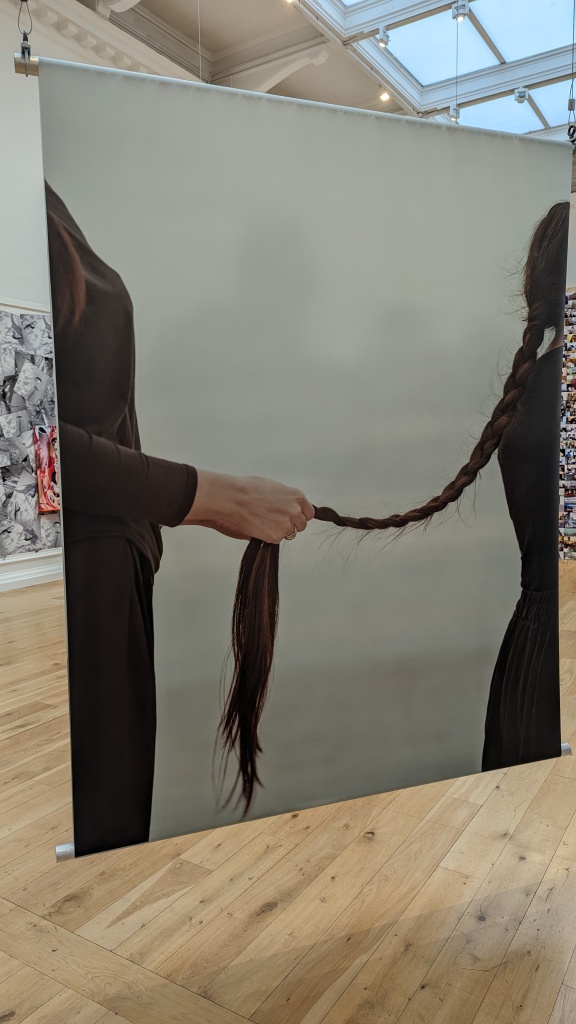
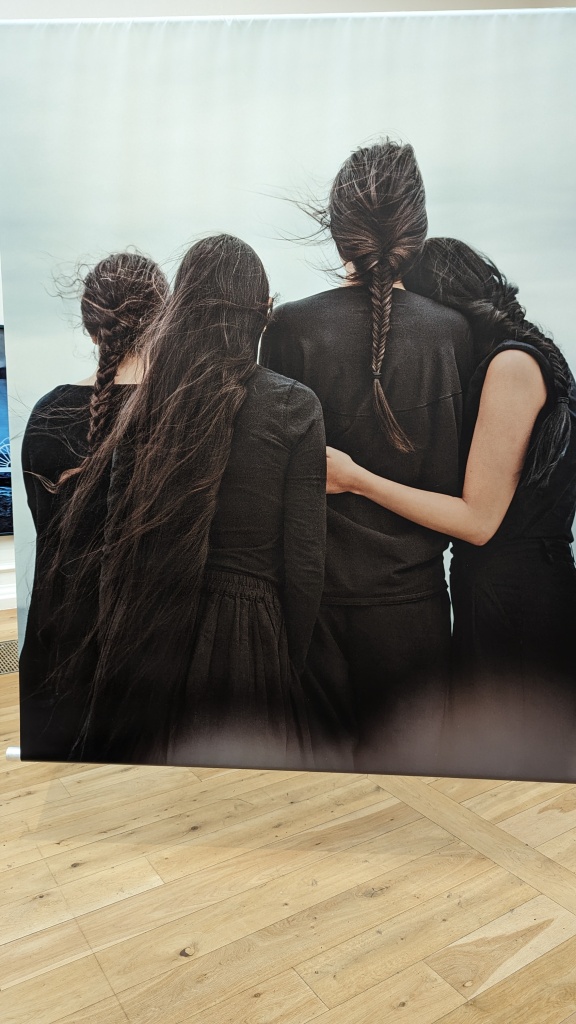
Hoda Afshar, In Turn (2023)

Tehran’s ‘morality police’ killed twenty-two year old Mahsa Amini for not wearing the hijab under government standards. These photographs are one with the protest against that legally sanctioned murder of a woman’s freedom and choice over her body.

The photographs are staged images that utilise the imagery of the doves, birds that are released at the funerals of those that have lost their lives in the protest. The birds stand for martyrdom and peace.

The women in the photographs are largely anonymous because anonymity protects the protesters on social media. These protest photographs show women plaiting each other’s hair and discarding their veils. The hair is plaited as respect is given to women freedom fighters fighting in Kurdistan against the Islamic state. They plait their hair before battle.

These monumental photographs are impressive and powerful. They give a body to the protesters and, with it, humanity. A community is formed around hair and the freedom to show it. The large format itself is a celebration of women and female bodily display, the ‘exposure’ that photography gives. Because, despite the fact that most of the models are anonymous, in the final images as we walk through the space, as you journey through the images and the story they are telling, you see the full frontal body of the woman with doves and her face is completely visible. And on the reverse, you can see the profile of a woman that braids the hair.

The plaited black hair of warfare and the white doves of peace tell a story. To have peace, you have to have the war first. Peace is the aim that can only be achieved through fighting for the rights to have choice and freedom. In the final photograph, a pair of hands braids the hair Another pair of hands superimposed on the back of the woman whose hair is being plaited holds the dove of peace and martyrdom. A reminder that freedom costs something. The fight.

These photographs are an inspiring celebration of heroism.

Sheida Soleimani, ‘Tulip Poster’ from the Series To Oblivion (2016)
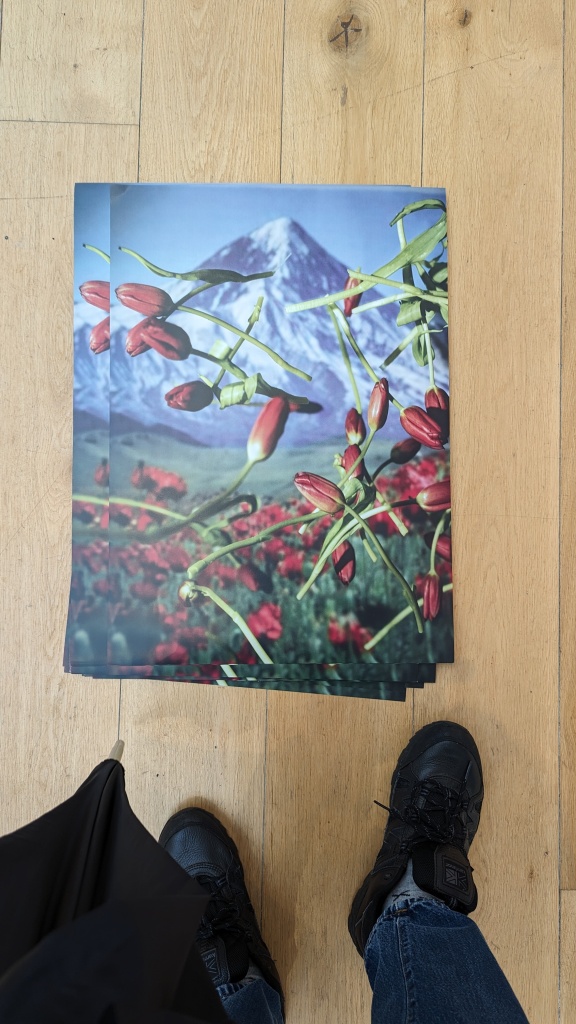
This poster is a tribute to the Iranian women unjustly imprisoned and killed by the state. The tulips reference an Iranian revolutionary song that sees the flower as revolutionary hope – because although it is fragile, it is resilient and it regrows every spring. The numbers on the back of the poster show current published data of those arrested and killed by the Iranian state.

The redness of the flowers. Blood. Against the mountain in the background. With their stalks, the tulips are the ladders up to the peak. They are the scaffolding that can even go above the peak. To ascend the ladders, you have to have the revolutionary hope. Which no sword can cut down. Which no gun can diminish. The tulips are the beauty of hope. The beauty of the revolution. They transcend death with their growth. They have the beauty of growth, nature, resilience. To ascend the ladder of hope is the ascent into heaven. In the religious context of the photographer’s background, this is the image of faith in the revolution and eternal justice. Like Antigone, the photographer promotes the eternal laws of justice rather than the man-made laws of the earth.

Wendy Red Star, Amni (Echo) (2021)

This is a tribute to the matrilineal clan membership of the Appsalooke Nation which was erased by colonialism and its patriarchal laws. The artwork gives power back to the women in her family (the photographer who is Wendy Red Star, her daughter and her great-great-grandmother). And the power back to the names of the women of the Nation.

This was one of the most moving of the artworks in the exhibition for me. They called them Indians when they are Native Americans. They took their land and tried to destroy their culture and their people. They are us. We also have clan membership through our mother – Mother India is our mother and the religion of my mother is the Mother Goddess. It is this which the patriarchal, colonising state wishes to destroy and, with it, difference.

The names of power call out in the background, behind the photographic sculptures. And the photographs themselves build power. Out of the small photograph at the base, a greater entity is formed through the use of overlapping photographs. If you look carefully, you see that the aura is extended into the names of power behind, with the use of negative white space.

One of the ideas around photography when it first came into widespread use was that it could take away the soul of the sitter. Here, that idea is reversed through resistance against the patriarchy.

Because the photograph of the great-great-grandmother is there and the different generations, the photograph scultptures build up the matrilineal history which the law and the colonising state wanted to end. In the face of erasure, we have the form that has come back to us, become literalised in word and image. The phoenix has emerged from the flame.

The exhibition included many other pieces worth a careful examination and study. My overall impression of this exhibition is that I learnt a lot from it and I was inspired by it. We, our community, we also fight the wars against the patriarchal state and its patriarchal laws. For our way of life. For our culture. The patriarchal law wishes to kill what we are. We, the ethnic minorities, even if we are the men, we are also the women.

And the photographs showed the resistance can take many different forms. There are many dances to learn. Many songs to sing.

Time and time again, the photographs exposed what the patriarchal law of the state is. And why it has to be fought against. Not just in ‘other countries’. In Western type countries like Australia and Poland.

Sometimes, I was disappointed. One video installation said to become a ‘peaceful warrior’ and not ‘an angry warrior’. I don’t believe we should spit out our anger. But the philosophy of India is that everyone has their own path. Who are we to judge? As long as the warrior remains the warrior. That is the point.

The union of women with photography suggested calamity to the male Victorian authors that I studied. It suggested the revolution. The exhibit of feminist protest photography is the natural outcome of the resistance. As a form of truth which exposures the corrupt heart of power, photography has few rivals. These images demand more attention and more thought. Within them, they contain the resistance to the state structure and the patriarchal law. And, within them, they contain the conception of justice that the patriarchal law does not have, with its false claims to universality, timelessness and ‘truth’. By making photography concrete, by giving it the female body, these photographers have fought against the male body of the law with its male subject. They have created women’s – and photography’s – jurisprudence in the present moment.

In the end, the warrior loves the warrior. The exhibition is warrior culture.

Becoming a Woman: Revenge, Ethics, Law and The Wounded in a Hindi Film

13.10.16

Is it wrong to desire revenge? Some people suggest that it is. My own research into the Victorian period has shown that not only is the desire for revenge seen as irrational, being emotional, and unreasonable, but that it is also feminised. The desire for revenge is a transgressive desire which attacks the very foundations of Western rationality, the rationality and reasonableness of (white, middle-class) men. Perhaps the most famous example of this feminisation is Miss Haversham in Great Expectations which I read as a schoolboy, but it is also in other famous novels like Vanity Fair, where Miss Sharp favours revenge too.

It is with some surprise that I noted that revenge was also feminised in my favourite Hindi film, starring my favourite actor, Sunny Deol. The name of the film is Ghayal, which means, literally, “wounded”, although I believe the correct translation into English should be “The Wounded”, which would make a significant difference to the overall meaning of the film. Ghayal is not just a film, it is an entire philosophy, some of which I will try to make clear in this little piece. I return to the film when I begin to forget who I am and where I come from. The film is a revenge story. The villain kills the hero’s brother. He is framed for the murder and then an accusation that he killed his brother because he was having an affair with his sister-in-law leads her to suicide. The hero triumphs and has his revenge outside of the law. The film is divided into a number of sections, but the obvious structuring is to contrast everything that follows with a first happy period.

Female revenge is present even in the first happy period, which is full of comedy. One day, the heroine of the film travels to see the boxer hero at his training camp. Because he is scared that he might get sent home, he says to her that he doesn’t know her and tells her to go away. The hero is the only person in the world that the heroine loves and who loves her back. She has no family as her mother and father are dead. When the hero tells her to go away and pretends that he doesn’t recognise her, he is refuting his love for her and treating her as a non-person with no identity. He is excluding her and returning hate and apathy for her love. He hurts her badly, he wounds her absolute trust in him and herself, in other and self.

The heroine does go away. But then, the hero has to apologise. He finds her in a restaurant and tries to speak the words of love to her. But now, the heroine’s mind is concentrated on revenge. She tries to provoke the other customers in the restaurant by turning all of the hero’s words against him to insult them, saying that he has called people bald or fat, etc. She wants the hero to be beaten by the mob, she opportunistically manipulates them to give the hurt and the satisfaction that she will feel. The customers are equated with India – this is an explicit comparison that is made. But Mahabharat (Great India, or ancient India) is also invoked when the hero actually touches the heroine.

As soon as the woman is touched, she opportunistically uses the status of victim to further manipulate the mob. She pretends that she is a damsel in distress, she mimics completely passivity and helplessness. She calls out that the hero, who she pretends is a stranger, mirroring his refutation of her identity, has touched her and rhetorically questions the crowd: Is there no man among you (to protect me, to have the courage to protect me, to protect not only me but all women, the women that are your sisters and mothers)? Here is when the Mahabharat comes to the rescue in the form of Bhima. Bhima is perhaps most famous in the epic saga because of his relationship to women, law and revenge. Draupadi, the wife of five men, was dishonoured by Dushasana who vowed to keep her hair unkempt and unmanaged until they were washed with the blood of her oppressor. Bhima was one of her husbands and he vows not only to bring his wife the blood, but also to drink it. Their vows and laws are based on their revenge. The beginning of legality is based on revenge, the revenge of a woman.

The heroine only forgives the hero when he falls from an elephant in trying to win her over. It is only when the hero is hurt that the heroine is able to forgive him. He has now shared her hurt. He has felt what it has been like to have been in pain. He has hurt himself for her. This is love.

The main revenge story is also marked by its relationship to the law and feminisation. First of all, the hero is clearly “the wounded”. I was discussing wounds and their relationship to femininity with one of my supervisors – someone had questioned my tying together of the wound with femininity in a poem by Robert Browning at a postgraduate reading session – and she told me that the wound has indeed been historically been associated with women, which a number of commentators have noted. He has been hurt badly. The hurt is that his loved ones have been taken from him. But the hurt is not just the loss of his brother, who is murdered, but also his sister-in-law who is like his mother that commits suicide. She is murdered just as much as his brother because she is dishonoured and shamed by what the world has been led to believe about her and her brother-in-law. However, the main hurt has been from the law. The law rejects the hero’ hunt for his missing brother and then he is subjected to brutal torture when he is framed for his brother’s murder. It is in the courtroom that the accusation of the incestuous relationship with his sister-in-law is made that leads to her suicide and extinction, her non-identity. The entire legal system fails him. What he should have been able to trust does not help him, it takes away his love, what he loved most. It takes away that which gives him his identity – his family, the brother and sister-in-law that are like his father and his mother.

Thus, the hero’s quest for revenge is a quest for revenge against the law. It is explicitly stated that his campaign of revenge is a campaign against the law since it is a direct challenge to law and the rule of the law. Of course, this law is only there to protect the villain, the rich man who plays Western music on his piano. Yet every time the hero pulls the gun against the villain, he is impotent. The crisis of impotence reaches its head towards the end of the film. Yet, in the most beautiful scene of the film, when the hero’s campaign of revenge is about to fail and he is pounded by a group of policemen and the law which forms a tight circle around him, the heroine sees him as the victim. She remembers what it is like to be the victim. She knows its reality. She knows what it is to be the wounded. And it is woman and the wounded that help the wounded. They see the place of woman in the wounded. She gives him the loaded gun and he is no longer impotent. He shoots and he does not miss. He hands himself over to the police with a smile on his face and a child that he rescued from the villain, the child that was separated from his mother by the villain and snatched from her, separated from the one he loves the most, applauds. The crowd of the people applaud too. The hero walks beside the heroine who gave him back his potency, both towards the law.

On ethics and law. There is a structuring of five. Draupadi had five husbands. There are five in the family: the hero, his brother, his sister-in-law, the heroine and the evil uncle who is a lawyer, the one that makes the suggestion of the incestuous affair. The brother, before he dies, says that five fingers of the hand are not all the same. The hero has four associates in his desire for revenge (five in total), each of which fall, leaving only him. This is because in revenge, the only one concerned and interested and self-serving can carry out their revenge for themselves. The hero kills the evil uncle, the lawyer: the identity of lawyer, liar, must be eliminated. Law itself is a prostitute: it is said to sleep on the bed of those such as the villain, the rich man. It is not the sacred prostitute, it is the one that only serves the rich. Law is there to be hated. It destroys love and unity. It is the insertion of law and the lawyer into the family which leads to the dishonour of woman and her extinction. It is law that stops a woman becoming a woman and which threatens her integrity and existence.

There is a lot to learn from “The Wounded”. Hurt is only appeased by hurt. Because when the oppressor is hurt, it is then and only then that they learn what it means to be hurt. It is only then that they learn the disintegration of self and integrity. It is only then that they learn what it is to be a victim, to be woman. And all of the negative stereotypes associated with an angry and revengeful women are the very things that we need to be: touchy, sensitive. When we want to hurt the law, we have to attack the places that hurt most. We must take everything from the law and give nothing. We must be merciless and relentless. For it is only the execution of revenge that teaches empathy. It is there to eliminate the ego. The oppressor must be humiliated in a contest, in a duel. In the film, the hero kills the villain, but the real defeat of the villain is in knowing that the law which protected his vicious self cannot save him because he has hurt others. Either no-one must be hurt or all must hurt. This is the lesson of empathy. Hurt only desires further hurt. Hurt can only be satisfied by further hurt, by being placed in the exact same place and position that you place another through hurt. Revenge is the teaching of empathy and the production of emphatic persons, learning empathy with woman. This is what is law.

Waiting for Justice

03.06.2018 –

Christianity, Islam and Judaism share similar features as religions. In particular, they are all based on similar ideas of justice. In each religion, an all-powerful god occupies the position of a judge and there is a day of final judgement when good actions are rewarded and there is punishment for bad actions. The idea that the god of these religions is a judge is said to derive from the political and cultural context of the time when the bible was first written, where it was the prerogative of royalty to mete out judgement. Since god was likened to a king, it was natural that he should also be seen as a judge. The idea of a final day of judgement that comes in the afterlife is possibly derived from the ancient Egyptian beliefs where there is a similar concept.

Because their god is a judge, justice is therefore considered to be a foundation for Christianity, Islam and Judaism and notions of divine justice inform and influence ways of living for believers. But what is interesting in each religion is the fact that the believer has to wait an entire lifetime in order to receive their just desserts. Justice can only be achieved upon death in another time and space, not in the earthly realm and earthly time and space. It is apparent that waiting for justice is really what informs the believer’s actions and choices. Why is the wait for justice so important to these religions and their philosophies? Why is it necessary for their conceptualisation of justice?

From an atheist’s point of view, the requirement that justice can only be meted out by a god in the afterlife and one has to wait for it forever is a convenient mystification that disguises that fact that god doesn’t actually exist and can’t intervene in earthly affairs. However, let us consider the wait for justice in the believer’s own terms. How can each believer wait their entire existence for justice?

Science tells us that human beings are driven by reward-seeking behaviour. We do something because we get a reward out of it. The reason why we hunt for food is so that we can enjoy eating it. The reason why we have children is because we enjoy the process of making children and derive pleasure from it. The religions mentioned above, however, all defer the concept of reward. There is no immediate reward (or punishment) for action in this world. There is only a divine reward or punishment, not an earthly one. One reason why a believer has to wait for justice is therefore to destroy the reward-seeking motivations and behaviour of the individual. The believer is prevented from following human impulse and the instinctual drives of the body. They sacrifice such impulses and drives for a belief. Hence, the human body is being repressed in each religion in order to foster and support an imaginary belief. The human body is being sacrificed for a thought. One component of the wait for justice is therefore an illusion. My speculation is that this illusion is pleasure-inducing, since the reward system relies on pleasure (the pleasure of food or sex). The pleasure derived from this illusion that there is an absolute and final justice which transcends earthly considerations and the desires of the body occupies a prime place in the reward-seeking and reward-inducing components of the believer’s mind (I believe one can say that this would exist in the dopamine system in the brain).

What kind of a pleasure is induced by a wait? There are two things that one thinks of here, each with a sexual component. First of all, one thinks of frustration. Frustration can be enjoyed if one is a masochist. The pleasure in frustration relies on a simple idea, that the reality of a fantasy will not match the pleasure contained within the fantasy. If justice is considered important and foundational to each religion, it is because the fantasy of justice is considered to be more pleasure inducing than the reality of earthly justice. The second thing that one thinks about is foreplay. The prolonging of the beginning of the act can induce pleasure as a specific type of frustration and inform action. The wait for justice in each religion can therefore be conceptualised as a type of foreplay.

I think there is one further component of the wait for justice. Divine justice is seen as final, absolute and perfect and true in each religion. One can therefore wait for it patiently and hopefully. On the other hand, earthly justice is messy, limited, imperfect and frequently based on falsity and mistake. The ones that wait for justice can therefore be likened to a single person that keeps on waiting for the perfect mate to come along even though he or she knows that perfection does not exist. Such a person will not go on dates or consider any substitute or alternative.

The ideas of divine justice have been interpreted in radically different ways by different groups in each religion. I remember reading a pamphlet from the Jehovah’s Witnesses which stated that the devil owned the world and there was no such thing as earthly justice. What is interesting and perhaps most important about the wait for justice in each religion is the case of the Protestant. In Western countries, those people that are most likely to support the earthly system of justice and the laws of the land are conservative Christians. These people appear to believe that the divine system of justice has been translated into earthly form in the mundane and banal form of the English judge. There is therefore a big strand in Western thought in which divine conceptions of justice still play a big role in the conception of what justice is.

What are my own thoughts about the wait for justice? I believe that one should never wait for justice. I believe that the wait for justice is a mystification that favours the powerful in society. If one keeps on waiting for this justice, then one no longer takes affairs in one’s own hands to change and transform this unjust world of ours. I do not believe in any perfect, absolute and unlimited form of justice that is out there waiting for humankind. The very concept of justice is an illusion. I do not understand how people in this world of ours can believe in this illusion. There is merely the self-interest of the powerful which governs all things in this world of ours, including our laws and conceptions of law. And this self-interest forces those with little power to lose their voices and their will, to forsake their self-interest. There is no justice. Yet, even though there is not justice, there is still self-interest. I do not believe we should wait for justice. I believe that we should fight for our own self-interest and our own truths. That is what the idea of “justice”, to use the outdated and misleading term, means to me.

Internalising Stereotypes: Suggested Identities, Individuality and Free Choice

25.04.2018 –

Abstract: Oppressed groups in our society internalise negative constructions of identity and learned sets of behaviours transmitted in media which override personal responsibility and individuality. They do this because they are required to exhibit such identities and behaviours on the public stage because of the constraints imposed upon them by culture.

Keywords: Stereotypes, Cultural Brainwashing, Free Will, Personal Responsibility, Negative expectations

Elaboration. Clarification. Evidence.

Speculation, even that of the armchair theorist, has to be sustained by the holy trio I have just cited. The last time I wrote, the topic was how the justice of the oppressed has been constructed as inevitably having a violent and bodily conclusion. The argument that I made was that the identity of the violent individual and even the framework of action of this individual have been transmitted across Western culture and time as a model for the behaviour and personhood of oppressed groups in our society. This is a model which they turn to in order to construct ideas of justice and individuality and to deal with injustice in this society since it is conceived of as “their own justice”, a justice that is peculiar to them and in which constructions of personhood and difference are inherent. Another reason why they turn to these models for identity and action is because they have been systematically denied any other form of expression in this society so that they cannot become factors in public thought, politics and in the apportioning of power.

There is a big assumption in the argument that I made. Instead of talking about individual responsibility, consciousness and so on, I cited the phrase “cultural brainwashing” in the key terms at the start of the speculations. I argued that individuals take up the identity and framework of action evident in the plays of Shakespeare and such productions as the recent Black Panther movie because they have been insidiously insinuated to them from the time before they have even been born.

Why have I assumed that the identity of the violent avenger is suggested to oppressed individuals and can override conventional notions of individuality, free will, conscious choice and personhood? Is there any proof of this? Just because something is there in Shakespeare and the Black Panther movie, and a similar thing seems to happen in real life, does that prove that my speculations are correct?

While I was pondering whether fiction can be invoked to prove something that happens in real life, I thought I would make a few notes on the topic of suggested identity and the internalisation of stereotypes and how both relate to free will, choice and conscious thought. To introduce the topic, I want to write about a recent change in advertising standards which you can read about here – http://www.bbc.co.uk/news/business-40638343 

As the BBC writes, the Advertising Standards Authority have set out a mission statement to “crack down on ads that feature stereotypical gender roles.” There were particularly aggravating examples that were cited:

One example was an advert for Aptamil baby milk formula that showed girls growing up to be ballerinas and boys becoming engineers.

Complaints had also been made about adverts for clothing retailer Gap that showed a boy becoming an academic, and a girl becoming a “social butterfly”.

What was the justification for cracking down on such adverts? As the BBC journalist writes:

The review suggested that new standards should consider whether the stereotypes shown would “reinforce assumptions that adversely limit how people see themselves and how others see them.”

“Portrayals which reinforce outdated and stereotypical views on gender roles in society can play their part in driving unfair outcomes for people,” said Guy Parker, chief executive of the ASA.

“While advertising is only one of many factors that contribute to unequal gender outcomes, tougher advertising standards can play an important role in tackling inequalities and improving outcomes for individuals, the economy and society as a whole.”

There is a simple idea at the heart of the justification of the advertising crackdown: media plays a role in constraining individuals to adopt certain identities and schemas of action. Media can determine and limit notions of personhood and action. Media can override ideas about free will and choice to produce certain types of individuals that act in a certain kind of way. Stereotypes in the media can be internalised and magnify and build on societal expectations to influence behaviour and identity. There is a qualification: media is just one factor in contributing to “unequal gender outcomes”.

The question remains, however, whether this justification is valid or not. The ASA suggests that media is just one aspect of an entire societal apparatus which is producing gender and gendered forms of identity and behaviour. They make the same claim about cultural brainwashing that I do, that such cultural brainwashing produces zombies that lack responsibility and free will. How exactly is this process of cultural brainwashing played out?

As I was thinking over this topic, trying to work out how individuals internalise expected identities and learned sets of behaviours, one persistent image kept on coming to mind. I am talking about the case of the athlete with the home crowd advantage. There is no need to focus on a particular example, since everyone knows exactly what I am talking about. Here is the typical scenario. There is a home crowd which is composed of people of the same nationality. The home crowd have one athlete in the final who is of the same nationality as them. If one looks at the past record of this athlete, there seems to be very little chance that they will win anything. The athlete’s ranking is not that good. However, the crowd expects the athlete to bring home a medal. Somehow, amazingly, the athlete performs better than he or she has ever performed in their life. They fulfil the crowd’s expectations and bring home a medal. It is the same with teams as it is with individuals.

Here, then, is the prime illustration of how a society’s expectations can be internalised in order to produce a certain identity, that of medal winner, and an expected set of behaviours, a medal winning performance. But what isn’t remarked on and what is brilliantly weird about this phenomenon is that it actually happens. How can someone whose body hasn’t ever and seemingly can’t perform at that level suddenly do what it does in the final? Why does their body and their behaviour change so radically? It is precisely because of the societal expectation that they act in a certain way and become medallists. And this societal expectation is based in nationalism and ideas of national identity. These athletes are drawing on notions of shared and constructed identities in order to behave in a certain way. All the training that they did in their life never allowed them access to a medal winning performance before. It required an internalisation of shared national identity and a meeting of the expectation and demand of the nationalist crowd in order to achieve that result.

One can see then, that individuals can internalise identities and behaviours which are expected of them by society and which themselves radically transform them and their actions in a way that is nothing short of miraculous. The expectations of a group can change the very fabric of reality. These expectations can override conscious thought – the athletes have always consciously tried to win but were never able to gain the victory, however much they trained and tried. It is the adoption of a shared cultural identity and set of behaviours by athletes which, although they are seemingly unrelated to the task in hand (after all, it is not a requisite qualification of being British that one is a gymnast or fast runner) completely changes performance and result and, indeed, alters the body at a fundamental level.

Well. Let us return to our ideas about how culturally shared negative expectations of oppressed individuals can transform their behaviour and override conscious thought, free will and choice. If the scenario in the athlete example can be seen as analogous to how a culture works, then we can see how and why negative expectations fundamentally change the character of individuals. Such expectations, transmitted though media, are internalised and are too powerful to resist. They do away with ideas about free choice, individual responsibility and individuality. Such ideas crush the very stuff that persons are made out of to reproduce stock types. They are too powerful. The group’s expectations completely overwhelm and defeat the individual. The individual can then only exhibit learned behaviour. The word exhibit is important. I think the athlete situation is analogous to the situation in culture because of one important point. Both the athlete and the oppressed individual are on display. They have to perform as though they were in a play to a society that is watching since their actions take place in public. This is why I think that the justice of the oppressed is a form of communication and perceived as the only way to express ideas about justice and the resistance to injustice.

Well, such are the speculations of the armchair theorist. What is the importance of such idle speculations and this short note on the matter? I think the significance is that in Western media, there are only really negative representations of oppressed peoples. They are always shown as violent, barbaric, backward and criminal. Where are the positive role models? When was the last time you saw a British Asian as a hero in western media? The fact is that it is negative expectations of us that are always channelled in the western imagination. If people then internalise and act on these negative expectations, which are not just in media, but everywhere around us in this society, are these people really to blame? If personal responsibility and individuality are really obliterated by group expectations, can we point the finger at perceived criminals? Surely our ideas about law and justice, which rely on notions of free will, choice and individual responsibility have to change?

Shakespeare and the Justice of the Oppressed

23.04.2018 –

Abstract: Violence and justice are linked. Our culture teaches oppressed groups in our society that violence is the only viable means available to them to resist injustice. These lessons are evident in Shakespeare’s plays in which oppressed characters always demand justice in bodily terms and in horrific acts against the bodies of oppressors. Hamlet is just one example.

Keywords: Violence, Justice, Law, Shakespeare, Hamlet, Nasim Aghdam, Cultural Brainwashing

A recent news item that caught my eye was the case of the YouTube Killer, Nasim Aghdam. The woman in question, now known as a killer, was someone that cared passionately about justice. As the Guardian stated, she “used social media to fight for justice on a planet ‘full of diseases’” (https://www.theguardian.com/us-news/2018/apr/04/youtube-shooting-suspect-nasim-aghdam-profile). Nasim had been a gentle person from her childhood. In an interview, her father reflected on how out of character her crime was. He told the Bay Area News Group that “his daughter was a vegan activist and animal lover who as a youngster would not even kill ants in the family home, instead using paper to move them to the back yard” (https://www.theguardian.com/us-news/2018/apr/04/youtube-shooting-suspect-nasim-aghdam-profile). What led a gentle woman that was committed to justice to such a violent conclusion?

Violence and justice. Violence and justice. Are these two things intimately connected? Or was Nasim’s final act just a random event? For the armchair theorist, a theorist who moreover has no time to pursue his many and diverse interests, everything has to remain at the level of speculation. My speculation is that Nasim was one of the oppressed. She was an Iranian immigrant in a country that is thoroughly and systematically afflicted with racism. She had seen how the human race treated our animal brothers and sisters who she felt an honest kinship with. What the immigrant suffers, what the lover of nature must suffer in this world of iniquity and injustice. Have you ever stayed up all night wondering where your justice is? Have you ever cried in your heart of hearts for justice, knowing that it will never come? As Nasim wrote, “I live on a planet that is full of injustice”. The justice that she was led to, in the form of violence, was the justice of the oppressed. Already, the reader is enraged. How can one call a random killing an act of justice, like the killer framed it? How can one speak of the justice of the oppressed as a form of justice, hence giving it some sort of validity and legitimacy? What evidence do I base this seemingly bizarre and arbitrary claim upon, that Nasim’s act was an act of the justice of the oppressed? The evidence is in Shakespeare’s plays.

There is a stock type character in the Shakespeare play, a Nasim, one of the oppressed that demands justice in the form of terrible violence. In the Merchant of Venice, the stock type is a Jew called Shylock. Because of the indignities and hate he has to face in a Christian country, Shylock demands his pound of flesh from one of his oppressors. Shylock is not alone. Tamora, the Queen of the Goths, who is captured in war as a trophy, also demands justice and exacts a systematic plan of revenge against her oppressors. Her wrath is terrible indeed and involves murder, rape and mutilation. This stock type, the immigrant, the oppressed that is out for a violent justice exists in the Western imagination even today. I have written at length about one such character in the recent Black Panther movie, who is called “Killmonger’ to emphasise his link with violence. The Killmonger, an immigrant, wishes to arm the oppressed against the oppressors and is therefore treated like a supervillain.

Why does the oppressed victim pursue a campaign of horrific violence against their oppressors? It may seem natural to link violence and revenge in ideas about “instincts” and “natural aggression” but this would be to obscure the cultural link of meaning between them. Moreover, such ideas obscure the fact that the oppressed have had to endure horrific suffering themselves to become what they have become. The reader of this piece has never seen the illusion of justice torn to pieces before their eyes and realized their awful impotency in this world of injustice. That illusion of justice, which gives meaning to the life of those that live in a thoroughly unjust world is what makes life bearable. When it is gone and replaced by harsh and punishing truth, how does one bear life? What illusion can give meaning and value to life again?

What gives meaning and value to the life of the oppressed is to be revenged. The brutal mental wounds that they have to bear are to be resolved in an act against the body of the oppressor. The oppressed know that they cannot attack the mind of the oppressor. The mind of the oppressor is blind to the justice of the oppressed and to their fury. This mind, the mind of the oppressor, is moreover, a mind shared by the entirety of culture and society. It sits there like an all-powerful Christian god at the heart of everything. It is in the so-called laws and justice of the time, the art of the time, in the literature of the time, in the music of the time, in the commercial transactions and economy of the time, in the international relations of the time and in every act and thought in this culture and society. For the oppressed, there is only one method to attack the oppressor. It is the body. And this is why the justice of the oppressed is inextricably tied to the body.

The greatest play of Shakespeare is about this same idea. Hamlet is one of the oppressed. He has to live as subject to someone who has killed his father. Hamlet knows that the only way that he can achieve justice is to kill his oppressor in a violent act. There is no other alternative. Hamlet doesn’t use poison or any subtle method against his oppressor, although he thinks of it. He doesn’t raise a revolution against Claudius, his uncle and usurper. The justice of the oppressed can only be expressed in violent form against the body of the oppressed. This is the ultimate lesson and finale of the play. Shakespeare has taught us that the justice of the oppressed can only take a certain form which allows no exceptions.

When the people judge someone like Nasim then, a woman who loved justice, and write their biased accounts about what led her to her act, when the culture that claims that Shakespeare is some sort of human god, I will always say the same thing. The oppressed have only acted according to the rules which this culture and society has put in place. They have aimed for the only justice which we have accorded them, which is the justice of the oppressed. These people are acting in a framework of thought and action which this culture and society have given them, a framework which is specially intended for them and which has been taught to them even before they were born. As immigrants and oppressed people, they have been taught that they can only express their rage in terms of the body and against bodies. They have not been allowed into the rules that govern thought, only the rules that govern the body and violence. It is this culture and this society that is ultimately at fault. It is Shakespeare that it is at fault. It is the oppressor that is at fault, not the oppressed. A woman that could not hurt an ant can become a cold blooded murderer because of a lifetime of suggestion and brainwashing in Western culture. And then, this victim, this same woman, can be shown as an example of what immigrants are like in this same culture, as just another example of the same thing. Such is the hypocrisy, malice and deviousness of the culture that we live in, and its ultimate injustice.