Review by Dr. Suneel Mehmi. Images courtesy of the Saatchi Gallery with permission granted to reuse. This is an unpublished first draft for the Plant Curator website – https://plantcurator.com/
An inspiration for the ages and a fount of creativity, flowers have been the originating force, subject and detail of the masterpieces of all cultures. A colossus of endeavour and love, the flower exhibition at the Saatchi Gallery celebrates the contribution – and the omnipresence – of these unparalleled objects of beauty up to and including the present moment. The achievement? To have made a discriminating incision into the ubiquity of the flower in art so that the satisfactory slice can be served up – and digested.
Ranging across two floors which house large-scale installations, technically innovative videography, paintings, graphic design, textiles and photography, over 500 unique artworks and objects form the display. Organisation across this wealth of material is found in nine sections which deal with topics such as fashion, books and film, and representations of the flowers in the work of emerging contemporary artists.
In one room, we find the bespoke installation piece by Rebecca Louise Law, made up of over 100,000 dried flowers that have been salvaged from the wasteful society. A creation of sublimity from rejection which can be viewed from the floor or from above in the balcony. Another space has been transformed into an innovative and interactive digital projection by French artist Miguel Chevalier where we move the flowers and, in turn, they move us. A virtual garden of the imagination.
There is a mixture of justifiably perennial sources of delight such as Boticelli’s Primavera and the designs of William Morris alongside the unknown and uncontemplated work of others around the globe. Highlights include the 3D bronze sculpture of Van Gogh’s ‘Sunflowers’ by Rob and Nick Carter, where the viewing experience of the artwork is renewed (and given another dimension, if the pun is forgiven), Anna Von Freyburg’s gloriously coloured textile interpretation of a Dutch still life painting, Vivienne Westwood’s sensational floral costumes and Ann Carrington’s collection of finds in silver and cutlery for her shining and awe inpiring sculptures of remodification and metamorphosis.
What the exhibition succeeds in doing well is to sting the monkey of the mind so that she flickers across the branches of the canopy, forever at all moments looking for new paths of exploration and into new thoughts. There is so much beauty, so much food for thought.
What struck me in particular was the constant oscillation and the influence of the flower on the female body and the female body on the flowers. And how this dynamic has been woven into art and culture. Women have been understood as flowers, however we may interpret that equation. The exhibition suggests that works such as Mucha’s ‘La Rose’ give the woman flower the aura of power, the transcendence of a domestic role. In Gary Hume’s ‘Two Blooms, Grey Fields’, we are advised to see human faces in the flowers, a coupling of minds.
Another theme that emerged was the relationship between violence and the flowers. Sometimes, ‘flower power’ was an antidote to the oppressive state and the military as we see in photographs, such as Bernie Boston’s image of George Harris sticking carnations into gun barrels during the demonstrations against the Vietnamese war in 1967. In Wole Lagunju’s reinterpretation of the violence of ‘Judith with the Head of Holofernes’, we see flowers from the cultural iconography of the Yoruba which invigorates a postcolonial approach to real history.
As with all subjects of art, it was interesting to see the pull between the abstract representations of flowers, such as Damien Hirst’s ‘Valium’ and the figurative brilliances of art such as Janet Pulcho’s ‘The Dream of Love’ which was painted last year.
To end the exhibition on emerging voices was infinitely pleasing. A demonstration that the fascination with the flower and its beauty drives contemporary art and will be the future for art for time to come.
Immensely enjoyable and productive for a creative mind, ‘Flowers’ at the Saatchi Gallery is a big and delicious fish to have caught and to feast upon. I spent three hours in each of the spaces hoovering everything up. Beautiful variety, stylish presentation of the pieces, the experience was like an entry in the kaleidoscope of the senses. I learnt much, I contemplated much, I hungered much for the beauty of some of the pieces. My overall impression was of a shining, irresistibly coloured flower which emerges from the dark to cast its wonder upon a world of hearts.
Synonymous with the figure of the great and suffering artist, for many, Vincent Van Gogh represents the quintessential meaning of modern art. ‘Poets and Lovers’ brings together his best loved paintings alongside ones that are rarely seen in public. His drawings are interspersed throughout.
Over just two years in the south of France at the end of the nineteenth century, Van Gogh’s fertile and versatile imagination created a revolution in style which married the wonder of the Japanese vision with all the spirituality and poetry of the West. The exhibition encompasses this transformative and influential, inspirational journey in Arles and Saint-Rémy as masterpieces such as ‘Sunflowers’ were painted and the artist explores – with all of his fevered intensity – the realms of poetry and love.
Van Gogh struggled with mental health issues during this time – the current psychological and spiritual crisis that is marring humanity in this moment and therefore of the utmost relevance and significance to us. The exhibition shows how he transcended suffering. And that it was because of this suffering that he became Van Gogh. The exhibition is a demonstration of the strength of the human and of our resilience, creativity and adaptation in the face of collapse and breakdown.
Portraits abound as do scenes of the garden, including the most revealing imaginative grounds of the asylum where Van Gogh was treated. Each picture shows how Van Gogh coupled poetry and romance with an inner vision of things external to create beauty and the vivid life we see in each of his swirls and pirouettes across the canvas to envisage anew nature and individuals.
Highlights of the exhibition include ‘Starry Night over the Rhône’ (1888, Musée d’Orsay), ‘The Yellow House’ (1888, Van Gogh Museum), as well as the National Gallery’s ‘Sunflowers’ (1888) and ‘Van Gogh’s Chair’ (1889).
This is the first major exhibition devoted to Van Gogh in the National Gallery’s rich history.
….
Well researched and genuinely generous to the artist’s ouevre, the Van Gogh exhibition really is a delight for those that love his work and want to know more about his life and inspirations. What was particularly interesting for me was the devotion to the literary and artistic influences on the man as some of the most famous episodes of his existence unfolded: the friendship and arguments with Paul Gaugin and, notoriously, the episodes of mental illness. Van Gogh emerges as the devotee of romance novels, a dreamer and a romantic.
The selection of paintings work as an artistic map of Van Gogh’s journey and exploration of a new locale. He investigates the landscape creatively and with inspired fervour. He remakes the world into his own shape. We see how from a first infatuation, darker and darker elements of the landscape and the world crystallise in the works, the descent into mental difficulties.
As we walk around the many rooms of the exhibition, we mirror Van Gogh’s tracing of the territories around him that he claimed: and we claim that artistic map of the world ourselves, these two years of life amidst the countryside, the Yellow House and the asylum.
Love is a major theme of the exhibition, Van Gogh’s dream of love. The desire to belong to someone. The early landscapes are idealised worlds of love populated by couples, romance and poetry. Van Gogh repeatedly associated poetry with love. This love counterbalances with the cold institutionalisation of the asylum where, perhaps, love is impossible.
On the walls of the exhibition, we see morsels of Van Gogh’s letters to his brother Theo which explain and promote his work. The words allow us to see what his intentions were behind each of the works, the deep river of emotion behind every brush stroke, what was attempted as expression and idealisation. The powerful voice of the man and his humanity and feeling.
Profound, moving, inspirational. This is how I would describe the Van Gogh exhibition. A delight for the lovers of Van Gogh and also, a meditation on how place transforms personality and creativity and how personality and creativity transform place. The magical canvases and portals into the imagination and poetry of Van Gogh and humanity itself are on show here. Who could object or criticise this wonderful achievement?
…
Suneel’s Notes
When I looked at the portrait of ‘The Lover (Portrait of Lieutenant Milliet)’, I was struck by the sadness of Van Gogh. The artist, all alone, dreaming of love, had looked upon Milliet with envy because of his success with women. Here was the artist, the dreamer, the creator of beauty, looking at what the women love: a man of the state. The man synonymous with the power of the state and its violence. A man of violence. I too looked at this figure in this uniform that was the object of female desire with sadness and resignation, remembering my own failures in love. And I shared the subversive vision of Van Gogh who had reversed the star and crescent which was the regimental emblem of Milliet’s infantry unit the Zouaves. A desire to change the desires of others. A desire to transform and subvert the symbols of the state. A criticism of love and its conservativism. A desire for revolution and change. A desire to reverse reality.
What after all is envy? The imaginative desire to transcend and to transform reality so that it is the self that is favoured instead of the other. You contemplate the fortune of the other and the love that the other receives through their privilege and their adherence to the status quo and you feel that you deserve the same no matter how different you are. Envy is not inferiority. Envy is the feeling of life and others not having been fair to you. If life is unfair, at least in the imagination you can be fair to yourself. Because you deserve love too. And if the only way to get love is to shake the foundations of the world, this can be done in art.
Against the man of violence, we protest love. Against the staring face of the state and its coercion and violence, we protest love. Against power, the powerless protest love. Sadly. Against the blue background of depression and the blue scars and bruises of the heart.
…
The garden abounded in Van Gogh’s art. The beautiful garden. The dream to have a garden, to be in the garden, to tend the garden, to live a life in the garden away from the troubles of the world.
But the flowers? The flowers were little dots and dashes. What was of the magnificence and study was the sturdy tree. The trees dominated, swirled and danced in the flow of the artist’s brush and pen. Invigorating, powerful, the connection with nature, with healing. For many of the gardens were in the midst of mental suffering, in the asylum. Those trees were anchors which held the artist down to the world. Their patterns and their growth an inspiration to go on, to keep on finding beauty, to grow again.
And then, the sunflowers and the oleanders and irises. What Van Gogh could not give attention to in the garden, he gave attention to within the home. Away from the overpowering force of the garden and the outside world. Once more, he could concentrate. The meaning of the flowers became clear to me. The attention to beauty, to life. It could come back again from the assault of the senses that was the outside world.
…
Van Gogh. An artist. A poet. A writter of letters.
But above all, a reader. A dweller of the imagination and of the city of beauty.
Many paintings and drawings inspired by novels. And the one that struck me the most in what he read and how he presented his reading was Zola’s The Sin of Abbe Mouret (La Faute de l’Abbé Mouret), about a priest that forgets about his vows of chastity.
For Van Gogh is a man consumed with the passion of love and the passion to love. And love is what he is not getting in his life or from his art.
And that one novel, of falling in love, of feeling the madness of love, of forgetting the self, destroying the self, falling completely, completely… This is the dream of love. The dream of the artist. The dream of the lover of beauty.
And when you have understood what that novel is and the role of nature and the flowers within it, including in the tragic ending, that is when you understand Van Gogh and his art as a whole.
I have loved Van Gogh’s art my whole life. The dancing, mesmerising swirls. The vivid colours, brighter and more intense than this drab life that we have to live. A man that dreams of absolute love, whose art is a plea for that absolute love. The absolute love which I give to Van Gogh. However different he is from me. However we may disagree on things. He is the poet and the lover. And in that, he is me.
Photographs reproduced by permission from the exhibition curator for my personal blog which is non-commercial and written with ‘fair use’ for academic comment and analysis. I will remove any photographs if there is any issues and there has been any misunderstanding.
One of my favourite Hindi songs says that love is expressed by adorning a flower in a love letter. It is what the writer (the lyricist) says because he writes to the woman that he loves. Here, we have a book with a flower inside it. Of course, fairy tales come to us mostly in books now that the oral tradition is dead. One of the themes of this book series by the artist is supposed to be the ‘journey inward’. Following the Protestant Revolution in reading, a journey into a book is a journey inward, as you try to understand yourself through the reading, to arrive at a distant truth. But is the destination the flower? Perhaps for some. And then, what does the flower represent? Or, more to the point, what does the flower not represent? For me, the flower will always be Woman. And Sex. Or, to put it in symbolic terms, connection. Which leads to reproduction. This is the destination at the ultimate aim of the journey inward. The Flowering of the Mind.
The nymph in the fairy tale, the artist says, is the subject of transformation, someone that can be anyone, and influence the natural world around them. This painting is about the power of transformation. Is the context the global nightmare that is human induced climate change? Is the hope in transformation about this? There are red scribbles on the woman’s body. Is this blood? Is she hurt? Will transformation heal her and the planet? The painting is across two screens and cut in half. There is violence at the heart of this image.
The fear of death: the brief glance at death’s feet as he slides down a chimney to kill an old married couple from the Polish fairy tale. Unseen death covered over and disguised in a structure of disavowal – we conceal the reality of death because it is too traumatic when we are grieving, like the reader will grieve the violent endings of these fairy tales. A traumatic illustration that has followed the artist around since he was a child. Accompanied by the book that has had pages torn out from it and sutured to the chimney which is made out of paper – the stuff of trauma.
Sanem Özdemir ‘Evvel zaman içinde, kalbur saman içinde /Once upon a time, in a griddle of straw’ (2024)
A testament to the strong women in fairy tales. And woman as beginning, since the title of the painting is about the traditional Turkish beginning of the story. Woman is beginning because she is the origin of life. Woman is beginning because she is the one that teaches us to look, talk, she is the one that writes our destiny in life. The beginning is woman and the ending is woman. In Western culture, this is recognised in the palindrome: the words for the mother begin and end in the same letter: mum, mom, ma’am, madam.
The woman is by the water. The beginning of the land? The beginning of life in the water for all life on this planet?
A comment upon the ubiquity of the female saviour and their self sacrifice in fairy tales – and in life.
The egg at the bottom perhaps indicates that one of the themes is about female reproduction since women have eggs – that sacrifice for children is written into the biology of women. The idea seems reinforced by the imagery of nature in the piece, with all the trees. But then, the cultural images above the egg suggest that it is a social construct that women should sacrifice to save others (is this paradox?).
A kingly figure is flipped upside down, perhaps to indicate that the collage is an attack upon male ego and patriarchal rule – that which dictates the script.
In speaking, Darico told me that feminism has changed the way that we look at the world and fairy tales.
This is a reinterpretation of a painting which reinterprets an opera which reinterprets a story about magic and love – the fairy tale animal princess that gives love and bestows presents:
As a reinterpretation of a reinterpretation of reinterpretation, this is about the influence of fairy tales and the games of Chinese whispers that they create to forge the identities of readers, artists, opera writers and photographers.
The work is for a charity which supports Downs Syndrome, which the muse has, and some of the proceeds from the work will go to a theatre for those with the syndrome. So the whole thing is about the creation of culture from culture from culture – the never ending cycle of stories with stories within stories, copies of copies of copies.
Did you know that Down’s Syndrome comes from an extra copy of chromosome 21? Did the photographer know this? If so, then the work is about copies and their creation of differences, at the level of images, stories and even at the bodily level.
Katia Kesic ‘Affirmation 5. Take the courage to be seen’ (2022)
The fragmented hand that holds up the mirror to us. We look inside it. We are seen – but by ourselves. This is perhaps supposed to be looking at ourselves honestly in the mirror, having the courage to do so. But, perhaps, at the same time, it is about the courage of being seen as an artist – someone that holds up a mirror to the world – with the artist’s hand which creates the work. There is no disconnection – the artist shows us who we are.
A representation of fear as distorted body, darkness, abstraction, the vague, the indistinct, the blurred. The photography captures the fear in time as a product of time – so there is motion blur. Why the time? Because fear passes. In a sense, this is a photographic history of fear. Just as the fairy tale is a literary history of fear. There is a parallel though – both are fictions.
Because real fear is when you look at the ugliest things in the whole world in crystal clear photographic fidelity and they are emblazoned on your mind as a scar which keeps you up at night, screaming in your dreams. So these photographs and fairy tales are actually protecting us from the reality and the trauma of fear. The acceptable face of fear which masks.
These Indian women represent the Mahabharata and Indian mythology featuring male gods? Why? The series is called ‘My Head is a Vessel Full of Thoughts’. These women are the artist that has been inspired by Indian culture. And she has become strong, a load carrier as a result. These images are about the strength of Indian culture. But also woman carrying the weight of myths about men, gods and heroes as men.
The mirror that the woman sees her face in, with her back to us seems to be in half the shape of a heart. Is it about a concealed love? Since the partner in the mirror of the heart is absent?
The wounded heart is black. Because it is the black that have been hurt. The heart is cut open and its bleeds – the violence that has been inflicted upon the heart is the violence that has been inflicted upon the love of the black. Instead of love given to us, we are cut to the core by the hate of this society and the ‘lovers’ in it – since they can never love us. The wounded heart is the rejection that we, the black, face.
There is a face with four eyes in symmetry with one another. In India, there is a saying that in love, two eyes become four. We share the gaze with someone. Our perspectives blend into each other. In fact, when you look into the eyes of the woman you love… But this is another story that the woman that you love knows…
“The Arachnids were found on witch’s altars in southern Russia, dating back to the early 18th century. The text includes unpronounceable spells, and the images contain some particles that can be used in the preparation of a love potion”.
In the artwork, we are presented with women’s magic: the magic of love. So the question is, who is this spell meant to make a lover of the artist? Is it us, the viewer? Are we supposed to love the artist witch? And what is the nature of this love – with these unpronounceable spells that only work through writing? A reflection on women’s silence in love – when the men have to do all the talking while the women never move their lips? The lover the artist wants is a secret of silence…
Elena Stashkova ‘Herne’s Golden horns’ (2023)
A representation of the horned god of the European peoples. In gold to suggest that mythology is gold, that the god still has enduring and everlasting value in culture. A comment perhaps on the valuations that we bestow on the gods in mythology. Perhaps an attempt to bring to the earth the imagination, to breathe life into the treasures of story and culture (like Agammenon’s golden death mask at Troy?).
This is ostensibly about death and loss. But if you look at the female figure’s dress, it transforms surreally into a clown’s face with a big bow tie. That is spooky and perhaps relays the idea that tragedy can turn into comedy and comedy into tragedy.
Crying is heavy. We carry it. She is carrying the tears around her neck. And, like a farmer, she appears to water the earth. The tears have faces. She is sowing heads into the ground. Because the head has the brain in it – sadness makes us see reality because reality is sadness. That’s why sadness is the head and the mind. Suffering makes the mind grow.
This is a reflection of pure emotion. But what emotion is it? Red for anger? Red for desire? The big, dilated eyes could be anger or lust. The idea of a ‘bloom’? Emotion as the flower? Lust causes a red blush. Anger makes us see red. Maybe the ambiguity is intentional. A deliberate blurring of distinction. Maybe you have to be a Greek to understand this one.
Lera Dergunova ‘She’ (2024)
Artist statement:
“Flowers have always symbolised significant aspects of human nature, such as life, death, love, passion, and power. My first memory of a flower comes from “Beauty and the Beast”, where I was scared by the Rose losing its petals, symbolising imperfection and lifelessness. Through my work, I aim to help people accept their internal softness and the parts of themselves considered “weak” and “defenceless”. I want to unify opposites and show that their strength lies in acceptance and integration”.
Gaining strength through crotchet, confronting fear and the idea of fragmentation and developing resilience through repetitive patterning and creating a whole which masters trauma and loss.
Alona Rubinstein ‘Metaphorical Cards’ (2023)
Artist Statement
In my metaphorical cards, I strive to offer viewers a unique way to find answers to their inner questions through imagery. These cards, created by hand using mixed techniques, predominantly watercolour, serve as a tool for self-discovery. Each card contains a metaphorical image that can be interpreted based on personal experience and intuition.
Suneels’ Comment is ‘no comment’ – because these ones, the whole point is that you are supposed to look at them and go onto your own journey. I have been on my own journey with these. However, one point. With the embrace, there is one behind that does not embrace. The past is rejection.
“This diptych explores the life and death of a modern Thumbelina. The girl could not withstand the current ecological conditions and was buried in a teapot. In today’s environment, fairy tales are not always possible.”
The idea that current reality kills the fairy tale. The diptych seems to be about the death of romantic love. And therefore the death of everything that is human. Because in the story, Thumbelina falls in love with someone and has a happy ending. The current climate is killing love.
I did not pay attention to fashion when I was a child. I never read any newspapers or watched the news until I had my Cambridge interview coming up when I was seventeen and I was told I had to start doing that because no one had ever told me to read a newspaper before. I was not exposed to Western culture except in pop music, largely American TV shows and commercial films. So, the first moment I will always remember of Naomi Campbell is in a music video: Michael Jackson’s ‘In the Closet’ in 1992 when I was ten years old. Despite all the allegations and the overtly sexual nature of the song which sometimes threaten to spoil the delight of the music and singing, this is one of my favourite songs by Michael Jackson whose music I grew up with as a small boy. I was dazzled by Naomi, her perfect looks and her statuesque body in this song, her exhilarating dance moves. The curves of her impossibly long legs. She was the kind of woman I had never seen before in my life, me who lived outside of London in a white area with very little diversity. She was the kind of woman that made you notice that there were women in the world. She did not look like she was real. Looking at her was like looking at a different, glamorous, ideal world.
The next moment with Naomi is again something that I would never forget my whole life. The year was 1994. Now, I was twelve years old. We were watching Top of the Pops which I watched regularly because I have always loved singing for as long as I can remember. Suddenly, Naomi Campbell came onto the screen in an Indian sari. I had watched Hindi song and dance routines with women in saris my whole life in Hindi films (‘Bollywood’ – a term I don’t like to use because it is so derivative of Western cinema and Hollywood). But here, instead of the fair skinned Indian actresses that I had always seen, who were usually petite and curvaceous, here was a statuesque, dark skinned woman in Indian dress. It was an unexpected, dazzling, amazing sight. Back then, you didn’t really see women in saris singing songs on Top of the Pops. There wasn’t diversity on British television (has anything really changed there?) The performance was absolutely unique. And Naomi was one of the most beautiful women I had ever seen in my entire life and looked even more beautiful in the sari, because that was from our culture.
You can see this performance here:
That moment is how I will always remember Naomi Campbell. She often wears saris. Because her ethos in fashion is to promote diversity and to celebrate the style that Western fashion has ignored – India and Africa.
As you can imagine, my visit to the Naomi Campbell exhibit at the Victoria and Albert museum was a trip down memory lane, with perhaps one of the most remarkably beautiful women that had made an impact upon me as I was entering puberty. I got a chance to see what I had not seen at the time – Naomi walking on the catwalk, Naomi the activist. Naomi on the magazine covers. I had only known her as a dancer and a singer. Now, I finally got to see what she was as a supermodel.
I was wary of these celebrity exhibitions at the Victoria and Albert museum before. That is because I was not really a fan of any of the celebrities that they were showing. Now, here I was, a fan of the exquisite beauty of Naomi Campbell. The exhibition made you feel close to her passage to fame and to her. It showed you the life that she was living, the clothes that she wore, the people who she was friends with. The exhibition enhanced the sense of connection you feel to remarkable people, the basking in the glory of their achievement that makes you rekindle the love you feel for your idols. More than this, the exhibition showed you the impact that your idols made on the world around them at the time, the fans that shared your passion for this amazing human being.
In the exhibition, they said that Naomi was seen as being able to wear any kind of fashion costume and make it look good, to pull it off. That wonderful athletic dancer’s body that she has, the imposing tallness, the statuesque quality, it works on everything. Whatever she wears looks dynamic and fluid, and, in fact, many of her clothes were figure-hugging. You could sense the powerful quality of being able to wear anything when you looked at the clothes on the mannequins. The clothes, beautiful as they were, looked lifeless without her in them. She exuded power and confidence, the energy of the noble beauty that she has in her appearance and within her. The style.
People often remark on my clothes. But some of them are very cheap clothes from market stalls and most of them have been bought at a sale because no one else wanted them, or could wear them. It is not the clothes themselves that make them look good. It is the body. I tell people this whether they believe me or not – the clothes look good because I am within them and I have absolute confidence in myself, despite being short, thin and not being particularly broad. Someone once told me that I look good in anything and a professional male model half my age once told me that he wanted to look like me and dress like me when he was my age. Naomi Campbell had even more of this quality of super confidence than me, perhaps more than anyone else. And with her, she has the kind of body that only a supermodel can have. Whether it is posture, gesture on the face, the apparent, easy athleticism of the body, or some kind of unconscious signification, perhaps to do with the connotations of ethnicity in a white universe, she has the body of power and visual display.
The exhibition was spectacular in every sense. And the appeal of it was that women want to imitate the power and confidence that Naomi has. There was a catwalk where you could walk like Naomi, become her in a sense. Watch yourself in a video as you become her. She is a role model for so many women and for women that are non-white, proof that you can rise to the absolute top despite prejudice, racism and a lack of real diversity in this society. However, I did note to myself how she was able to achieve this success: by being absolutely extraordinary. By being one of the most beautiful people alive. By having that air of absolute confidence, dynamism, power. These qualities are rare and not easy to replicate. And they show you how ethnic minorities have to achieve this level of success in this society: by being a million times more talented than white people, this being the ‘fairness’ and ‘meritocracy’ of this society.
There were many unique characteristics of the RHS Flower Show at Hampton Court which I observed as a novice to the event. The variety of our relationships to plants and flowers in art, culture and food. The friendliness of the people there. The almost overwhelming enthusiasm. One such characteristic was that they had plant porters and also that many of the public that did without the plant porters were struggling with the structures of the plants as they flowed within the spaces. The plant structures – so beautiful to behold and so suitable to evolution and adaptation – seemed particularly unwieldy and cumbersome, and their fragility in transit was worrying. I was particularly surprised that at the very start of the morning, people were buying the plants so that they had to carry them around for the whole event, although I suppose that was so that they could get their first choice.
ss Great Britain Botanist.
It was in this context that I came across the SS Great Britain Wardian Cases Exhibition. I had already seen the Wardian case at Kew Gardens for our volunteer training there, so it was not an unfamiliar sight, and I even knew some of the history behind this construction. The Wardian case is what I would describe as a life box that protects plants in a microclimate where they only need to be watered once during a two-month crossing.
ss Great Britain Botanist.
Something akin to a miniature Victorian glasshouse, although made out of wood, the Wardian case has been described as a revolution in the long distance transportation of plants. Patently, the construction was where the sciences of botany and biology found their sanctuary and spring as the living plants could be studied in Europe rather than grown from seeds in a foreign land. Again, the case allowed the transportation of economically important plants and is thus one of the most significant relics in the history of modern capitalism and global development. One of the most noteworthy connections with Kew gardens is with the exportation of seedlings from our glasshouses to Ceylon and Malaya in the 1870s to begin the rubber plantations. However, Kew Gardens also habitually used Wardian cases to transport plants until 1962.
The display at the RHS Flower show was a preview of the exhibition at the SS Great Britain which is Bristol’s number one visitor attraction. On the ship’s weather deck, six reconstructed Wardian cases are on display for visitors to explore. Each is a replica of the last surviving ship-board example designs which are to be found in the Kew Gardens archive. Based on research from the Brunel Institute, studies of the ship’s cargo manifests, each case is planted with a true-to-life ‘order’. The cases will celebrate the inbound and outbound plant species that the ship transported across the world between 1859 and 1875. The exhibition highlights the role of steamships in the transportation of plants and the making of the modern world.
ss Great Britain Botanist.
Along with the exhibition of the Wardian cases, there is other horticultural interest. There is a botany-themed ‘discovery talk’ and horticultural workshops. A ‘botanist’s cabin’ has also been added to the ship’s museum in which you are to become immersed in the sights, sounds and smells of life onboard – a lived experience and introduction to the important work and research of Victorian botanists and ‘plant hunters’.
ss Great Britain Botanist.
The exhibition at the RHS Flower Show was an exciting and stimulating moment in time travel to a monumental period in the history of plants and in the makings of a globalised world. Looking at those fairly small boxes with such a colossal impact was a message that just a little thought and a few materials can change reality. The resourcefulness and ingenuity of the human mind can reshape everything. As we try to combat the mass extinction event that is threatening all plant life and diversity, the Wardian case stands as a symbol that improvement can be wrought to transform botany, biology, the life sciences – and the future. And the Wardian case is also a symbol of connection across the world through transport. The future is about more connection across cultures through science and study enabled through constructions like the Wardian case. And more connections with Kew Gardens, its science and its archives and knowledge to inspire the understanding of this living planet and the foundations on which it has been built.
Acknowledgements Thank you to the SS Great Britain for allowing me to share the photographs and especially to Emily France there who was so helpful with the research and the permissions.
Incredibly, for a country associated with everything that is hi-tech, Japan does not have its own museum of design. At Japan House, the Design Discoveries exhibition puts together seven major designers to consider what they would contribute in the form of design treasures to such a museum. We get a chance to see the rich diversity of Japanese design and some of the unique and inspirational design stories in the land of the rising sun.
I went to this exhibition after my first visit to the Design Museum here in London. I realised that I needed to learn more about this subject, design. Design is all around us. I often wonder to myself if I can ever extract myself from everything that is human made and see real wilderness. The reality is that everything around us – especially in London – is designed. Even when you are in the parks, the parks have been sculpted to look like what they look like. And this exhibition was an illuminating look into the nature of design creativity, how it depends on a historical and geographic context and a rich history of tradition.
Here are the design treasures and my personal comments on each of the exhibitions:
Haburagin, the Clothing of the Noro Priestesses: Design to Protect the Wearer by Morinaga Kunihiko, Fashion Designer
Worn over 500 years ago, these garments enable spiritual safety for the wearer and the community. The stitching keeps out evil spirits. This exhibit was particularly fascinating. Because protection is what coordinates, what is at the basis of our human relationships. I was talking about this with one my best friends. Women want a man that protects them. Men want a woman that gives them protection from the world. Protection is the basic need of humankind. And, I am named after protection: Sunil Dutt who saved the actress Nargis from the fire that broke out on the set of the film ‘Mother India’, a film itself made to protect the honour of India from attacks from the West.
The spirituality of fashion design, fashion built for a community and its spiritual needs was an insight into a world where clothes are not about looking good, but which protect the mind and the self. A psychology of safety that you wear to enable mental functioning and health.
But what is sad about this garments is the reality behind the design: that sometimes the evil spirits creep in and then you no longer have protection.
The premise behind this design may seem archaic, but it continues into the present. I am partially Hindu and my background is that we pray to the Mother Goddess, the warrior, to protect us. And I wear a bracelet on my hand of Bastet with her cats, because she protects and brings good health.
This design is a treasure because it shows that what is important to humans from a design point of view is the fulfilment of of deep-rooted psychological needs such as security and wellbeing, mental health.
Whip Tops and Tops Inspired by Them: Toys as Our First Contact with Design by Tsujikawa Koichiro, Film Director
Here’s what the exhibition notes say:
‘Toys nurture the five senses and the child’s primal desires to touch, see and hear. They embody design in its most primitive form’.
There is a mystical property to the spinning tops because their motion mirrors the human life cycle. They remind us of death when they stop spinning.
What intrigued me about the spinning tops exhibition in terms of design is how rich, colourful and beautiful design is when adults are designing things for children. Because then, the love for design becomes one with the love of children. Adults are trying to initiate children into the world of the human imagination and they present everything that is best about it. And, the conscientious adult – like the designer of these spinning tops – does not stint with knowledge and the experience of life. The design that is made for children is to educate them into the passage and the meanings of life, each of its different stages. It is the greatest moment of sharing in culture: when you are trying to mould the mind of the inexperienced through your own experience. This is why these spinning tops – and design for children – is always so beautiful. The meaning of our human existence is to share our knowledge, our appreciation of beauty, our experience with the future and the next generation.
Jōmon Village Design: Design Found in 10,000-year-old Living Spaces by Tane Tsuyoshi, Architect
‘The Jōmon people designed based on a ring system. The structure of village society was a ring. For 800 years, others joined this ring and belonged to the ring’.
‘Houses were arranged in a circle with the entrances facing the centre. At the centre, there was a ring of stones. This central ring was a place where the living paid their respects to and mourned the dead’.
In my view, the elemental social unit of gathering and community is the ring. With the discovery of fire, the original human group would have ranged themselves in a circle around the fire. This is the only way of maximising the warmth of the flames. This ring design of the Jōmon people embodies the basic unit of organisation.
In our society, where there is no longer eye contact, much face to face interaction, where we sit or stand for hours by ourselves in an unnatural state of affairs, the ring stands for community, integration, oneness. It is a beautiful ideal that we have lost: that connection of human to human that is the secret longing of every heart that dreams for something better than what we have now.
This design is a treasure because it speaks to a fundamental human need for connection and community. It is a reminder of what we have lost in the modern age.
State-of-the-Art 3D Sportswear: Inspired by a Lantern Festival in Toyama by Sudō Reiko, Textile Designer
Before computers, there were humans. And what humans have, compared to a computer, are traditions, spirituality and the brilliance and resourcefulness of their brains. Culture.
Before computer-aided design, there was the festival where the designer made bamboo frames which transformed two dimensional drawings into three dimensional lanterns. And it was because of that that he was able to make three dimensional garments such as 3D-cut woven skiwear in the 1970s..
This design story resonated with me deeply because it shows the resourcefulness of creativity, the inspiration from tradition that prompts innovation. Creativity can be at its best when you are importing or transferring one design tradition into an innovation for another problem.
And, myself, I find constant inspiration from religion. When I was a child, my mother got me, out of everyone, to take the incense and burn it before the mother goddess, the warrior, in the prayer rituals of the house. Bowing my head and holding my hands joined together before her. We asked for her protection. And that moment comes backs to me over and over again and it has become one of the powerful inspirations for creativity and life. The work for the goddess, the work for the festival, the work for the people.
A design treasure because love is work and work is love.
Please note: The views in my personal review do not reflect the views of any organisation in which I work and do not reflect any kind of consensus within any organisation in which I work. This is an independent review for my non-commercial personal blog written in my free time in which I am at liberty to think and say what I want. And nobody is compelled to read what I write – I can only offer an invitation.
In the atmospheric bowels of the King William building, Hugh Fox’s photographs document the interactions of visitors with the space at the Old Royal Naval College, as well as portraits of staff and brief interviews. Visitors are thus able to learn more about what happens behinds the scenes at such a grand historic site, the tales of protection and conservation.
The first photograph is of one of the entrance gates to the attraction, the first glimpse of the beauty inside. Fox has chosen an angle which hides the building behind the trees. So there is a mystery created, a veil between the viewer and the site. There is an idea of an inner, hidden core within the building that is to be investigated. Is this an invitation to penetrate the veil? The allurement of concealment? The lamp in the middle of the archway of the entrance floats over the veil of the trees suggesting the enlightenment of obscurity. Perhaps it is also a reflection on the nature of photography which is writing with light, which promises to go deep within the exhibition.
The fact that there is a tussle between the trees in the archway and the man-made building suggests a fight between humans and nature, culture and authenticity, perhaps even the life of the trees and the stasis of stone. Does nature – and the representation of nature – win? One of the trees appears as though it is bigger than the Baroque dome of the building.
Actually, this entrance (The West Gate) was photographed by the inventor of the photograph in Great Britain, William Henry Fox Talbot in about 1839. So this photograph could possibly be a modern update of that historic photograph – particularly as Hugh Fox also has the name ‘Fox’ in his name.
The theme of enlightenment is continued in the photograph of a mother with a pram who is walking beside her daughter in the shadows. They are walking towards the lamp to the right of the image in one of the colonnades in the site. Because there are two children, perhaps we can assume that they represent the curiosity which the photographer is to kindle in the audience that are following the light of photography and its writing. Illumination is manifest in the image – the three bodies are to move from the sphere of darkness into the light just in front of them. And there is a subtlety too – the mother has one foot behind her in the pool of light. She is leading her daughter into the path of light. She is a being of light herself. The lamp itself is situated over the skyscape of the London Docklands – it represents modernity and the future rather than the Baroque of the Old Royal Naval College.
What is peculiar about the mother is that she wears a yellow coat. This was the coat that the Naval Pensioners wore as punishment in the days of the Royal Hospital for Seamen. This incidental detail may seem to complicate the image in one sense. And then, there is a further complication. Because the staff at the Old Royal Naval College also wear yellow T-shirts. Therefore, the yellow is split between goodness and badness and is ambiguous in its suggestion of the role for the mother.
Particularly interesting to someone with some familiarity of these figures is the portrait of Natalie Conboy, Collections Manager. Obviously the scholarly aspects of her work persona are emphasised and she holds a pencil in her hand. Her personality shines through in her smile: we know that she is a warm person. At the same time, she blazes spectacularly in blue, like a blue fire. Because her hair is blue and she is wearing a blue outfit. In the photograph of the mother leading her daughter into the light, the mother was wearing a blue rucksack. Is this a thematic resonance within the series of photographs here, the breaking down of the barrier between visitor and staff, like this exhibition which presents them both side to side?
But there is also a theme of blackness here. Because the blue has black tiger’s stripes pulsating through it and Natalie also wears black gloves. And there is a mirroring of the black gloves in her necklace that she wears, in which a black hand dangles as a pendant, pointing downwards so that the black hand is gesturing to the black hands below. The photograph is there a symphony of colours and hands. That portray and point to the act of writing, research. And that point to something else: a transformation of the white body into blackness with the black hands of the writer: maybe an allusion to the act of writing where the white body transmutes into the black ink which then relays personality and identity.
But again, there is the pointing towards what is concealed: the concealed hand behind the hand that writes. The hand behind the scenes. We have a meta reference to what is being portrayed in the photograph: the work that is going on behind the vision of the visitor. It is what is concealed that is the object of attraction.
And then, there is an insinuation of precarity here. Because the focus is on writing and the most visible writing in the photograph is the word ‘FRAGILE’ in capital letters on the box above Natalie’s head to the right. The gloves, of course, are to protect the collection, our precious history. They need delicate handling. So Natalie’s role as protectress is emphasised. But at the same time, she is positioned in the shot as fragile herself: she is amongst the shelves which form the background, as one of the objects in the collection…
One photograph of a man looking upwards in front of the West Wall in the Painted Hall and who is directing his smartphone as a camera has a game of arms. The figures behind him are touching his outstretched arms: the nude woman and the King. The relationships between photography, femininity and power are perhaps being explored here as the photographer reflects upon his craft. Photography here appears to be a joining with woman’s body and the photographer gives ‘the elbow’ to male power. It is indicative that all of the staff that he has photographed are women….
The torch and the image of the light makes its way again into the image of one of the friendly Volunteer Tour Guides, Chenda. She is directing the gaze of the visitors upwards with her torch. Once again, the educative mission of the charity and the site is highlighted, its leading of the viewers and the visitors to Enlightenment. It is the gaze upwards towards the heavens…
Does the posture of Chenda imitate the photograph of the mother leading her daughter to the lamp? The mother who was also wearing yellow? Because Chenda is holding her stomach as she points the torch, the place where the babies come from… The action of holding her hand there also obscures her name tag and therefore her identity as she becomes the anonymous purveyor of truth, knowledge, art and culture.
An interesting exhibit with some interesting photographs. A perspective on the site and the people that make it what it is that is well worth exploring. And, furthermore, with the use of framing devices around the site, some of the photographs were quite visually striking.
About the Author
Dr. Suneel Mehmi holds a PhD in the history of photography which was published as a monograph by Routledge – Law, Literature and the Power of Reading: Literalism and Photography in the Nineteenth Century. He is currently in the third year of an Open University Degree in Art History and Visual Culture.
When I did my PhD and then got my doctorate published as a monograph, I showed that, just after the invention of photography, Victorian authors associated photography with women and a challenge to the patriarchy and its law. Because of this, throughout the novels of Thomas Hardy, Charles Dickens, Henry James and Wilkie Collins, photography was belittled and there was an attempt to exorcise it from the text. They associated photography with a woman’s supposedly superficial and legally ignorant gaze in The Moonstone (alongside the Indian gaze of the Idolater). The reason was because photography was used to photograph the body and women were seen as bodies rather than minds. Therefore, the denigration of photography was the denigration of the body in Judaeo Christian culture and the repressed times of the Victorians. The most obvious equation of photography with women and their bodies is in She, where Ayesha, the epitome of feminine beauty and physical attractiveness is able to make telepathic mental photographs of the male heroes through her surveillance in her feminine empire and as an expression of her womanly power.
It was the feminine body of photography that was thought of as such a challenge to the male body of the law in these novels that I studied. A usurper to the throne. The medium of revolution.
Almost two hundred years after that equation of the photographic with women, I walked into a feminist protest through the means of photography at the South London Gallery. It was an exhibition space where women were fighting against injustice, state regimes and the law, like the laws controlling abortion. These women were trying to extend the meaning of protest photography. It was a fight of the truth of women against the ideology of the patriarchal state.
The exhibition label calls this ‘the fourth wave’ of feminist protest which is about the empowerment of women, uses internet tools and includes factors such as intersectionality, where there are overlapping oppressions such as misogyny, race and class (Wikipedia). The exhibition is organised in four different sections:
– Body as Battleground
– Institutional Failure
– Revising Histories
– Feminist Futures
Here, in this review, I am going to consider the photography that I had a particular interest in.
Sofia Karim, Ihtijaj (Resistance) (Delhi, 2019)
This photograph is part of a series against anti-Muslim citizenship laws in India which have gone against the ideals of cosmopolitanism and acceptance that Indian descent people like me have grown up on. The title of the series is Turbine Bagh, which is a woman’s resistance movement intended to go against the oppressive laws. The image is printed on a samosa packet made out of newspaper – Sofia was served a samosa packet with court hearings on it once. The image is something that is being fed to the recipient of the law, of news. It is food, nourishment. For the women’s resistance movement.
What strikes me in this black and white photograph is the relationship between the active body of the woman holding her hand above her head to make a gesture and the seemingly passive bodies of the other seated women around her. This is what is apparent at first sight: the movement towards resistance, the action. The active woman’s mouth is forming words. She is communicating, acting. She is energy in the face of passivity. And you look closely to the woman in the right that creates a relationship to this action – her hands are clasped in seeming prayer. The resistance is the prayer of the people, of women. The active woman is the heroine that they are praying for to overturn the injustice of the modern day state. And then, the passivity of the other seated women becomes something else. It is the gesture of waiting. Patient waiting. For the revolution. For the fire that burns and sears the world.
The humble samosa packet which contains the greatness of the revolution.
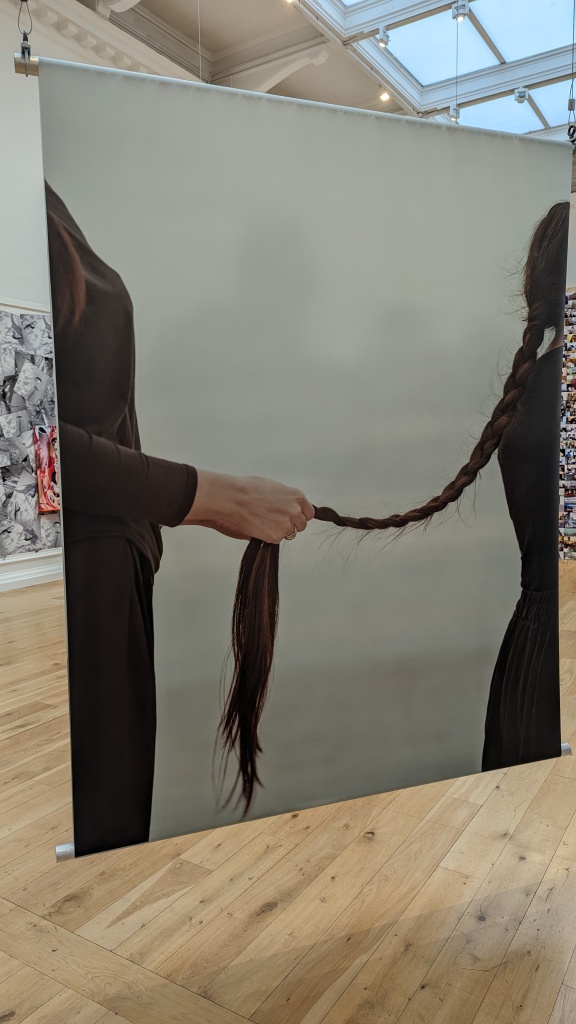
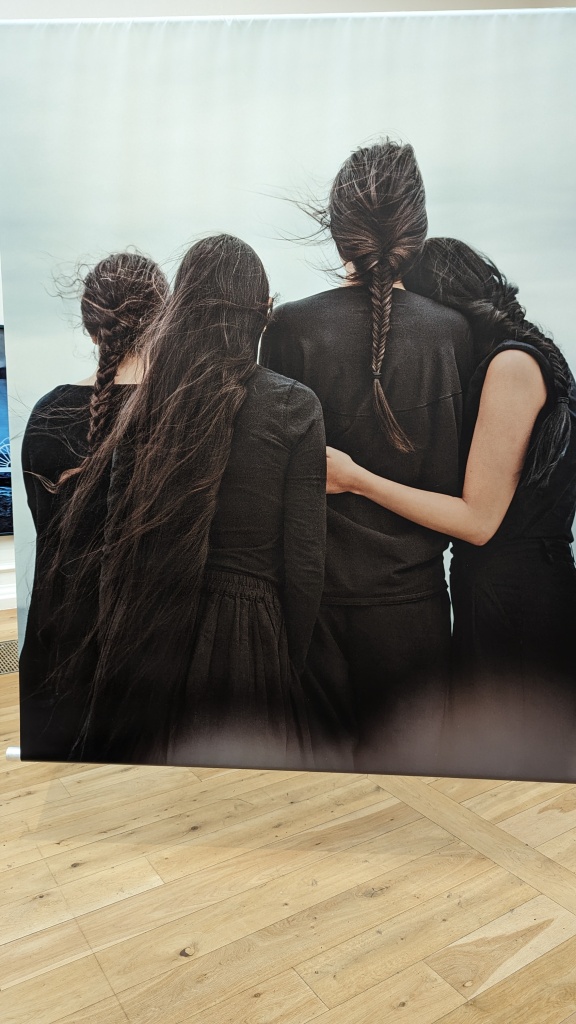
Hoda Afshar, In Turn (2023)
Tehran’s ‘morality police’ killed twenty-two year old Mahsa Amini for not wearing the hijab under government standards. These photographs are one with the protest against that legally sanctioned murder of a woman’s freedom and choice over her body.
The photographs are staged images that utilise the imagery of the doves, birds that are released at the funerals of those that have lost their lives in the protest. The birds stand for martyrdom and peace.
The women in the photographs are largely anonymous because anonymity protects the protesters on social media. These protest photographs show women plaiting each other’s hair and discarding their veils. The hair is plaited as respect is given to women freedom fighters fighting in Kurdistan against the Islamic state. They plait their hair before battle.
These monumental photographs are impressive and powerful. They give a body to the protesters and, with it, humanity. A community is formed around hair and the freedom to show it. The large format itself is a celebration of women and female bodily display, the ‘exposure’ that photography gives. Because, despite the fact that most of the models are anonymous, in the final images as we walk through the space, as you journey through the images and the story they are telling, you see the full frontal body of the woman with doves and her face is completely visible. And on the reverse, you can see the profile of a woman that braids the hair.
The plaited black hair of warfare and the white doves of peace tell a story. To have peace, you have to have the war first. Peace is the aim that can only be achieved through fighting for the rights to have choice and freedom. In the final photograph, a pair of hands braids the hair Another pair of hands superimposed on the back of the woman whose hair is being plaited holds the dove of peace and martyrdom. A reminder that freedom costs something. The fight.
These photographs are an inspiring celebration of heroism.
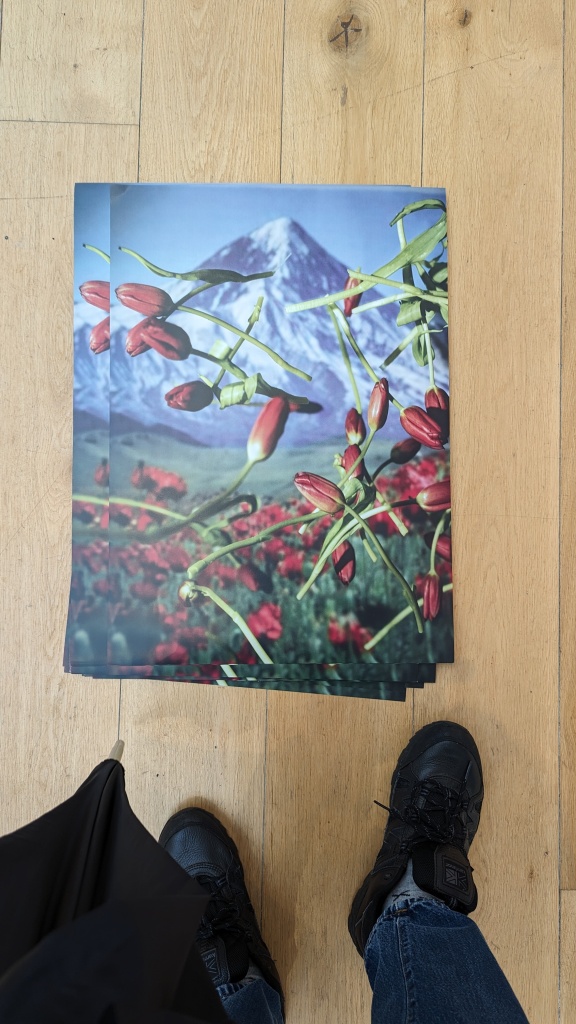
Sheida Soleimani, ‘Tulip Poster’ from the Series To Oblivion (2016)
This poster is a tribute to the Iranian women unjustly imprisoned and killed by the state. The tulips reference an Iranian revolutionary song that sees the flower as revolutionary hope – because although it is fragile, it is resilient and it regrows every spring. The numbers on the back of the poster show current published data of those arrested and killed by the Iranian state.
The redness of the flowers. Blood. Against the mountain in the background. With their stalks, the tulips are the ladders up to the peak. They are the scaffolding that can even go above the peak. To ascend the ladders, you have to have the revolutionary hope. Which no sword can cut down. Which no gun can diminish. The tulips are the beauty of hope. The beauty of the revolution. They transcend death with their growth. They have the beauty of growth, nature, resilience. To ascend the ladder of hope is the ascent into heaven. In the religious context of the photographer’s background, this is the image of faith in the revolution and eternal justice. Like Antigone, the photographer promotes the eternal laws of justice rather than the man-made laws of the earth.
Wendy Red Star, Amni (Echo) (2021)
This is a tribute to the matrilineal clan membership of the Appsalooke Nation which was erased by colonialism and its patriarchal laws. The artwork gives power back to the women in her family (the photographer who is Wendy Red Star, her daughter and her great-great-grandmother). And the power back to the names of the women of the Nation.
This was one of the most moving of the artworks in the exhibition for me. They called them Indians when they are Native Americans. They took their land and tried to destroy their culture and their people. They are us. We also have clan membership through our mother – Mother India is our mother and the religion of my mother is the Mother Goddess. It is this which the patriarchal, colonising state wishes to destroy and, with it, difference.
The names of power call out in the background, behind the photographic sculptures. And the photographs themselves build power. Out of the small photograph at the base, a greater entity is formed through the use of overlapping photographs. If you look carefully, you see that the aura is extended into the names of power behind, with the use of negative white space.
One of the ideas around photography when it first came into widespread use was that it could take away the soul of the sitter. Here, that idea is reversed through resistance against the patriarchy.
Because the photograph of the great-great-grandmother is there and the different generations, the photograph scultptures build up the matrilineal history which the law and the colonising state wanted to end. In the face of erasure, we have the form that has come back to us, become literalised in word and image. The phoenix has emerged from the flame.
…
The exhibition included many other pieces worth a careful examination and study. My overall impression of this exhibition is that I learnt a lot from it and I was inspired by it. We, our community, we also fight the wars against the patriarchal state and its patriarchal laws. For our way of life. For our culture. The patriarchal law wishes to kill what we are. We, the ethnic minorities, even if we are the men, we are also the women.
And the photographs showed the resistance can take many different forms. There are many dances to learn. Many songs to sing.
Time and time again, the photographs exposed what the patriarchal law of the state is. And why it has to be fought against. Not just in ‘other countries’. In Western type countries like Australia and Poland.
Sometimes, I was disappointed. One video installation said to become a ‘peaceful warrior’ and not ‘an angry warrior’. I don’t believe we should spit out our anger. But the philosophy of India is that everyone has their own path. Who are we to judge? As long as the warrior remains the warrior. That is the point.
The union of women with photography suggested calamity to the male Victorian authors that I studied. It suggested the revolution. The exhibit of feminist protest photography is the natural outcome of the resistance. As a form of truth which exposures the corrupt heart of power, photography has few rivals. These images demand more attention and more thought. Within them, they contain the resistance to the state structure and the patriarchal law. And, within them, they contain the conception of justice that the patriarchal law does not have, with its false claims to universality, timelessness and ‘truth’. By making photography concrete, by giving it the female body, these photographers have fought against the male body of the law with its male subject. They have created women’s – and photography’s – jurisprudence in the present moment.
In the end, the warrior loves the warrior. The exhibition is warrior culture.
All views in this article represent my personal views as a private and political individual and do not represent the views of any of the organisations I work at. My expertise? My PhD involved the early history and reception of photography in its political and legal contexts.
‘Don’t survive it. Live it.’ These were the words that someone said to me recently. Survival is the most important thing for us as a species. In the field of psychology, they tell us that the human mind is geared towards survival. That’s where we get our intelligence from: evolutionary adaptations for surviving. But with survival, you have to live it too. You have to experience the fight.
The new photographic display ‘Echoes of the Blitz’ shows how we have to live through our survival. The exhibition ‘explores how Underground stations and metro systems provide shelter to citizens during periods of war – now and in the past’ [1]. How, when you are confronted with death and mortality, when you look death in the eyes, you fight for breath, sense and security. How you find shelter in unexpected places in extreme circumstances and still make a life for yourself. How throughout history and its rivers of blood, throughout the modern period and the supposedly ‘civilised’ Western world, people have hidden in fear to preserve their life, children, culture and heritage.
In total, the photography gallery displays:
‘70 striking images, including historical images from the Museum collection alongside 38 contemporary photographs by six renowned, mainly Ukrainian, documentary photographers.’ [2]
Some of the most recognisable images of the war have been of people sheltering in the London Underground shelters and these icons of memory are given an update and a new relevance through a juxtaposition of the scenes in the Underground shelters in Ukraine.
According to the London Transport Museum, what we are seeing is:
recent photography of ordinary Ukrainian citizens in extraordinary circumstances. They are shown sleeping, waiting, cooking, washing clothes, caring for their pets and creating temporary make-shift homes in Metro stations in the Ukrainian capital Kyiv and its second largest city Kharkiv. These scenes are ‘echoed’ in the black and white archive images of Londoners taking refuge in Tube stations during the Second World War. [3]
The aim of the exhibition is to:
present strong parallels of human experience across different locations and conflicts. This exhibition documents the resilience of people in Ukraine and London during times of war and the reality of having to escape from aerial bombardment. [4]
Other comments have been made about the aims of the exhibition. Matt Brosnan, Head Curator, London Transport Museum, said that the photographs ‘show the resilience and tragic reality of war’ [5]. Stefan Günther, Project Manager, Photo, n-ost, said that the exhibition is ‘an opportunity to perceive the current war in Ukraine on a very personal level, away from the wider political and media glare’. [6]
I think that the exhibit makes concrete the idea of Ukrainians rather than Ukraine. All nations are fictions. It is the people there that are real. And in these photographs, we see the people directly and how they are having to live. And it is photography and its truth that allows us to see the reality behind the abstractions of the newspapers. It is photography that allows us to see them face to face and come directly into their lives. As a matter of fact, the frames of the exhibition invite us to do this. The black and white World War photographs have black frames. These photographs are framed and closed off to us – because as we know, the past is a foreign country. However, the photographs of the Ukrainians are not framed. We are in direct contact with them through our eyes and our perspectives. We are immersed into their world. There is no separation from us through the device of the frame. What is happening there is spilling out into our world, including us. Asking us to contemplate, sympathise.
Some historical details taken from the London Transport Museum website allow us to see the facts behind what is being portrayed:
London’s air raid sirens sounded almost every day for eight months from September 1940 to May 1941 and again between June 1944 and March 1945. Sheltering in Tube stations overnight became a routine. There were special admission tickets, bunk beds on the platforms, refreshments and, at some stations, libraries, music and live entertainment.
In Kyiv, sheltering in the Metro peaked at around 40,000 people at the beginning of the Russian invasion in February 2022. Some stayed overnight, others for days or weeks, returning to the surface only for groceries or to wash. Those who lost their homes lived underground for months.
Kharkiv, close to the border with Russia, experiences more frequent shelling. People spent more time in the Metro there, creating comfortable homely spaces with bedding, tents, carpets, decorations and toys. [7]
After you have read the blurb of the exhibition, the first photograph that dominates is ‘Woman in tent at Dorohozhychi station’ by Maxim Dondyuk, 2 March 2022. The woman defensively has her hand held to her shoulder, covering her chest: a striking image of someone in need of protection, someone that has to defend themselves from an unjust attack. She has to comfort herself with that hand on her shoulder. The woman stands out isolated from the crowd behind her that is not visible, vulnerable and isolated, perhaps like the situation of Ukraine itself – a country that has been left to fend for itself by the ‘civilised’ world of modernity which has disappeared when it is needed. She looks directly at the camera: she implores us to look upon her as the fate of her people, the innocent civilians subjected to the imperialism of the modern day state and its brutality, to their unjust greed and their uncontrolled and obscene desire for control, domination, land and resources. She asks us to acknowledge our role, the roles of our countries that have left her in this position. Does she ask us why? Her face is touched with sadness and suffering. She is in – through the connotations of the opening of the tent – in the dark den of despair, half-eaten by the hole, the absence.
In terms of its historical importance, the exhibition features one of the first ever photographs that were taken when the war broke out and the Ukranians sheltered in the underground stations. Viacheslav Ratynkyi, that on the very first day of the Russian invasion on 24 February 2022 he went down into the Metro and brought a camera so that he could document the situation. [8] The people have used the edges of the stairs along the walls as seats to create a clearing in the middle so that others can move up and down. They have been resourceful to give themselves make-shift seats that would be extremely uncomfortable to sit upon for long periods of time. They have had to adapt for survival and protection as a group, a group and species bound together by necessity and the cruel games of the politicians and the modern day states that are supposed to serve and protect them, the states that are supposed to be bound by the laws and justice. In response to the unjust throne of the state and its modern day king, who cannot sit as he should, the people sit heroically and patiently, in solidarity and suffering. They begin the long wait for peace, the desire of every thinking and feeling human being. These people are the human contrast to the inhuman face of power and brutality, the fascism of the modern-day state.
When I say I am Indian and come from India, it is the India of the people, not the India of the politicians or the intolerant and oppressive citizenship that they want to create. The state that they create is not India. What they create is corruption. We, we the people, we are India. And here, in this photography exhibit, we have the Ukrainians and Ukraine. These people are not defined by the war. In this exhibit, we see them doing the things that we all do every day: listening to music, learning, reading, dying their hair. Holding each other for comfort. They are victims of the state and the politicians. But they have organised themselves. They have created a space away from the brutal games of the state and its quest for total domination. Across world history, across the suffering that man has created, we look at the victims of the politicians and how they have tried to carve out another space and another reality beyond what the unimaginative and corrupt state has imagined. People who live through their struggle for survival. With resilience. As I look at these photographs, I know that one day, the modern-day state with its evils will fall. It has to. Because the spirit of the people will one day overcome the absurd egotistical limitations of geographical and racial boundaries. You can see this in the people and the photographs. You can feel the power of pure being. The desire to move out of the control of others. The spirit of resistance. The spirit of overcoming. Because these people are not trying to create a nation state down there in the underground shelters. They are trying to create a human community: a sphere of protection and life. It is a world meant to foster life – the world that we are trying to create by countering domination with the philosophy of live and let live, by countering selfishness with the desire for preservation, by countering the desire for destruction and death with the desire for life and the future.
If you want to see what a real hero looks like, don’t look at the soldier with blood on his hands, the killer for the state. Look at the everyday hero that fights for survival in an oppressive world and the games of control around them by trying to create another reality – the reality of peace and life. Freedom from death, envy, killing, exploitation. Freedom from the state and its obscenity and blood lust. The people that have created history, tradition and culture by surviving – by fighting to survive and live through that survival – and not by dying and killing in war.
The Infinite Colourful Light of the Moving Kaleidoscope – The Spaces In-Between, Tottenham Court Road
08.04.23
FREE ENTRY
Art by Rupert Newman (light artist) and PixelArtworks
It happened unexpectedly. A fine example of serendipity, the right place at the right moment. I had just spent a few hours browsing in Foyle’s and a small independent second-hand bookshop and was just making myself towards Tottenham Court Road. I was musing over the books I had seen and I was thinking to myself that I certainly wasn’t rich enough to have all the books that I wanted to read and to have to keep in my own personal library and to share with my kids. That privilege was reserved for the billionaire or the British Museum.
And there it was. The Infinite Colourful Light of the Moving Kaleidoscope… An awe-struck mass of bodies within a space carved out by futuristic light, right next to the station.
The space is described as a ‘digital portal’ and we are meant to ‘discover a prismatic new experience’. The location of the site is important because it is ‘In-Between’ spaces. One of the installations (or ‘spaces’) reacts to your body as you stand before it. The display is in front of you, above, around four walls. It is a type of immersive, interactive art (four dimensional, they sometimes call it). The experience is touted as semi-religious and the installation is described on a panel as a crystalline cathedral of light’.
So this is why I call it ‘The Infinite Colourful Light of the Moving Kaleidoscope ‘. Light, of course, is associated with Christianity, with enlightenment, progress and truth, things that capitalists like to give lip service to when they put us out of work because of computers and technology (it is always right to rail against the so-called technological progress of the capitalists, since this is the weapon of their hubris). I was in a Chapel service recently and they called the Christian God’s kingdom a place of ‘infinite light’. Art is akin to the Christian religion in our age, perhaps its best substitute. When you go to an art gallery, there is a hush like there is in the chapel. There is a reverent lowering of the eyes before the icons of the age, just as they gaze up at the icons in a religious setting. All the visual display is impregnated with a colossal and sublime meaning, with divine beauty that is not of this earth… For art is considered to be of the spirit for some (not for me, it is still earthly and profane).
As I moved within this computer generated, geometric space, encased in the ingenuity of man and machine, within light, art, animation, music, the energy of the crowd, I was certainly impressed. It was a novel experience. It was a beautiful experience. Yes, it was even a beautiful experience.
Yet where was the meaning behind it all? I read the panels for each of the three different spaces. There were the described themes. Firstly, ‘A Step Beyond’, the immersion in another digital world. Yet how different was it from the contemporary enveloping of the subject in the age of the computer? Was the artwork just priming us as digital subjects, a repetition of what was happening in our technologically mediated reality? Secondly, ‘Transcendence’. Yes, the art is beautiful. The beautiful forms of nature are rejuvenated in an encounter with geometry. The translation of the subtle mathematics of the world into the mathematical language of geometry. But what does the viewer get from this? A strict regularisation and stylisation of the beauty of what is for what can be imagined is the staple of most art, which is abstract at heart (even within supposed realism). But what is the status of this new abstraction for us now and why are we being placed within it in this space? Is awe for nature to be replaced for the awe of what man and machine in unity can now do, what imagination and computer code can achieve? ‘Tessellations’ was more of the same thing: animated geometric patterns filled with light. A world of code that surrounds us, like the Matrix, changing, transforming, not sending out any obvious message, not allowing any thought but awe…
Perhaps the difficulty is not the lack of the message but the lack of the training we have to try and understand abstract art and the elusiveness of meaning in abstract, geometric art itself. Perhaps I do not understand the proposed religiosity behind the installation. Certainly, geometric art figures in Islam in Mosque designs and calligraphy as an expression of faith. Perhaps there is a feeling of endless harmony and connection with things that the piece is supposed to evoke. I did not get this feeling. I got the beauty. I did not get the sense of the digital sublime which all the spaces were meant to evoke. I did not feel engulfed, threatened (perhaps the wonders of the technology are supposed to threaten to usurp man). I lack fear – Punjabi men are afraid of nothing and no-one. Especially not code or geometry filled with light. For me, the exhibit was a good waste of time just before I got onto the Tube, but not an inspirational experience or one which provoked much thought, except for the vague idea that I could get together a venue for something like it and make a bit of money off it… To be really honest, it was like being in a screensaver.






 diary of a lone man