Acts of Resistance: Photography, Feminisms and the Art of Protest

ACTS OF RESISTANCE: PHOTOGRAPHY, FEMINISMS AND THE ART OF PROTEST

8 MAR – 9 JUN 2024

FREE EXHIBITION, The South London Gallery

https://www.southlondongallery.org/exhibitions/acts-of-resistance/

When I did my PhD and then got my doctorate published as a monograph, I showed that, just after the invention of photography, Victorian authors associated photography with women and a challenge to the patriarchy and its law. Because of this, throughout the novels of Thomas Hardy, Charles Dickens, Henry James and Wilkie Collins, photography was belittled and there was an attempt to exorcise it from the text. They associated photography with a woman’s supposedly superficial and legally ignorant gaze in The Moonstone (alongside the Indian gaze of the Idolater). The reason was because photography was used to photograph the body and women were seen as bodies rather than minds. Therefore, the denigration of photography was the denigration of the body in Judaeo Christian culture and the repressed times of the Victorians. The most obvious equation of photography with women and their bodies is in She, where Ayesha, the epitome of feminine beauty and physical attractiveness is able to make telepathic mental photographs of the male heroes through her surveillance in her feminine empire and as an expression of her womanly power.

It was the feminine body of photography that was thought of as such a challenge to the male body of the law in these novels that I studied. A usurper to the throne. The medium of revolution.

Almost two hundred years after that equation of the photographic with women, I walked into a feminist protest through the means of photography at the South London Gallery. It was an exhibition space where women were fighting against injustice, state regimes and the law, like the laws controlling abortion. These women were trying to extend the meaning of protest photography. It was a fight of the truth of women against the ideology of the patriarchal state.

The exhibition label calls this ‘the fourth wave’ of feminist protest which is about the empowerment of women, uses internet tools and includes factors such as intersectionality, where there are overlapping oppressions such as misogyny, race and class (Wikipedia). The exhibition is organised in four different sections:

– Body as Battleground

– Institutional Failure

– Revising Histories

– Feminist Futures

Here, in this review, I am going to consider the photography that I had a particular interest in.

Sofia Karim, Ihtijaj (Resistance) (Delhi, 2019)

This photograph is part of a series against anti-Muslim citizenship laws in India which have gone against the ideals of cosmopolitanism and acceptance that Indian descent people like me have grown up on. The title of the series is Turbine Bagh, which is a woman’s resistance movement intended to go against the oppressive laws. The image is printed on a samosa packet made out of newspaper – Sofia was served a samosa packet with court hearings on it once. The image is something that is being fed to the recipient of the law, of news. It is food, nourishment. For the women’s resistance movement.

What strikes me in this black and white photograph is the relationship between the active body of the woman holding her hand above her head to make a gesture and the seemingly passive bodies of the other seated women around her. This is what is apparent at first sight: the movement towards resistance, the action. The active woman’s mouth is forming words. She is communicating, acting. She is energy in the face of passivity. And you look closely to the woman in the right that creates a relationship to this action – her hands are clasped in seeming prayer. The resistance is the prayer of the people, of women. The active woman is the heroine that they are praying for to overturn the injustice of the modern day state. And then, the passivity of the other seated women becomes something else. It is the gesture of waiting. Patient waiting. For the revolution. For the fire that burns and sears the world.

The humble samosa packet which contains the greatness of the revolution.

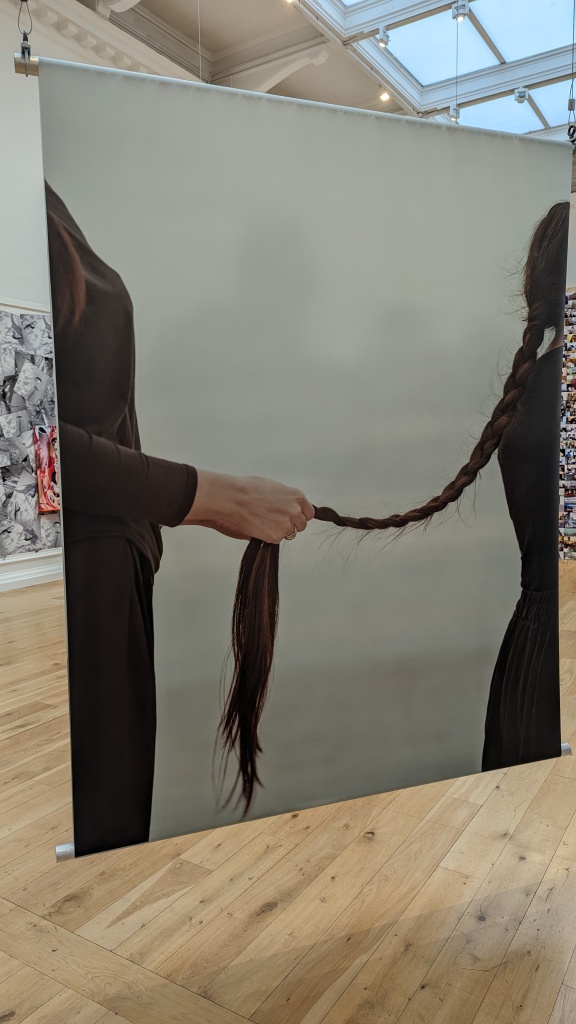
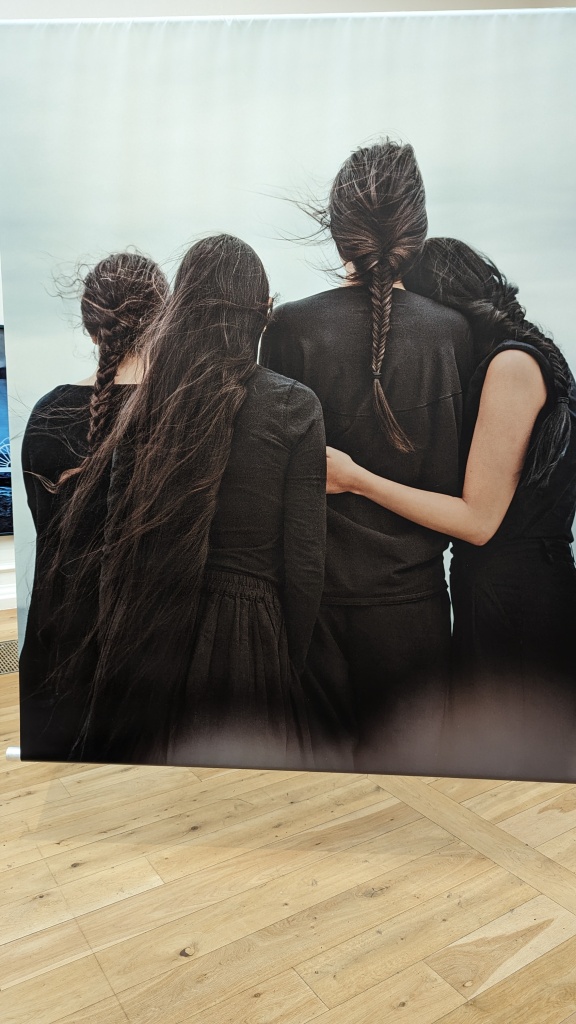
Hoda Afshar, In Turn (2023)

Tehran’s ‘morality police’ killed twenty-two year old Mahsa Amini for not wearing the hijab under government standards. These photographs are one with the protest against that legally sanctioned murder of a woman’s freedom and choice over her body.

The photographs are staged images that utilise the imagery of the doves, birds that are released at the funerals of those that have lost their lives in the protest. The birds stand for martyrdom and peace.

The women in the photographs are largely anonymous because anonymity protects the protesters on social media. These protest photographs show women plaiting each other’s hair and discarding their veils. The hair is plaited as respect is given to women freedom fighters fighting in Kurdistan against the Islamic state. They plait their hair before battle.

These monumental photographs are impressive and powerful. They give a body to the protesters and, with it, humanity. A community is formed around hair and the freedom to show it. The large format itself is a celebration of women and female bodily display, the ‘exposure’ that photography gives. Because, despite the fact that most of the models are anonymous, in the final images as we walk through the space, as you journey through the images and the story they are telling, you see the full frontal body of the woman with doves and her face is completely visible. And on the reverse, you can see the profile of a woman that braids the hair.

The plaited black hair of warfare and the white doves of peace tell a story. To have peace, you have to have the war first. Peace is the aim that can only be achieved through fighting for the rights to have choice and freedom. In the final photograph, a pair of hands braids the hair Another pair of hands superimposed on the back of the woman whose hair is being plaited holds the dove of peace and martyrdom. A reminder that freedom costs something. The fight.

These photographs are an inspiring celebration of heroism.

Sheida Soleimani, ‘Tulip Poster’ from the Series To Oblivion (2016)
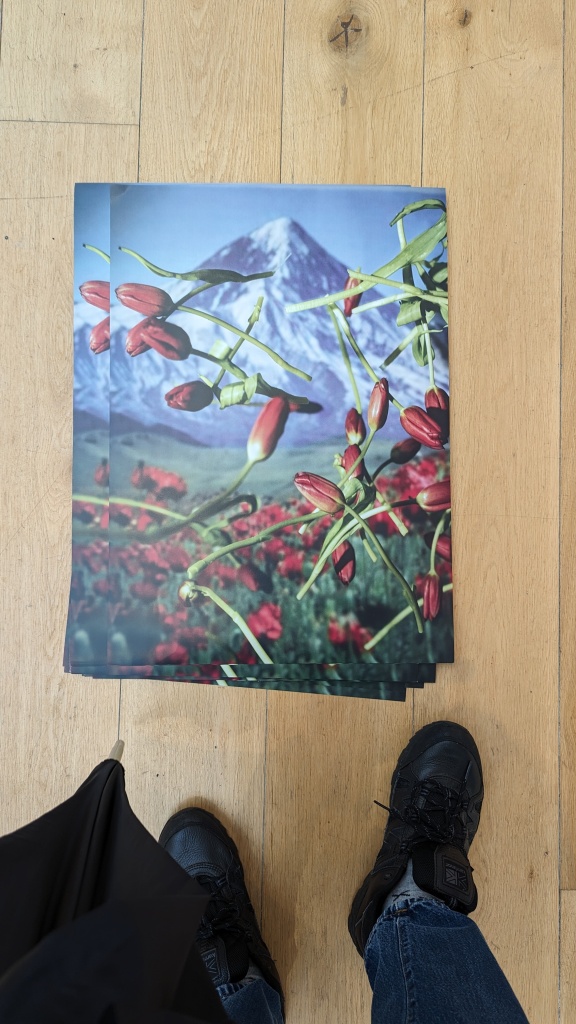
This poster is a tribute to the Iranian women unjustly imprisoned and killed by the state. The tulips reference an Iranian revolutionary song that sees the flower as revolutionary hope – because although it is fragile, it is resilient and it regrows every spring. The numbers on the back of the poster show current published data of those arrested and killed by the Iranian state.

The redness of the flowers. Blood. Against the mountain in the background. With their stalks, the tulips are the ladders up to the peak. They are the scaffolding that can even go above the peak. To ascend the ladders, you have to have the revolutionary hope. Which no sword can cut down. Which no gun can diminish. The tulips are the beauty of hope. The beauty of the revolution. They transcend death with their growth. They have the beauty of growth, nature, resilience. To ascend the ladder of hope is the ascent into heaven. In the religious context of the photographer’s background, this is the image of faith in the revolution and eternal justice. Like Antigone, the photographer promotes the eternal laws of justice rather than the man-made laws of the earth.

Wendy Red Star, Amni (Echo) (2021)

This is a tribute to the matrilineal clan membership of the Appsalooke Nation which was erased by colonialism and its patriarchal laws. The artwork gives power back to the women in her family (the photographer who is Wendy Red Star, her daughter and her great-great-grandmother). And the power back to the names of the women of the Nation.

This was one of the most moving of the artworks in the exhibition for me. They called them Indians when they are Native Americans. They took their land and tried to destroy their culture and their people. They are us. We also have clan membership through our mother – Mother India is our mother and the religion of my mother is the Mother Goddess. It is this which the patriarchal, colonising state wishes to destroy and, with it, difference.

The names of power call out in the background, behind the photographic sculptures. And the photographs themselves build power. Out of the small photograph at the base, a greater entity is formed through the use of overlapping photographs. If you look carefully, you see that the aura is extended into the names of power behind, with the use of negative white space.

One of the ideas around photography when it first came into widespread use was that it could take away the soul of the sitter. Here, that idea is reversed through resistance against the patriarchy.

Because the photograph of the great-great-grandmother is there and the different generations, the photograph scultptures build up the matrilineal history which the law and the colonising state wanted to end. In the face of erasure, we have the form that has come back to us, become literalised in word and image. The phoenix has emerged from the flame.

The exhibition included many other pieces worth a careful examination and study. My overall impression of this exhibition is that I learnt a lot from it and I was inspired by it. We, our community, we also fight the wars against the patriarchal state and its patriarchal laws. For our way of life. For our culture. The patriarchal law wishes to kill what we are. We, the ethnic minorities, even if we are the men, we are also the women.

And the photographs showed the resistance can take many different forms. There are many dances to learn. Many songs to sing.

Time and time again, the photographs exposed what the patriarchal law of the state is. And why it has to be fought against. Not just in ‘other countries’. In Western type countries like Australia and Poland.

Sometimes, I was disappointed. One video installation said to become a ‘peaceful warrior’ and not ‘an angry warrior’. I don’t believe we should spit out our anger. But the philosophy of India is that everyone has their own path. Who are we to judge? As long as the warrior remains the warrior. That is the point.

The union of women with photography suggested calamity to the male Victorian authors that I studied. It suggested the revolution. The exhibit of feminist protest photography is the natural outcome of the resistance. As a form of truth which exposures the corrupt heart of power, photography has few rivals. These images demand more attention and more thought. Within them, they contain the resistance to the state structure and the patriarchal law. And, within them, they contain the conception of justice that the patriarchal law does not have, with its false claims to universality, timelessness and ‘truth’. By making photography concrete, by giving it the female body, these photographers have fought against the male body of the law with its male subject. They have created women’s – and photography’s – jurisprudence in the present moment.

In the end, the warrior loves the warrior. The exhibition is warrior culture.

Some Thoughts on Medusa in the Painted Hall Ceiling at the Old Royal Naval College in Greenwich

Some Thoughts on Medusa in the Painted Hall Ceiling at the Old Royal Naval College in Greenwich

17.03.2023 (amended 07.05.2023)

There is an obvious theme of mirroring in the Painted Ceiling, which you can see in the mirroring of the arches or balustrades and in the mirroring of defeated sea vessels. THE MIRROR OF PRUDENCE – important for royal authority to control the mirror and mirror images. I am looking at this around the figure of Medusa.

The Facts are that the severed head of Medusa is depicted on Athena’s shield as in ancient Greek myth. Perseus the hero slew Medusa while looking at her reflection in his own shield so that he could avoid being turned to stone through her gaze.

– Wikipedia: “Medusa was beheaded by the Greek hero Perseus, who then used her head, which retained its ability to turn onlookers to stone, as a weapon until he gave it to the goddess Athena to place on her shield. In classical antiquity, the image of the head of Medusa appeared in the evil-averting device known as the Gorgoneion”.

Medusa means ‘guardian’ or ‘protectress’ in Ancient Greek (Wikipedia). Possibly why she is on the shield. Athena is wisdom/protectress of the city of Athens. So, there is a  doubling between Athena and Medusa in the role of protectress. Because Perseus looked in the mirror to slay Medusa, there is a role for doubling in the original myth – I will argue that Medusa is associated with doubling that gets out of control later (as she is associated with the Hydra, which also doubles). (DEFINITION – Doubling means produces copies, reflections, doppelgangers, etc.)

– The most obvious Double: There is another Gorgon depicted right of the shield and to the right of Hercules who is clubbing away at the Vices with Athena. While it may be that this Gorgon is a sister of Athena (and it has been suggested that the gorgon is ‘Envy’ amongst the vices stamped out by William and Mary), there is an uncanny, visual doubling between the gorgon and Medusa at least. The uninitiated would not know that it is not another Medusa. The Vices also included the snake-like many headed Hydra – Hydra is a water monster (like Medusa – see below about her links to water). I AM ARGUING THAT THE WATER LINK IS CONNECTED TO THE THEME OF DOUBLING – WATER HAS A REFLECTION WHICH DOUBLES THE INDIVIDUAL LOOKING INTO IT.

DOUBLING AROUND THE ROYAL CREST:  Queen Mary as Athena at least

– MEDUSA’S LINKS TO THE SEA/NAVAL PENSIONERS – ILLEGITIMATE RELATIONSHIPS TO THE GOD OF THE SEA AND NAVAL POWER:

  • The three Gorgon sisters—Medusa, Stheno, and Euryale—were all children of the ancient marine deities Phorcys (or “Phorkys”) and his sister Ceto (or “Keto”), chthonic monsters from an archaic world (Wikipedia). 
  • In a late version of the Medusa myth, by the Roman poet Ovid (Metamorphoses 4.794–803), Medusa was originally a beautiful maiden, but when Neptune/Poseidon (THE GOD OF THE SEA) had sex with her in Minerva/Athena‘s temple,[7] Minerva punished Medusa by transforming her beautiful hair into horrible snakes.
  • When Perseus slayed Medusa, she was pregnant by Poseidon. SHE WAS ABOUT to Reproduce/Double as the bad mother, dark mother (Jung), produce an alternative sea god, naval power, etc.

Subjective Facts

–  We note that the Gorgon next to Hercules (THE ONE THAT DOUBLES AS MEDUSA VISUALLY IF NOT LITERALLY) has escaped the goddess and demi-god casting the Vices out of the kingdom. Instead of being under their feet and being trampled on, she is actually equal with them, as though she is divine herself (doubling the divinity of the gods).

– THE ROYAL CREST – Look at the gilding on the royal crest and compare it with the shield of Athena and Medusa’s head on it. The gold of Medusa’s head mirrors the royal crest of Queen Mary. However, the inclusion of Queen Mary as Athena on the right of the crest (doubling) creates a good double as opposed to a bad double (like Medusa). Let us remember the doubling of the idea of ‘protrectress’ (‘Medusa’ in Ancient Greek). Queen Mary was the ‘protectress’ of the Naval Pensioners…

– (The gorgon that visually doubles as Medusa is possibly Envy.) However, if it turns out the Gorgon that visually doubles as Medusa is Euryale, one of Medusa’s two sisters, this might mean ‘the wide sea’ (as a daughter of the sea gods) (Greek and Roman Mythology, A to Z, Kathleen N. DalyMarian Rengel, 2009, 54). AS I HAVE SAID BEFORE, THE SEA REFLECTS – IT IS A MIRROR… Her mouth is open on the painted ceiling: she was known for an agonised, piercing shriek after Medusa was killed, which was turned into a lamenting song and music for humans (ibid.)

– Athena actually directs the shield with Medusa’s head on it at Hercules, not at the Vices – against men (Medusa is associated with feminism in modern scholarship – is this a coincidence?)

– Hydra kept on spouting two heads when one was cut off (doubling), similarly the Gorgons are repeating in the painting, or doubling. Doubling between Athena and Medusa as protectress. Deduction – there is a theme of doubling going on.

– Apollo killed the Python (snake/chaos) – snakes at bottom to illustrate their lowliness, killer of snakes at top as God of reason, light (enlightenment) etc. Is Apollo being badly doubled by Louis IV ‘the Sun King’ that is being trampled by King William? (depends on if this is Louis IV or not). Certainly, Truth is holding is a miniature sun in her hand – the doubling of Apollo with light (truth).

– Medusa was killed through doubling – in the mirror, when she was to give birth to the god of the sea’s son. Wikipedia: “In most versions of the story, she was beheaded by the hero Perseus, who was sent to fetch her head by King Polydectes of Seriphus because Polydectes wanted to marry Perseus’s mother. The gods were well aware of this, and Perseus received help. He received a mirrored shield from Athena, sandals with gold wings from Hermes, a sword from Hephaestus and Hades‘s helm of invisibility. Since Medusa was the only one of the three Gorgons who was mortal, Perseus was able to slay her while looking at the reflection from the mirrored shield he received from Athena. During that time, Medusa was pregnant by Poseidon”. 

– Woman as animal nature – is this is link to the sea and the power of nature in the water? That woman/nature can’t be controlled, but controls (as in Queen Mary controlling the kingdom of men?) Is this why the Gorgon escapes the casting out of the vices in the kingdom and mimics the power of the gods?

INTERPRETATION (Psychoanalysis, mirroring)

– Does Medusa and the other Gorgon represent a male artist’s misogynistic response to Queen Mary’s rule (as ‘Queen of the Sea) [part of the general expectation that only men rule and women’s rule leads to monstrosity and chaos – chaos as the snake which Apollo defeated]? This is a CONTROL OF DOUBLING – IF ONE WOMAN’S RULE IS ACCEPTED, OTHER WOMEN WILL RULE AS HER ‘DOUBLES’. Is this an example of the attitude to the daughter that usurped her father’s throne? We know that Athena is also doubling as Queen Mary from the arch. The whole game is about doubling: the ‘good’ double and the ‘bad’ double. On the one hand, Mary can double as the goddess, the good double. On the other hand, is she doubling as Medusa the monster, with illegitimate power, producing Hydra like monsters in the kingdom as the Vices? Is she the reverse of Apollo the Sun King?

– Between Hercules and the Gorgon, there is a V sign (largely empty, representing lack, something to be filled in as per misogynistic constructions) – if we look in terms of psychoanalysis, does this represent the vagina (and therefore female power?) Snake as phallic symbol – women seizing phallic power illegitimately in the form of Athena with the shield and with forming Hydra type monsters (i.e. more women that rule – Mary led to Queen Anne and no male heirs)?

Dora Batty Poster Parade – London Transport Museum

Dora Batty Poster Parade – London Transport Museum

07.04.2023

You can see all of the posters in the Poster Parade here:

https://www.ltmuseum.co.uk/collections/the-collection

1st Floor, London Transport Museum

Adult ticket: 24 pounds, Concessions including students: 23 pounds (ANNUAL PASS)

REVIEW

While I have many interests in life, there is one game that has always captivated my attention. My friends, it is THE Game. The game of interpretation: finding meaning, making connections, excavating the context, trying to understand what others are trying to express underneath a rigmarole of deceptive diversions. I have played this game quite seriously, having studied for an English Literature degree and then having pursued doctoral studies in the subject (then publishing books and articles). The game is all-consuming and unending. I lie in bed at nights replaying conversations, working over sentences for half an hour at a time if they are important enough to warrant it in the conversations I have during the day. To play the game, I have studied all these subjects at university level: legal studies, English literature, history, psychoanalysis, philosophy, anthropology, criminology, sociology, psychology, the history of photography, feminism, Marxism, deconstruction, Postcolonialism – and now – art history. Besides forays in my spare time into mythology, archaeology, cryptography and the decoding of languages, language learning, politics, animal intelligence, evolutionary psychology, biology, and the physical sciences which reveal how humankind attempts to fathom the cosmos.

Why do I mention The Game? I survey the posters in the London Transport Museum Poster Parade because I love to play it. And above all, the most enticing thing is a mystery, a puzzle, a seeming dead-end, what first comes as a blank wall. As I have admitted so much, it will now do to admit more. It was a genuinely exciting moment to encounter an unknown female artist who has not received much critical attention and about whom I could make a big contribution towards understanding. The subject was the enigmatic Dora Batty…

Little is known about Dora’s life. She is known only for her professional roles and her output. Like other women artists, she has been neglected, never achieved the fame of her male compatriots… As a result, one cannot bring biography to a study of her artwork. Neither can one be misled by what others have written, which seems to be a particularly abhorrent current practice of the scholar, the interpretor and the guide. One imagines a woman that never made much of an impression. One cannot even visualise her appearance because a photograph has not even been recovered. For a moment, I had a fantasy of tracing her family genealogy so that I could try and contact any living descendants that might have a diary, a photograph, written records or objects of some description so that I could have something else than the art. In the game, it is permitted to cheat… What a delicious daydream: an expedition, an adventure, new people to meet, new avenues to pursue, a quest of interpretation…

But I am left to just looking at the work and thinking. Justice demands a scrutiny of the woman artist’s works, a redressing of her dismissal by (White) Man. Let us begin.

The first exhibit that meets us in the Poster Parade is ‘The Underground brings all things nearer’. We are in the conventional grounds of Greek Myth. As it clearly states, the poster celebrates ‘The Return of Persephone’. She is being rescued from the underground by Hermes. Dora loves to tease. The obvious play is upon the concept of the ‘underground’. While it signifies Hades and hell, it is also obviously referencing the Tube. For a poster commissioned by London Transport, this is clearly a subtle bite at the hand that feeds her, the delicious tease of a mocking and ego-defeating woman. From the Underground, hell and the tube, Persephone is emerging. The concept of the poster is that from the Underground, which we imagine as the realm of the dead, life and fertility is emerging in the form of Persephone. But there is a moment of feminism in that period of emerging women’s rights and the Suffragette movement – Persephone (woman oppressed, captured, imprisoned) is rescued from her controlling husband (the LAW, Death, Sovereignty, POWER…) Now, there is the question. What is the biographical aspect, what is the women’s movement? The Suffragettes were around at this time and they were fighting against the patriarchal laws of marriage, with its enclosure of the woman in the domestic realm. But is there something else in Dora’s life? Bearing the hallmarks of its time, Persephone is rescued by Hermes, a man… There isn’t total emancipation of the woman. Is there a new man in Dora’s life at this time, an extra-marital affair…? However, one also remembers that Hermes is the protector of travellers, the god of roads… He is dressed as a traveller, of course, with winged sandals. There are subtle resonances for the highly educated and the classicists in this poster about travel. Dora is clearly classically educated… The game, my friends. One has to learn the mythology of the world to play it…

The tragedy with the poster is that Persephone still had to spend months of the year in the Underworld – there is no ultimate freedom from MAN AS KING AND DEATH… Ambiguity and despair is always there in the background. Is this a realistic assessment of women’s politics at the time (and still now?) Or is it the acceptance that Dora cannot release herself from her marriage (was she married, or is the poster simply about a fantasy of emancipation)?

Now, let us talk about the flowers. Flowers flood the posters. Persephone is also holding a flower. Is the flower sex (the flower is a sexual organ which is ‘penetrated’)? Are we witnessing sexual liberation in Dora’s psyche? The implicit love triangle in the first poster – Hermes, Persephone, Hades. Travel itself as sex (a holiday romance, perhaps?). The fantasy of sex rather than its achievement from a repressed woman? Dear Dora, why do you not write what is the case? If the hypothesis that the flowers are sex is right, can it be confirmed by some of the other posters? [It is worthwhile to mention here that there are other suggestions. Not only have female artists painted flowers throughout art history, as a ‘woman’s genre’, but also that women themselves have been described as flowers throughout history and particularly guilty were the Victorians and those around at the start of the twentieth century – flower as woman herself in this art, or rather her sexual body and her body as a body of desire…)

In ‘Bluebells are out’, an anonymous female caresses the flowers lovingly. Her lips are upon them, her hand clenches them. Her senses are engaged. She smells them. So we have touch, the sexuality of a kiss, intoxication with the scent. Full sensory engagement. She also looks directly into the flowers. Is this look at the flower and sex what the viewer is expected to understand and echo? Woman playing with her own sex and sexuality? Is this the revealing mirror of subjectivity at the heart of the image? Let us be Freudian and make an insinuation about how the hand is holding the phallic bunch of stalks of flowers at the bottom of the image…

In ‘Crocuses are out’, woman swoons over the flowers which she caresses again with her hands. With her eyes shut in ecstasy and Lacanian jouissance… The flower she smells is pinkish red – the colour of sex…

So, perhaps we have an exhibition of a woman artist that is pursuing liberation, including sexual liberation. Perhaps we are seeing a woman fighting against the Law and the figure of the King for a new tomorrow and for ownership over her own body and desires… Perhaps we see Dora the fighter. But a jaded fighter. After all, what is the fight of the artist? It is true that many of the Suffragettes were artists, a disproportionate amount. Was the main fight in the visual arts and against the visual culture of the Law and the King, Oppressor Man?

Let us leave identity politics for a moment. Let us talk about Dora as she is in my favourite works of hers. I will write first about the interesting pattern in ‘Whitsuntide by Underground’. The artist has woven together many moments of leisure into almost a textile pattern (she worked in textiles). The composition is crowded and flooded with energy. People are joined in small communities by their pursuits, families, friends, athletes. They are also integrated in nature and the countryside through trees, fields and water, animals. There is a harmony of leisure and nature, life and the world, an inter-connected and unbreakable pattern. And let us not forget the female body’s interaction with the flowers in the early posters – nature is a body that unites with woman’s body. Woman is nature, humankind is nature – the celebration of the animal self that we have come from that lived in trees…

Similarly, ‘There is still the country’ shows the woman’s body wedded to the (phallic, it must be said) tree. The whole scene is blown about from a strong wind and enriched with the sun which seems to emanate from the woman’s head, her creative force and mind. There is pure energy, enlightenment (emancipation)… The leaves fall from the trees – there is transformation, the relentless but cyclical turning of the time as in Hindu thought… What is dead and dying is to be shed to make space for what is living….

So is this Dora? Or is this merely Suneel’s Dora? One makes an argument. One seeks to persuade. But more than that, one seeks to know. In the absence of clues, one looks to a Suffragette context. In the absence of a photograph, one tries to plumb a mind. The Dora exhibit is interesting and important because it brings these thoughts to mind. It asks why a woman of such talent has no place in thought. It seeks to rectify this wrong. Dora’s art is stylistically very Art Deco. I do not know if she followed the movement, or how much she contributed. I do not know how important she is in the history of Women’s Rights for making art that explores women’s issues and attempts to rescue them from the ills of sexual repression (if sex is the theme that I have not invented for our Dora). And finally, one makes an admission. The interest, the thread that I have followed is that Dora is Modern Woman. Someone that I do not understand – if anyone does. To understand the mind of this challenging and reticent creature, one often has to gaze at the expressions that she leaves about her in the world. And to form an opinion, one has to dare a conjecture, even as a man – which might wholly be wrong and is entirely contestable, of course…

You can see all of the posters in the Poster Parade here:

https://www.ltmuseum.co.uk/collections/the-collection

List of Posters:

  1. Dora Batty, 1923 – The Underground brings all things nearer
  2. Dora Batty, 1925 – From country to the heart of town
  3. Dora Batty, 1924 – Foxgloves, Kew Gardens
  4. Dora Batty, 1925 – From town to open country
  5. Dora Batty, 1921 – Travel with the children
  6. Dora Batty, 1930 – Season ticket, travel cheaply, save money
  7. Dora Batty, 1927 – Bluebells are out
  8. Dora Batty, 1927 – Blackberry time
  9. Dora Batty, 1935 – Special shows of tulips
  10. Dora Batty, 1927 – Crocuses are out
  11. Dora Batty, 1927 – Daffodils are blooming
  12. Dora Batty, 1932 – Regents Park to see the rose garden
  13. Dora Batty, 1928 – Buy a season ticket
  14. Dora Batty, 1924 – Survivals of the past, Painted Hall
  15. Dora Batty, 1932 – RAF display, Colindale station
  16. Dora Batty, 1936 – Trooping the colour
  17. Dora Batty, 1924 – Survivals of the past, Yeoman Warders
  18. Dora Batty, 1934 – Easter
  19. Dora Batty, 1938 – Out and about by London Transport
  20. Dora Batty, 1926 – Make yours a General holiday
  21. Dora Batty, 1931 – Whitsuntide by Underground
  22. Dora Batty, 1926 – Hampton Court by tram
  23. Dora Batty, 1926 – There is still the country