
12.07.2026
Instagram: @arrangregory
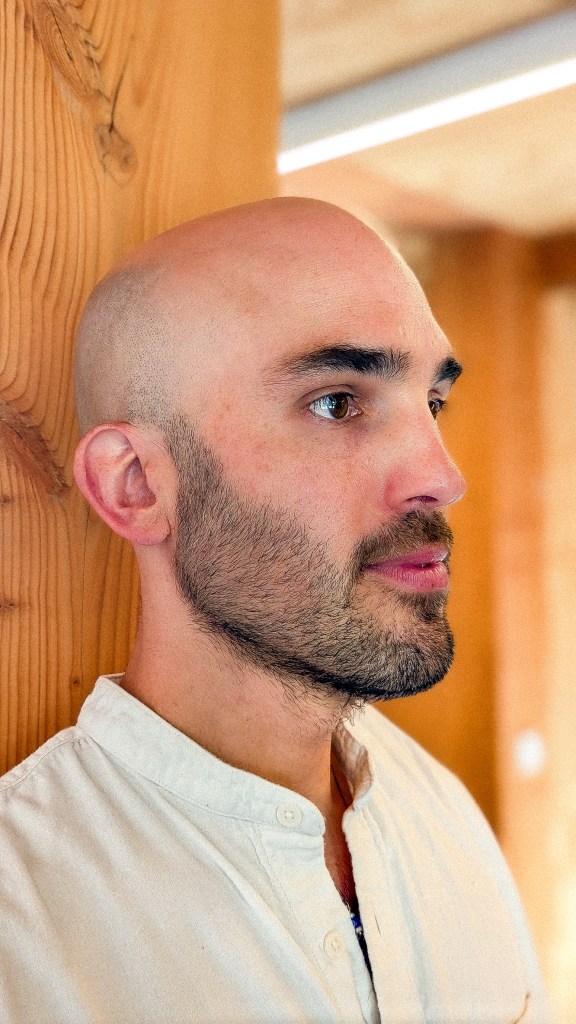
In a spontaneous excursion to Omved Gardens, we came across an art gallery that was dedicated this month of July to Arran Gregory, a British-Sri Lankan land artist. He calls the environment ‘a collaborator’ of his work and ‘sees clay as a living organism’. Barefoot and with a crisp linen shirt, Arran was a friendly and charming presence in the art gallery. He radiated an air of tranquillity.
We first looked at a line drawing of a horse that Arran had drawn with what looked like an ink brush that disappeared into mist, much in the Japanese or the Chinese style. This was placed by the door of the exhibition and then the space proceeded to deconstruct it. The horse was drawn again and then it was disassembled and put together again by rotating the sections so that you got the impression of a type of cubism which explored, rotated and decomposed how the lines were put together. On top of this, you had patterns of sewing which stitched the rotated sections together, sometimes circles, sometimes other shapes like a staple. Something of a meditation on looking, how a whole is put together, perhaps an investigation of the gestalt theory of art which explores how art creates a whole. Certainly an exploration of how creating, destroying and mending are all put together and perhaps a reflection on human intervention into the natural world, how the destruction of the climate crisis can resolve itself into a conscious effort to put the world back together again in a different format which challenges anthropocentric human intention and perceptions.
In the midst of these reassembled pieces, Arran had constructed a circle of earth which he had raked in concentric circles. It immediately reminded me of Buddhist art and the raked gardens that they have in Japanese art, so I was getting that Japanese vibe with the work again. Arran told us that he had spontaneously had the idea of creating the circle. I thought it was very interesting. It was on the ground and in earth, so it connected our human gaze with the earth. Again, it was done in the form of a circle so it had the idea of completion within it, the completion that comes with adjoining the human with the elemental, the man-made with the natural.
Two other pieces caught my attention. One was a depiction of the phallic man of Cerne Abbes, a line drawing etched into the earth with an erection. A symbol of fertility. This was a striking image and full of meaning. The equation of the human with the earth and with art. The desire for a new fecundity in our union with nature. Arran told us that he was influenced by the land artist Richard Long, who also puts together nature, art and human vision into new configurations and meanings, an artist who is also feeling out the way to re-orientate us in nature.
The other piece I found very interesting was also line art. It was the outlines of two women that merged together. Again, this was about the reimagination of the human body. It was a sleek and elegant piece with the lines, the sinuous shapes of the beautiful human body. This was for me a template of many of the line drawings, since Arran had drawn animals in geometrical shapes through line art as well, an investigation of how the body could be mapped onto the earth and line art like Cerne Abbes (the pieces were called ‘geo’-(animal) – ‘geo’, of course, means earth).
Arran elaborated on the photographs of his earth sculptures that were integrated into the land much like Henry Moore’s art and showed us a video of nature reclaiming the artwork afterwards and creating new arrangements with the work too. Just like we found Arran earnest, charming and reflective, so we found his work. There was much to intrigue and delight in the exhibition and much to inspire further thought about the urgent need for our new immersion and continuity with nature.
REFERENCES
https://omvedgardens.com/journal/introducing-arran-gregory-our-artist-of-the-month-of-july

