
Arran Gregory: Omved Artist of the Month of July 2026

12.07.2026

Instagram: @arrangregory

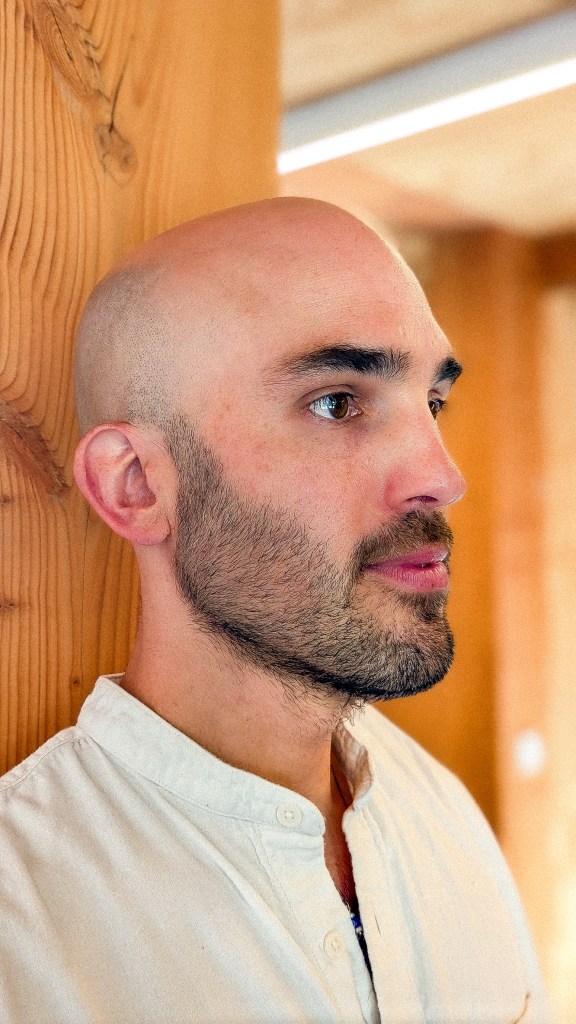
In a spontaneous excursion to Omved Gardens, we came across an art gallery that was dedicated this month of July to Arran Gregory, a British-Sri Lankan land artist. He calls the environment ‘a collaborator’ of his work and ‘sees clay as a living organism’.  Barefoot and with a crisp linen shirt, Arran was a friendly and charming presence in the art gallery. He radiated an air of tranquillity.

We first looked at a line drawing of a horse that Arran had drawn with what looked like an ink brush that disappeared into mist, much in the Japanese or the Chinese style. This was placed by the door of the exhibition and then the space proceeded to deconstruct it. The horse was drawn again and then it was disassembled and put together again by rotating the sections so that you got the impression of a type of cubism which explored, rotated and decomposed how the lines were put together. On top of this, you had patterns of sewing which stitched the rotated sections together, sometimes circles, sometimes other shapes like a staple. Something of a meditation on looking, how a whole is put together, perhaps an investigation of the gestalt theory of art which explores how art creates a whole. Certainly an exploration of how creating, destroying and mending are all put together and perhaps a reflection on human intervention into the natural world, how the destruction of the climate crisis can resolve itself into a conscious effort to put the world back together again in a different format which challenges anthropocentric human intention and perceptions.

In the midst of these reassembled pieces, Arran had constructed a circle of earth which he had raked in concentric circles. It immediately reminded me of Buddhist art and the raked gardens that they have in Japanese art, so I was getting that Japanese vibe with the work again. Arran told us that he had spontaneously had the idea of creating the circle. I thought it was very interesting. It was on the ground and in earth, so it connected our human gaze with the earth. Again, it was done in the form of a circle so it had the idea of completion within it, the completion that comes with adjoining the human with the elemental, the man-made with the natural.

Two other pieces caught my attention. One was a depiction of the phallic man of Cerne Abbes, a line drawing etched into the earth with an erection. A symbol of fertility. This was a striking image and full of meaning. The equation of the human with the earth and with art. The desire for a new fecundity in our union with nature. Arran told us that he was influenced by the land artist Richard Long, who also puts together nature, art and human vision into new configurations and meanings, an artist who is also feeling out the way to re-orientate us in nature.

The other piece I found very interesting was also line art. It was the outlines of two women that merged together. Again, this was about the reimagination of the human body. It was a sleek and elegant piece with the lines, the sinuous shapes of the beautiful human body. This was for me a template of many of the line drawings, since Arran had drawn animals in geometrical shapes through line art as well, an investigation of how the body could be mapped onto the earth and line art like Cerne Abbes (the pieces were called ‘geo’-(animal) – ‘geo’, of course, means earth).

Arran elaborated on the photographs of his earth sculptures that were integrated into the land much like Henry Moore’s art and showed us a video of nature reclaiming the artwork afterwards and creating new arrangements with the work too. Just like we found Arran earnest, charming and reflective, so we found his work. There was much to intrigue and delight in the exhibition and much to inspire further thought about the urgent need for our new immersion and continuity with nature.

REFERENCES

https://omvedgardens.com/journal/introducing-arran-gregory-our-artist-of-the-month-of-july

https://arrangregory.com

the conviction of legacy

21.05.2026

S: Does an artist fear death?

A: Why do you ask?

S: It is always a question with a question for you. There is a reason to think so. The artist attempts to capture that which is fleeting, a flicker in the wind. He will paint an animal or a woman. He will paint a baby or a feeling. He attempts to rescue the moment from death. He attempts to write eternity.

A: But does the artist think this when he works?

S: Surely yes. Surely those portrait painters of the past thought that they were preserving a likeness for all time. Surely their patrons thought that they were preserving a monument to all time. Read the poem ‘Ozymandius’.

A: Ozymandius is about the folly of power.

S: It is also about the corruption of time. The tragedy of time.

A: Only you are the one that I can discuss literature with. But do you worry about your legacy?

S: No. I have produced enough already. I can produce more, much more. What you do not know is how easy everything is for me.

A: You have found everything easy in your studies?

S: Yes. There is nothing complicated in anything that I have studied, law, literature or art history. Or psychology, criminology, anthropology, philosophy, history, any of the subjects I have studied at university level.

A: But you are not read. Your published work, your art, your photography. You are not famous.

S: Yet. I know that I have produced good work. Therefore, I do not worry. You cannot make the ignorant listen to sense. I am the truth. I have produced the truth.

A: Stop these scribbles and these sketches. Do something more substantial.

S: Why? Why do things that you get nothing from? I know that I am a genius. I have nothing to prove to anyone.

A: Remember that your name is the name of the Untouchables. The Oppressed. They need your shine. Don’t forget that. Don’t become selfish. Remember what other geniuses have said. Genius is a gift. You have to give and give and give. It is your duty. For the community.

S: I am listening. I have perhaps forty more years in me. And I will work, don’t you worry. I will work on substantial things.

A: Now, while you have the energy. Do not let this life defeat you.

the money monsters

02.05.2026

S: I read with disgust that London’s Whitechapel Gallery hired an Economist in Residence.

A: What’s so bad about that?

S: She thinks that she can tell us what the value of art and culture is, that is the most disgusting thing. All of us that get into arts and culture are trying to escape from these money monsters with their bullshit ideas of value. And this London institution is hiring precisely that kind of individual to talk about what’s important and significant about art and culture. For us to be represented by these jokers. What the fuck does she know about it? Does she have any training in art and culture? This society is a joke. The people that are least able to do anything are the ones that they employ and listen to.

A: Come come now. I’m sure she’s interested in art and culture.

S: Then she wouldn’t demean it by being there to appraise its value as an economist. And pander to this bullshit fascist and idiotic government and this audience of philistines.

A: I’m sure there’s more here.

S: This society can only listen to a fake. When it comes to people that care for art and culture, live for art and culture, produce art and culture, then they cannot listen. They force us into marginalisation. They do not value our interpretations or our ideas. Because they want to keep on doing the same stupid thing over and over again. And what is the most stupid thing? Money. That’s all that comes into their rotten heads. Everything is about money. Make everything about money. They have a monomania. Their language is about money. Their ideas are about money. And these are the people that you want in the museum representing what the museum is about? These are the people that you want in art, representing what art is about? Do you wonder why I am angry?

A: Relax. There’s nothing you can do about it.

S: There is something that you can do about it. There’s always something. Do you know, when Michael Jackson wanted to shoot the video ‘They Don’t Care About Us’, which is about protesting racism and how the government mistreats people, about showing reality, the Brazilian government banned him from shooting it. So he went to the Mafia. The Mafia looked after him. They took him to the favela. They made the video happen. The disenfranchised supported the disenfranchised. I know that there are more of us.

A: You are not Michael Jackson.

S: I believe anyone with conviction, strength and discipline can change this world. Just like Jesus stood for something against Mammon, so can I. I can stand for a world of art and culture that does not rely on money. I am living proof of it. I have my own publishers. I have my own books. I have my own blog. I have my own photography and art accounts. All done without requiring money.

A: You do not have fame.

S: I have something better than the value that these cretins accord to those that apologise for the injustice and racism of this culture. I have my own self-respect and I have love for my community, the community of Tigers. That love is evident in everything that I produce. I don’t have to show why I value the community in terms of money. My love is a love that does not cost money. My love that I express? It does not cost money. And that is why I am the genuine article. That is why I am the poet, the artist, the photographer, the writer, the scholar. The genius. I am above money.

The Artistic Failures of a Mr. Nobody

02.02.2018

A little while back, I read an article in a newspaper, possibly the Guardian, about a writer who had never made it and had never been published. The novels that this man had dedicated his life to, forgoing employment and the material things of life, were described as “execrable”, or some such choice word. Here was a Mr. Nobody who produced “artistic failures”. No one wanted to publish his writing. No one wanted to read his writing. Yet, day after day, Mr. Nobody sat at his desk and pushed out the words.

Mr. Nobody could be anyone. There are thousands of people in the same position: writers, poets, artists, singers and musicians. Certainly, Mr. Nobody is myself. One wonders, though, how Mr. Nobody can bear his numerous disappointments and the miscarriages of his babies in the world. Today I want to write a little piece about this artistic failure and disappointment. I regard artistic failure as a lack of recognition. The reader will forgive this narcissistic exploration. Chekov wrote that it is only a mediocre novelist that goes on and on about writing a novel, not the successful writer. So be it, yet even the mediocre novelist must have an opinion and reflect upon his or her failures and successes.

The story is a common one. After years of publishing creative work in student newspapers and magazines as a young man, I thought, optimistically, that the next step would surely be publication with a serious publisher. I expected the wider world to take note of what I had published in the student publications. I sent off my poetry to magazines and publishing houses like Faber and Faber. I tried to get my short stories published in American magazines. I applied for book reviewing and journalistic positions. The result? Rejection after rejection. Gradually, I stopped sending my stuff out to companies and applying for work. I published online, thus cutting off any potential revenue from my work. Now, my poetry was up on my blog and I found out that poetry publishers wouldn’t publish work that had already featured online. The amount of readers that I had could be counted on one hand. It was the same thing with my short stories and book reviews. I put the music that I had composed and sang to online. When it was my own original music, perhaps twenty people would listen to my songs at most. I took up art about two years ago and post work on my Instagram account. The work has generated zero income and I have never managed to go over seventy likes on a picture.

Having reached middle age, it is clear that I am an artistic failure. Like Mr. Nobody, my creative work has never been published, has never generated any revenue and is read, listened to and seen by only a small handful of people. I have not received real recognition for my work. Producing this creative work, which costs money and takes up time when I could be earning money is therefore something of Sisyphean enterprise. Like the Ancient Greek character, I push the boulder up the mountain every time I sit at my desk to produce anything and it never gets anywhere. How does a person bear the constant disappointment and frustration? How does he or she bear the indifference and apathy of the general public which would tend to suggest that these cultural productions are worthless?

These questions have been considered by creative thinkers in the past. I recently read a short story about the issue called “Enoch Soames” by Max Beerbohm which was first published in The Century Illustrated Monthly Magazine (May 1916). Enoch is a poet who does not get the attention that he feels he deserves. His belief in his work, however, is undying. He therefore makes a pact with the devil to travel into the future because he is convinced that his work is ahead of its time and will be revered by future readers. He thus stakes his soul on his belief in his work since this is the devil’s fee. However, on arriving into the future, Enoch finds that he is still a Mr. Nobody. Beerbohm’s story reflects a somewhat delusional belief which keeps a Mr. Nobody going. Mr. Nobody believes that, if not today, then maybe tomorrow there will be the attention and the notice. Mr. Nobody lives in a strange world of time, chance and happening, much like the lottery ticket buyer. After all, Mr. Nobody has read the rubbish which is published everywhere and which is popular. He’s seen the hacks claiming the prime place in the affections of people. Mr. Nobody knows that it is a just a question of luck and the capricious and fickle whims of the public. It is not what is of value that is valued. What is of value is frequently discarded to the rubbish pile of history while that which is worthless is heralded as brilliant and daring. The darlings of the public are not infrequently mountebanks and monsters. Mr. Nobody therefore, irresistibly, inevitably, sets himself at defiance to the world. He stands in contempt of this world. This contempt hardens Mr. Nobody’s strict belief in himself. Mr. Nobody says to himself each and every morning “It does not matter if none believe in me. For I am only to believe in myself and everything will follow”.

After all, Mr. Nobody does not just model himself on Sisyphus, but also models himself on Cassandra. Cassandra was cursed to speak words of truth that none would believe. If her words of prophecy had been listened to and followed, Troy would not have fallen to the Greeks. Mr. Nobody believes in the value of what he expresses. If, one day, Mr. Nobody is to be recognised as someone who was saying something of value, then he believes it is the misfortune of others not to have heard his voice. Mr. Nobody believes that in frustrating his expression and his voice, which is only fully expressed in the presence of an audience, the public is hurting itself.

Such is the ego and the arrogance of a Mr. Nobody. Ego is the apt word because one thinks of how Sigmund Freud divided up the work of the different components of subjectivity. Ego would produce and produce. It had a limitless creativity and spontaneity. However, the superego guarded the gates of expression. It would sit in judgement of what ego had written and censor the material, not allowing certain things past the gate. Mr. Nobody is the ultimate version of the ego while the public, as ever, is the superego. Mr. Nobody wants ego to prevail and burst through every attempt at resistance. Mr. Nobody does not believe in “compromise”, the word that Sigmund Freud picked out for the repressive mechanism of the superego. And, one wonders, without the arrogance of the ego, would creative work be possible? In the creative work, the human being says “I am and I am beautiful”. The creative human being is not just arrogant but a narcissist. And where the creative being does not assert that claim, then, says Mr. Nobody, that creative being has failed. If creative work is not the expression of self, it is nothing. But what of it? For, of course, Mr. Nobody is neither published, read, or listened to. Where Mr. Nobody is concerned, the world blind and deaf. And these are the artistic failures of a Mr. Nobody.