Happily Ever After: Rethinking of a Fairytale – International Exhibition · London, 1−4 August 2024

Reviewed by Doctor Suneel Mehmi

Photographs reproduced by permission from the exhibition curator for my personal blog which is non-commercial and written with ‘fair use’ for academic comment and analysis. I will remove any photographs if there is any issues and there has been any misunderstanding.

https://happy-ever-after.art/

Opening hours
11.00 am — 6.00 pm

“A group of artists from different countries and cultural backgrounds have come together to reflect on fairy tales.”

You can download the exhibition catalogue with all photographs here:

https://drive.google.com/file/d/1IujnyNTM0nRz19WFBR1N2Eu9ELDiy2ww/view

Photographs of the introductory performance by the beautiful woman in red:

Aidan Salakhova ‘Without Words (Book Series)’ (2020)

https://artaidan.com/en-US/

One of my favourite Hindi songs says that love is expressed by adorning a flower in a love letter. It is what the writer (the lyricist) says because he writes to the woman that he loves. Here, we have a book with a flower inside it. Of course, fairy tales come to us mostly in books now that the oral tradition is dead. One of the themes of this book series by the artist is supposed to be the ‘journey inward’. Following the Protestant Revolution in reading, a journey into a book is a journey inward, as you try to understand yourself through the reading, to arrive at a distant truth. But is the destination the flower? Perhaps for some. And then, what does the flower represent? Or, more to the point, what does the flower not represent? For me, the flower will always be Woman. And Sex. Or, to put it in symbolic terms, connection. Which leads to reproduction. This is the destination at the ultimate aim of the journey inward. The Flowering of the Mind.

Ekaterina Belukhina ‘Forest Nymph’ (2023)

https://ekaterinabelukhina.com/

The nymph in the fairy tale, the artist says, is the subject of transformation, someone that can be anyone, and influence the natural world around them. This painting is about the power of transformation. Is the context the global nightmare that is human induced climate change? Is the hope in transformation about this? There are red scribbles on the woman’s body. Is this blood? Is she hurt? Will transformation heal her and the planet? The painting is across two screens and cut in half. There is violence at the heart of this image.

Henryk Terpiłowski ‘Dziad i Baba’ (2023)

https://www.instagram.com/henrykterpart/?hl=en#

The fear of death: the brief glance at death’s feet as he slides down a chimney to kill an old married couple from the Polish fairy tale. Unseen death covered over and disguised in a structure of disavowal – we conceal the reality of death because it is too traumatic when we are grieving, like the reader will grieve the violent endings of these fairy tales. A traumatic illustration that has followed the artist around since he was a child. Accompanied by the book that has had pages torn out from it and sutured to the chimney which is made out of paper – the stuff of trauma.

Sanem Özdemir ‘Evvel zaman içinde, kalbur saman içinde /Once upon a time, in a griddle of straw’ (2024)

https://www.instagram.com/snmozd/?hl=en#

A testament to the strong women in fairy tales. And woman as beginning, since the title of the painting is about the traditional Turkish beginning of the story. Woman is beginning because she is the origin of life. Woman is beginning because she is the one that teaches us to look, talk, she is the one that writes our destiny in life. The beginning is woman and the ending is woman. In Western culture, this is recognised in the palindrome: the words for the mother begin and end in the same letter: mum, mom, ma’am, madam.

The woman is by the water. The beginning of the land? The beginning of life in the water for all life on this planet?

https://www.instagram.com/snmozd/?hl=en#

Darico Hasaya ‘Savior Complex’ (2024)

https://darico.space/

A comment upon the ubiquity of the female saviour and their self sacrifice in fairy tales – and in life.

The egg at the bottom perhaps indicates that one of the themes is about female reproduction since women have eggs – that sacrifice for children is written into the biology of women. The idea seems reinforced by the imagery of nature in the piece, with all the trees. But then, the cultural images above the egg suggest that it is a social construct that women should sacrifice to save others (is this paradox?).

A kingly figure is flipped upside down, perhaps to indicate that the collage is an attack upon male ego and patriarchal rule – that which dictates the script.

In speaking, Darico told me that feminism has changed the way that we look at the world and fairy tales.

Mariya Shamina ‘The Swan Princess’ (2022)

https://www.instagram.com/mashashkin/

This is a reinterpretation of a painting which reinterprets an opera which reinterprets a story about magic and love – the fairy tale animal princess that gives love and bestows presents:

https://en.wikipedia.org/wiki/The_Tale_of_Tsar_Saltan#

As a reinterpretation of a reinterpretation of reinterpretation, this is about the influence of fairy tales and the games of Chinese whispers that they create to forge the identities of readers, artists, opera writers and photographers.

The work is for a charity which supports Downs Syndrome, which the muse has, and some of the proceeds from the work will go to a theatre for those with the syndrome. So the whole thing is about the creation of culture from culture from culture – the never ending cycle of stories with stories within stories, copies of copies of copies.

Did you know that Down’s Syndrome comes from an extra copy of chromosome 21? Did the photographer know this? If so, then the work is about copies and their creation of differences, at the level of images, stories and even at the bodily level.

Katia Kesic ‘Affirmation 5. Take the courage to be seen’ (2022)

https://www.katiakesic.com/

The fragmented hand that holds up the mirror to us. We look inside it. We are seen – but by ourselves. This is perhaps supposed to be looking at ourselves honestly in the mirror, having the courage to do so. But, perhaps, at the same time, it is about the courage of being seen as an artist – someone that holds up a mirror to the world – with the artist’s hand which creates the work. There is no disconnection – the artist shows us who we are.

Mariya Tatarnikova ‘Faces of Fear’ (2020)

https://www.instagram.com/tatarnikova_studio/#

A representation of fear as distorted body, darkness, abstraction, the vague, the indistinct, the blurred. The photography captures the fear in time as a product of time – so there is motion blur. Why the time? Because fear passes. In a sense, this is a photographic history of fear. Just as the fairy tale is a literary history of fear. There is a parallel though – both are fictions.

Because real fear is when you look at the ugliest things in the whole world in crystal clear photographic fidelity and they are emblazoned on your mind as a scar which keeps you up at night, screaming in your dreams. So these photographs and fairy tales are actually protecting us from the reality and the trauma of fear. The acceptable face of fear which masks.

Anna Antonova ‘Figures in Cobalt Blue’ (2024)

https://www.instagram.com/annaantonova.art/?igsh=aGtqeGlmZ3VwcWFr

These Indian women represent the Mahabharata and Indian mythology featuring male gods? Why? The series is called ‘My Head is a Vessel Full of Thoughts’. These women are the artist that has been inspired by Indian culture. And she has become strong, a load carrier as a result. These images are about the strength of Indian culture. But also woman carrying the weight of myths about men, gods and heroes as men.

Lindsey Jean McLean ‘Vase and Mirror’ (2024)

https://www.instagram.com/lindseyjeanmclean/?hl=en#

The mirror that the woman sees her face in, with her back to us seems to be in half the shape of a heart. Is it about a concealed love? Since the partner in the mirror of the heart is absent?

Natalia Grezina ‘Wounded Heart’ (2022)

https://www.grezina.art/

The wounded heart is black. Because it is the black that have been hurt. The heart is cut open and its bleeds – the violence that has been inflicted upon the heart is the violence that has been inflicted upon the love of the black. Instead of love given to us, we are cut to the core by the hate of this society and the ‘lovers’ in it – since they can never love us. The wounded heart is the rejection that we, the black, face.

Katya Tsareva ‘Tender 7’ (2024)

https://www.instagram.com/katyatsareva_artist/#

There is a face with four eyes in symmetry with one another. In India, there is a saying that in love, two eyes become four. We share the gaze with someone. Our perspectives blend into each other. In fact, when you look into the eyes of the woman you love… But this is another story that the woman that you love knows…

Natasha Arendt ‘The Arachnids’ (2024)

https://www.instagram.com/arendtnatasha/?hl=en#

Artist’s statement:

“The Arachnids were found on witch’s altars in southern Russia, dating back to the early 18th century. The text includes unpronounceable spells, and the images contain some particles that can be used in the preparation of a love potion”.

In the artwork, we are presented with women’s magic: the magic of love. So the question is, who is this spell meant to make a lover of the artist? Is it us, the viewer? Are we supposed to love the artist witch? And what is the nature of this love – with these unpronounceable spells that only work through writing? A reflection on women’s silence in love – when the men have to do all the talking while the women never move their lips? The lover the artist wants is a secret of silence…

Elena Stashkova ‘Herne’s Golden horns’ (2023)

A representation of the horned god of the European peoples. In gold to suggest that mythology is gold, that the god still has enduring and everlasting value in culture. A comment perhaps on the valuations that we bestow on the gods in mythology. Perhaps an attempt to bring to the earth the imagination, to breathe life into the treasures of story and culture (like Agammenon’s golden death mask at Troy?).

Alena Kroshechkina ‘The Tree Brunches’ (2023)

https://www.instagram.com/lelya_lo/#

This is ostensibly about death and loss. But if you look at the female figure’s dress, it transforms surreally into a clown’s face with a big bow tie. That is spooky and perhaps relays the idea that tragedy can turn into comedy and comedy into tragedy.

Alice Hualice ‘Tear Apparatus’ (2024)

https://alicehualice.com/

Crying is heavy. We carry it. She is carrying the tears around her neck. And, like a farmer, she appears to water the earth. The tears have faces. She is sowing heads into the ground. Because the head has the brain in it – sadness makes us see reality because reality is sadness. That’s why sadness is the head and the mind. Suffering makes the mind grow.

Aimilios Metaxas ‘Crimson Bloom’ (2024)

https://www.aimiliosmetaxas.com/

This is a reflection of pure emotion. But what emotion is it? Red for anger? Red for desire? The big, dilated eyes could be anger or lust. The idea of a ‘bloom’? Emotion as the flower? Lust causes a red blush. Anger makes us see red. Maybe the ambiguity is intentional. A deliberate blurring of distinction. Maybe you have to be a Greek to understand this one.

Lera Dergunova ‘She’ (2024)

Artist statement:

“Flowers have always symbolised significant aspects of human nature, such as life, death, love, passion, and power. My first memory of a flower comes from “Beauty and the Beast”, where I was scared by the Rose losing its petals, symbolising imperfection and lifelessness. Through my work, I aim to help people accept their internal softness and the parts of themselves considered “weak” and “defenceless”. I want to unify opposites and show that their strength lies in acceptance and integration”.

Gaining strength through crotchet, confronting fear and the idea of fragmentation and developing resilience through repetitive patterning and creating a whole which masters trauma and loss.

Alona Rubinstein ‘Metaphorical Cards’ (2023)

Artist Statement

In my metaphorical cards, I strive to offer viewers a unique way to find answers to their inner questions through imagery. These cards, created by hand using mixed techniques, predominantly watercolour, serve as a tool for self-discovery. Each card contains a metaphorical image that can be interpreted based on personal experience and intuition.

Suneels’ Comment is ‘no comment’ – because these ones, the whole point is that you are supposed to look at them and go onto your own journey. I have been on my own journey with these. However, one point. With the embrace, there is one behind that does not embrace. The past is rejection.

Ekaterina Ominina ‘Thumbelina Diptych’ (2024)

https://www.ekaterinaominina.com/

Artist statement:

“This diptych explores the life and death of a modern Thumbelina. The girl could not withstand the current ecological conditions and was buried in a teapot. In today’s environment, fairy tales are not always possible.”

The idea that current reality kills the fairy tale. The diptych seems to be about the death of romantic love. And therefore the death of everything that is human. Because in the story, Thumbelina falls in love with someone and has a happy ending. The current climate is killing love.

Herbert Smith Freehills Portrait Award 2024 – National Portrait Gallery

Dr. Suneel Mehmi

27.07.2024

A portrait might be about many things. But it is often about a moment of human connection with someone and a relationship. The artist’s relationship with the sitter, or even himself or herself in a self-portrait. I was inspired by the exhibition at the National Portrait Gallery where I used to volunteer just before the Covid Pandemic. I wanted to be – and still want to be – a portrait painter and and a portrait photographer. The human face, the human form, personality, psychology – all these are endlessly fascinating to me. Life gives us opportunities. Even if the people you care about the most won’t let you take them, sometimes you get lucky. Just yesterday, I took three portraits of one of my closest friends with my camera who has always resisted my entreaties. He was very pleased with the results as he thought himself very fine in them. I told him the truth: I see him as very good looking. So in my camera, he is good looking. I am comfortable with my sexuality: only women are attractive to me. So I don’t mind telling men that they are handsome if I think so. It is not often.

Here are a few notes about the work that some of my peers are doing because they actually have the time to do these things. I look at their work with a trace of jealousy because they have time, something that I don’t have, and willing sitters, people close to them. Again, something I do not have in my life.

Download the large-print exhibition guide here to see more detailed notes about each of the paintings that I discuss:

https://www.npg.org.uk/whatson/exhibitions/2024/hsf-portrait-award/?_gl=1*1iwsq97*_up*MQ..&gclid=Cj0KCQjwtZK1BhDuARIsAAy2VzuaYunZFb3b8wkSJLfhvFBWgUMRsai66b1R-HwyfW5n0T1vjVXUCJ0aAtAhEALw_wcB

The Last Portrait By Aleksandra Sokolova Oil on canvas, 2020

An old man. A veteran from the world wars. An artist. With a mug and a piece of bread. A commonplace scene of life elevated to art. The layers in the background build up in the humble kitchen scene in a series of three, giving a strong horizontal, structured feel to the painting. The man’s head is caught in the second and topmost of the three layers. Wisps of smoke emerge behind the head of this figure, who is imposing and strong, giving him perhaps an appearance of what? Heat, spirituality (he died while this was being painted – is it a spirit photograph that is capturing his soul departing)? A contrast to his strength with his paunch? What does he signify? Consumption, as he is eating? A moment of repose? But there is movement coming or which has just finished. The glass is just on the edge of the table – either he has just put it back or is just about to pick it up. Time is ambiguously presented: a snapshot in either the immediate before or the immediate future.

Anna By Jack Freeman Oil on canvas, 2023

Her black eyes. But more than that, her black hair which dominates the image for me. The hair of the one that you love. Wild and untamed on the pillow in the bed and seen from above. Twisting about in its full richness like a dark forest above her head. Like a mermaid in the water. The hair of the goddess. In Hindu mythology, when Draupadi was dishonoured, she vowed to keep her hair untamed until she bathed it in the blood of her oppressor. One of her husbands vowed to drink the oppressor’s blood, a terrible oath. The hair of revenge. Shiva, the god of destruction and creation, the Lord of the Dance, his hair was also unkempt and powerful and contained the waters, the Ganges that descended from heaven. Why the water? Why think of it? She is holding a cup. She seems suspended in water, with that crowning glory of hair and its strength. The hair of the woman that you love.

Stereo (diptych) By Peter Davis Acrylic on canvas, 2023

A study in how colour creates unconscious meaning and prejudice. Two studies of a Muslim woman side to side, one in black clothes and another in white, with hijabs in both. The background is the opposite colour to the clothes in both cases. In black clothes, she appears more scarred. In white clothes, she does appear different. But what is the difference when you look at the images side by side? The difference is that when you associate ethnic minorities with black, black as it contrasts with the whiteness that is our surrounding and our culture, then in this culture, we appear scarred. The eyes appear to have no life or soul in them in the black costume, whereas they appear to have more life in the white costume. In the white costume, the face seems friendlier. There is an exposure of how taking on whiteness for an ethnic minority is what makes them palatable in this society. And the lesson? The lesson in the choice. Because I have chosen to take the blackness. If not in clothes, in my behaviour. And, in one context that I am in, many people call me by the name of one of the black men that work there. Because they recognise the blackness in me, even though I am Asian.

Double Portrait of Clara By Michael Slusakowicz Oil on canvas, 2021

A woman decides between two university courses. She becomes two people, one whose shoulder supports the other’s head. But what is the message here? An idea of self support? Or isn’t this about a woman’s decision making process, when she becomes two people because the decision will be life altering. She can either take the decision in which she is the support or the supported. Isn’t this about a woman’s career choice and whether she wants to make enough money to be ‘independent’ or whether she will need someone to look after her? Since in this society, education just means money to most people?

The supported woman wears blue and seems depressed, tired, languid. Because this is how this society sees the dependent. But look again at the woman that is supporting. She looks away from who she supports coldly, a glaring contrast to the warm colours of yellow and red that she is wearing. And she is blue in the face too. Ultimately, whatever the decision that is going to be made, both of the women are blue and seem depressed. At the moment of greatest excitement in life, when you are forging the future, the women are blue. Because one decision perhaps, will be to have wealth but not happiness in what you do. And the other decision will be to have the work but not the reward. The bind that informs all our choices for education in this kind of society.

Painting here:

https://www.npg.org.uk/whatson/exhibitions/2024/hsf-portrait-award/?_gl=1*1fkkavn*_up*MQ..&gclid=Cj0KCQjwtZK1BhDuARIsAAy2VzuaYunZFb3b8wkSJLfhvFBWgUMRsai66b1R-HwyfW5n0T1vjVXUCJ0aAtAhEALw_wcB

Alain at Kew By Carl Randall Oil on canvas, 2022

The floral shirt integrates the man into the palm house at Kew Gardens. The requirement of the moment is to be integrated into nature. However, he holds a flower that droops downwards – the flowers are dying. They need their protector, they need help like the blooming flowers in the palm house that they are contrasted to. He is old, with white hair. The protection is in the hands of the older generation. The children do not have the resources. But behind, there are all youngsters walking around the Gardens: one day they will be in a position to protect because they will have the resources. It is just a matter of time.

Gerard in Hospice By Jackie Anderson Oil on cotton, 2023

A memorial to a dying husband by a loving wife. Minimalistic. Done in a wash of brown, delicate and virtuoso like a Da Vinci drawing. Simple, elegant. Hugely impactful. In the style of the succinct, in the style of brevity. The silence of real grief behind it, the restrained emotion, the guarded feelings that would burst out and consume everything if they could.

Jacqueline with Still Life By Antony Williams Tempera on board, 2020

A portrait of desire, a nude of a beautiful woman. The one painting that seemed to be most about desire. And desire with a mystery. The face, the artist says, is mysterious. And the symbolism is mysterious. The figure is between a fan and a heater – extremes of temperature compete with each other on either side. What does this say about the body in the middle which the fan is to cool or the heater to heat? And don’t we know that heat and cold are how we think about desire and lust? Is this a comment about art and the nude? That we have to reach a medium between lust and cool observation when we are representing our desire?

The still life that is compared and contrasted to the naked body below. A model of a dinosaur, a model of two houses. A dinosaur living in modern times? Sublime nature which towers above human built design and homes? Is the idea of nature contrasting and comparing with the woman ‘in a state of nature’ in the nude? There is a cross at the base of the wooden table – introducing the iconography of the wooden cross to complicate things. A resonance of Christ’s nakedness on the cross? Woman as victim and martyr?

Painting here:

https://www.npg.org.uk/whatson/exhibitions/2024/hsf-portrait-award/?_gl=1*1fkkavn*_up*MQ..&gclid=Cj0KCQjwtZK1BhDuARIsAAy2VzuaYunZFb3b8wkSJLfhvFBWgUMRsai66b1R-HwyfW5n0T1vjVXUCJ0aAtAhEALw_wcB

The Most Important Thing in the World By Stephen Leho Oil on canvas, 2020

A woman unpacking a home-made mobile after a mental strain. The face lost in the task. The strangeness of the moment as she destroys what is built, undoes what is done. Perhaps a comment upon the craziness of attention in this society – the trivial things that we bestow our attention on, their ultimate meaninglessness. But also an image of hope: because, hopefully, she will become better. And bestow her attention onto something that she should be bestowing it upon. Something productive and not destructive.

I’ll Never Not Miss You By Laura Carey Oil on canvas, 2023

The emotions as folds and cloth which covers the body of the person we bestow the emotions onto, making them impossible to see as they are – the human condition.

Quoted from the exhibition catalogue.

Laura Carey painted her mother enveloped in a bright red blanket during an afternoon sleep brought on by her chemotherapy treatment. She explains: ‘Her blanket is my love, my anger, hopelessness, grief as well as her cancer all at once.’

Self-Portrait at Low Tide By Alex Tzavaras Oil on linen, 2023

A modern version of Munch’s ‘The Scream’ it appeared to me, with the man in the hoodie that sees hope in the beautiful sky reflected in the sand after a mental illness. We can see the sky behind him in its original state. Not what he sees. This is the thing that got me in the painting – you can’t see the hope in it. You can’t see his hope. What instigates his hope is there up in the sky. But the medium between the sky and us and him, that is not there. Why not? What is this saying about hope and how we can see it? Is it saying that you need a magical moment and unity with nature and existence to have hope? A moment that can’t be shared with others? Is it a comment upon the individualistic nature of hope? That it can only be created in an individual and not in a society, that it can’t be shared? That it is a moment of individual, private psychology?

Or am I reading this completely wrong? Is the idea that hope is always there behind us, following us around. That we just need to see it somewhere? Where is not important?

Maybe the idea is that hope is not really there. There is just its illusion. It is built upon sand, to quote the bible. Sand is not steady. Perhaps the mental illness and the darkness is still there:

life cries

her eyes fill with tears

that never fall

and they hide

for us to slip on

Before it’s Ruined  (or an Unrealized Mean Side) By Rebecca Orcutt Oil on canvas, 2020

A woman. An oversized coat. A web. Perhaps an idea of weaving since the textiles are so conspicuous and perhaps an allusion to the Greek myth about the spider’s web and weaving as a competition between Arachne and Athena. If so, about woman’s transformation into nature and the fragility of nature, since the web goes across her forehead and seems to be united with her body as well as her clothes which it is also overlapping against (reinforcing the idea of weaving and the web, the idea of textiles). It could be the wish to be integrated into nature as woman becomes spider but also the desire not to be, as the title suggests that the web is to be torn by the model in the painting, that the work of weaving is to be undone (as traditional roles for femininity as woman weaving are resisted?) An ambiguous and mysterious piece of work.

Painting here:

https://www.npg.org.uk/whatson/exhibitions/2024/hsf-portrait-award/?_gl=1*1fkkavn*_up*MQ..&gclid=Cj0KCQjwtZK1BhDuARIsAAy2VzuaYunZFb3b8wkSJLfhvFBWgUMRsai66b1R-HwyfW5n0T1vjVXUCJ0aAtAhEALw_wcB

Acts of Resistance: Photography, Feminisms and the Art of Protest

ACTS OF RESISTANCE: PHOTOGRAPHY, FEMINISMS AND THE ART OF PROTEST

8 MAR – 9 JUN 2024

FREE EXHIBITION, The South London Gallery

https://www.southlondongallery.org/exhibitions/acts-of-resistance/

When I did my PhD and then got my doctorate published as a monograph, I showed that, just after the invention of photography, Victorian authors associated photography with women and a challenge to the patriarchy and its law. Because of this, throughout the novels of Thomas Hardy, Charles Dickens, Henry James and Wilkie Collins, photography was belittled and there was an attempt to exorcise it from the text. They associated photography with a woman’s supposedly superficial and legally ignorant gaze in The Moonstone (alongside the Indian gaze of the Idolater). The reason was because photography was used to photograph the body and women were seen as bodies rather than minds. Therefore, the denigration of photography was the denigration of the body in Judaeo Christian culture and the repressed times of the Victorians. The most obvious equation of photography with women and their bodies is in She, where Ayesha, the epitome of feminine beauty and physical attractiveness is able to make telepathic mental photographs of the male heroes through her surveillance in her feminine empire and as an expression of her womanly power.

It was the feminine body of photography that was thought of as such a challenge to the male body of the law in these novels that I studied. A usurper to the throne. The medium of revolution.

Almost two hundred years after that equation of the photographic with women, I walked into a feminist protest through the means of photography at the South London Gallery. It was an exhibition space where women were fighting against injustice, state regimes and the law, like the laws controlling abortion. These women were trying to extend the meaning of protest photography. It was a fight of the truth of women against the ideology of the patriarchal state.

The exhibition label calls this ‘the fourth wave’ of feminist protest which is about the empowerment of women, uses internet tools and includes factors such as intersectionality, where there are overlapping oppressions such as misogyny, race and class (Wikipedia). The exhibition is organised in four different sections:

– Body as Battleground

– Institutional Failure

– Revising Histories

– Feminist Futures

Here, in this review, I am going to consider the photography that I had a particular interest in.

Sofia Karim, Ihtijaj (Resistance) (Delhi, 2019)

This photograph is part of a series against anti-Muslim citizenship laws in India which have gone against the ideals of cosmopolitanism and acceptance that Indian descent people like me have grown up on. The title of the series is Turbine Bagh, which is a woman’s resistance movement intended to go against the oppressive laws. The image is printed on a samosa packet made out of newspaper – Sofia was served a samosa packet with court hearings on it once. The image is something that is being fed to the recipient of the law, of news. It is food, nourishment. For the women’s resistance movement.

What strikes me in this black and white photograph is the relationship between the active body of the woman holding her hand above her head to make a gesture and the seemingly passive bodies of the other seated women around her. This is what is apparent at first sight: the movement towards resistance, the action. The active woman’s mouth is forming words. She is communicating, acting. She is energy in the face of passivity. And you look closely to the woman in the right that creates a relationship to this action – her hands are clasped in seeming prayer. The resistance is the prayer of the people, of women. The active woman is the heroine that they are praying for to overturn the injustice of the modern day state. And then, the passivity of the other seated women becomes something else. It is the gesture of waiting. Patient waiting. For the revolution. For the fire that burns and sears the world.

The humble samosa packet which contains the greatness of the revolution.

Hoda Afshar, In Turn (2023)

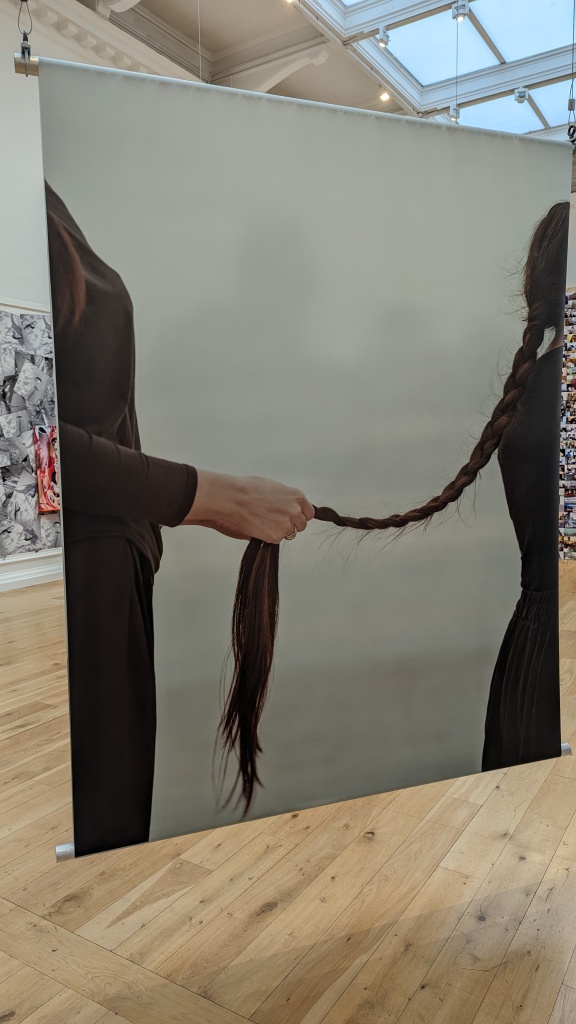
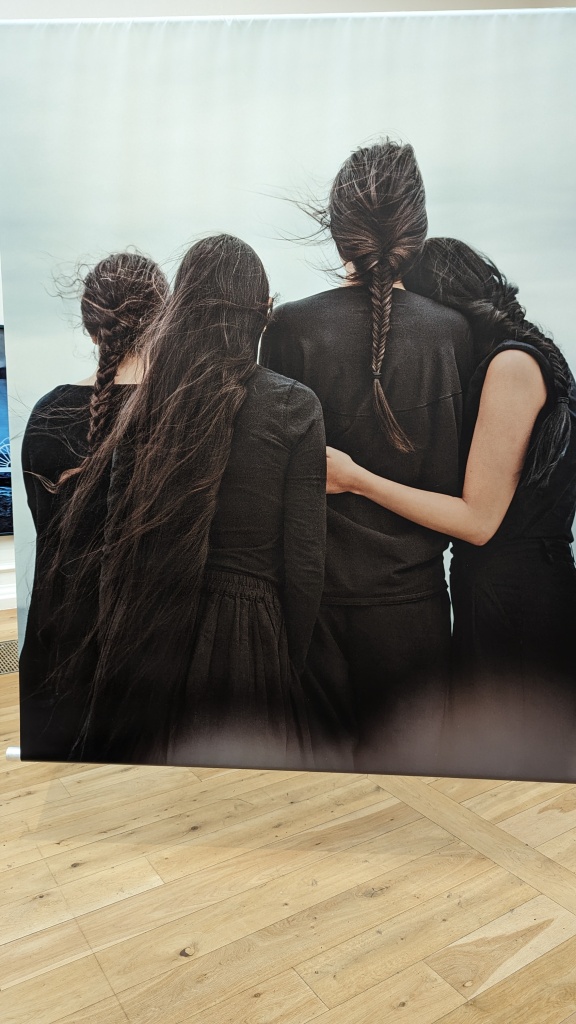
Tehran’s ‘morality police’ killed twenty-two year old Mahsa Amini for not wearing the hijab under government standards. These photographs are one with the protest against that legally sanctioned murder of a woman’s freedom and choice over her body.

The photographs are staged images that utilise the imagery of the doves, birds that are released at the funerals of those that have lost their lives in the protest. The birds stand for martyrdom and peace.

The women in the photographs are largely anonymous because anonymity protects the protesters on social media. These protest photographs show women plaiting each other’s hair and discarding their veils. The hair is plaited as respect is given to women freedom fighters fighting in Kurdistan against the Islamic state. They plait their hair before battle.

These monumental photographs are impressive and powerful. They give a body to the protesters and, with it, humanity. A community is formed around hair and the freedom to show it. The large format itself is a celebration of women and female bodily display, the ‘exposure’ that photography gives. Because, despite the fact that most of the models are anonymous, in the final images as we walk through the space, as you journey through the images and the story they are telling, you see the full frontal body of the woman with doves and her face is completely visible. And on the reverse, you can see the profile of a woman that braids the hair.

The plaited black hair of warfare and the white doves of peace tell a story. To have peace, you have to have the war first. Peace is the aim that can only be achieved through fighting for the rights to have choice and freedom. In the final photograph, a pair of hands braids the hair Another pair of hands superimposed on the back of the woman whose hair is being plaited holds the dove of peace and martyrdom. A reminder that freedom costs something. The fight.

These photographs are an inspiring celebration of heroism.

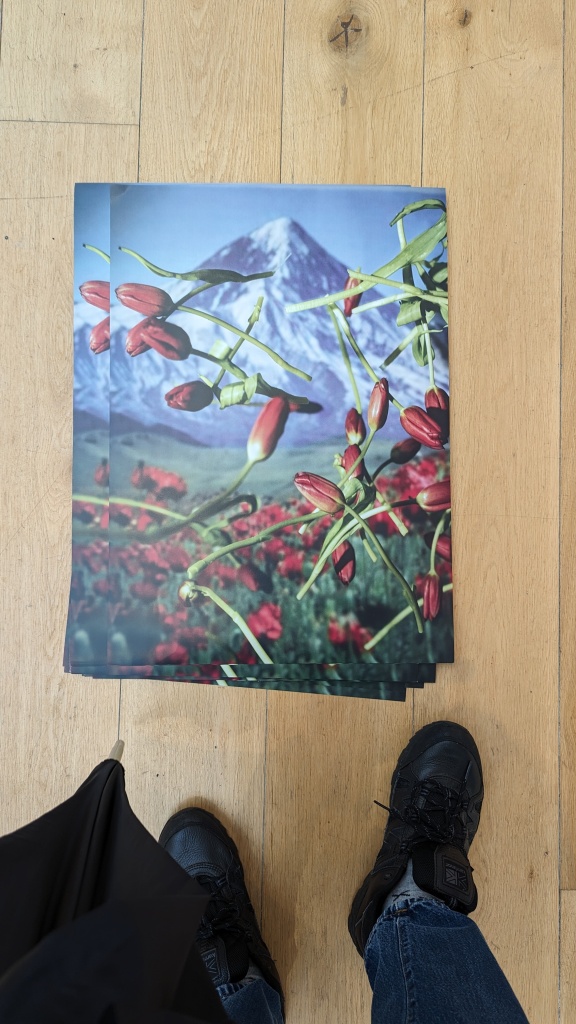
Sheida Soleimani, ‘Tulip Poster’ from the Series To Oblivion (2016)

This poster is a tribute to the Iranian women unjustly imprisoned and killed by the state. The tulips reference an Iranian revolutionary song that sees the flower as revolutionary hope – because although it is fragile, it is resilient and it regrows every spring. The numbers on the back of the poster show current published data of those arrested and killed by the Iranian state.

The redness of the flowers. Blood. Against the mountain in the background. With their stalks, the tulips are the ladders up to the peak. They are the scaffolding that can even go above the peak. To ascend the ladders, you have to have the revolutionary hope. Which no sword can cut down. Which no gun can diminish. The tulips are the beauty of hope. The beauty of the revolution. They transcend death with their growth. They have the beauty of growth, nature, resilience. To ascend the ladder of hope is the ascent into heaven. In the religious context of the photographer’s background, this is the image of faith in the revolution and eternal justice. Like Antigone, the photographer promotes the eternal laws of justice rather than the man-made laws of the earth.

Wendy Red Star, Amni (Echo) (2021)

This is a tribute to the matrilineal clan membership of the Appsalooke Nation which was erased by colonialism and its patriarchal laws. The artwork gives power back to the women in her family (the photographer who is Wendy Red Star, her daughter and her great-great-grandmother). And the power back to the names of the women of the Nation.

This was one of the most moving of the artworks in the exhibition for me. They called them Indians when they are Native Americans. They took their land and tried to destroy their culture and their people. They are us. We also have clan membership through our mother – Mother India is our mother and the religion of my mother is the Mother Goddess. It is this which the patriarchal, colonising state wishes to destroy and, with it, difference.

The names of power call out in the background, behind the photographic sculptures. And the photographs themselves build power. Out of the small photograph at the base, a greater entity is formed through the use of overlapping photographs. If you look carefully, you see that the aura is extended into the names of power behind, with the use of negative white space.

One of the ideas around photography when it first came into widespread use was that it could take away the soul of the sitter. Here, that idea is reversed through resistance against the patriarchy.

Because the photograph of the great-great-grandmother is there and the different generations, the photograph scultptures build up the matrilineal history which the law and the colonising state wanted to end. In the face of erasure, we have the form that has come back to us, become literalised in word and image. The phoenix has emerged from the flame.

The exhibition included many other pieces worth a careful examination and study. My overall impression of this exhibition is that I learnt a lot from it and I was inspired by it. We, our community, we also fight the wars against the patriarchal state and its patriarchal laws. For our way of life. For our culture. The patriarchal law wishes to kill what we are. We, the ethnic minorities, even if we are the men, we are also the women.

And the photographs showed the resistance can take many different forms. There are many dances to learn. Many songs to sing.

Time and time again, the photographs exposed what the patriarchal law of the state is. And why it has to be fought against. Not just in ‘other countries’. In Western type countries like Australia and Poland.

Sometimes, I was disappointed. One video installation said to become a ‘peaceful warrior’ and not ‘an angry warrior’. I don’t believe we should spit out our anger. But the philosophy of India is that everyone has their own path. Who are we to judge? As long as the warrior remains the warrior. That is the point.

The union of women with photography suggested calamity to the male Victorian authors that I studied. It suggested the revolution. The exhibit of feminist protest photography is the natural outcome of the resistance. As a form of truth which exposures the corrupt heart of power, photography has few rivals. These images demand more attention and more thought. Within them, they contain the resistance to the state structure and the patriarchal law. And, within them, they contain the conception of justice that the patriarchal law does not have, with its false claims to universality, timelessness and ‘truth’. By making photography concrete, by giving it the female body, these photographers have fought against the male body of the law with its male subject. They have created women’s – and photography’s – jurisprudence in the present moment.

In the end, the warrior loves the warrior. The exhibition is warrior culture.

Tom Eckersley Poster Parade

Tom Eckersley Poster Parade

09.11.2022

London Transport Museum, Covent Garden

Price – 21 pounds annual pass regular ticket for the museum (20 for students)

REPRODUCTIONS AVAILABLE AT THE MUSEUM’S ONLINE SHOP.

ALL ECKERSLEY WORKS ACCESSIBLE ONLINE AT:

https://www.ltmuseum.co.uk/collections/the-collection?f%5B0%5D=collection_type%3APosters

Although many Londoners don’t realise it, Transport for London has one of the biggest collections of specially commissioned artworks in the entire world. At the London Transport Museum, the thousands of posters in the archive are narrowed down to a select few for the Poster Parade which can be found on the first floor of the museum, behind some of the historic vehicles. It is one of my post Art History Open University degree ambitions to write a monograph on the collection of posters which bear illustrations and advertisements concerned with the world wars, destinations inside and outside of London, architecture and seasonal greetings which nestle amongst safety warnings and ticketing offers.

Most alluringly, the current exhibition boasts the work of Tom Eckersley, a twentieth century poster designer. The introduction to the exhibition summarises his signature style: “bold, bright colours and flat graphic shapes”. Personally, I think Eckersely owes much to Matisse the master, including the use of cut out colours in collages, the simplification and stylisation of figures and the obsession with the brightest hues.

Eckersely worked through the 1930s to the 1990s and managed to design over eighty posters for London Transport. At first, he worked in collaboration with the artist Eric Lombers. The exhibition describes him as ‘transforming commercial art’.

When Eckerseley was working in the 1930s, ‘posters were a hugely effective form of publicity’ the exhibition relates, although the challenge was to compress information so that it could incite further curiosity and relay compressed information in milliseconds: ‘a strong message with a simple design’. To quote the exhibition again, to achieve these ends, Eckerseley employed ‘minimal text’, conveyed messages ‘through pared-down graphic elements and bold blocks of colour’. My personal view, however, is that the posters play quite complicated visual games. I don’t see them as a visual reduction of information. They take quite a bit of decoding to understand the message shown and to understand the flight of imagination that Eckersely took to create the design.

Overall impressions of the Poster Parade? The artworks are visually stunning, richly coloured and immensely memorable. Eckersely really is a master of the poster genre. It is a delight to see the things. However, the short exhibition suffers from repetition, where nearly identical posters are displayed, and there is a certain fragmentariness where a fish poster is shown with the other half (another poster) missing. Having said that, the final word must be that the posters are beautiful, historically significant and therefore interesting because they deal with issues raised by the World War and show how heritage in London has been promoted before.

Finally, from my perspective as a digital artist that often uses flat, bold colours in my compositions, the exhibition is successful in that it shows how beautiful art can be when it uses simple geometic elements to build up its own language and communicate with the viewer. Although Eckersley uses a much more polished style than my own spontaneous ‘calligraphy-art’, the affinities are astounding, as you can see from a poster I designed recently below, and which I will finish this short summary of my impressions with: