There were many unique characteristics of the RHS Flower Show at Hampton Court which I observed as a novice to the event. The variety of our relationships to plants and flowers in art, culture and food. The friendliness of the people there. The almost overwhelming enthusiasm. One such characteristic was that they had plant porters and also that many of the public that did without the plant porters were struggling with the structures of the plants as they flowed within the spaces. The plant structures – so beautiful to behold and so suitable to evolution and adaptation – seemed particularly unwieldy and cumbersome, and their fragility in transit was worrying. I was particularly surprised that at the very start of the morning, people were buying the plants so that they had to carry them around for the whole event, although I suppose that was so that they could get their first choice.
ss Great Britain Botanist.
It was in this context that I came across the SS Great Britain Wardian Cases Exhibition. I had already seen the Wardian case at Kew Gardens for our volunteer training there, so it was not an unfamiliar sight, and I even knew some of the history behind this construction. The Wardian case is what I would describe as a life box that protects plants in a microclimate where they only need to be watered once during a two-month crossing.
ss Great Britain Botanist.
Something akin to a miniature Victorian glasshouse, although made out of wood, the Wardian case has been described as a revolution in the long distance transportation of plants. Patently, the construction was where the sciences of botany and biology found their sanctuary and spring as the living plants could be studied in Europe rather than grown from seeds in a foreign land. Again, the case allowed the transportation of economically important plants and is thus one of the most significant relics in the history of modern capitalism and global development. One of the most noteworthy connections with Kew gardens is with the exportation of seedlings from our glasshouses to Ceylon and Malaya in the 1870s to begin the rubber plantations. However, Kew Gardens also habitually used Wardian cases to transport plants until 1962.
The display at the RHS Flower show was a preview of the exhibition at the SS Great Britain which is Bristol’s number one visitor attraction. On the ship’s weather deck, six reconstructed Wardian cases are on display for visitors to explore. Each is a replica of the last surviving ship-board example designs which are to be found in the Kew Gardens archive. Based on research from the Brunel Institute, studies of the ship’s cargo manifests, each case is planted with a true-to-life ‘order’. The cases will celebrate the inbound and outbound plant species that the ship transported across the world between 1859 and 1875. The exhibition highlights the role of steamships in the transportation of plants and the making of the modern world.
ss Great Britain Botanist.
Along with the exhibition of the Wardian cases, there is other horticultural interest. There is a botany-themed ‘discovery talk’ and horticultural workshops. A ‘botanist’s cabin’ has also been added to the ship’s museum in which you are to become immersed in the sights, sounds and smells of life onboard – a lived experience and introduction to the important work and research of Victorian botanists and ‘plant hunters’.
ss Great Britain Botanist.
The exhibition at the RHS Flower Show was an exciting and stimulating moment in time travel to a monumental period in the history of plants and in the makings of a globalised world. Looking at those fairly small boxes with such a colossal impact was a message that just a little thought and a few materials can change reality. The resourcefulness and ingenuity of the human mind can reshape everything. As we try to combat the mass extinction event that is threatening all plant life and diversity, the Wardian case stands as a symbol that improvement can be wrought to transform botany, biology, the life sciences – and the future. And the Wardian case is also a symbol of connection across the world through transport. The future is about more connection across cultures through science and study enabled through constructions like the Wardian case. And more connections with Kew Gardens, its science and its archives and knowledge to inspire the understanding of this living planet and the foundations on which it has been built.
Acknowledgements Thank you to the SS Great Britain for allowing me to share the photographs and especially to Emily France there who was so helpful with the research and the permissions.
No one understands your heart. No one understands your words. No one understands your actions. But people think they understand your photographs.
The day:
Bus into the Flower show: Three women my age from outside London came and sat next to me on the bus and started talking to me and joking around with me. Proving that everyone outside of London is still friendly.
Walking around the place where they were selling all the flowers. An inspiring experience. People kept on complimenting me on my clothes – it was at least twenty people, mostly women. And the women gardeners all approached me and talked to me themselves. Women kept on talking to me all day.
However, I had work to do (and what was I going to do talking to women that live outside of London?). It was a case of mixing pleasure with business. Or, rather, pleasure with pleasure. Because my obsession is writing. I went to all of the art stores because I write for a website about plant art. So I collected lots of contacts and got permission to use their artwork for the site. There is a huge amount of stuff to get through.
I skipped lunch. I thought I could treat myself on my holiday to an expensive lunch. I am not used to luxury when that money could be used for something useful. I stayed hungry the whole day and survived off two chocolate bars and water (two Lindt chocolate bars for £1.80).
Hampton Court Palace Gardens towards the end before one final push to get some good photographs inside again.
I went on the Ferry back to the station to get a boat ride in. There was some miscommunication about a buoy a boat had ran into – a young girl thought it was a boy and not a buoy which everyone found amusing.
I walked into town afterwards to look around and went into a last art gallery with a daughter and father duo of artists. He was a carver, she was a painter. I got permission from her to use her work and to write about it for the website.
I was going to go straight home and eat but I ended up helping a sick person on the tube that was throwing up in the bins. It is my duty to help people – the philosophy of the religion I was raised in. No one else was helping him and he needed help. I ran to get someone even though they took their time to walk to him and get him assistance. I had to stay with him for a while.
Which meant that I ended up eating a take out in London before I went home.
Incredibly, for a country associated with everything that is hi-tech, Japan does not have its own museum of design. At Japan House, the Design Discoveries exhibition puts together seven major designers to consider what they would contribute in the form of design treasures to such a museum. We get a chance to see the rich diversity of Japanese design and some of the unique and inspirational design stories in the land of the rising sun.
I went to this exhibition after my first visit to the Design Museum here in London. I realised that I needed to learn more about this subject, design. Design is all around us. I often wonder to myself if I can ever extract myself from everything that is human made and see real wilderness. The reality is that everything around us – especially in London – is designed. Even when you are in the parks, the parks have been sculpted to look like what they look like. And this exhibition was an illuminating look into the nature of design creativity, how it depends on a historical and geographic context and a rich history of tradition.
Here are the design treasures and my personal comments on each of the exhibitions:
Haburagin, the Clothing of the Noro Priestesses: Design to Protect the Wearer by Morinaga Kunihiko, Fashion Designer
Worn over 500 years ago, these garments enable spiritual safety for the wearer and the community. The stitching keeps out evil spirits. This exhibit was particularly fascinating. Because protection is what coordinates, what is at the basis of our human relationships. I was talking about this with one my best friends. Women want a man that protects them. Men want a woman that gives them protection from the world. Protection is the basic need of humankind. And, I am named after protection: Sunil Dutt who saved the actress Nargis from the fire that broke out on the set of the film ‘Mother India’, a film itself made to protect the honour of India from attacks from the West.
The spirituality of fashion design, fashion built for a community and its spiritual needs was an insight into a world where clothes are not about looking good, but which protect the mind and the self. A psychology of safety that you wear to enable mental functioning and health.
But what is sad about this garments is the reality behind the design: that sometimes the evil spirits creep in and then you no longer have protection.
The premise behind this design may seem archaic, but it continues into the present. I am partially Hindu and my background is that we pray to the Mother Goddess, the warrior, to protect us. And I wear a bracelet on my hand of Bastet with her cats, because she protects and brings good health.
This design is a treasure because it shows that what is important to humans from a design point of view is the fulfilment of of deep-rooted psychological needs such as security and wellbeing, mental health.
Whip Tops and Tops Inspired by Them: Toys as Our First Contact with Design by Tsujikawa Koichiro, Film Director
Here’s what the exhibition notes say:
‘Toys nurture the five senses and the child’s primal desires to touch, see and hear. They embody design in its most primitive form’.
There is a mystical property to the spinning tops because their motion mirrors the human life cycle. They remind us of death when they stop spinning.
What intrigued me about the spinning tops exhibition in terms of design is how rich, colourful and beautiful design is when adults are designing things for children. Because then, the love for design becomes one with the love of children. Adults are trying to initiate children into the world of the human imagination and they present everything that is best about it. And, the conscientious adult – like the designer of these spinning tops – does not stint with knowledge and the experience of life. The design that is made for children is to educate them into the passage and the meanings of life, each of its different stages. It is the greatest moment of sharing in culture: when you are trying to mould the mind of the inexperienced through your own experience. This is why these spinning tops – and design for children – is always so beautiful. The meaning of our human existence is to share our knowledge, our appreciation of beauty, our experience with the future and the next generation.
Jōmon Village Design: Design Found in 10,000-year-old Living Spaces by Tane Tsuyoshi, Architect
‘The Jōmon people designed based on a ring system. The structure of village society was a ring. For 800 years, others joined this ring and belonged to the ring’.
‘Houses were arranged in a circle with the entrances facing the centre. At the centre, there was a ring of stones. This central ring was a place where the living paid their respects to and mourned the dead’.
In my view, the elemental social unit of gathering and community is the ring. With the discovery of fire, the original human group would have ranged themselves in a circle around the fire. This is the only way of maximising the warmth of the flames. This ring design of the Jōmon people embodies the basic unit of organisation.
In our society, where there is no longer eye contact, much face to face interaction, where we sit or stand for hours by ourselves in an unnatural state of affairs, the ring stands for community, integration, oneness. It is a beautiful ideal that we have lost: that connection of human to human that is the secret longing of every heart that dreams for something better than what we have now.
This design is a treasure because it speaks to a fundamental human need for connection and community. It is a reminder of what we have lost in the modern age.
State-of-the-Art 3D Sportswear: Inspired by a Lantern Festival in Toyama by Sudō Reiko, Textile Designer
Before computers, there were humans. And what humans have, compared to a computer, are traditions, spirituality and the brilliance and resourcefulness of their brains. Culture.
Before computer-aided design, there was the festival where the designer made bamboo frames which transformed two dimensional drawings into three dimensional lanterns. And it was because of that that he was able to make three dimensional garments such as 3D-cut woven skiwear in the 1970s..
This design story resonated with me deeply because it shows the resourcefulness of creativity, the inspiration from tradition that prompts innovation. Creativity can be at its best when you are importing or transferring one design tradition into an innovation for another problem.
And, myself, I find constant inspiration from religion. When I was a child, my mother got me, out of everyone, to take the incense and burn it before the mother goddess, the warrior, in the prayer rituals of the house. Bowing my head and holding my hands joined together before her. We asked for her protection. And that moment comes backs to me over and over again and it has become one of the powerful inspirations for creativity and life. The work for the goddess, the work for the festival, the work for the people.
A design treasure because love is work and work is love.
Please note: The views in my personal review do not reflect the views of any organisation in which I work and do not reflect any kind of consensus within any organisation in which I work. This is an independent review for my non-commercial personal blog written in my free time in which I am at liberty to think and say what I want. And nobody is compelled to read what I write – I can only offer an invitation.
In the atmospheric bowels of the King William building, Hugh Fox’s photographs document the interactions of visitors with the space at the Old Royal Naval College, as well as portraits of staff and brief interviews. Visitors are thus able to learn more about what happens behinds the scenes at such a grand historic site, the tales of protection and conservation.
The first photograph is of one of the entrance gates to the attraction, the first glimpse of the beauty inside. Fox has chosen an angle which hides the building behind the trees. So there is a mystery created, a veil between the viewer and the site. There is an idea of an inner, hidden core within the building that is to be investigated. Is this an invitation to penetrate the veil? The allurement of concealment? The lamp in the middle of the archway of the entrance floats over the veil of the trees suggesting the enlightenment of obscurity. Perhaps it is also a reflection on the nature of photography which is writing with light, which promises to go deep within the exhibition.
The fact that there is a tussle between the trees in the archway and the man-made building suggests a fight between humans and nature, culture and authenticity, perhaps even the life of the trees and the stasis of stone. Does nature – and the representation of nature – win? One of the trees appears as though it is bigger than the Baroque dome of the building.
Actually, this entrance (The West Gate) was photographed by the inventor of the photograph in Great Britain, William Henry Fox Talbot in about 1839. So this photograph could possibly be a modern update of that historic photograph – particularly as Hugh Fox also has the name ‘Fox’ in his name.
The theme of enlightenment is continued in the photograph of a mother with a pram who is walking beside her daughter in the shadows. They are walking towards the lamp to the right of the image in one of the colonnades in the site. Because there are two children, perhaps we can assume that they represent the curiosity which the photographer is to kindle in the audience that are following the light of photography and its writing. Illumination is manifest in the image – the three bodies are to move from the sphere of darkness into the light just in front of them. And there is a subtlety too – the mother has one foot behind her in the pool of light. She is leading her daughter into the path of light. She is a being of light herself. The lamp itself is situated over the skyscape of the London Docklands – it represents modernity and the future rather than the Baroque of the Old Royal Naval College.
What is peculiar about the mother is that she wears a yellow coat. This was the coat that the Naval Pensioners wore as punishment in the days of the Royal Hospital for Seamen. This incidental detail may seem to complicate the image in one sense. And then, there is a further complication. Because the staff at the Old Royal Naval College also wear yellow T-shirts. Therefore, the yellow is split between goodness and badness and is ambiguous in its suggestion of the role for the mother.
Particularly interesting to someone with some familiarity of these figures is the portrait of Natalie Conboy, Collections Manager. Obviously the scholarly aspects of her work persona are emphasised and she holds a pencil in her hand. Her personality shines through in her smile: we know that she is a warm person. At the same time, she blazes spectacularly in blue, like a blue fire. Because her hair is blue and she is wearing a blue outfit. In the photograph of the mother leading her daughter into the light, the mother was wearing a blue rucksack. Is this a thematic resonance within the series of photographs here, the breaking down of the barrier between visitor and staff, like this exhibition which presents them both side to side?
But there is also a theme of blackness here. Because the blue has black tiger’s stripes pulsating through it and Natalie also wears black gloves. And there is a mirroring of the black gloves in her necklace that she wears, in which a black hand dangles as a pendant, pointing downwards so that the black hand is gesturing to the black hands below. The photograph is there a symphony of colours and hands. That portray and point to the act of writing, research. And that point to something else: a transformation of the white body into blackness with the black hands of the writer: maybe an allusion to the act of writing where the white body transmutes into the black ink which then relays personality and identity.
But again, there is the pointing towards what is concealed: the concealed hand behind the hand that writes. The hand behind the scenes. We have a meta reference to what is being portrayed in the photograph: the work that is going on behind the vision of the visitor. It is what is concealed that is the object of attraction.
And then, there is an insinuation of precarity here. Because the focus is on writing and the most visible writing in the photograph is the word ‘FRAGILE’ in capital letters on the box above Natalie’s head to the right. The gloves, of course, are to protect the collection, our precious history. They need delicate handling. So Natalie’s role as protectress is emphasised. But at the same time, she is positioned in the shot as fragile herself: she is amongst the shelves which form the background, as one of the objects in the collection…
One photograph of a man looking upwards in front of the West Wall in the Painted Hall and who is directing his smartphone as a camera has a game of arms. The figures behind him are touching his outstretched arms: the nude woman and the King. The relationships between photography, femininity and power are perhaps being explored here as the photographer reflects upon his craft. Photography here appears to be a joining with woman’s body and the photographer gives ‘the elbow’ to male power. It is indicative that all of the staff that he has photographed are women….
The torch and the image of the light makes its way again into the image of one of the friendly Volunteer Tour Guides, Chenda. She is directing the gaze of the visitors upwards with her torch. Once again, the educative mission of the charity and the site is highlighted, its leading of the viewers and the visitors to Enlightenment. It is the gaze upwards towards the heavens…
Does the posture of Chenda imitate the photograph of the mother leading her daughter to the lamp? The mother who was also wearing yellow? Because Chenda is holding her stomach as she points the torch, the place where the babies come from… The action of holding her hand there also obscures her name tag and therefore her identity as she becomes the anonymous purveyor of truth, knowledge, art and culture.
An interesting exhibit with some interesting photographs. A perspective on the site and the people that make it what it is that is well worth exploring. And, furthermore, with the use of framing devices around the site, some of the photographs were quite visually striking.
About the Author
Dr. Suneel Mehmi holds a PhD in the history of photography which was published as a monograph by Routledge – Law, Literature and the Power of Reading: Literalism and Photography in the Nineteenth Century. He is currently in the third year of an Open University Degree in Art History and Visual Culture.
When I did my PhD and then got my doctorate published as a monograph, I showed that, just after the invention of photography, Victorian authors associated photography with women and a challenge to the patriarchy and its law. Because of this, throughout the novels of Thomas Hardy, Charles Dickens, Henry James and Wilkie Collins, photography was belittled and there was an attempt to exorcise it from the text. They associated photography with a woman’s supposedly superficial and legally ignorant gaze in The Moonstone (alongside the Indian gaze of the Idolater). The reason was because photography was used to photograph the body and women were seen as bodies rather than minds. Therefore, the denigration of photography was the denigration of the body in Judaeo Christian culture and the repressed times of the Victorians. The most obvious equation of photography with women and their bodies is in She, where Ayesha, the epitome of feminine beauty and physical attractiveness is able to make telepathic mental photographs of the male heroes through her surveillance in her feminine empire and as an expression of her womanly power.
It was the feminine body of photography that was thought of as such a challenge to the male body of the law in these novels that I studied. A usurper to the throne. The medium of revolution.
Almost two hundred years after that equation of the photographic with women, I walked into a feminist protest through the means of photography at the South London Gallery. It was an exhibition space where women were fighting against injustice, state regimes and the law, like the laws controlling abortion. These women were trying to extend the meaning of protest photography. It was a fight of the truth of women against the ideology of the patriarchal state.
The exhibition label calls this ‘the fourth wave’ of feminist protest which is about the empowerment of women, uses internet tools and includes factors such as intersectionality, where there are overlapping oppressions such as misogyny, race and class (Wikipedia). The exhibition is organised in four different sections:
– Body as Battleground
– Institutional Failure
– Revising Histories
– Feminist Futures
Here, in this review, I am going to consider the photography that I had a particular interest in.
Sofia Karim, Ihtijaj (Resistance) (Delhi, 2019)
This photograph is part of a series against anti-Muslim citizenship laws in India which have gone against the ideals of cosmopolitanism and acceptance that Indian descent people like me have grown up on. The title of the series is Turbine Bagh, which is a woman’s resistance movement intended to go against the oppressive laws. The image is printed on a samosa packet made out of newspaper – Sofia was served a samosa packet with court hearings on it once. The image is something that is being fed to the recipient of the law, of news. It is food, nourishment. For the women’s resistance movement.
What strikes me in this black and white photograph is the relationship between the active body of the woman holding her hand above her head to make a gesture and the seemingly passive bodies of the other seated women around her. This is what is apparent at first sight: the movement towards resistance, the action. The active woman’s mouth is forming words. She is communicating, acting. She is energy in the face of passivity. And you look closely to the woman in the right that creates a relationship to this action – her hands are clasped in seeming prayer. The resistance is the prayer of the people, of women. The active woman is the heroine that they are praying for to overturn the injustice of the modern day state. And then, the passivity of the other seated women becomes something else. It is the gesture of waiting. Patient waiting. For the revolution. For the fire that burns and sears the world.
The humble samosa packet which contains the greatness of the revolution.
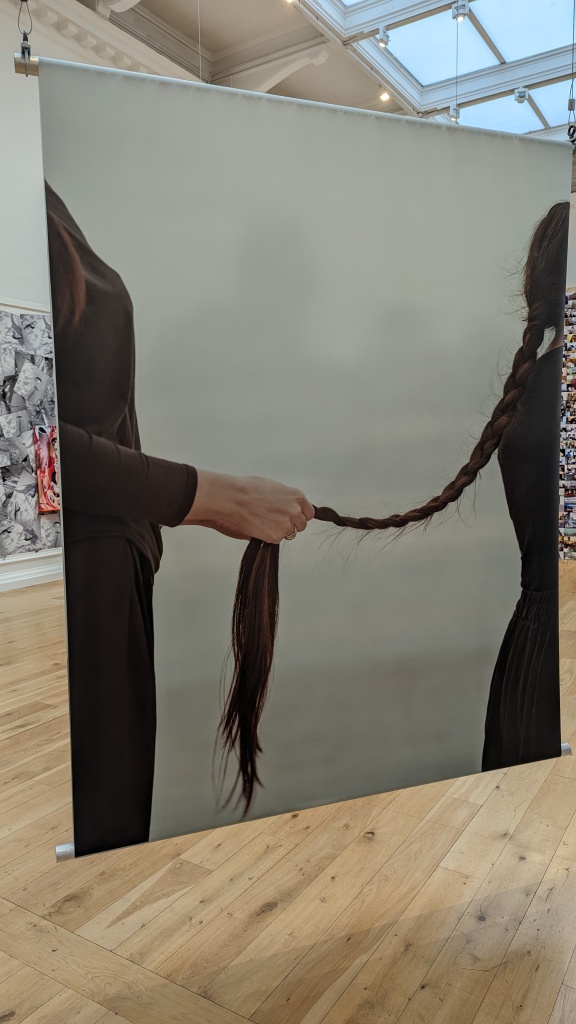
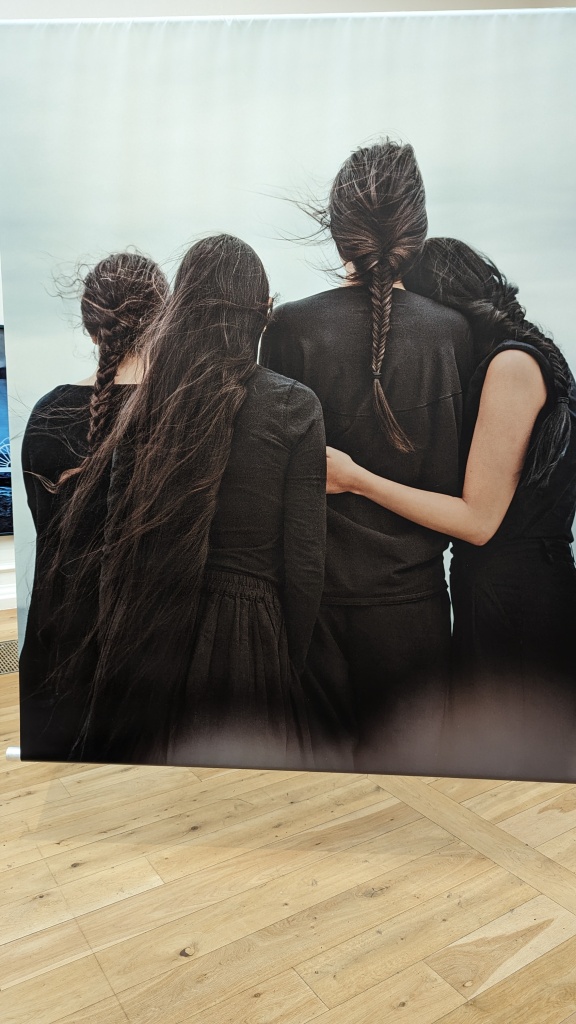
Hoda Afshar, In Turn (2023)
Tehran’s ‘morality police’ killed twenty-two year old Mahsa Amini for not wearing the hijab under government standards. These photographs are one with the protest against that legally sanctioned murder of a woman’s freedom and choice over her body.
The photographs are staged images that utilise the imagery of the doves, birds that are released at the funerals of those that have lost their lives in the protest. The birds stand for martyrdom and peace.
The women in the photographs are largely anonymous because anonymity protects the protesters on social media. These protest photographs show women plaiting each other’s hair and discarding their veils. The hair is plaited as respect is given to women freedom fighters fighting in Kurdistan against the Islamic state. They plait their hair before battle.
These monumental photographs are impressive and powerful. They give a body to the protesters and, with it, humanity. A community is formed around hair and the freedom to show it. The large format itself is a celebration of women and female bodily display, the ‘exposure’ that photography gives. Because, despite the fact that most of the models are anonymous, in the final images as we walk through the space, as you journey through the images and the story they are telling, you see the full frontal body of the woman with doves and her face is completely visible. And on the reverse, you can see the profile of a woman that braids the hair.
The plaited black hair of warfare and the white doves of peace tell a story. To have peace, you have to have the war first. Peace is the aim that can only be achieved through fighting for the rights to have choice and freedom. In the final photograph, a pair of hands braids the hair Another pair of hands superimposed on the back of the woman whose hair is being plaited holds the dove of peace and martyrdom. A reminder that freedom costs something. The fight.
These photographs are an inspiring celebration of heroism.
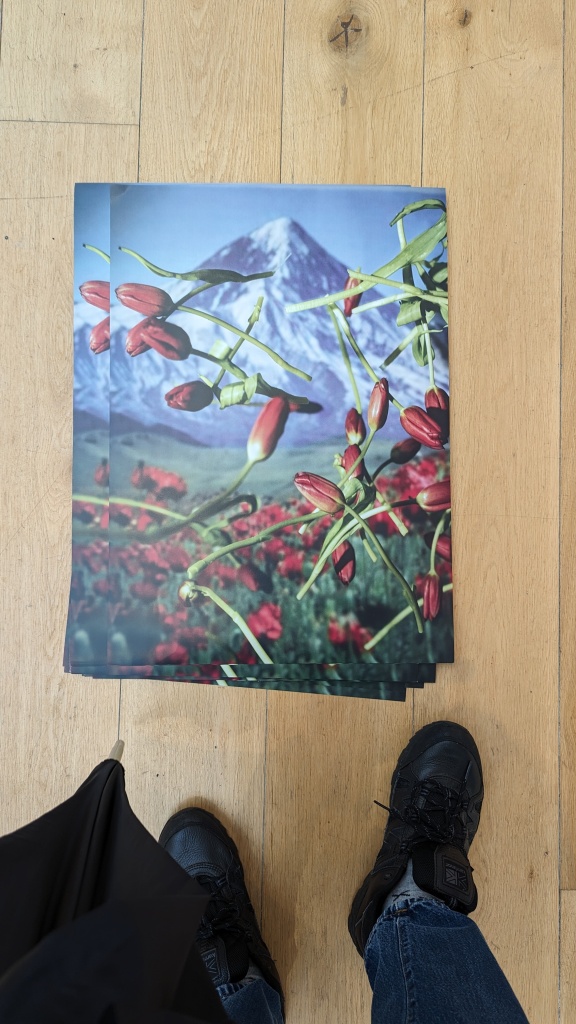
Sheida Soleimani, ‘Tulip Poster’ from the Series To Oblivion (2016)
This poster is a tribute to the Iranian women unjustly imprisoned and killed by the state. The tulips reference an Iranian revolutionary song that sees the flower as revolutionary hope – because although it is fragile, it is resilient and it regrows every spring. The numbers on the back of the poster show current published data of those arrested and killed by the Iranian state.
The redness of the flowers. Blood. Against the mountain in the background. With their stalks, the tulips are the ladders up to the peak. They are the scaffolding that can even go above the peak. To ascend the ladders, you have to have the revolutionary hope. Which no sword can cut down. Which no gun can diminish. The tulips are the beauty of hope. The beauty of the revolution. They transcend death with their growth. They have the beauty of growth, nature, resilience. To ascend the ladder of hope is the ascent into heaven. In the religious context of the photographer’s background, this is the image of faith in the revolution and eternal justice. Like Antigone, the photographer promotes the eternal laws of justice rather than the man-made laws of the earth.
Wendy Red Star, Amni (Echo) (2021)
This is a tribute to the matrilineal clan membership of the Appsalooke Nation which was erased by colonialism and its patriarchal laws. The artwork gives power back to the women in her family (the photographer who is Wendy Red Star, her daughter and her great-great-grandmother). And the power back to the names of the women of the Nation.
This was one of the most moving of the artworks in the exhibition for me. They called them Indians when they are Native Americans. They took their land and tried to destroy their culture and their people. They are us. We also have clan membership through our mother – Mother India is our mother and the religion of my mother is the Mother Goddess. It is this which the patriarchal, colonising state wishes to destroy and, with it, difference.
The names of power call out in the background, behind the photographic sculptures. And the photographs themselves build power. Out of the small photograph at the base, a greater entity is formed through the use of overlapping photographs. If you look carefully, you see that the aura is extended into the names of power behind, with the use of negative white space.
One of the ideas around photography when it first came into widespread use was that it could take away the soul of the sitter. Here, that idea is reversed through resistance against the patriarchy.
Because the photograph of the great-great-grandmother is there and the different generations, the photograph scultptures build up the matrilineal history which the law and the colonising state wanted to end. In the face of erasure, we have the form that has come back to us, become literalised in word and image. The phoenix has emerged from the flame.
…
The exhibition included many other pieces worth a careful examination and study. My overall impression of this exhibition is that I learnt a lot from it and I was inspired by it. We, our community, we also fight the wars against the patriarchal state and its patriarchal laws. For our way of life. For our culture. The patriarchal law wishes to kill what we are. We, the ethnic minorities, even if we are the men, we are also the women.
And the photographs showed the resistance can take many different forms. There are many dances to learn. Many songs to sing.
Time and time again, the photographs exposed what the patriarchal law of the state is. And why it has to be fought against. Not just in ‘other countries’. In Western type countries like Australia and Poland.
Sometimes, I was disappointed. One video installation said to become a ‘peaceful warrior’ and not ‘an angry warrior’. I don’t believe we should spit out our anger. But the philosophy of India is that everyone has their own path. Who are we to judge? As long as the warrior remains the warrior. That is the point.
The union of women with photography suggested calamity to the male Victorian authors that I studied. It suggested the revolution. The exhibit of feminist protest photography is the natural outcome of the resistance. As a form of truth which exposures the corrupt heart of power, photography has few rivals. These images demand more attention and more thought. Within them, they contain the resistance to the state structure and the patriarchal law. And, within them, they contain the conception of justice that the patriarchal law does not have, with its false claims to universality, timelessness and ‘truth’. By making photography concrete, by giving it the female body, these photographers have fought against the male body of the law with its male subject. They have created women’s – and photography’s – jurisprudence in the present moment.
In the end, the warrior loves the warrior. The exhibition is warrior culture.
Review by Dr. Suneel Mehmi on 19.05.2024. (Suneel’s original artwork from 2016).
This is my personal view of the exhibition and does not reflect the view or any consensus at any of the places I work at or volunteer.
For a very long time, Ezen Foundation featured a breath-taking wedding kimono decorated with cranes in its exhibition space. I was absolutely entranced by this wonderful construction of textile and art. I would take a careful look at the kimono every time I went to the gallery. For me, the kimono stood for everything that was beautiful about not just Japanese, but Asian culture. For the kimono was red, like the wedding dress of an Indian woman. The textiles were magical, shiny, seductive, splendid. They spelt out love.
My family comes from those involved in the clothing trade in India and in Britain. My mother’s side are leather merchants. My grandfather’s side were shoe makers. My grandmother worked in textiles when she was invited into this country. My mother made her own Punjabi suits when I was growing up on the sewing machine at home from the sumptuous fabrics she bought from the Indian shops. It has always been interesting to me to look at clothes and, when my grandmother passed away, I am reminded of her through the beautiful clothes that I see around me. She made me shirts and jumpers when I was a child and even when I was an adult. So when I look at these kimonos, I think of my grandmother and my mother, even if they have been made by men. That is the memory
Familiar to even the farthest flung nooks and crannies of the globe, the kimono is synonymous with Japanese culture and style. This exhibition at Ezen Foundation aims to showcase the clothing’s remarkable evolution in the latter half of the nineteenth century alongside the country’s ‘cultural and artistic transformation’.
Print to Pattern displays over 20 antique woodblock prints from kimono pattern books primarily dating from the late 19th century, also known as the Meiji era. The pattern books are fashion catalogues which were used in a multitude of ways by a diverse range of audiences and which feature designs for kimonos, patterns and motifs. The exhibition comes in the form of pictures, curator labels and then QR codes which give us more information about the exhibits.
The exhibition begins by featuring kimono designs of trees and their blossoms as auspicious motifs. A tree loving country is how we know Japan. From the bonsai tree collector Mr Miyagi in The Karate Kid to the equation of everything Japanese with the cherry blossoms, that is how we have imagined and known Japan in the West. We are told how the trees form symbols and meanings, how humans are relating to the natural world by representing it in a system of human meaning. We form the idea of the Japanese as those that communicate through nature, that style themselves through nature. That see human qualities in the plants as well as abstract qualities like transience in the cherry blossoms or adversity in white irises.
There is a sensation of magic in the air because the trees are regarded as auspicious symbols in these designs. We are seeing the aspiration of magic in the flesh, the starvation for sorcery. Magic infiltrates the picture plane, the desire for success to be accomplished, the desire for love. It is a touching human moment.
The exhibition then moves to animals that figure on kimono design such as bats and cranes. As with the natural environment in the form of trees, we find out the meanings of these auspicious creatures and how they have figured in the Japanese imagination. The case of the bats is indicative of the historical contextualisation at work in the exhibition. We learn how the bats went from representations of prosperity to representations of modernity and aspirations for economic growth and social advancement.
Objects as motifs in kimonos now make their way into the gaze. There are bobbins, threads and needles as well as sake cups. Then, there is a print showing the iconic Mount Fuji which has remained ‘a prominent theme in kimono designs’. We learn that the motif has traditionally adorned the kimonos of young boys and has stood for resilience and strength.
We then stand before a wall decorated with floral patterns. Each element repeated into an overall scheme in a sparing, minimalistic aesthetic, with the use of negative space and flat colours to highlight the Japanese emphasis on the idea that what is not there structures the space just as much as what is there.
Other exhibits include wonderfully coloured and striking, intricately designed obi belts and prints which feature women in beautiful kimonos.
Then, finally, we see how the kimono looked on the body and in the social contexts that the women carried themselves in. We are reminded that the kimono was for presenting the body, for presenting subjectivity. There has been a move from the realm of abstract design towards how these designs signified the female form, the concrete lived experience of the Japanese in time.
In my view, Print to Pattern is a good, short introduction to the Japanese aesthetic and kimono design in the Meiji period. I remember that gallery space through the inclusion of that wonderful red wedding kimono dancing with cranes and beauty. And the exhibits of kimono design are beautiful too. Textile design is itself a neglected field in Western art history and the gallery space, so I feel that the exhibit does something to remedy this injustice. With fabrics and clothing, we see how the body relates most intimately to art and the movement of the exhibition has expressed this very well, from abstract design to, concretely, women wearing the kimono designs. There is much food for thought with the arrangement and the research into the symbolism of the things we are seeing. And the exhibition stimulates our curiosity to learn more and to see more kimonos, the crystallisation of skills in cloth-making, dying, design and fashion.
Print to Pattern is organised and curated by Olivia Mieke Maria-Paulina Martha, Wojtek Doria Dernalowicz, and Kalliopi Hadjipateras.
Summary: Artwork from the African Diaspora. The website says:
”As well as surveying the presence of the Black figure in Western art history, we examine its absence – and the story of representation told through these works, as well as the social, psychological and cultural contexts in which they were produced”.
Notes:
– The title ‘The Time is Always Now’ comes from James Baldwin in the 1960s writing about the civil rights struggle.
My comment: So the aim of the exhibition is to combat racism and this is what it should be judged on – if it is giving dignity, equality and positivity to the black figure. Is it?
Overall impressions:
Goes through quite a lot of the current thinking about racism like ‘double consciousness’ when non-white people have to look at themselves through a white perspective as well as their own non-white perspective, etc. Educational for people that haven’t experienced racism and don’t really understand what it is like.
The art is presented as educational and as being completely resistant to racism. Can art be unambiguous and not contradictory like that? How easy is it to escape racism and to be free in terms of artistic vision and in your expression?
And how beautiful are the artworks? Were they captivating? Art does not have to be apolitical to be beautiful. But I wonder whether there were any pieces of great beauty in this exhibition.
The artist says this is a composited fictional character ‘which really looks at the value systems contained within portraiture and monuments’. He was supposed to be giving power and grandeur to ‘fictional everyday people’, the under-represented black people excluded from art history and classical sculpture.
My Comment: Why closed eyes? The artist says she is embracing ‘the inner world that she’s manifesting there and trying to bring clarity perhaps, to all this noise around us’.
I wrote a book about the valuation of symbolic blindness in imperialistic, racist and misogynistic Victorian Britain. When blindness stood for power. Are the eyes closed because of this association from the past? Devaluation of sight in this system of valuation as in Western culture – when for Indians it is the queen of the senses and the motor of revolution.
The statue stands right at the front of an exhibition where we are looking – a guide to how we are supposed to see the rest of the exhibition?
Composited photographs from Victorian Britain by Galton were used to isolate supposed ‘racial features’ – how distanced is this sculpture from that process of racism and essentialisation when we are talking about race and the black figure reframed?
My favourite painting in the whole exhibition. This is an intimate portrait of one of the artist’s friends and family. It is about a ‘human relationship’, not a person.
The face is caught in a mood of introspection. A thinking man. A reflection on thought and on the minds that give us our personality, that create our relationships with others. The restricted palette of pink is beautiful: textured, cloudlike, dreamy. Details make up the piece, there are no flat colours, many many colours. Complication. Nuance in technique. The enigmatic meaning of the feet – one clothed foot, one bare. The play between the spectacle of the body and the covering of the clothes, the ‘outer’ and the ‘inner’. A drip of paint falls from the black figure as it escapes into liquid from form. There is an air of insubstantiality, dissolution, as though everything is melting away.
The thoughts of this thinking man are what are highlighted by the artist in the personal relationship. So is she connected to him because he thinks? And what is the emotion here about that connection and his thinking? It is a mysterious image, a puzzle. Maybe her thoughts about him are unresolved, oscillating between definite form and the cloudiness that informs the image. An ambigious, contradictory and paradoxical image.
This is supposed to ‘dismantle’ an exclusionary Western visual representation and to subvert it. The artist is replacing the white female figures from neoclassical style paintings with black women. The artist deconstructs the western representation and removes it from the picture through cutting, etc. Then, he inserts the black figure – inclusion.
In this painting, the black serving figure for the white woman then serves the black woman instead, so the racial power disappears from the image.
The white figure disappears and becomes a black face. However, there is a sophisticated point to this image: the white figure is still providing the frame for the black face. Blackness is still being seen through the frame of whiteness. If you look carefully, one of the eyes is cut off by the outlines of the white figure that has been cut out. The black eye is limited by the white outlines that have been given to us from history. There is a tired self-awareness in this image.
The black face inside the white frame looks sad. Her own body is missing – the black body. Even her hair – with all of its power and symbolism – is not being presented. We are seeing the fragment of a black woman’s body – she still hasn’t achieved full representation. The image conveys the sadness of racism and the artist’s rendition of the black figure. It is still a work in progress, still unattained. The Time is Always Now…
What’s on the Turner Prize shortlist this year in terms of ‘Punjabi’ art? Covered with a giant white doily, a red Ford Escort vehicle is presented to us. The ‘art’ is in front of a photograph of a family with the car.
Rosie Cooper, director of Wysing Arts Centre, who sits on the judging panel, said Kaur sees the vehicle as a “representation of her dad’s first car and his migrant desires” and it “blasted snippets of uplifting pop songs referencing freedom and liberation throughout the space”.
Obviously the artist shortlisted in this country – when they are Indian – would necessarily be female. This is what ‘diversity’ means to white people when it comes to the Subcontinent – the women. Their books, their art, their cinema. It is all celebrated. Because they are heroic ‘victims’ of Indian culture to the West. Us men are to be ignored and marginalised. Because we are the ‘oppressors’ of women in this culture.
And what about this piece which white taste has valued? The big white doily is the key. It covers over the car. The migrant desire – according to the rules of white society – is to be covered over in whiteness. The white doily – the whiteness – is self-consciously patterned and artistic – it is the touch of art in the piece. Otherwise, there would just be a car and a family snapshot. The white doily – the whiteness – is what creates this exhibition as a piece of art work. It is what demonstrates ‘taste’, ‘selection’, artistic ‘discrimination’ (the pun is intended).
And what about this ‘migrant desire’ which – despite the capture of the car in the whiteness that is like a constraining net – blasts songs of freedom and liberation (laughable)? It is ideology at work. The veil of ideology covering over the vision of the car, the white veil over things for the migrant experience. Blinding the eyes and vision. Interfering. Coming between self and object, mind and reality. Art is the white veil itself. What else is? They sing of freedom. When they are the exploited. They sing of liberty. When they are constrained and bound by the white net.
The car. The phallic symbol. Red to signify status and dominance. Gross materialism. Migrant desire is couched as greed. Desire for masculinity in this patriarchal white supremacist society. Desire for control – one drives a car.
Desire for freedom – the car represents freedom. A cliched symbol of freedom the car. But this one is caught up in the net. Even the music – they blast snippets of songs about freedom. Even musically, the freedom is partial, disrupted, interrupted, punctured by purposely oppressive silence.
Do you know what the net signifies in India? The net of maya – illusion. Gross materialism. Trickery. What comes between us and the understanding of reality. The doily is perhaps maya. This white culture and its control, its limitation of freedom for the migrant. The doily becomes kitcsch art – described by several art historians as the artwork of a capitalistic, unthinking and unfeeling, philistine and totalitarian society.
Yet, there is a paradox. If I remember correctly from the Metro newspaper article that I read today about the art piece, the doily also represents the Sikh and Indian workers that worked in textiles factories in huge numbers when they first migrated here to the United Kingdom (Metro 24.04.2024). So this net of whiteness is being created by the migrants themselves. Their deference. Their blind adulation. Their willingness to be exploited. Their inability to revolt against the systems of power.
So what are the migrant desires of the Father in this image? As seen through the eyes of a Punjabi woman? Desire to criticise the wants of the Father? Or an attempt to be sympathetic to his wants?
The artist writes:
‘In this show I am having a conversation with personal histories,’ explains Kaur, ‘exploring improvisation and political mysticism as tools to reimagine tradition and inherited myths.’
But is this a re-imagination? Look at the piece again. It tries to base itself against reality as ideology – against the photograph, the representation of reality. The photograph has the Indian family in it. The base unit of Punjabi and Indian culture. The finished art exhibit has no family in it. It has a relationship merely to the Father in a patriarchal system of culture. A Father that wants to be covered in whiteness. Is this what is valued in this culture? Probably. The probability is on the side that adulates whiteness and patriarchy. The family is forgotten in favour of the Master. In favour of isolation and individualism. In favour of the desire for mastery and control and power.
This opinion reflects my personal views in my capacity as a private individual and does not reflect any consensus or anyone else at any of the organisations I work at or volunteer for.
Ascending up the stairs to the exhibition space on the mezzanine, you see a window through which you glimpse another world, another milieu, the past. It is a rare interior scene of a coffee house, one of the new forums for public debate that shaped the modern world. The customers are reading the newspapers that created the imagined community and fostered and nurtured the Western nation-state. Thus begins the historical journey into the Chocolate House in Greenwich. We are guided through a sort of window onto the past.
Behind another window, we then see the esteemed lady that ran the Chocolate House on Blackheath as one of the many women in history that have provided the world with its unique and wanted things. It is Grace Tosier ‘at the height of her powers’. Her eyes stare at us in the portrait through time. We are sharing her vision. She is the character that is leading us through things, the guide, the model: a strong, independent woman in a capitalistic culture. The heroine for this time and this society.
We learn that the Chocolate house served royalty. It then ‘became the Georgian equivalent of a celebrity hotspot’. So now we experience the glamour of the place.
The exhibition now shifts its focus. The story changes. We start learning about the origins of chocolate in South America, how it came to Europe, how it involved the morally reprehensible evils of a capitalistic society which evolved from slavery and exploitation. The trajectory of the story has shifted. We have come to a moral reckoning of the realities behind the glamour of the chocolate house. A confrontation with evil.
At this point in the story of the exhibition, like a huge wild monster from the imagination, we see a glorious display of the Cacao Tree rising up on the wall against a black canvas. The plant is covered over in insects. Why this image? The beauties of nature? The absolute origin of chocolate depicted without any varnish, perhaps, warts and all? The idea that the comforting illusions of capitalism, when the veil of ideology has been ripped off, reveal an insect-ridden reality?
The story of the exhibition journeys next into how coffee houses enabled ‘the free discussion of the latest ideas, unrestrained by the protocols of the royal court.’ In the light of what was before, the implications begin to produce a result: the free speech of this country is founded on the fruits of slavery and exploitation. It is an implicit link.
There are quite a few interesting pictures to ponder over at this junction in our journey which reflect the culture of the times, so that the task of time travel is further enabled.
Now, there is the context: Greenwich. So the place is elaborated.
A table draped in a table cloth reveals the production process of chocolate.
We then move onto the last years of the Chocolate House. And we see an image of what the building might have looked like from the outside.
Finally, the piece of the resistance: the final destination of our time travel. In a room, we enter the chocolate house. We are fully immersed now in the space. There is a life size reproduction of Grace Tosier’s image as we descend down the ramp to meet her face to face. A video plays in the space to complete the immersion not only through space in the room, but through vision, sound and characterisation. We have travelled backwards through time into the space of the chocolate house.
What do we make of this exhibition? It covers a lot of ground to make a coherent narrative: this was the chocolate house, with all of its social and political implications at the time, with its basis in capitalism, exploitation, slavery. With its enabling of social mobility at the same time for women like Grace Tosier in this context. All of the pertinent facts are presented. There is balance. And there is a stimulation of the senses with pictures and videos alongside the curator labels. There is the face of Grace Tosier to characterise the whole scene, as well as the images from the country of origin with the people there.
You get a sense of historical immersion in the chocolate house. You get a ticket into time travel into Greenwich in the 1700s – a unique virtual reality experience. An enabling of the imagination. A real journey into another place and time.
My overall sense of the exhibition is that it is interesting, unique, well researched and well thought out. In addition, there were labels for the children which would make them interested in this topic that they love too – chocolate (and the pictures to stimulate their imaginations). This was a conscience driven exposure of the past and its evils, the foundations of the public forums and the discussions that they bred that have lasted into the present, the foundations of the modern day nation state and its present evils in the evils of the past.
I did feel a certain want in the exhibition – I wanted to know more about Grace Tosier, the character that we meet face to face. A curiosity about her. But of course, the reality is that while we have a name and an image, we cannot expect a biography in a historical exhibition like this. Part of the fun is imagining her life, too. Part of the fun is being stimulated to know more – and the chocolate house exhibition certainly does this. So, in summation, a stimulating and unique experience which fosters a self-reflection on the economic and political origins of our public forums and our public discourse, what has made us and this state into what it is today, a real journey. A real experience of learning.
These are my own personal views of the exhibition and do not represent any of the views at any of the organisations I am working in.
This exhibition is a triumph of energy and imaginative problem solving from the children, the future. It is a reaffirmation of the fact that the human race has always solved any problems that have come into its path and will do so again. That we do not lack inventiveness and ways of thinking around and through things. Even with problems that we have created for ourselves. It is a reaffirmation of optimism in the world and in the future of our children and the species. This world which we have spoilt can be fixed. That is the message of the exhibition.
Six primary schools were set an imaginative task in collaboration with the London Transport Museum – they had to find solutions for the climate change crisis. Aliens had told them that their planet was no longer liveable and they needed to start over again in an environmentally friendly way. The inspiration for their planet-friendly technology was to come from animals and plants.
As I walked around the masses of reclaimed cardboard boxes and lollipop sticks, the resourcefulness of the children was in abundant evidence. These cast away objects had been magically transformed. They had become something again. They had become the visions of the future. The tinkering of the children, with the artistic designs, showed their enviable creativity and collaboration skills.
Inventions were strewn about everywhere like a mad scientist’s frenzied laboratory:
‘The Helpful Bumblebee cleans the air and rubbish. The Earthly trees stop flooding and pollution as well as cleaning the Earth and so prevents coughing and sneezing. The Legendary Pigeon sucks in pollution through its nose.’ (Exhibition Text).
The models for each of the animal inspired inventions were cute and beautiful in their way – the innocent and sweet and simple beauty of children’s art and the infantile imagination.
The young artists and inventors had become curators too, and told us about the most interesting and important facts about the exhibits in the museum. It was beautiful to see what they had learnt and what had inspired them to share.
A nice touch was to show an old poster that imagined the future in London as a skyline with skyscrapers and flying vehicles. The idea that we have always dreamed of a better future for transport, that we have always had dreams which have changed this world that we live in for the better, that allow us to make a fantasy world that we live in in reality. The strength and far seeing sight of our mind’s eye.
This was a beautiful exhibition – full of dynamism, an adventure into a mad scientist’s laboratory. An excursion into possibility and the resilience of the children’s mind that can respond to the death of a world to create new life and new beginnings, to build a world entire, the world of the imagination. The desire for a better world from the innocent that have not been corrupted by dismay and stagnation in the selfishness and greed that is around us. But which rejuvenates itself in animal and plant life, in caring and positive change.






 diary of a lone man