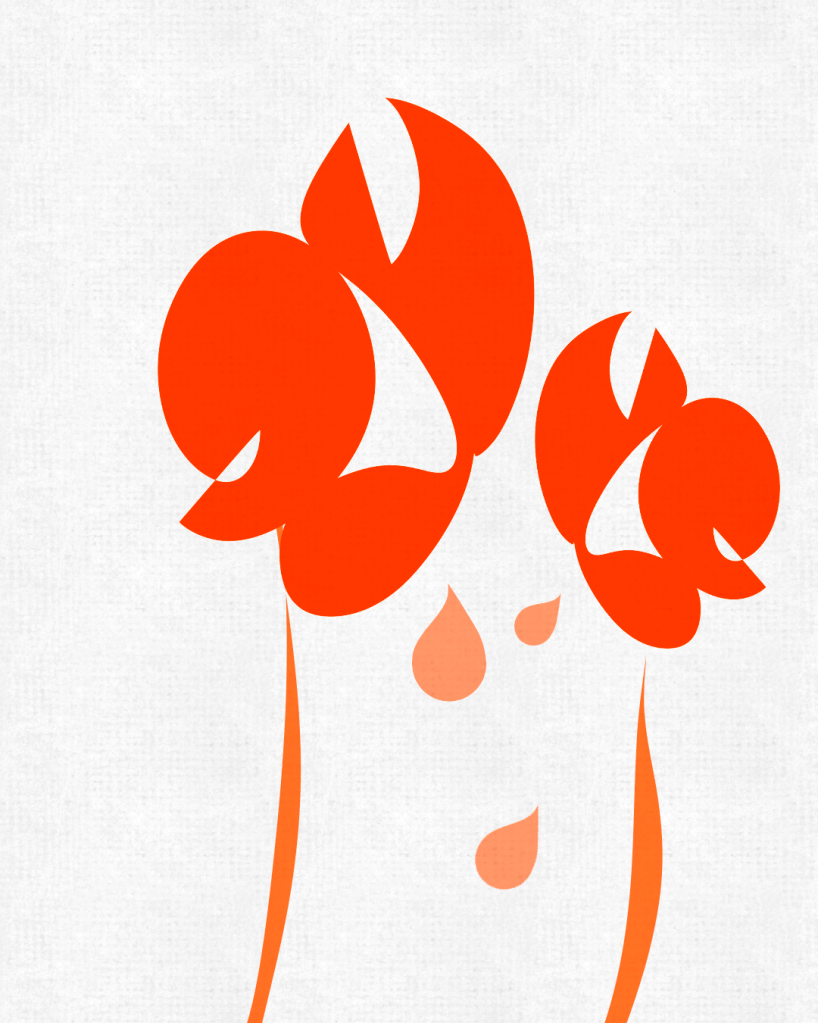
the tears of the flowers

04.11.2025

Unexpected acceptance can be found within unacceptable expectation.

The day was long. In the garden, the flowers wept. The grass lamented. The sky itself, it was filled with melancholies of grey.

A bird glided into the tree and S. watched her keenly. The birds of Da Vinci flew in his mind, the artist feverishly tracking and recording their movements. Wanting to become the bird.

  1. A. had asked him why he saw poison. Why he thought poison. Why his life had become poison.

What else was there? When all the good things were being churned from the ocean, instead, the god Shiva had swallowed the poison. To prevent the destruction of the universe. His throat became blue with the poison’s anger. And S.? His name was blue. The blue skin of a god.

  1. A. had asked him, how can you become a god? S. had said that in the West, to claim godliness is arrogance and the height of madness. It is folly. But in India, one modelled onself on god. They called the good people gods. It was the aim to become god upon the earth. A god was known by good deeds. The deeds of humanity. And S. tried his utmost.

‘So you are Shiva then?’ A. had asked.

  • S. had said that the hero is formed in adversity. The whole world, including the gods, fate itself, all had to be against the hero. It was only then that the triumph of the hero could be known and recognised. It was only then that the legends of the hero could be told and the songs  could be sung.

Life had to be poison. Otherwise, heroism was dead.

  1. A. had smiled. The Buddha’s smile was known. It was the sign of his wisdom. The smile delighted the hearts of his followers.

jealousy (microfiction)

03.11.2025

S: I was insanely jealous. With an emphasis on the insanity.

A: You are insecure?

S: Where was the security? I had nothing. I was not theirs. I was clutching at a speck of a straw in the storm of the river.

A: And?

S: Seeing them with another… It was like a pickaxe to the brain and to the gut.

A: You have said that you WERE jealous…

S: Life taught me a lesson. To give up.

A: You? You gave up?

S: You cannot force.

A: You could love from afar. Like Dante.

S: Preposterous. A waste of life. To long and to yearn. And never love to earn.

A: And now? Where has the jealousy gone?

S: When hope is gone, jealousy is gone. Jealousy is the hope that one is mine. When there is still a bridge that connects. When there is no bridge that connects?

A: That bridge that you built, you destroyed it so easily.

S: Mine was not the hand that held the fire.

A: But you swallowed the flame willingly.

S: Not willingly. I was much loth to do it. The body and the mind fought me valiantly. They are the body and the mind of The Tiger. I am strength. Years of strength. That is why I am invincible. One lesser would have succumbed.

A: But what comes now instead of jealousy?

S: Nothing. The numbness.

A: You told me that you are fire.

S: You can be fire only for what is yours.

A: You are lying to yourself. You are still fighting yourself.

S: You don’t believe that love dies? Our world is one in which love is for a moment. And only that. It is a faint murmur that is forgotten against a deafening noise. There is no loyalty. There was no encouragement. In short, there was nothing.

A: The heart of a Tiger, the heart of a traitor?

S:

where there is no bond there is no treason

the wheel of survival knows no season

A:

loss is what we hide

why lie? we have died

critic (microfiction)

03.11.2025

S: Have you ever watched that film, I think it is called Birdman?

A: No. But I remember you talking about it once. That you were like Birdman.

S: In the film there is a critic. She is determined to destroy the hero.

A: Motivation?

S: His past. The fact that he plays the role of a superhero. She is against heroism.

A: Why?

S: She guards the gates of culture. She excludes. And again, it is the battle of the sexes. She attempts to crush the male ego.

A: We will have to watch it together. An artist must be against the critic that demands death.

A: The resolution?

S: Ambiguous. She calls for his death. A critic that  demands death. Can Birdman die for his art?

A: Why talk of this film?

S: Birdman has this voice. The voice of power. He is a hero. He has the voice of a hero. Is the film a meditation on this culture’s exclusion of the hero? A jealous culture that cannot stomach heroes and their heroism?

S: Yes, but the demand for the death of the hero persists. They ask for tragedy. We give them comedy. Comedy ends in marriage.

the stealer of sweets (microfiction)

02.11.2025

In that shared space, S. had a cupboard. And in the cupboard, along with his other food, S. used to keep chocolate. No longer, because there is a stealer of sweets at large.

They began by lifting packets of chocolate. S. thought it was just an exception to the general trust that he could extend to the group. So he had kept on storing his treasures there. But the thief was resolute and shameless. So S. hid the chocolate somewhere else, under lock and key.

But then, after a while, when S. thought that the thief would no longer root around in a place where there was nothing, he had put a few packets of sweets there for himself. A quick energy boost to get him through the busy day. The thief had returned.

At first, the thief was careful. They took what could not be noticed. But, after a while, the thief became brazen. And they would take all of the sweets and leave the packet entirely empty. A message.

What was the motivation of this thief? Why were they stealing the sweets in such a targeted way?

Was it just the case that they could see something there, knew there would be something there and it was an easy heist? Was it just shameless greed?

Or was it more the case that they were communicating something? Was it a personal rivalry? Payback for some mistake? Did this thief even know whose cupboard they were stealing from?

One day, the thief left something. A giant furry strawberry. Or was it the thief at all?

The thief chews S.’s sweets in their mouth. They feel happiness. S. has fed everyone there with sweet treats on many occasions. He is happy to share. But S. does not want to share with this thief. Because generosity is a choice and not a compulsion. And this thief is forcing things.

S. wonders whether the thief thinks of their thefts at all. Whether they are happy just to take and not give a second thought. Is the thief different from this world that just takes at all without giving?

providence (microfiction)

02.11.2025

S: The other day, I had to look up the exact meaning of ‘providence’.

A: It is an old fashioned word.

S: To me, it means ‘fate’. In the dictionary, they talk about the plan of god.

A: Do you believe in fate? You always talk of it. And do you believe in the Mother Goddess?

S: Fate is real. I was chosen for my destiny. The prayer of the people. The prayer of my mother. The names I have been given. My origin. The myths tell of the hero born against death in the most humble of backgrounds. Of children that are pursued by murders from infancy. And the Mother is real as an ideal. The perfect warrior. The one that protects.

A: You are not religious. How can you believe?

S: I am Indian. Our philosophy comes from religion. From the stories. That is how we transmitted our knowledge and culture.

A: Is it then your fate to be all alone in this world? Is that what your Mother decides for you?

S: That is for time to tell. In this whole world, can there be one who opens their arms for an embrace? Or do all have their arms folded and their fists clenched?

A: Dream of an embrace. Rupture is deadly.

fate has asked for hardness

and freedom from fear

destiny has demanded desolation

and the peerless demands a peer

Complaint (microfiction)

01.11.2025

‘Shikayat’ (from “Gangubai Kathiawadi” soundtrack)

I was writing to A. About a song.

In this song, there is complete understanding. The understanding of a woman. The story is that there is a man who is upset with her. And she understands that he is upset with her because he loves her.

He does not look at her.

He does not think about her.

She passes by him. He does not stop her.

He complains about her.

She even says that he hates her.

But yet, she still believes in his loyalty. She believes that they are not separated. That he complains is that he loves her.

The song plays with the concept of ‘roothna’ or ‘ruthna’, being sulky or sullen. It is ‘when someone close to you gets UPSET, OFFENDED or SLIGHTLY ANGRY and STOPS TALKING/COMMUNICATING for some period’. https://www.quora.com/What-is-the-English-word-for-the-Hindi-word-ruthna 

“Ruthna” implies a temporary emotional withdrawal often intended to prompt reconciliation; “to sulk” and “to pout” capture the behavioral aspect, while “to be offended” or “to take offense” capture the feeling. (Ibid.)

So, in the song, she understands that he complains because he loves her. And she loves him too. The complaint is evidence of their love. It brings them together instead of breaking them apart.

Obsessively, I listened to this song. In it was the mystery of love. Of an Indian man’s love. I have not watched the film. However, the form of the song is important. It is a qawwali. This was originally a song form in Sufi Islam designed to be hypnotic and to inspire religious ecstasy and love. Hindi films use the form to convey earthly love. The divinity of love is being expressed in ‘Shikayat’ (Complaint).

How different, I thought, the Hindi film is from life. The understanding of this song, does it happen in real life? Real life is full of misunderstanding and confusion. As we know it, real life is full of misguided assumptions, tangle and confusion, mind games that meander and go nowhere.

The song has inspired me to watch the film. Perhaps in the film, there is the reconciliation of the lovers. A happy love story for a change. Instead of another witnessing of the death of love. And the death of the lover. Who is reviled for being in love.

a bubble of happiness (microfiction)

31.10.2025

A: Halloween comes once again.

S: Every day and night the dead haunt us. What is special about this day?

A: You are haunted. You always speak for everyone. When, in fact, you are different from everyone else. Do you ever feel happiness in your life?

S: I feel happy sometimes. I felt happy yesterday. You know that, naturally, I have a positive disposition. All my friends tell me that I have a positive energy. Unhappiness has been forced upon me. And I only feel the unhappiness most keenly in the night time and in the morning when it is hard to rise.

A: Yes, it is indeed remarkable that despite the amount that you complain, you never actually seem to be that low. Then we have your words in the night, a shocking contrast. Like Jekyll and Hyde. But to the question. How does a jaded and cynical, pessimistic person like you even feel any ounce of happiness?

S: There are people that make you happy. Everything comes from other people. They can make you happy. And then they can hurt you and make you sad.

A: Why talk about sadness?

S: Because that is what gives happiness meaning. Death and sadness, intolerable suffering, this is what gives happiness its meaning. In the old paintings, happiness was depicted as a child playing with a bubble. Happiness is a bubble. It is fragile and delicate. It is a shining orb of light which will only exist for a moment in this hard world. Look carefully at the surface of the bubble of happiness. It shines with light. It has all of the colours within its iridescence. It is beauty. The roundness of the bubble shows its perfection.

A: You can have the bubble forever.

S: The bubble has its enemies. What they should have shown in the old paintings is that the child has to protect his bubble from the world and the others. They are watching it jealously, hoping to prick at it and end its brief soujourn through the world.

A: So that is how you approach happiness? With fear?

S: Not fear. Caution. A warrior does not know fear. Do you know what the hero, my hero, Sunny Deol, the Punjabi Tiger says in the film ‘Jaat’? They ask this warrior who he is. He says that he is one that knows the value of life, but still puts his life in danger. What is most precious is what we risk in this life. That is the warrior culture. The bubble is precious. It is the most precious thing in the world. And we have to protect it. But we also put it at risk. In India, they believe in the evil eye. The eye of envy. It is real. Suffering in this world is created by people. But without risk, there is no meaning. And who am I? The biggest risk taker. The Tiger is known for his daring. Find someone braver. It is impossible. Because Tiger dares his whole heart on the people that he cares about and the things that he loves. Knowing the pain. Find someone else like that in this wretched universe.

the day of supposed happiness

30.10.2025

Again. Again it was the day. It was unlooked for. Hoped against. But what were we against the inevitability of time? A mere ant cannot swim against the current.

What was it that he was aiming to swim against? The day of supposed happiness.

It was supposed to be a day of celebration. A day of connection. A day that was to be remembered with fond memories.

Instead, every time, it was a day of sadness, hopelessness. If despair could be moulded into a shape, it was this day.

The day was like his leg. After they had burnt off the veins inside, they had damaged the nerves. If he brushed his hands against his calf, he could only just about feel it there.

How do we get through such a day?

In the morning, he lay there unmoving. What was racing with thought was his mind. What was fighting with every breath was his heart.

This burden of a day that was supposed to be happy. This burden of celebration. It was expected and wanted. He was being asked to perform again for this crowd. They that did not understand. That could not understand. He was sick of their inability to understand. And of the exhibition of emotions that did not run through him, which he would have to pluck from the theatre of selves around him.

Yet there were those that could be genuinely and earnestly happy on this day of supposed happiness.

They did not live his life.

skinned face (microfiction)

29.10.2025

Recently, I have begun disliking the sight of my face. It is not because I am ugly. Rather, it is because I am beautiful.

It is the beauty of the face that is causing upset. Because I look at it in the mirror, thinking to myself that that face has never done anything for me. Beauty is supposed to help someone find love. And it hasn’t.

It hurts me when people can’t believe that I don’t have anyone, when they tell me that I am so beautiful.

I am watching everyone around me get into a relationship at the drop of a hat. Whenever they want to. At any moment. Except for me. It doesn’t matter how long I know someone. It doesn’t matter how good the conversation is with them. It doesn’t matter how much I get on with them.

Someone put a curse on me when I was a child. That I would never have someone.

I am beginning to think that it would be best if I just peeled off that face. If someone with a knife just scraped all the skin off my face.

That way, my face would no longer be beautiful. And then, nobody would be able to see the colour of my skin. Nobody would be able to determine my ethnicity by looking at my face.

And then, maybe without a face, I would give up the dream of love. As long as I have this beautiful face, I keep on dreaming about love. And dreaming and dreaming. Without any love in my life.

sorry (microfiction)

28.10.2025

A: Your anger is too much. You are hurting people. You are saying things just because you are angry.

S: I am an angry person. I’ve always been an angry person.

A: You need to find some other way to get rid of it. You know how much it upsets you when you upset someone. The guilt completely consumes you.

S: Not when I’m angry. But yes, I genuinely feel sorry that I have hurt anyone. I did not mean to do it. I didn’t think it out. I made mistakes.

A: Why not just say sorry?

S: No one ever accepts an apology.

A: Really?

S: Well, a good friend did recently. But usually not.

A: Find some way to control your anger. Then you would not have to say sorry.

S: It seems like every emotion I have, I have to apologise for it. Maybe the best thing would be not to have any emotions at all. Isn’t that the ideal of Hinduism? Emotion is a cloud…

A: Your problem…

S: My problem is that when someone upsets me,maybe I should tell them I am upset with them. And then maybe I would hear sorry instead of having to say it all the time. Maybe I should only talk to people that can communicate directly in words what they are saying too. Because then I don’t have to read their expressions and their minds. Which I can’t do.

A: No one is going to communicate directly to you. They don’t. You can’t do it yourself. That is the problem for everyone.

S: The problem is that I’m sorry. And I can’t say it. And what good would it do? It is another emotion that you cannot express, regret. And then you wonder why I am so angry. It is the one emotion that a man is allowed to express. And even my anger, I am not allowed to express it fully. You see? There is no emotion that you can express. Tell me something, how do you express your anger fully? Surely you would not have me bottle it up inside?

A: Listen…

S: Everyone has moved on in life. The bridges have all been broken. I don’t have any bridges connecting me to anyone any more. Anything I did that hurt anyone, I am sorry for. But what is the point of anything now? The boats have floated away from each other. Some things, I am still not sorry for. Some things I am sorry for. The people that I most wanted to impress, they are disappointed. That is life. And I am not going to offer explanations and excuses. No one listens to them.

A: Has anyone ever said sorry to you?

S: Yes.

A: And what did you do?

S: I accepted their apology.

A: How long ago?

S: Just yesterday. Many times. Certain friends.

A: What do you think of the sorry?

S: If someone feels bad and wants to say sorry for something, I just forgive them. Because they are reaching out to you and they care about you and want to keep things as they’re going. That’s what I see a sorry as.

A: But you realise, for some people, sorry doesn’t mean anything.

S: Maybe nothing means anything in this life. I am going to sleep. One time a Punjabi guest came to the house. And when they left, they said to forgive them if they had committed any mistakes. Maybe that is all you can do in this life, whether the sorry is heard or accepted or not. There is an intention behind a sorry, if you could recognise it.