Acts of Resistance: Photography, Feminisms and the Art of Protest

ACTS OF RESISTANCE: PHOTOGRAPHY, FEMINISMS AND THE ART OF PROTEST

8 MAR – 9 JUN 2024

FREE EXHIBITION, The South London Gallery

https://www.southlondongallery.org/exhibitions/acts-of-resistance/

When I did my PhD and then got my doctorate published as a monograph, I showed that, just after the invention of photography, Victorian authors associated photography with women and a challenge to the patriarchy and its law. Because of this, throughout the novels of Thomas Hardy, Charles Dickens, Henry James and Wilkie Collins, photography was belittled and there was an attempt to exorcise it from the text. They associated photography with a woman’s supposedly superficial and legally ignorant gaze in The Moonstone (alongside the Indian gaze of the Idolater). The reason was because photography was used to photograph the body and women were seen as bodies rather than minds. Therefore, the denigration of photography was the denigration of the body in Judaeo Christian culture and the repressed times of the Victorians. The most obvious equation of photography with women and their bodies is in She, where Ayesha, the epitome of feminine beauty and physical attractiveness is able to make telepathic mental photographs of the male heroes through her surveillance in her feminine empire and as an expression of her womanly power.

It was the feminine body of photography that was thought of as such a challenge to the male body of the law in these novels that I studied. A usurper to the throne. The medium of revolution.

Almost two hundred years after that equation of the photographic with women, I walked into a feminist protest through the means of photography at the South London Gallery. It was an exhibition space where women were fighting against injustice, state regimes and the law, like the laws controlling abortion. These women were trying to extend the meaning of protest photography. It was a fight of the truth of women against the ideology of the patriarchal state.

The exhibition label calls this ‘the fourth wave’ of feminist protest which is about the empowerment of women, uses internet tools and includes factors such as intersectionality, where there are overlapping oppressions such as misogyny, race and class (Wikipedia). The exhibition is organised in four different sections:

– Body as Battleground

– Institutional Failure

– Revising Histories

– Feminist Futures

Here, in this review, I am going to consider the photography that I had a particular interest in.

Sofia Karim, Ihtijaj (Resistance) (Delhi, 2019)

This photograph is part of a series against anti-Muslim citizenship laws in India which have gone against the ideals of cosmopolitanism and acceptance that Indian descent people like me have grown up on. The title of the series is Turbine Bagh, which is a woman’s resistance movement intended to go against the oppressive laws. The image is printed on a samosa packet made out of newspaper – Sofia was served a samosa packet with court hearings on it once. The image is something that is being fed to the recipient of the law, of news. It is food, nourishment. For the women’s resistance movement.

What strikes me in this black and white photograph is the relationship between the active body of the woman holding her hand above her head to make a gesture and the seemingly passive bodies of the other seated women around her. This is what is apparent at first sight: the movement towards resistance, the action. The active woman’s mouth is forming words. She is communicating, acting. She is energy in the face of passivity. And you look closely to the woman in the right that creates a relationship to this action – her hands are clasped in seeming prayer. The resistance is the prayer of the people, of women. The active woman is the heroine that they are praying for to overturn the injustice of the modern day state. And then, the passivity of the other seated women becomes something else. It is the gesture of waiting. Patient waiting. For the revolution. For the fire that burns and sears the world.

The humble samosa packet which contains the greatness of the revolution.

Hoda Afshar, In Turn (2023)

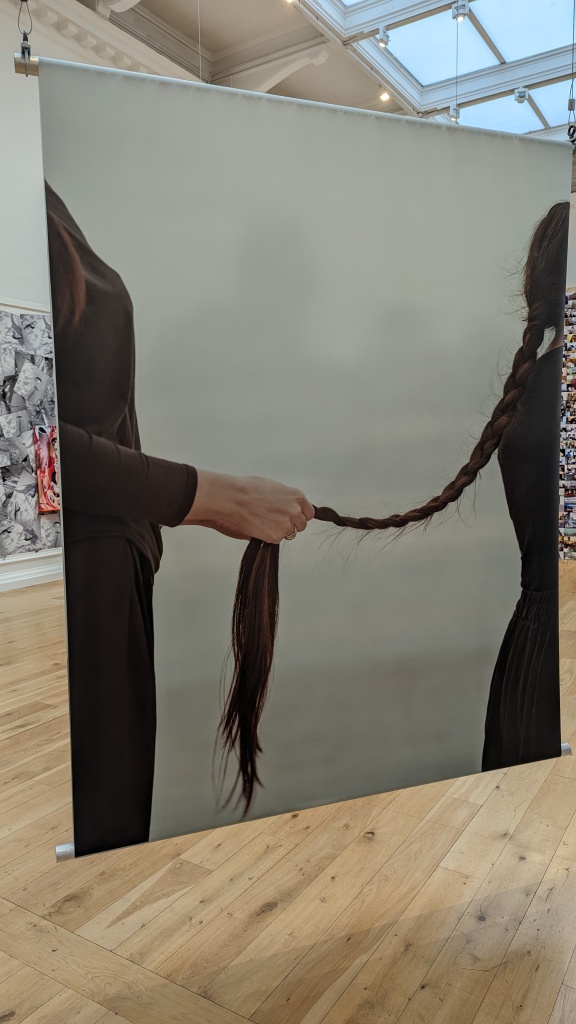
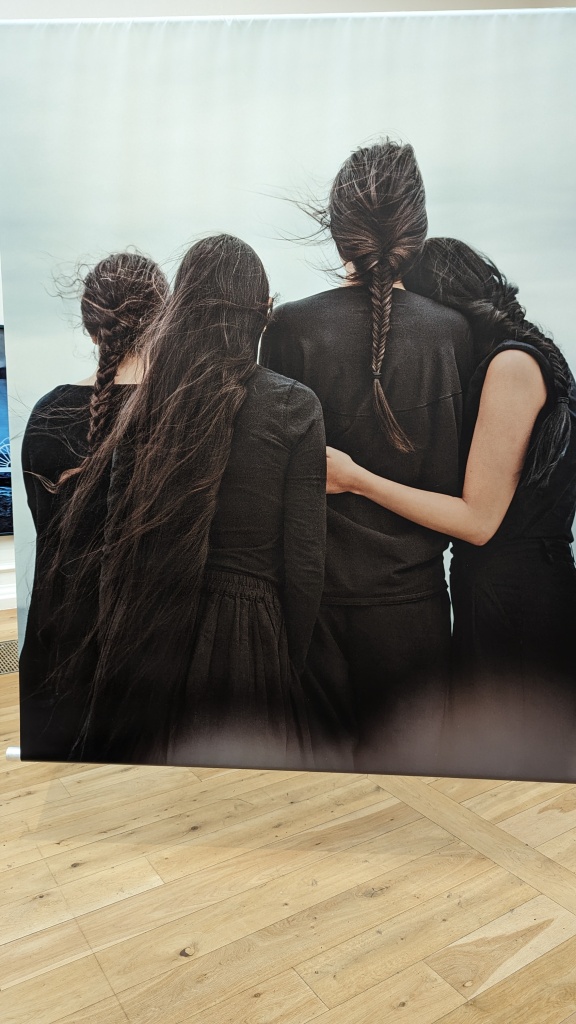
Tehran’s ‘morality police’ killed twenty-two year old Mahsa Amini for not wearing the hijab under government standards. These photographs are one with the protest against that legally sanctioned murder of a woman’s freedom and choice over her body.

The photographs are staged images that utilise the imagery of the doves, birds that are released at the funerals of those that have lost their lives in the protest. The birds stand for martyrdom and peace.

The women in the photographs are largely anonymous because anonymity protects the protesters on social media. These protest photographs show women plaiting each other’s hair and discarding their veils. The hair is plaited as respect is given to women freedom fighters fighting in Kurdistan against the Islamic state. They plait their hair before battle.

These monumental photographs are impressive and powerful. They give a body to the protesters and, with it, humanity. A community is formed around hair and the freedom to show it. The large format itself is a celebration of women and female bodily display, the ‘exposure’ that photography gives. Because, despite the fact that most of the models are anonymous, in the final images as we walk through the space, as you journey through the images and the story they are telling, you see the full frontal body of the woman with doves and her face is completely visible. And on the reverse, you can see the profile of a woman that braids the hair.

The plaited black hair of warfare and the white doves of peace tell a story. To have peace, you have to have the war first. Peace is the aim that can only be achieved through fighting for the rights to have choice and freedom. In the final photograph, a pair of hands braids the hair Another pair of hands superimposed on the back of the woman whose hair is being plaited holds the dove of peace and martyrdom. A reminder that freedom costs something. The fight.

These photographs are an inspiring celebration of heroism.

Sheida Soleimani, ‘Tulip Poster’ from the Series To Oblivion (2016)
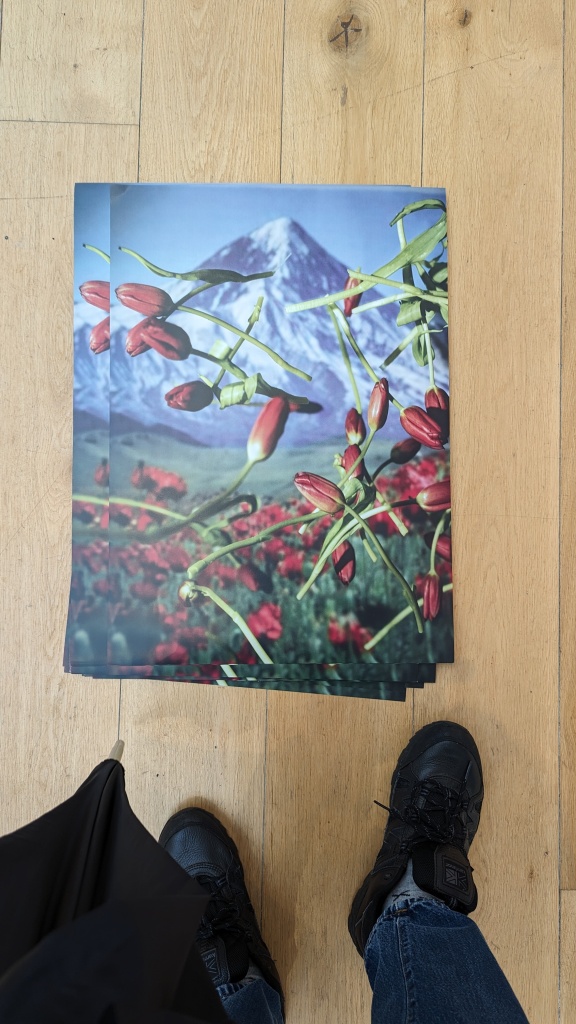
This poster is a tribute to the Iranian women unjustly imprisoned and killed by the state. The tulips reference an Iranian revolutionary song that sees the flower as revolutionary hope – because although it is fragile, it is resilient and it regrows every spring. The numbers on the back of the poster show current published data of those arrested and killed by the Iranian state.

The redness of the flowers. Blood. Against the mountain in the background. With their stalks, the tulips are the ladders up to the peak. They are the scaffolding that can even go above the peak. To ascend the ladders, you have to have the revolutionary hope. Which no sword can cut down. Which no gun can diminish. The tulips are the beauty of hope. The beauty of the revolution. They transcend death with their growth. They have the beauty of growth, nature, resilience. To ascend the ladder of hope is the ascent into heaven. In the religious context of the photographer’s background, this is the image of faith in the revolution and eternal justice. Like Antigone, the photographer promotes the eternal laws of justice rather than the man-made laws of the earth.

Wendy Red Star, Amni (Echo) (2021)

This is a tribute to the matrilineal clan membership of the Appsalooke Nation which was erased by colonialism and its patriarchal laws. The artwork gives power back to the women in her family (the photographer who is Wendy Red Star, her daughter and her great-great-grandmother). And the power back to the names of the women of the Nation.

This was one of the most moving of the artworks in the exhibition for me. They called them Indians when they are Native Americans. They took their land and tried to destroy their culture and their people. They are us. We also have clan membership through our mother – Mother India is our mother and the religion of my mother is the Mother Goddess. It is this which the patriarchal, colonising state wishes to destroy and, with it, difference.

The names of power call out in the background, behind the photographic sculptures. And the photographs themselves build power. Out of the small photograph at the base, a greater entity is formed through the use of overlapping photographs. If you look carefully, you see that the aura is extended into the names of power behind, with the use of negative white space.

One of the ideas around photography when it first came into widespread use was that it could take away the soul of the sitter. Here, that idea is reversed through resistance against the patriarchy.

Because the photograph of the great-great-grandmother is there and the different generations, the photograph scultptures build up the matrilineal history which the law and the colonising state wanted to end. In the face of erasure, we have the form that has come back to us, become literalised in word and image. The phoenix has emerged from the flame.

The exhibition included many other pieces worth a careful examination and study. My overall impression of this exhibition is that I learnt a lot from it and I was inspired by it. We, our community, we also fight the wars against the patriarchal state and its patriarchal laws. For our way of life. For our culture. The patriarchal law wishes to kill what we are. We, the ethnic minorities, even if we are the men, we are also the women.

And the photographs showed the resistance can take many different forms. There are many dances to learn. Many songs to sing.

Time and time again, the photographs exposed what the patriarchal law of the state is. And why it has to be fought against. Not just in ‘other countries’. In Western type countries like Australia and Poland.

Sometimes, I was disappointed. One video installation said to become a ‘peaceful warrior’ and not ‘an angry warrior’. I don’t believe we should spit out our anger. But the philosophy of India is that everyone has their own path. Who are we to judge? As long as the warrior remains the warrior. That is the point.

The union of women with photography suggested calamity to the male Victorian authors that I studied. It suggested the revolution. The exhibit of feminist protest photography is the natural outcome of the resistance. As a form of truth which exposures the corrupt heart of power, photography has few rivals. These images demand more attention and more thought. Within them, they contain the resistance to the state structure and the patriarchal law. And, within them, they contain the conception of justice that the patriarchal law does not have, with its false claims to universality, timelessness and ‘truth’. By making photography concrete, by giving it the female body, these photographers have fought against the male body of the law with its male subject. They have created women’s – and photography’s – jurisprudence in the present moment.

In the end, the warrior loves the warrior. The exhibition is warrior culture.

Print to Pattern: Unveiling the Kimono Through Japanese Prints

Ezen Foundation, Angel

Review by Dr. Suneel Mehmi on 19.05.2024. (Suneel’s original artwork from 2016).

This is my personal view of the exhibition and does not reflect the view or any consensus at any of the places I work at or volunteer.

For a very long time, Ezen Foundation featured a breath-taking wedding kimono decorated with cranes in its exhibition space. I was absolutely entranced by this wonderful construction of textile and art. I would take a careful look at the kimono every time I went to the gallery. For me, the kimono stood for everything that was beautiful about not just Japanese, but Asian culture. For the kimono was red, like the wedding dress of an Indian woman. The textiles were magical, shiny, seductive, splendid. They spelt out love.

My family comes from those involved in the clothing trade in India and in Britain. My mother’s side are leather merchants. My grandfather’s side were shoe makers. My grandmother worked in textiles when she was invited into this country. My mother made her own Punjabi suits when I was growing up on the sewing machine at home from the sumptuous fabrics she bought from the Indian shops. It has always been interesting to me to look at clothes and, when my grandmother passed away, I am reminded of her through the beautiful clothes that I see around me. She made me shirts and jumpers when I was a child and even when I was an adult. So when I look at these kimonos, I think of my grandmother and my mother, even if they have been made by men. That is the memory

Familiar to even the farthest flung nooks and crannies of the globe, the kimono is synonymous with Japanese culture and style. This exhibition at Ezen Foundation aims to showcase the clothing’s remarkable evolution in the latter half of the nineteenth century alongside the country’s ‘cultural and artistic transformation’.

Print to Pattern displays over 20 antique woodblock prints from kimono pattern books primarily dating from the late 19th century, also known as the Meiji era. The pattern books are fashion catalogues which were used in a multitude of ways by a diverse range of audiences and which feature designs for kimonos, patterns and motifs. The exhibition comes in the form of pictures, curator labels and then QR codes which give us more information about the exhibits.

The exhibition begins by featuring kimono designs of trees and their blossoms as auspicious motifs. A tree loving country is how we know Japan. From the bonsai tree collector Mr Miyagi in The Karate Kid to the equation of everything Japanese with the cherry blossoms, that is how we have imagined and known Japan in the West. We are told how the trees form symbols and meanings, how humans are relating to the natural world by representing it in a system of human meaning. We form the idea of the Japanese as those that communicate through nature, that style themselves through nature. That see human qualities in the plants as well as abstract qualities like transience in the cherry blossoms or adversity in white irises.

There is a sensation of magic in the air because the trees are regarded as auspicious symbols in these designs. We are seeing the aspiration of magic in the flesh, the starvation for sorcery. Magic infiltrates the picture plane, the desire for success to be accomplished, the desire for love. It is a touching human moment.

The exhibition then moves to animals that figure on kimono design such as bats and cranes. As with the natural environment in the form of trees, we find out the meanings of these auspicious creatures and how they have figured in the Japanese imagination. The case of the bats is indicative of the historical contextualisation at work in the exhibition. We learn how the bats went from representations of prosperity to representations of modernity and aspirations for economic growth and social advancement.

Objects as motifs in kimonos now make their way into the gaze. There are bobbins, threads and needles as well as sake cups.  Then, there is a print showing the iconic Mount Fuji which has remained ‘a prominent theme in kimono designs’. We learn that the motif has traditionally adorned the kimonos of young boys and has stood for resilience and strength.

We then stand before a wall decorated with floral patterns. Each element repeated into an overall scheme in a sparing, minimalistic aesthetic, with the use of negative space and flat colours to highlight the Japanese emphasis on the idea that what is not there structures the space just as much as what is there.

Other exhibits include wonderfully coloured and striking, intricately designed obi belts and prints which feature women in beautiful kimonos.

Then, finally, we see how the kimono looked on the body and in the social contexts that the women carried themselves in. We are reminded that the kimono was for presenting the body, for presenting subjectivity. There has been a move from the realm of abstract design towards how these designs signified the female form, the concrete lived experience of the Japanese in time.

In my view, Print to Pattern is a good, short introduction to the Japanese aesthetic and kimono design in the Meiji period. I remember that gallery space through the inclusion of that wonderful red wedding kimono dancing with cranes and beauty. And the exhibits of kimono design are beautiful too. Textile design is itself a neglected field in Western art history and the gallery space, so I feel that the exhibit does something to remedy this injustice. With fabrics and clothing, we see how the body relates most intimately to art and the movement of the exhibition has expressed this very well, from abstract design to, concretely, women wearing the kimono designs. There is much food for thought with the arrangement and the research into the symbolism of the things we are seeing. And the exhibition stimulates our curiosity to learn more and to see more kimonos, the crystallisation of skills in cloth-making, dying, design and fashion.

Print to Pattern is organised and curated by Olivia Mieke Maria-Paulina Martha, Wojtek Doria Dernalowicz, and Kalliopi Hadjipateras.

Exhibition: The Time is Always Now – Artists Reframe the Black Figure (Some Notes)

National Portrait Gallery

02.05.2024

https://www.npg.org.uk/whatson/exhibitions/2024/the-time-is-always-now

Summary: Artwork from the African Diaspora. The website says:

”As well as surveying the presence of the Black figure in Western art history, we examine its absence – and the story of representation told through these works, as well as the social, psychological and cultural contexts in which they were produced”.

Notes:

– The title ‘The Time is Always Now’ comes from James Baldwin in the 1960s writing about the civil rights struggle.

My comment: So the aim of the exhibition is to combat racism and this is what it should be judged on – if it is giving dignity, equality and positivity to the black figure. Is it?

Overall impressions:

Goes through quite a lot of the current thinking about racism like ‘double consciousness’ when non-white people have to look at themselves through a white perspective as well as their own non-white perspective, etc. Educational for people that haven’t experienced racism and don’t really understand what it is like.

The art is presented as educational and as being completely resistant to racism. Can art be unambiguous and not contradictory like that? How easy is it to escape racism and to be free in terms of artistic vision and in your expression?

And how beautiful are the artworks? Were they captivating? Art does not have to be apolitical to be beautiful. But I wonder whether there were any pieces of great beauty in this exhibition.

Some Works Which Caught My Attention

As Sounds Turn to Noise (bronze sculpture)

Thomas J Price

https://www.galleriesnow.net/artwork/as-sounds-turn-to-noise

The artist says this is a composited fictional character ‘which really looks at the value systems contained within portraiture and monuments’. He was supposed to be giving power and grandeur to ‘fictional everyday people’, the under-represented black people excluded from art history and classical sculpture.

My Comment: Why closed eyes? The artist says she is embracing ‘the inner world that she’s manifesting there and trying to bring clarity perhaps, to all this noise around us’.

I wrote a book about the valuation of symbolic blindness in imperialistic, racist and misogynistic Victorian Britain. When blindness stood for power. Are the eyes closed because of this association from the past? Devaluation of sight in this system of valuation as in Western culture – when for Indians it is the queen of the senses and the motor of revolution.

The statue stands right at the front of an exhibition where we are looking – a guide to how we are supposed to see the rest of the exhibition?

Composited photographs from Victorian Britain by Galton were used to isolate supposed ‘racial features’ – how distanced is this sculpture from that process of racism and essentialisation when we are talking about race and the black figure reframed?

Ivan (painting)

Jennifer Packer

https://www.studiomuseum.org/artworks/ivan

My favourite painting in the whole exhibition. This is an intimate portrait of one of the artist’s friends and family. It is about a ‘human relationship’, not a person.

The face is caught in a mood of introspection. A thinking man. A reflection on thought and on the minds that give us our personality, that create our relationships with others. The restricted palette of pink is beautiful: textured, cloudlike, dreamy. Details make up the piece, there are no flat colours, many many colours. Complication. Nuance in technique. The enigmatic meaning of the feet – one clothed foot, one bare. The play between the spectacle of the body and the covering of the clothes, the ‘outer’ and the ‘inner’. A drip of paint falls from the black figure as it escapes into liquid from form. There is an air of insubstantiality, dissolution, as though everything is melting away.

The thoughts of this thinking man are what are highlighted by the artist in the personal relationship. So is she connected to him because he thinks? And what is the emotion here about that connection and his thinking? It is a mysterious image, a puzzle. Maybe her thoughts about him are unresolved, oscillating between definite form and the cloudiness that informs the image. An ambigious, contradictory and paradoxical image.

Seeing through Time

Titus Kaphar

A painting I found very beautiful too.

This is supposed to ‘dismantle’ an exclusionary Western visual representation and to subvert it. The artist is replacing the white female figures from neoclassical style paintings with black women. The artist deconstructs the western representation and removes it from the picture through cutting, etc. Then, he inserts the black figure – inclusion.

In this painting, the black serving figure for the white woman then serves the black woman instead, so the racial power disappears from the image.

The white figure disappears and becomes a black face. However, there is a sophisticated point to this image: the white figure is still providing the frame for the black face. Blackness is still being seen through the frame of whiteness. If you look carefully, one of the eyes is cut off by the outlines of the white figure that has been cut out. The black eye is limited by the white outlines that have been given to us from history. There is a tired self-awareness in this image.

The black face inside the white frame looks sad. Her own body is missing – the black body. Even her hair – with all of its power and symbolism – is not being presented. We are seeing the fragment of a black woman’s body – she still hasn’t achieved full representation. The image conveys the sadness of racism and the artist’s rendition of the black figure. It is still a work in progress, still unattained. The Time is Always Now…